Sponsored

Do you regret choosing your power adder?

robvas

Well-Known Member
Joined
Nov 18, 2023
Threads
15
Messages
3,498
Reaction score
3,287
Location
MI
Vehicle(s)
2011 GT
The other question that I have for the boosted crowd is, would a rear gear swap be necessary?

I currently have a 3.73 Torsen out back and would rather not have to swap that out if I don’t have to.
I have a Whipple with 3.73 + MT82, I don't know why everyone thinks that won't work. Nothing to worry about at all with a 2018+ ratios...
Sponsored


NGOT8R

Well-Known Member
Joined
Jul 19, 2020
Threads
153
Messages
9,219
Reaction score
7,676
Location
Florida
First Name
Adrian
Vehicle(s)
2019 Bullitt
The cooling stuff was WAY more of a concern back before E85 was widely available. On pump 93, it's beneficial to do even a 50 shot, just to keep the IAT2's reasonable.

Nitrous is generally 120 hp/lb of sauce, so at $8/lb, you're talking roughly $10 for every 150 hp hit.

I mean, it's not VIP bottle money, but an extra $10 tax on every hit is noticeable.

But it seems like you've put a lot of up front capital into it already. I'm not boomerish enough to moan about the price of fuel and lord knows I fill up the car often when I'm hooning around and getting 5-6 mpg, but if I think of it as an extra $10 every time I mash the go button, that would add up for me REAL quick. And I'm already over here trying to ignore the fact that it costs me basically $30 every time I take the car out for a 75 mile cruise.

Laughing gas costs nearly as much per lb as ribeye:) And goes a lot quicker!:)
The good thing is, I’ve been pretty disciplined about my use of nitrous.

I would want to tune for boost only to say around 850 rwhp and maybe 700-750 rwhp on boost, plus the addition of whatever size nitrous shot I decided on.
 

NGOT8R

Well-Known Member
Joined
Jul 19, 2020
Threads
153
Messages
9,219
Reaction score
7,676
Location
Florida
First Name
Adrian
Vehicle(s)
2019 Bullitt
I have a Whipple with 3.73 + MT82, I don't know why everyone thinks that won't work. Nothing to worry about at all with a 2018+ ratios...
Thanks! That’s very good to know.
 

Wolfys11

Well-Known Member
Joined
Aug 27, 2023
Threads
3
Messages
1,037
Reaction score
753
Location
New york
First Name
Jakub
Vehicle(s)
2023 Mustang Gt
Thanks! That’s very good to know.
3.7 gears are harder to put down but are fine, just get better tires! Or pretend to be a hellcat and spin all day
 

Forestlump

Well-Known Member
Joined
Apr 1, 2022
Threads
5
Messages
210
Reaction score
148
Location
uk
Vehicle(s)
2017 Mustang GT
The Whipple and gt500 log data don’t agree with your belief so you are applying selective scrutiny through hypotheses with no supporting data. Why aren’t you applying the same scrutiny to the centrif IAT data or to the hear-say anecdotes you’ve been told?

Luckily we have data. The Roush kit uses the same exact sensor as Whipple, mounted similarly if not worse. Yet I’ve shown a data log that had 34 deg temp rise in 8 seconds in a Roush. Is that not fast enough response? And kevinvan6000 posted that his temps read 15-20 deg hotter with the sensor closer to the cylinder vs closer to the tb. This supports what I posted earlier that the air picks up additional heat from the intake manifold, so your centrif readings could actually be erroneously low as compared to the Whipple measurement.


Literally no one is arguing heat moves from cold to hot, nor did my data suggest it.


The sensor is at the entrance of the runner.


That would be interesting data. My bet is that the MCT and the water entering the intercooler are nearly unison.


Literally no one is arguing this.


No one is arguing otherwise.


No one is arguing the PD blower is at or above 100% efficient.
What I'm saying is the thing being cooled will always be hotter than the cooling media, no matter if it's liquid or gas.
so in your case the boost will be hotter than the coolant and the coolant hotter than the ambient air cooling that. You've said that it's literally parity which is rubbish, itl be 10-20 degrees each between the water and ambient minimum, and more so when at wot when there's more heat generated and less time for it to be In contact with the cooler. That's why I said knowing the coolant temp would help you verify data to be correct or misleading. If the coolant temperature is over 100, very likely (just from the conducted heat from the cylinder heads alone and being on top of a 210 degree engine, under the bonnet and made from aluminium which conducts well), then you know your amazingly stable iat reading of 90 must be false.

You could never realistically reach parity, like you have said before, ie zero delta T.
You'd need both the heat exchangers the size of the car and such little flow, hence why they can't ever get 100% out of a boilers heat exchanger, by nature they suffer some loss, just like what you see in an air/air ic, same rules apply. Unless you use a heat pump and that's those killer chiller things but you use more energy from the engine to make it happen, on top of running your water pump.

Posting up rando data is pointless as there's no control and can be manipulated easily.
Joe blogs car does this,
Bill baggins does this, all on different days, temps and collected by different sensors and under different conditions =unreliable data.

The truth is that we have no reliable data to prove one way or the other.
I studied combustion, gas turbines and piston engine theory. Everything suggested that spur gear type pumps like pd superchargers or oil pumps had a certain leakage and inefficiencies higher than other compressors. Axial flow compressors being highest in efficiency but centrifugal compressors being slightly less efficient than axial that could generate larger pressure differences in a smaller package. That's why they are the cold side of all turbos and many gas turbines, water pumps and many others. How many Pd style compressors do you see on jet engines, turbos or anything other than a rudimentary hydraulic pump on a vintage tractor? None is the answer, and there's good reason, the efficiency isn't quite as good. As for the suitability to mach a piston engines requirement for air, well you have that one in the bag, they hold an awesome flat boost level.

PD is an excellent match for a piston engine, which is also a positive displacement style pump. But like discussed at length here, they also bring other disadvantages like weight and although your data says otherwise, heat and limited space to be able to shed that heat. Which is what started this debate. But on scientific principle, the centri has the efficiency advantage, even if you can find data to disprove that in your particular application, it's still how it is.

Think pushrod engine beats a vvt overhead cam engine on a Dyno, Does that make pushrod the answer to all applications and better efficiency. No, it's just set up well for that application.

https://www.mustang6g.com/forums/threads/iats-with-whipple.124481/

Not the gen 5 but Documents the error with the whipple iat2 sensor against an accurate sensor. This guy was on to it and comparing the right stuff like coolant temps ect.

Some of you are calling others out on misunderstanding principles, I only got in to this debate as you were all believing unreliable and false data and that's backed up by misunderstanding principles. I backed up wolfys11 because he is right when he said centrifugal are more efficient and generate less heat per hp used from the crank in the application vs a pd compressor. You try to say that both are the same efficiency, maybe max yes but we aren't operating in the max areas of the maps especially when you start changing pulleys.

Almost page 30, let's see how far it goes 😂😂😂

Oh and here's some randos data 🤦🏻, I can't confirm the accuracy but it's evidence that not all is what it seems with mikes data. But read the link above as it gives context.
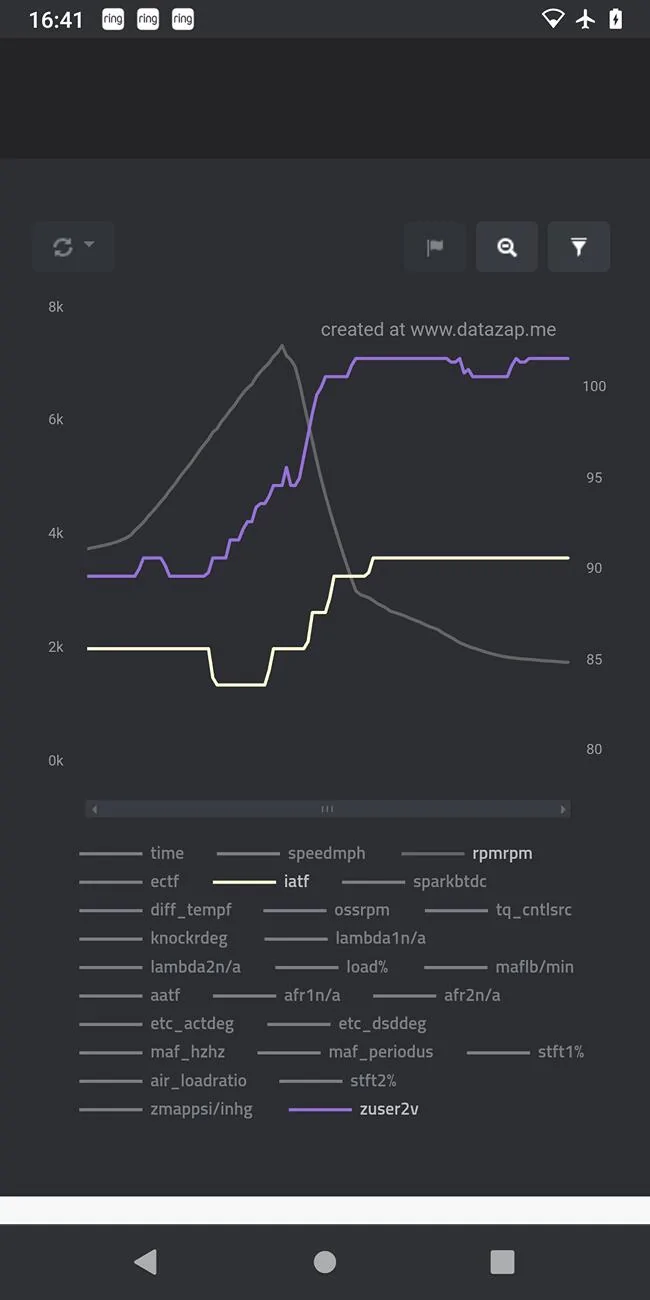

Whipple guys log between iat2 and his more accurate ZT sensor, notice the data offset and reduced refresh rate?
white is iat2(Whipple manifold)
purple is more accurate sensor also in manifold
grey is rpm.

One other thing is, Dustin Whipple said in an interview on Enginelabs that they use part of fords fi program in their tune and that allows them to introduce a second iat sensor, he says it allows them to use the maf as iat1 and the Mapt as iat2 and minus one from the other to produce the delta. That allows the whipple tune to stay right on the edge for better knock suppression compared to other brands like roush ect, I wonder if that's why you are seeing such large differences with the whipple iat2? maybe iat2 is the delta between 1+2 and not the actual reading from iat2?

Screenshot_20241016-164119.webp
 

Sponsored

Forestlump

Well-Known Member
Joined
Apr 1, 2022
Threads
5
Messages
210
Reaction score
148
Location
uk
Vehicle(s)
2017 Mustang GT
This was the article, I can't remember the title. But looking at the temperature difference on the data log above of the two iat sensors, it's a shame the guy didn't also log the Maf temp iat1 as it's likely the difference.

View attachment 852995
 
Last edited:

robvas

Well-Known Member
Joined
Nov 18, 2023
Threads
15
Messages
3,498
Reaction score
3,287
Location
MI
Vehicle(s)
2011 GT
So they use two sensors and read two different locations...what's your point?
 

Wolfys11

Well-Known Member
Joined
Aug 27, 2023
Threads
3
Messages
1,037
Reaction score
753
Location
New york
First Name
Jakub
Vehicle(s)
2023 Mustang Gt
So they use two sensors and read two different locations...what's your point?
Jesus, you are a pain to debate with

He gave you a cited essay, more research than i did in college, and you comment just this 😂

The two sensors are specifically made to read information for the whipple calibration to be better, that doesnt mean the whipple sensor reads what you think it reads, nor does it do what you think it does. Point being, the sensor(s) you pd setups use arent clear whether or not they show the true clear cut iat post intercooler, and dont necessarily dread a proper tempature that can be compared to a post intercooler centri setup that clear cut gives a true reading of the temp going into the manifold, now along with this data from these sensors showing data that doesnt really make sense with what temps it is doing at 16psi or whatever psi, we simply dont believe in the data being comparable. Not necessarily bad data, but data that isnt going to give a good comparison to a centri dataset
 

robvas

Well-Known Member
Joined
Nov 18, 2023
Threads
15
Messages
3,498
Reaction score
3,287
Location
MI
Vehicle(s)
2011 GT
Jesus, you are a pain to debate with

He gave you a cited essay, more research than i did in college, and you comment just this 😂

The two sensors are specifically made to read information for the whipple calibration to be better, that doesnt mean the whipple sensor reads what you think it reads, nor does it do what you think it does. Point being, the sensor(s) you pd setups use arent clear whether or not they show the true clear cut iat post intercooler, and dont necessarily dread a proper tempature that can be compared to a post intercooler centri setup that clear cut gives a true reading of the temp going into the manifold, now along with this data from these sensors showing data that doesnt really make sense with what temps it is doing at 16psi or whatever psi, we simply dont believe in the data being comparable. Not necessarily bad data, but data that isnt going to give a good comparison to a centri dataset
The sensors are reading the correct data. From the article:

“Almost always, we incorporate the IAT sensors post-intercooler,” Dustin elaborated. “Therefore, we have the actual temperatures entering the combustion chamber. The other part of that is, in a lot of our systems, we have the advantage of being able to rewrite Ford’s software to allow us to run two sensors. We’ve run one sensor on the inlet side at the MAF where the air is being taken in, and another sensor post-intercooler – so we’re actually able to get the Delta between the two.”

What number/logic whipple uses...you don't know and neither do I.

But then again you said IAT doesn't matter for tuning and you also don't understand that A2W is better than A2A.
 

Sponsored

engineermike

Well-Known Member
Joined
Jul 15, 2018
Threads
31
Messages
6,189
Reaction score
6,454
Location
La
Vehicle(s)
2018 GTPP A10
@andrewtac thank you for the kind words. One thing this journey has taught me is how little I really know. For instance, when my charge temp readings were better than expected, I challenged and tried to prove it wrong by spending hours testing the sensor response and learned that my preconceived notions about PD blower charge temps were wrong. I learn something new every day on these things.
 

StickShiftyFifty

Well-Known Member
Joined
Nov 1, 2017
Threads
25
Messages
238
Reaction score
128
Location
CA
First Name
Steve
Vehicle(s)
2016 mustang pp
Part of me wished I went whipple or procharger because of CA regulations, But the way these turbos put down power is incredible. Just so much plumbing
 

Timbuck

Well-Known Member
Joined
Mar 26, 2023
Threads
4
Messages
444
Reaction score
469
Location
Australia
First Name
Tim
Vehicle(s)
2017 s550 6r80
Part of me wished I went whipple or procharger because of CA regulations, But the way these turbos put down power is incredible. Just so much plumbing
your set up is so good. Love it. Must be a blast to drive.

have you got a boost curve shot from on the dyno or a log by any chance. ?
 

engineermike

Well-Known Member
Joined
Jul 15, 2018
Threads
31
Messages
6,189
Reaction score
6,454
Location
La
Vehicle(s)
2018 GTPP A10
What I'm saying is the thing being cooled will always be hotter than the cooling media, no matter if it's liquid or gas.
so in your case the boost will be hotter than the coolant and the coolant hotter than the ambient air cooling that.
This is a straw man argument. No one has said or implied otherwise.

You've said that it's literally parity which is rubbish,
I see you've resorted to lying.

itl be 10-20 degrees each between the water and ambient minimum, and more so when at wot when there's more heat generated and less time for it to be In contact with the cooler.
When cooling a gas using a liquid, the gas can very easily get close to the liquid temp due to the density difference.

That's why I said knowing the coolant temp would help you verify data to be correct or misleading. If the coolant temperature is over 100, very likely (just from the conducted heat from the cylinder heads alone and being on top of a 210 degree engine, under the bonnet and made from aluminium which conducts well), then you know your amazingly stable iat reading of 90 must be false.
If ambient is 70, then the water can easily be 85 and the charge temp can very easily be 90. Nothing is inherently wrong with this situation. No one is claiming the charge temp is below the intercooler water temp.

You could never realistically reach parity, like you have said before, ie zero delta T.
Another lie.

You'd need both the heat exchangers the size of the car and such little flow,
This is just incorrect. You can actually cool surprisingly high volumes of gas down to near-ambient using cooling water in very compact spaces.

hence why they can't ever get 100% out of a boilers heat exchanger,
No one is saying a heat exchanger is getting over "100%".

Posting up rando data is pointless as there's no control and can be manipulated easily.
Joe blogs car does this,
Bill baggins does this, all on different days, temps and collected by different sensors and under different conditions =unreliable data.
I've posted up my personal car data and data from cars I've tuned. Exploded_muffin posted up his personal data as well.

Everything suggested that spur gear type pumps like pd superchargers or oil pumps had a certain leakage and inefficiencies higher than other compressors.
Eaton actually publishes their compressor maps and you can see they are 70% efficient right in the flow/pressure/speed range where we run them. The larger Whipple is more efficient, but like ESS, they don't publish their maps. A centrif can very easily be 65-75% depending on where you're running it. With the data we have, it's a wash. Industrial PD compressors can reach 98% while the very most efficient industrial axial compressors barely break 90%. Industrial centrifs can run 70-85%.

Axial flow compressors being highest in efficiency but centrifugal compressors being slightly less efficient than axial that could generate larger pressure differences in a smaller package. That's why they are the cold side of all turbos and many gas turbines, water pumps and many others. How many Pd style compressors do you see on jet engines, turbos or anything other than a rudimentary hydraulic pump on a vintage tractor? None is the answer, and there's good reason, the efficiency isn't quite as good.
The reason they don't use PD blowers in gas turbine engines is two-fold. For one, a large axial flow compressor spinning 30,000 rpm moves prodigious amounts of air that are impractical for a PD blower. Secondly, the shaft speeds are much too fast, so it would require a large and heavy gearbox. It just doesn't make sense for the application, but it's not due to the efficiency.

But on scientific principle, the centri has the efficiency advantage, even if you can find data to disprove that in your particular application, it's still how it is.
Let me make sure I understand what you're saying here...even if data proves something, you still don't believe it because "it's still how it is"?

https://www.mustang6g.com/forums/threads/iats-with-whipple.124481/

Not the gen 5 but Documents the error with the whipple iat2 sensor against an accurate sensor. This guy was on to it and comparing the right stuff like coolant temps ect.
Aside from preconceived notions, why would you choose to believe his external sensor over the Whipple IAT2/GT500 sensor? Did you see his calibration data where he tested it in boiling water and an ice bath? I can show you mine if you want. Did you see his actual mounting location? I showed you mine. Why aren't you scrutinizing his data the same way you are mine?

One other thing interesting about his data is that even if you go by his higher-reading external temp sensor, he gained 5 deg on a 60-120 pull. Yes, he upgraded the coolant side of the setup, but he was also running the older, less-efficient Gen4 supercharger, intercooler in the hotter valley location, old single-pass non-counterflow intercooler, and had increased the boost to about 14 psi. Wolfys11's data log was also single gear, 50-120, 8 psi boost centrif, G4 intercooler, and gained 16 deg. If anything, that dataset supports my argument.

... I backed up wolfys11 because he is right when he said centrifugal are more efficient and generate less heat per hp used from the crank in the application vs a pd compressor.
If you have compressor maps for the Whipple 3.0 and ESS blowers, please post up. I cited my sources above and can show you more. The efficiency is a wash.

You try to say that both are the same efficiency, maybe max yes but we aren't operating in the max areas of the maps especially when you start changing pulleys.
Look up the Eaton R2650 map and plot out where we run it and you'll see it's running near peak efficiency up to about 12 psi boost. The Whipple is more efficient.

Whipple guys log between iat2 and his more accurate ZT sensor, notice the data offset and reduced refresh rate?
For starters, you can change the update rate in vcmscanner. Secondly, don't make the mistake of assuming the logger update rate is the same as the PCM logic's internal sample rate.

One other thing is, Dustin Whipple said in an interview on Enginelabs that they use part of fords fi program in their tune and that allows them to introduce a second iat sensor, he says it allows them to use the maf as iat1 and the Mapt as iat2 and minus one from the other to produce the delta. That allows the whipple tune to stay right on the edge for better knock suppression compared to other brands like roush ect, I wonder if that's why you are seeing such large differences with the whipple iat2? maybe iat2 is the delta between 1+2 and not the actual reading from iat2?
Did you miss the part where I tested the sensor in boiling water, an ice bath, and several data points in between to get a calibration curve? I stated this early in the thread and several times since then, and even offered to share the response curves. I actually used vcmscanner to log what the PCM is measuring and cross checked with a thermocouple in addition to the known water temps. It was +/-2 deg from 32 to about 120 deg F IIRC.
 

monte87

Well-Known Member
Joined
Mar 30, 2021
Threads
251
Messages
2,255
Reaction score
1,157
Location
NY-SHITTY!!!
First Name
Anthony
Vehicle(s)
2023 Mach 1
Since getting a s550 just always wanted a PD blower. Bought a10 3.15 gear 21 gt and kept deciding between a roush or whipple due to being a fun daily blower.

Have been reading that a lot of people say a centrifugal is better for an auto due to the powerband and shift points.

Did you go pd and wish you went centri?
Did you go centri and wish you went pd?

just assumed that a turbo wouldn’t be the ideal daily setup.
Yes, I regretted getting the dealer installed Roush phase 2 blower on my 2021 GT. Blowing CATS constantly was a major PITA and especially since roush tune is super conservative. Should've never happened....
I'm happy having a N/A 2023 Mach 1 now, no more headaches, but I def miss the power 750hp... for sure
Thanks Anthony
Sponsored


Top