Sponsored

Increasing air flow through grill

WD Pro

Well-Known Member
Joined
Jan 18, 2018
Threads
132
Messages
6,762
Reaction score
13,550
Location
United Kingdom
Vehicle(s)
Lime GT
Vehicle Showcase
1
I also opened mine from the back, but how did you get the grille separated from the bumper? I thought it was a one-way snap in, but I didn't try too hard to figure it out.
The body shop removed it to fix a pre delivery scuff on the bumper, they worked with me (and Ford) really well allowing me to collect it, modify it and then return it with the big mouth for painting and fitment.

People pop the grills out all the time though, so there must be an easy way to do it without damage.

I don't recall any visible marks around the mounting clips etc when I modified mine :like:

WD :like:
Sponsored


WItoTX

Well-Known Member
Joined
Dec 7, 2021
Threads
15
Messages
2,888
Reaction score
3,537
Location
Houston
First Name
Kyle
Vehicle(s)
'17 GT350
very interesting video! That’s why Shmoe’s like me modifying anything on my car is more likely to have a negative impact, than anything else. Even young inexperienced engineers at the OEM’s have all the previous experience or their predecessors to guide them.

however, for all the accolades the std GT air box gets, the GT 350 and Mach 1 have the open air box. Is that just for show?
It's "open", but at least on mine, it seals up tight to the hood when closed. I can see the weather stripping ring on the underside of my hood.

So maybe it is for show. I don't think my intake is any louder than a GT. The nice thing is, between runs I can pop the hood and get ambient air to the intake as opposed to air coming through the grill. It does make a small improvement, but it's only a couple degrees by the time I pull up to the start box.
 

KingKona

Well-Known Member
Joined
Jan 6, 2022
Threads
12
Messages
2,904
Reaction score
2,855
Location
Virginia
First Name
Shlomo
Vehicle(s)
2019 GT
Best way to fix that is to just get a jlt cai, I have the open style in mine and it gets all the air it needs. The stock box is pretty restrictive.
It absolutely is not. Unless you have LTHers, there's no reason to go with anything else other than the OEM CAI.

Don't believe the marketing hype.
 

shogun32

Well-Known Member
Joined
Feb 8, 2019
Threads
92
Messages
16,223
Reaction score
14,019
Location
Northern VA
First Name
Matt
Vehicle(s)
'19 GT/PP, '23 GB Mach1, '12 Audi S5 (v8+6mt)
Vehicle Showcase
2
The best reason to open the grill is to force more air through the radiator at speed, not the air intake.
you can't FORCE air thru a radiator. You have to PULL it thru. Radiators pass air at about 30mph rate and no more. the trick to maximize radiator efficiency is big vacuum behind it, and 'calm' air in front of it by reducing eddy and circular vortexes which occur when air hits a flat surface that blocks air. That's why we put angled vanes in front and box the rad.
 

Marketplaza

Well-Known Member
Joined
May 18, 2020
Threads
15
Messages
327
Reaction score
110
Location
Ks
First Name
Mike
Vehicle(s)
2019 GT shadow black and 18 dodge caravan
It absolutely is not. Unless you have LTHers, there's no reason to go with anything else other than the OEM CAI.

Don't believe the marketing hype.
Yes I understand that but I have a vortech and with that it absolutely makes a difference. It doesn’t do nothing on stock applications but with FI it does. More air more hp.
 

Sponsored

mustanghammer

Well-Known Member
Joined
Dec 11, 2017
Threads
2
Messages
183
Reaction score
179
Location
Parkville Mo
First Name
Scott
Vehicle(s)
2017 Mustang GT
Spend time making sure that all the air that passes through the grill has to go through the radiator. Making more openings in the grill if air can bypass the radiator won't do much good. A lesson learned trying to get an aero nose Fox Body mustang to cool in SCCA club racing.

I currently road race an 82 RX7. When I designed the grill opening for the car made it about 30% the size of the radiator core. Which is consistent with the grill sizing seen on IMSA GTU cars from the 80's. This ratio promotes a pressure differential between both sides of the grill opening that draws in air. It works, the car runs cool in racing conditions. Which is a bit of a feat because not many engines make more heat than a ported rotary.

Looking at the grill on my 2017 mustang it looks like Ford applied the same logic.
 

Keeffa

Well-Known Member
Joined
Mar 22, 2020
Threads
0
Messages
325
Reaction score
210
Location
australia
First Name
keith
Vehicle(s)
ford mustang 2018 gt
I'm in Australia where Mustangs are raced in our supercar v8 series and had an opportunity to visit a couple of teams HQ. I was surprised to see how small the air intake area is at the front of the car. Funnelled straight to the radiator. I guess a road car has to be able to operate in all conditions hot or cold.
 

Zooks527

Well-Known Member
Joined
Aug 24, 2018
Threads
67
Messages
1,727
Reaction score
1,395
Location
02048
Vehicle(s)
2019 KB GT, 401A, 6MT, PP1, S&S, MR, AE, B&O / 2018 Jeep Grand Cherokee Summit
you can't FORCE air thru a radiator. You have to PULL it thru. Radiators pass air at about 30mph rate and no more. the trick to maximize radiator efficiency is big vacuum behind it, and 'calm' air in front of it by reducing eddy and circular vortexes which occur when air hits a flat surface that blocks air.
I realize I'm being pedantic, but you cannot pull a fluid, you can only push it. In your case stated above, by creating a lower pressure zone behind the radiator, typically by a fan pushing the air that's there away from the radiator, you're creating a condition where the higher pressure in front of the radiator pushes the air through.
 

EFI

Well-Known Member
Joined
May 19, 2015
Threads
65
Messages
5,287
Reaction score
4,732
Location
Masshole central
Vehicle(s)
5.Br0
I was surprised to see how small the air intake area is at the front of the car. Funnelled straight to the radiator. I guess a road car has to be able to operate in all conditions hot or cold.
There are many other cooling factors that those dedicated racecars have that most of us don't have or would not be practical on a street driven daily car. So they don't need as much airflow through the grill to achieve the desired temperature.

Those engines are also pretty different from the street versions and their expected lifespans are measured in hours rather than years, so you can't compare the overall system of a dedicated race car/engine with a street car that sees a few HPDE weekends here and there.
 

shogun32

Well-Known Member
Joined
Feb 8, 2019
Threads
92
Messages
16,223
Reaction score
14,019
Location
Northern VA
First Name
Matt
Vehicle(s)
'19 GT/PP, '23 GB Mach1, '12 Audi S5 (v8+6mt)
Vehicle Showcase
2
I've been toying with putting air handler batting that green or blue weave stuff over the front grills. To slow and calm the air entering the chamber in front of the radiators. And maybe a switch to always run the rad fans.
 

Sponsored

WItoTX

Well-Known Member
Joined
Dec 7, 2021
Threads
15
Messages
2,888
Reaction score
3,537
Location
Houston
First Name
Kyle
Vehicle(s)
'17 GT350
I realize I'm being pedantic, but you cannot pull a fluid, you can only push it. In your case stated above, by creating a lower pressure zone behind the radiator, typically by a fan pushing the air that's there away from the radiator, you're creating a condition where the higher pressure in front of the radiator pushes the air through.
Sort of. The real answer is you want a pressure differential, and preferably the larger differential, the better. The high pressure side pushes, and the low pressure side pulls.

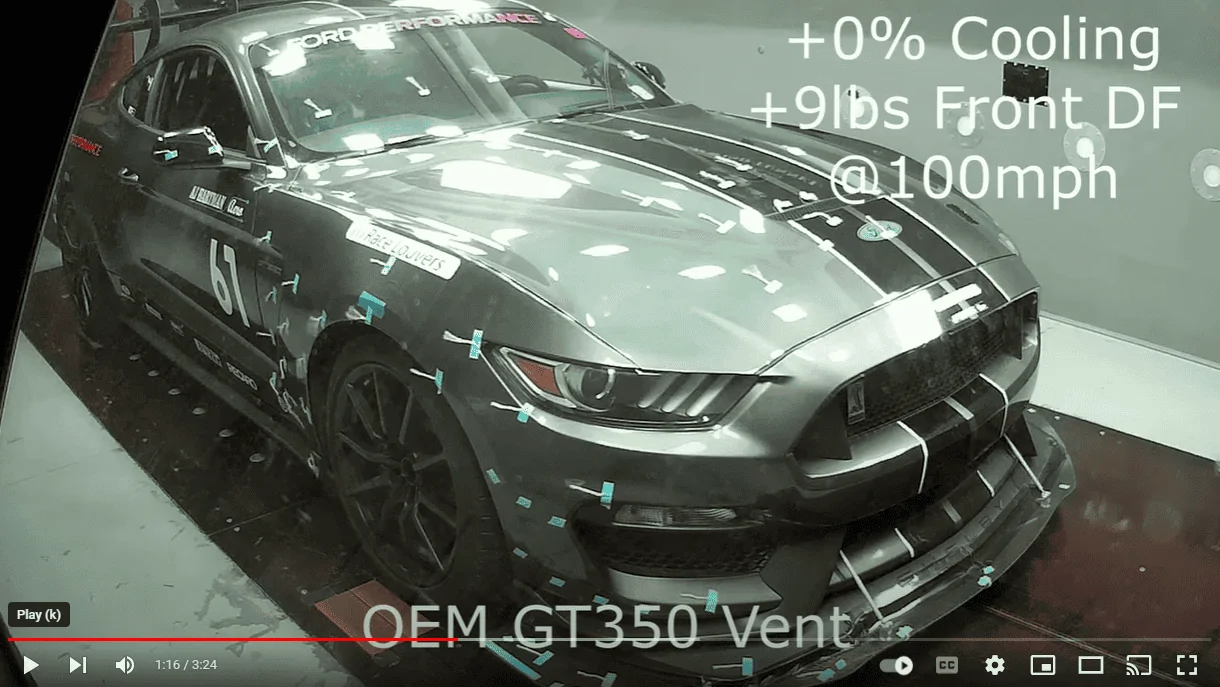
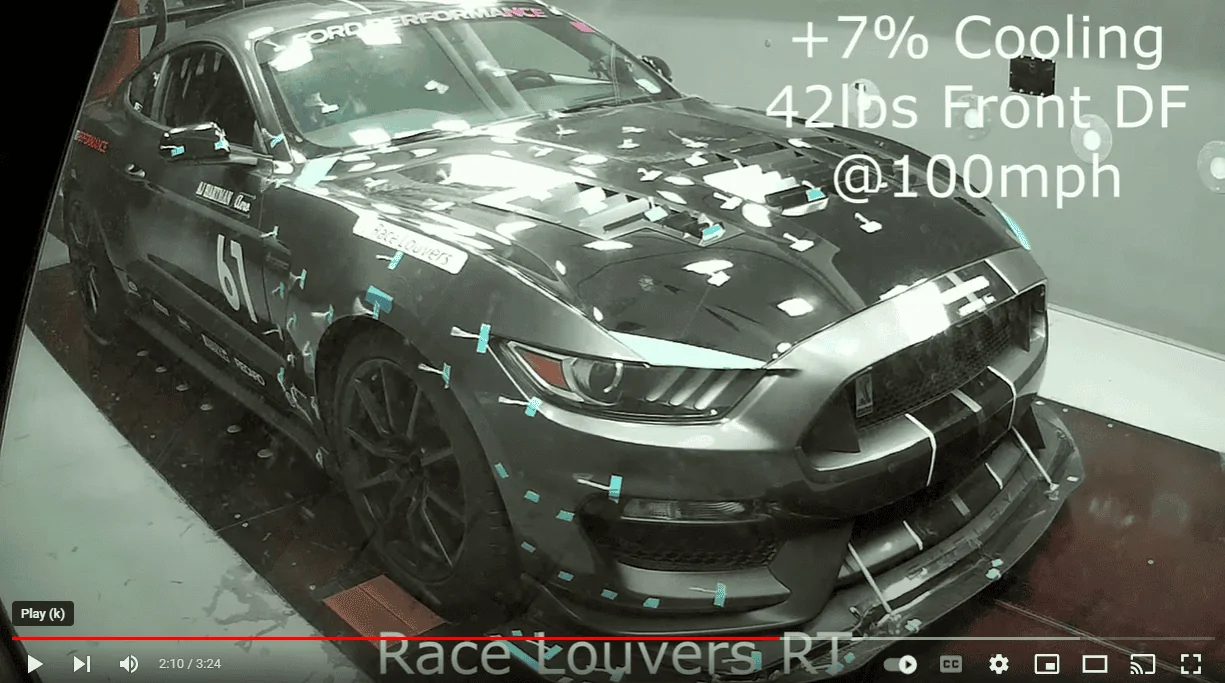
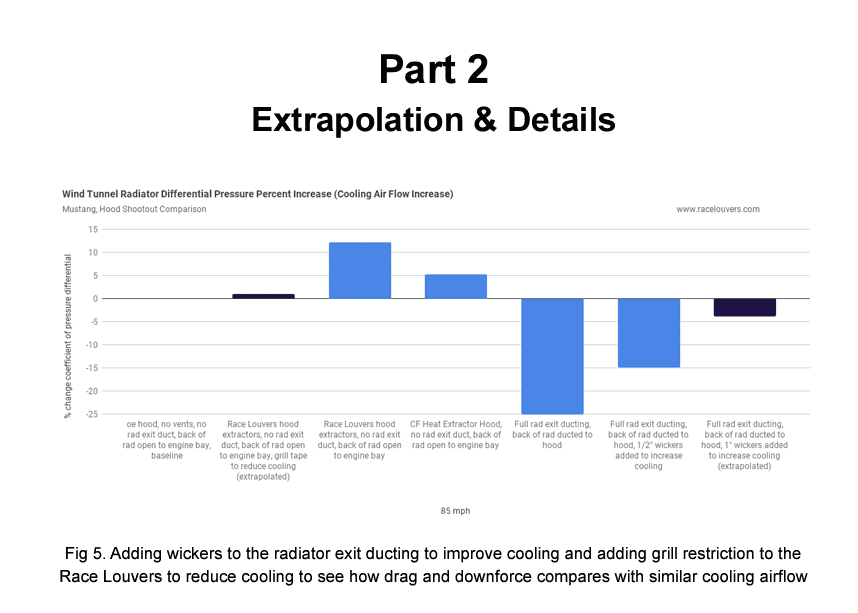
There is a low pressure bubble that forms on the nose of the car, sort of where the GT350 has it's hood vent. The idea is, make a hole in your hood there, then duct the air coming through the radioator, into that low pressure zone. The low pressure will "suck" the air through the radiator. Here is from AJ's video's showing how hood vents work. Factory GT350 hood.

1686849680515.webp


Aftermarket Vent:

1686849766448.webp


And here is the airflow through the grill, into the radiator, and out the hood:

1686849837626.webp


If you don't duct the air flowing through the radiator into that low pressure area, that hood vent becomes somewhat insignificant functionality-wise.

Here is the video link:


And here is what Race Louvers says:
1686849983585.png


chrome-extension://efaidnbmnnnibpcajpcglclefindmkaj/https://racelouvers.com/content/Race-Louvers-Mustang-Hood-Shootout-Wind-Tunnel-Data.pdf

As shown, ducting the airflow is the biggest issue. Don't duct, basically no gains.
 

shogun32

Well-Known Member
Joined
Feb 8, 2019
Threads
92
Messages
16,223
Reaction score
14,019
Location
Northern VA
First Name
Matt
Vehicle(s)
'19 GT/PP, '23 GB Mach1, '12 Audi S5 (v8+6mt)
Vehicle Showcase
2
Right so boxing the front side does zip? I'm surprised the purveyors of hood vents don't have a kit or at least suggested drawings to guide the customer
 
Last edited:

Paul McWhiskey

Well-Known Member
Joined
Apr 20, 2022
Threads
21
Messages
904
Reaction score
991
Location
United States
First Name
Paul
Vehicle(s)
2017 Mustang GT Premium w/PP
Just like heat flows from a hot area to a cold area ( so a delta between the energy in the warmer zone and the cooler zone) a radiator functions with a pressure delta between the inlet side and the exhaust side. Increasing the inlet pressure is fine. However maintaining the same exhaust side will be the choke point and limit the airflow even with increased pressure on the inlet side. Thus, to increase actual airflow both the inlet and exhaust side need to be properly modified to achieve this. Think in terms of only porting the intake ports on a head and doing nothin to the exhaust ports.
Then, there is the dwell time across the radiator fins and tubes. If the airflow is too fast there will not be enough time for the air to extract the heat from the metal.
 

Ewheels

Well-Known Member
Joined
Apr 5, 2019
Threads
69
Messages
1,919
Reaction score
2,732
Location
SoCal
First Name
Eric
Vehicle(s)
'18 GT PP1, '23 F150, '24 4Runner Pro
Vehicle Showcase
1
Right so boxing the front side does zip.
That's not true. Ducting the front or sealing the front side prevents airflow from going around the radiator and doing absolutely nothing for cooling.


Ducting the exit side to the hood is definitely the best solution but I've never seen anyone do it on an S550 as there's almost no room to do so. The only two Mustangs I've seen it done on are Vorshlag's S197 that had extensive mods to achieve and PAE's S550 that again had crazy amounts of custom work done to it.
 

NightmareMoon

Well-Known Member
Joined
Nov 22, 2015
Threads
62
Messages
7,059
Reaction score
6,318
Location
Austin
Vehicle(s)
2016 Mustang GT PP w/ Voodoo
Vehicle Showcase
1
Right so boxing the front side does zip. I'm surprised the purveyors of hood vents don't have a kit or at least suggested drawings to guide the customer
IDK where we established that boxing the front does *no* good?

I could understand that its not the path to the biggest gains, the car was engineered from Ford to cool adequately in normal usage conditions. You'll note that there's already trim below the radiator to seal it to the belly pan, etc, whereas the exit side has zero ducting on the stock car.
Sponsored


Top