Sponsored

Final Attempt - Misfire Issue

gilbenja

Well-Known Member
Joined
Dec 16, 2025
Threads
7
Messages
70
Reaction score
33
Location
CA
First Name
Ben
Vehicle(s)
Mustang GT 2018
Hello fellow Mustang6g members. Posting this for one last final attempt for any advice for a P0300 random misfire issue before selling my car.

I would really appreciate if only experienced members that have dealt with this issue / have the knowledge would comment to not stray away from the issue here. If all you have to say is change the spark plugs or coils, please do not leave a comment.

Overview of misfire issue
The car only has a random misfire during heavy load (typically happens in 2nd gear WOT uphill). I sometimes hear a strange noise coming from the exhaust of the car and starts around 6K rpms in second gear.

Common Themes with all 4 Mechanics
- All the mechanics I visited said that since the misfire only happens under heavy load, it’s basically a guessing game to diagnose.
- They all checked the spark plugs / coils and said this was not the problem
- Found it difficult / not possible to replicate the misfire and essentially believed the P0300 to be a phantom code
- 2/4 performed a compression test and said it passed. They did not provide photos or pictures - both just said it passed and met their standards

Mechanic #4 Upland Ford (most recent / trustworthy / relevant)
- performed a crank relearn - did not solve the issue
- did an oil change and found no metal or shavings - looked clean
- checked spark plugs, wiring/harnessing, fuel injectors, and did not believe these to be the problem
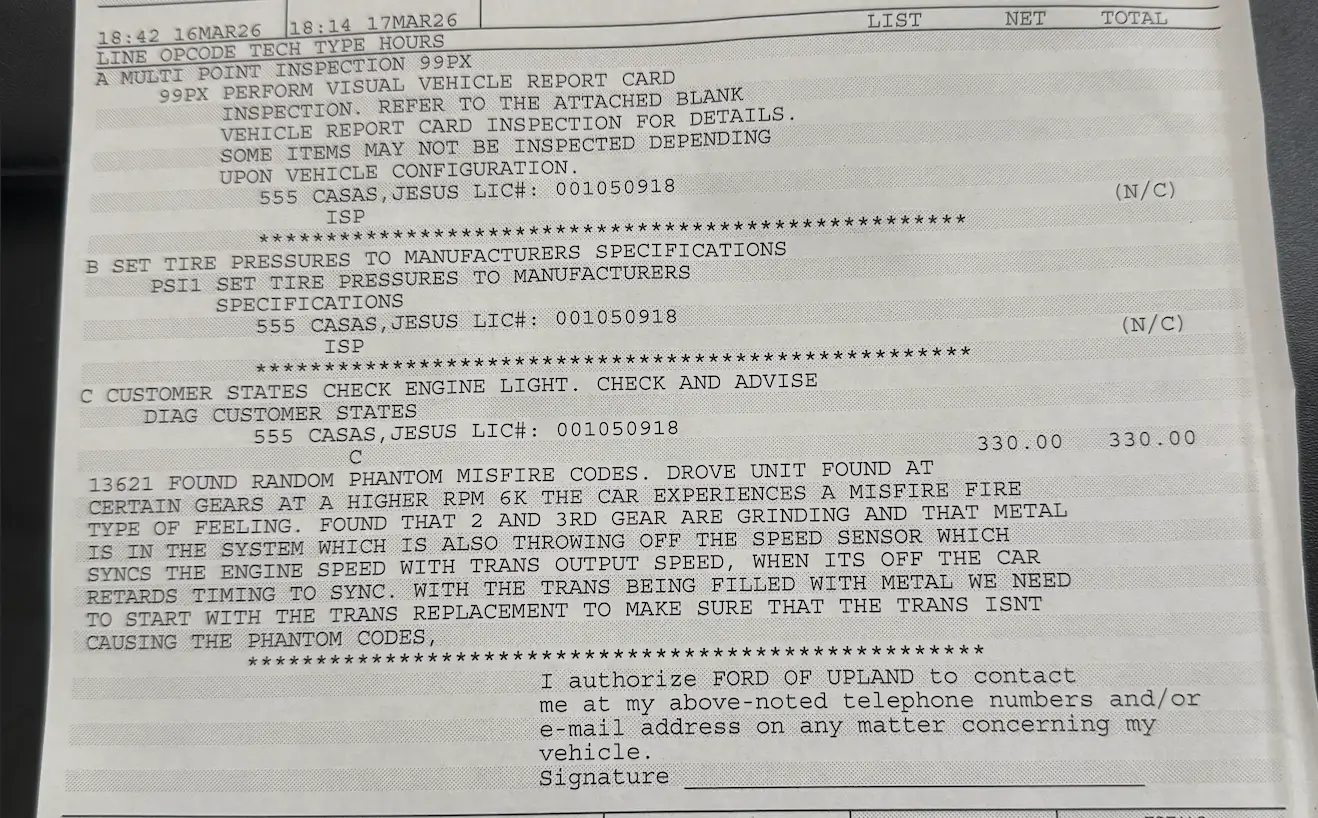
- they took the car out for a drive with a passenger hooking up a computer and could not see the misfires - believed that the sound I was hearing was from a failing transmission. (attached report)
- recommend I replace my whole transmission. The mechanic said he thinks my transmission is ruined but won't know for certain until he opens it up and thinks this is what is causing my misfire.
- the mechanic did say this may not even fix the issue. he did not want to make a statement on whether the transmission is fully broken down. He said because it only happens under heavy load that it is near impossible to really pin point an issue. He thinks the best bet is replacing the transmission rather than throwing random parts like new coils or fuel injectors.

Does anyone in this forum have any similar experiences or any opposition to the transmission repair being the next step? The car doesn't have any problem going into 2nd and 3rd gear which is why I just feel a little skeptical on this.

If the transmission does need to be replaced, I will just be selling the car.

1774333763911-jz.webp
Sponsored


Cobra Jet

Well-Known Member
Joined
Feb 12, 2015
Threads
771
Messages
17,554
Reaction score
19,983
Location
NJ
Vehicle(s)
2018 EB Prem. w/PP and 94 Mustang Cobra
Hello fellow Mustang6g members. Posting this for one last final attempt for any advice for a P0300 random misfire issue before selling my car.

I would really appreciate if only experienced members that have dealt with this issue / have the knowledge would comment to not stray away from the issue here. If all you have to say is change the spark plugs or coils, please do not leave a comment.

Overview of misfire issue
The car only has a random misfire during heavy load (typically happens in 2nd gear WOT uphill). I sometimes hear a strange noise coming from the exhaust of the car and starts around 6K rpms in second gear.

Common Themes with all 4 Mechanics
- All the mechanics I visited said that since the misfire only happens under heavy load, it’s basically a guessing game to diagnose.
- They all checked the spark plugs / coils and said this was not the problem
- Found it difficult / not possible to replicate the misfire and essentially believed the P0300 to be a phantom code
- 2/4 performed a compression test and said it passed. They did not provide photos or pictures - both just said it passed and met their standards

Mechanic #4 Upland Ford (most recent / trustworthy / relevant)
- performed a crank relearn - did not solve the issue
- did an oil change and found no metal or shavings - looked clean
- checked spark plugs, wiring/harnessing, fuel injectors, and did not believe these to be the problem
- they took the car out for a drive with a passenger hooking up a computer and could not see the misfires - believed that the sound I was hearing was from a failing transmission. (attached report)
- recommend I replace my whole transmission. The mechanic said he thinks my transmission is ruined but won't know for certain until he opens it up and thinks this is what is causing my misfire.
- the mechanic did say this may not even fix the issue. he did not want to make a statement on whether the transmission is fully broken down. He said because it only happens under heavy load that it is near impossible to really pin point an issue. He thinks the best bet is replacing the transmission rather than throwing random parts like new coils or fuel injectors.

Does anyone in this forum have any similar experiences or any opposition to the transmission repair being the next step? The car doesn't have any problem going into 2nd and 3rd gear which is why I just feel a little skeptical on this.

If the transmission does need to be replaced, I will just be selling the car.
1774333763911-jz.webp

- Crank sensor - failure can be the sensor itself, the harness to it or the pins in the connector. If the crank sensor is failing, it also will throw various misfire DTCs. The only time the crank sensor will throw a specific crank DTC is if the sensor is disconnected or it has completely failed. Many have found even with a generic misfire P0300, that the issue was related to the crank sensor. These sensors do not last forever due to their location and under hood heat cycles. Also to note, if there is debris stuck to the end of the crank sensor it will also create readability issues off the tone ring.

Check this thread:
https://www.mustang6g.com/forums/th...e-sensor-tone-ring.156234/page-2#post-3197692

The crank sensor reads the tone ring, which relays info back to the PCM. If the tone ring is ever so slightly damaged, no matter how many crank relearns are performed or how many new crank sensors are installed, it's not going to solve any problem, because the tone ring would need replacement. To determine if the tone ring was damaged requires removal of the transmission.

See this thread for Tone ring info:
https://www.mustang6g.com/forums/threads/p06e9-dtc-no-start.150022/page-2#post-3066365
See this thread; the first image in it, the round circular toothed object on the floor directly below the engine - that is the Tone Ring. It gets placed onto the back of the crank so the Crank Sensor can read it (also seen in the image):
https://www.mustang6g.com/forums/th...utch-install-and-flywheel-bolt-warning.87130/

—-

I would check the crank sensor first - it’s the most common failure point on the Coyote 5.0 and Voodoo variants. You could also do the repair in your driveway/garage if having the time and tools to do so.

Also check for any loose clamps along the air intake tract and make sure all of the air intake hoses are totally secure with no gaps where they mate. Any slight air gap or loose hoses can also cause a random P0300.

The P0300 error code is a Ford generic fault and doesn’t really point to any one part or sensor for failure. It’s caused by MANY variables and is most difficult to pinpoint that the problem is A vs B. If you want to spend the time reading up on the P0300, I’m including this link for knowledge sharing: about Ford's misfire strategies:
https://www.mustang6g.com/forums/threads/good-tech-article-on-ford’s-misfire-strategy.108076/

—
If YOU’RE NOT having any issues with the trans going into ANY gear, it’s NOT the trans causing your P0300…. LOL…. Sounds like the Tech can’t drive a manual transmission and is merely guessing for a diagnosis. Did you ask how he determined the transmission is “filled with metal” by his noted explanation? Did he drain the trans to find the metal?
 
Last edited:

pilotgore

Well-Known Member
Joined
Jan 29, 2020
Threads
47
Messages
1,652
Reaction score
2,479
Location
US
Vehicle(s)
A bunch
Hello fellow Mustang6g members. Posting this for one last final attempt for any advice for a P0300 random misfire issue before selling my car.

I would really appreciate if only experienced members that have dealt with this issue / have the knowledge would comment to not stray away from the issue here. If all you have to say is change the spark plugs or coils, please do not leave a comment.

Overview of misfire issue
The car only has a random misfire during heavy load (typically happens in 2nd gear WOT uphill). I sometimes hear a strange noise coming from the exhaust of the car and starts around 6K rpms in second gear.

Common Themes with all 4 Mechanics
- All the mechanics I visited said that since the misfire only happens under heavy load, it’s basically a guessing game to diagnose.
- They all checked the spark plugs / coils and said this was not the problem
- Found it difficult / not possible to replicate the misfire and essentially believed the P0300 to be a phantom code
- 2/4 performed a compression test and said it passed. They did not provide photos or pictures - both just said it passed and met their standards

Mechanic #4 Upland Ford (most recent / trustworthy / relevant)
- performed a crank relearn - did not solve the issue
- did an oil change and found no metal or shavings - looked clean
- checked spark plugs, wiring/harnessing, fuel injectors, and did not believe these to be the problem
- they took the car out for a drive with a passenger hooking up a computer and could not see the misfires - believed that the sound I was hearing was from a failing transmission. (attached report)
- recommend I replace my whole transmission. The mechanic said he thinks my transmission is ruined but won't know for certain until he opens it up and thinks this is what is causing my misfire.
- the mechanic did say this may not even fix the issue. he did not want to make a statement on whether the transmission is fully broken down. He said because it only happens under heavy load that it is near impossible to really pin point an issue. He thinks the best bet is replacing the transmission rather than throwing random parts like new coils or fuel injectors.

Does anyone in this forum have any similar experiences or any opposition to the transmission repair being the next step? The car doesn't have any problem going into 2nd and 3rd gear which is why I just feel a little skeptical on this.

If the transmission does need to be replaced, I will just be selling the car.

1774333763911-jz.webp
Sounds to me like you need a track day, which is probably the easiest way to stress test the hardware and find a sometimes faulty component! Worked for me :)

I agree on replacing the crank sensor… it’s cheap and easy. Same goes for the other diagnostic steps @Cobra Jet pointed out.

To me, this screams a faulty connection at a connector or a weak connection in a wiring harness somewhere. When one of my VCt solenoids was about to go out (I lost all 4 at one point or another), or the wiring pigtail connection between the VCT and main harness was about to go out, I would get random misfires until something fully failed.

Since the issue is presenting under heavy load when the engine is torquing in the engine bay, especially when going uphill when gravity pulling at the harness in a slightly different way, maybe that points to something in the wiring? I’ve had some limited success with using the misfire counter page on a code reader while using my hand to shake the wiring harness and all connections in the engine bay (preferably doing it while the engine is under load.). If you’re getting misfires to a particular cylinder, then your issue is in the wire to a specific plug, coil, injector, or the wiring to each. If you’re seeing misfires in one bank of the engine, I’d suspect the VCT system or cam position sensor. If the misfires are coming from everywhere randomly, I’d suspect a vacuum/air leak, or sensor (such as crank or maybe MAF). At any rate, if you don’t have a good OBD reader, you probably need one. You really need to play the long run game of trying to catch the engine misfiring in the act… which means lots of time hooked up to a code reader while using lots of gasoline.

Maintenance issues like this suck, but unless you get lucky with a sensor replacement or a loose wiring, you’re not going to find a magic bullet fix on the forum. Sometimes a car is worth the frustration of chasing down a gremlin… sometimes not. You started and ended the post with talking about selling the car. Sounds to me like you’re about to sell the car. . .

Best of luck (from a former mustang owner who couldn’t handle the frustration of a constantly breaking car.)
 
Last edited:

loucas-2021

Well-Known Member
Joined
May 14, 2023
Threads
26
Messages
251
Reaction score
227
Location
Tamarac, FL
First Name
Louis
Vehicle(s)
2021 Mustang GT PP Grabber Yellow
this whole situation does not smell like a transmission problem at all, and the dealership’s “best guess” approach is a giant red flag. The pattern described is classic Coyote under‑load misfire behavior, and none of the mechanics actually chased the data that matters.

1. A P0300 ONLY under heavy load is almost never a transmission issue

A transmission cannot cause a cylinder‑specific combustion failure.
It can cause:
  • Flare between gears
  • Harsh shifts
  • Slipping
  • RPM flutters
  • Mechanical noise
But it cannot cause the ECU to detect random misfires. The ECU detects misfires by measuring crankshaft acceleration between combustion events. A transmission problem doesn’t alter individual cylinder torque pulses.

So the dealer’s “replace the whole transmission” suggestion is basically:
We don’t know, so let’s replace the most expensive thing.
That’s not diagnosis — that’s surrender.

2. Misfires ONLY at WOT, high RPM, uphill = load‑dependent fuel or airflow issue

This pattern is extremely specific:
  • Happens only at high load
  • Happens only at high RPM
  • Happens only in lower gears where load spikes
  • No misfires at idle or cruising
  • No codes for specific cylinders
  • Compression tests “passed”

This points toward:

Likely causes
  • Weak or partially clogged fuel injector (very common on Gen 3 Coyotes)
  • Fuel rail pressure drop under load
  • Failing high‑pressure fuel pump (HPFP)
  • Low‑pressure pump not keeping up
  • Dirty or sticking IMRC (if applicable)
  • Slight vacuum leak that only matters at WOT
  • Bad O2 sensor response under load (not enough to throw a code)
  • MAF scaling issue (especially if intake is aftermarket)

Unlikely causes
  • Coils
  • Spark plugs
  • Transmission
  • Phantom code
🎧 3. The “strange noise from the exhaust at 6k RPM” is a clue

That’s often:
  • A lean pop
  • A partial combustion event
  • A cylinder that’s not firing fully under load
  • Fuel starvation at high demand

This is not a transmission noise.
Transmission noises don’t sync with RPM at WOT in a single gear.

4. The mechanics didn’t test the ONE thing that matters: fuel trims and rail pressure under load

To diagnose this properly, someone needs to log:
  • HPFP pressure (desired vs actual)
  • LPFP pressure
  • Injector pulse width
  • STFT/LTFT at WOT
  • MAF counts
  • Knock retard
  • Cylinder contribution test

If the misfire only happens under load, you must log under load.
Four mechanics “couldn’t replicate it” because they didn’t push the car hard enough.

5. The dealership’s logic is flawed
They said:
  • “We didn’t see misfires on the scanner.”
  • “We think it’s the transmission.”
  • “But we’re not sure.”
  • “Replacing the transmission may not fix it.”
That’s basically admitting:
We have no evidence, but we’ll happily charge you $6–10k.

No competent Ford tech would jump to transmission replacement for a P0300.
 

11GT50

Well-Known Member
Joined
Jul 13, 2019
Threads
3
Messages
91
Reaction score
67
Location
Union, WA
First Name
Matt
Vehicle(s)
2017 GT350
I have told you mutiple times that you need to be logging fuel pressure at this point I am almost certain you are losing fuel rail pressure. Listen to what loucas-2021 is saying here and listen to what I have been telling you.

The GT350 does have some issues with the transmission output shaft nut loosening and you can try the tone ring fix but it's not going to resolve the issue.

this whole situation does not smell like a transmission problem at all, and the dealership’s “best guess” approach is a giant red flag. The pattern described is classic Coyote under‑load misfire behavior, and none of the mechanics actually chased the data that matters.

1. A P0300 ONLY under heavy load is almost never a transmission issue

A transmission cannot cause a cylinder‑specific combustion failure.
It can cause:
  • Flare between gears
  • Harsh shifts
  • Slipping
  • RPM flutters
  • Mechanical noise
But it cannot cause the ECU to detect random misfires. The ECU detects misfires by measuring crankshaft acceleration between combustion events. A transmission problem doesn’t alter individual cylinder torque pulses.

So the dealer’s “replace the whole transmission” suggestion is basically:
We don’t know, so let’s replace the most expensive thing.
That’s not diagnosis — that’s surrender.

2. Misfires ONLY at WOT, high RPM, uphill = load‑dependent fuel or airflow issue

This pattern is extremely specific:
  • Happens only at high load
  • Happens only at high RPM
  • Happens only in lower gears where load spikes
  • No misfires at idle or cruising
  • No codes for specific cylinders
  • Compression tests “passed”

This points toward:

Likely causes
  • Weak or partially clogged fuel injector (very common on Gen 3 Coyotes)
  • Fuel rail pressure drop under load
  • Failing high‑pressure fuel pump (HPFP)
  • Low‑pressure pump not keeping up
  • Dirty or sticking IMRC (if applicable)
  • Slight vacuum leak that only matters at WOT
  • Bad O2 sensor response under load (not enough to throw a code)
  • MAF scaling issue (especially if intake is aftermarket)

Unlikely causes
  • Coils
  • Spark plugs
  • Transmission
  • Phantom code
🎧 3. The “strange noise from the exhaust at 6k RPM” is a clue


That’s often:
  • A lean pop
  • A partial combustion event
  • A cylinder that’s not firing fully under load
  • Fuel starvation at high demand

This is not a transmission noise.
Transmission noises don’t sync with RPM at WOT in a single gear.

4. The mechanics didn’t test the ONE thing that matters: fuel trims and rail pressure under load

To diagnose this properly, someone needs to log:
  • HPFP pressure (desired vs actual)
  • LPFP pressure
  • Injector pulse width
  • STFT/LTFT at WOT
  • MAF counts
  • Knock retard
  • Cylinder contribution test

If the misfire only happens under load, you must log under load.
Four mechanics “couldn’t replicate it” because they didn’t push the car hard enough.

5. The dealership’s logic is flawed
They said:
  • “We didn’t see misfires on the scanner.”
  • “We think it’s the transmission.”
  • “But we’re not sure.”
  • “Replacing the transmission may not fix it.”
That’s basically admitting:
We have no evidence, but we’ll happily charge you $6–10k.

No competent Ford tech would jump to transmission replacement for a P0300.
 

Sponsored

OP
OP

gilbenja

Well-Known Member
Joined
Dec 16, 2025
Threads
7
Messages
70
Reaction score
33
Location
CA
First Name
Ben
Vehicle(s)
Mustang GT 2018
I have told you mutiple times that you need to be logging fuel pressure at this point I am almost certain you are losing fuel rail pressure. Listen to what loucas-2021 is saying here and listen to what I have been telling you.

The GT350 does have some issues with the transmission output shaft nut loosening and you can try the tone ring fix but it's not going to resolve the issue.
I bought the scanner and hooked it to my car while doing multiple pulls. I believe I sent you the reports but never heard back. Could you take a look at these?
 

Attachments

OP
OP

gilbenja

Well-Known Member
Joined
Dec 16, 2025
Threads
7
Messages
70
Reaction score
33
Location
CA
First Name
Ben
Vehicle(s)
Mustang GT 2018
Did the coil ever get swapped. Now it’s replace the transmission along with motor.
I understand people in this forum are probably getting frustrated thinking I am stubborn - and maybe this is unintentionally true from me. I might need to just be more direct and just tell a mechanic to do xyz. But I keep going into the new mechanics giving some overview and trusting their judgement. They all say the coils and spark plugs do not need to be changed and that I should basically save my money and not throw parts.

No the coil did not get swapped. It seems that every time I post what a mechanic says, that the forum doubts their competence / intentions so I try a new one. I bought the new coil along with spark plugs. Two mechanic said to not change them - they tested and inspected all plugs and coils.

There was not any clear misfires which is why it is constantly a P0300 code and not isolated to one cylinder.

Maybe I'm being way too trusting, but this is now the 4th mechanic I've gone to.

I also believe that the tech on my car is a Ford Master Tech. There were like 6 GT350's in the lot and he said hes been working on the GT350's since 2016.
 

11GT50

Well-Known Member
Joined
Jul 13, 2019
Threads
3
Messages
91
Reaction score
67
Location
Union, WA
First Name
Matt
Vehicle(s)
2017 GT350
Were those scans taken while driving the car and the condition occurring?

I'm a little confused because there's a block of data that indicates you had a misfire but then a few lines down (line 178) days misfire currently detected "No".

Can your scanner show realtime data? Those printouts only show min and max values, but they don't show the actual values at the time of the event. You need to be able to see whether or not there is a drop in fuel pressure when the misfire happens. I know you said the techs inspected the harness and didn't find anything, but you need to be able to watch for a drop in fuel pressure as you are manipulating the wires with your fingers.

When I had a similar problem I caught it because I was logging when the event happened and caught the drop in fuel pressure. After that I was able to find the break in one of the wires to the fuel rail pressure sensor by manipulating the wires and watching the readout. Without being able to watch that output, you'll almost never find it an intermittent break like that.

The suggestion earlier in this thread to investigate the crank position sensor is a good idea as well.
 
Last edited:

Sajin

Well-Known Member
Joined
Dec 17, 2024
Threads
4
Messages
49
Reaction score
55
Location
TX
First Name
Jeremy
Vehicle(s)
2020 GT350r
If you were in Texas I would suggest you take your car to HPP Racing by Dallas. I know they could 100% diagnose your issue. Find a shop that builds race cars. They will figure it out.
 

Sponsored

robvas

Well-Known Member
Joined
Nov 18, 2023
Threads
15
Messages
3,485
Reaction score
3,274
Location
MI
Vehicle(s)
2011 GT
Has anyone stuck a scope on it, or just an OBD2 scanner?


SheepDog

Well-Known Member
Joined
Nov 3, 2018
Threads
26
Messages
4,189
Reaction score
5,250
Location
Colorado
First Name
Dax
Vehicle(s)
Iconic Silver 2022 MACH 1 HP, 2023 F150 Powerboost
Does anyone in this forum have any similar experiences or any opposition to the transmission repair being the next step?
Did they drain the transmission fluid to check for signs of wear or damage? All the moving bits inside the transmission are exposed to the fluid. If something broke or is excessively worn, it will show up in the fluid.

False knock can trigger a random misfire code. Did they check to make sure there isn't anything shifting or banging around under the car (especially on the exhaust and bell housing) A catalytic converter that has come apart, maybe a broken motor mount?

People in here are skeptical of mechanics (especially Ford service centers) because generally, they don't actually know what they are doing, ore how these systems work. They are just good test takers, and good at following a flow chart. If the Flow chart doesn't spoon feed the answer to them, they don't know how to diagnose an issue. This is even more common with dealership technicians that only work on a few models of vehicles over and over again. They see common issues and know how to fix them, but when something like this comes up, they are lost.

You have started several threads now, on the exact same topic which makes reviewing information in chronological order difficult.

Like others are saying, fueling issues can absolutely cause a random misfire. What is your fuel pressure at Idle? Under load? Did they check the external fuel filter for contaminates? What are your fuel trims?

Im not talking about the fuel pressure data, I talking about hooking up an actual pressure gauge in line, and running the car. A wiring issue doesn't necessarily tell you if your pressure is good. The pressure may be ok, but if you had a loose/poor connection you might see in the data that the pressure falls of, but is actually ok.
 
Last edited:

11GT50

Well-Known Member
Joined
Jul 13, 2019
Threads
3
Messages
91
Reaction score
67
Location
Union, WA
First Name
Matt
Vehicle(s)
2017 GT350
A wiring issue doesn't necessarily tell you if your pressure is good. The pressure may be ok, but if you had a loose/poor connection you might see in the data that the pressure falls of, but is actually ok.
For the concern I am trying to get him to look at it absolutely will show. The pumps loses signal and shut off. This is was exactly what was happening to mine.
 

SheepDog

Well-Known Member
Joined
Nov 3, 2018
Threads
26
Messages
4,189
Reaction score
5,250
Location
Colorado
First Name
Dax
Vehicle(s)
Iconic Silver 2022 MACH 1 HP, 2023 F150 Powerboost
For the concern I am trying to get him to look at it absolutely will show. The pumps loses signal and shut off. This is was exactly what was happening to mine.
Fair enough.

He isn't actually taking any advice from this forum anyway. He starts a new thread every few days, calls it something different, but for the same issue. Then, take it to various mechanics that don't actually know how to troubleshoot something like this (not his fault, just general industry incompetence) and the say "P0300 huh, definitely needs a new motor and transmission"
 

NightmareMoon

Well-Known Member
Joined
Nov 22, 2015
Threads
62
Messages
7,055
Reaction score
6,314
Location
Austin
Vehicle(s)
2016 Mustang GT PP w/ Voodoo
Vehicle Showcase
1
this whole situation does not smell like a transmission problem at all, and the dealership’s “best guess” approach is a giant red flag. The pattern described is classic Coyote under‑load misfire behavior, and none of the mechanics actually chased the data that matters.

1. A P0300 ONLY under heavy load is almost never a transmission issue

A transmission cannot cause a cylinder‑specific combustion failure.
It can cause:
  • Flare between gears
  • Harsh shifts
  • Slipping
  • RPM flutters
  • Mechanical noise
But it cannot cause the ECU to detect random misfires. The ECU detects misfires by measuring crankshaft acceleration between combustion events. A transmission problem doesn’t alter individual cylinder torque pulses.

So the dealer’s “replace the whole transmission” suggestion is basically:
We don’t know, so let’s replace the most expensive thing.
That’s not diagnosis — that’s surrender.

2. Misfires ONLY at WOT, high RPM, uphill = load‑dependent fuel or airflow issue

This pattern is extremely specific:
  • Happens only at high load
  • Happens only at high RPM
  • Happens only in lower gears where load spikes
  • No misfires at idle or cruising
  • No codes for specific cylinders
  • Compression tests “passed”

This points toward:

Likely causes
  • Weak or partially clogged fuel injector (very common on Gen 3 Coyotes)
  • Fuel rail pressure drop under load
  • Failing high‑pressure fuel pump (HPFP)
  • Low‑pressure pump not keeping up
  • Dirty or sticking IMRC (if applicable)
  • Slight vacuum leak that only matters at WOT
  • Bad O2 sensor response under load (not enough to throw a code)
  • MAF scaling issue (especially if intake is aftermarket)

Unlikely causes
  • Coils
  • Spark plugs
  • Transmission
  • Phantom code
🎧 3. The “strange noise from the exhaust at 6k RPM” is a clue

That’s often:
  • A lean pop
  • A partial combustion event
  • A cylinder that’s not firing fully under load
  • Fuel starvation at high demand

This is not a transmission noise.
Transmission noises don’t sync with RPM at WOT in a single gear.

4. The mechanics didn’t test the ONE thing that matters: fuel trims and rail pressure under load

To diagnose this properly, someone needs to log:
  • HPFP pressure (desired vs actual)
  • LPFP pressure
  • Injector pulse width
  • STFT/LTFT at WOT
  • MAF counts
  • Knock retard
  • Cylinder contribution test

If the misfire only happens under load, you must log under load.
Four mechanics “couldn’t replicate it” because they didn’t push the car hard enough.

5. The dealership’s logic is flawed
They said:
  • “We didn’t see misfires on the scanner.”
  • “We think it’s the transmission.”
  • “But we’re not sure.”
  • “Replacing the transmission may not fix it.”
That’s basically admitting:
We have no evidence, but we’ll happily charge you $6–10k.

No competent Ford tech would jump to transmission replacement for a P0300.
The mechanic isnt saying the transmission is making noise he’s saying there are metal shavings in the transmission case and may be causing issues with a speed sensor inside the case.

Anyway if I were the OP and I could sell the car, I might. No fun with random problems and if your car isnt modded to all heck, why not get rid of it.

Fueling issues could be the case. fWIW when I had fuel issues it was pretty clear on a datalog that the injectors were going to 100% and that was enough to know the fuel pressure was low and the pump was going out.

OP needs to find a local mechanic he trysts because aint none of yall gonna diagnose it over the internet. Someone local has to figure it out for him.
Sponsored


Top