
Sponsored

BBQ tick - another attempt to understand

TheLion

Well-Known Member
Joined
Jul 1, 2016
Threads
68
Messages
1,621
Reaction score
601
Location
US
Vehicle(s)
Ruby Red 2016 Mustang GT PP 6-MT
Keep in mind on my car, the dealer said they found scoring on cylinder #3 but that was just to get Ford to approve the short block. They told me they had to put something. SO in some cases I suspect the dealers aren't actually finding any damage and are just telling the customer they found something so they can get it all approved.
I did not know that. Well in that case the list of actual diagnosed issues with the replaced short blocks grows even smaller. That might be why Ford Engineering claims less than 0.5% failure. Because many of the noises are harmless.

If it doesn't bother you, then ignore it and drive the care like it's meant to be driven and enjoy it. If it's a bother, use Ceratec and experiment with small dosages until it minimizes or eliminates the sound. it's not super expensive, so if you could get away with 1/2 or 1/3 of a bottle, that's 1-2 years worth for a low cost. And it is an additive that is supposed to protect against wear, so if it works as advertised it will only reduce wear on critical parts.

How much it increases pumping losses I don't know (by thickening). But it may reduce losses in other areas to off-set and the net may be 0 effect on power / fuel economy but with added wear protection and reduced noise. BTW this thread should be stickied ASAP! It could help a lot of GT owners from the S197 all the way to 2nd gen S550's.
Sponsored


TheLion

Well-Known Member
Joined
Jul 1, 2016
Threads
68
Messages
1,621
Reaction score
601
Location
US
Vehicle(s)
Ruby Red 2016 Mustang GT PP 6-MT
One Boss 302 owner reported success with Driven's Street formula oil: http://www.drivenracingoil.com/dro/fr20-synthetic-5w-312html/

First gen S550's 2nd Gen 5.0 is much closer to the Boss 302's Road Runner variant than the 1st gen 5.0. So it's a good base line. It sounds to me like it's all additive package related and most modern oils don't really dampen mechanical clatter. I'm starting to wonder if the side to side clearances are enough even when in spec to cause the "BBQ Tick" and that's just how that design is. There is no side bearing and maybe that's a common thing with the clearances Ford uses. This is not just a Coyote 5.0 Mustang edition phenomenon. It's a F350 6.2 Gas, F350 6.7 Power Stroke, F-150 5.0 and Mustang 5.0 phenomenon.

From what we've seen so far, Ceramic Powders are the best solution from a street car perspective as I believe they are catalyst safe, assuming you care enough to quiet it down. Otherwise, drive on :rockon:
 

GT Pony

Well-Known Member
Joined
Mar 13, 2015
Threads
77
Messages
9,402
Reaction score
4,839
Location
Pacific NW
Vehicle(s)
2015 GT Premium, Black w/Saddle, 19s, NAV
But even of those with short blocks replaced, the techs found no signs of anything wrong in most cases. Tolerances were all ok.
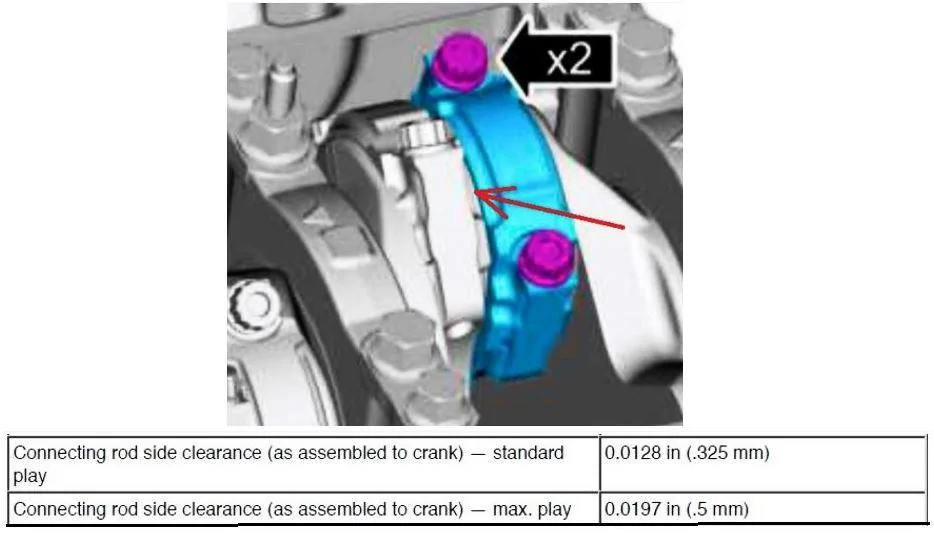
I was hoping that the Tech measured the rod side clearance in that YouTube video and reported it. It would have taken a minute to do with some feeler gauges. It sure seemed way more than the max allowed limit of 0.5 mm to me.

Problem with this whole BBQ Tick issue is nobody has done a complete in-depth tear down and measurement of every short block component to compare to factory manual specifications. Ford probably has done it on varios short blocks sent to them by dealerships, and we will never hear of those measurement results. Dealers aren't going to get into that level of diagnostics, but rather just install the new short block and call it a day .
 
Last edited:

TheLion

Well-Known Member
Joined
Jul 1, 2016
Threads
68
Messages
1,621
Reaction score
601
Location
US
Vehicle(s)
Ruby Red 2016 Mustang GT PP 6-MT
Here's some more possibilties. CeraTech makes motor oil in 5W-20 that meets Ford's spec. That means you can run their ceramic compound additive package oils without voiding your warranty.

https://products.liqui-moly.com/oils.html?cat=597&viscosity=2795

Also Cera Tec (Liquid Moly) is catalyst safe: https://pim.liqui-moly.de/pidoc/P000017/3721-CeraTec-23.0-us.pdf

These are their claimed properties:

Description Micro ceramic solid lubricant suspension based on hexagonal boron nitride (BN) in selected base oils. The laminar graphite-similar structure reduces friction and wear and prevents direct metal-to-metal contact. The < 0.5 µm particle size guarantees optimum filter flow properties and protects against depositing of solid lubricant particles. Properties - reduces frictional losses - suitable for diesel particulate filters - mixable with all commercially available motor oils - increases smooth operation - highest thermal stability - excellent high and low temperature behavior - tested for catalytic converters - stable under extreme pressures - compatible with fine filters - no deposits - long engine service life - chemically inert - reduces fuel consumption

So my concern about it possibly clogging filters or lifters or other fine tolerances or issues with the catalysts like Zinc can cause should more or less be put to rest by their claims assuming they are true. Sounds like this is a winner if you have the tick.

I'm wondering if you could get away with every other oil change. They claim it lasts 50,000 km. I'm not aware of an oils on the market with that kind of service interval. So my guess is that it's based on how it coats the internal components and remains through several oil changes.

Areas of application Added to the lubricating oil of engines, compressors, pumps and transmissions. Excellent for use in passenger car and commercial vehicle engines (gasoline and diesel). Mixable with all commercially available motor oils.

They claim it's chemically inert and safe to mix with all commercially available oils. So seems like a good solution. I may try it in my PP GT. Maybe half 150ml just to see then go from there.
 

CEHollier

Well-Known Member
Joined
Sep 6, 2015
Threads
81
Messages
1,570
Reaction score
707
Location
Prairieville, La.
First Name
Charles
Vehicle(s)
2015 GT Premium Magnetic
Vehicle Showcase
1
@CEHollier - BBQ tick started around 28k after an oil change. Note he is tuned for E85 with an aggressive after market tune (Lund) and stated there was a diagnosis of detonation issues resulting in cylinder wall damage. This is not a Ford failure but a Lund failure. Lucked out and is getting a new short block anyway...lucky dog!
Lucky Blue Dog. LOL. Got the short block in. Runs great. Also the Ford Tech put in MMR Billet OPG and crank spline. So now I'm good to 8K. A friend with a 100 % stock Mustang got a new short block because of detonation issues. If I stated this it was speculation before the tech got back with me. This is a message from him. "Hey Charles just to let u know I had to order cams & followers for ur car I didn’t like the wear on a couple of lobes. Looks like the rollers on the follower stop rolling at times." Just want to make sure my facts are correct.
 
Last edited:

Sponsored

TheLion

Well-Known Member
Joined
Jul 1, 2016
Threads
68
Messages
1,621
Reaction score
601
Location
US
Vehicle(s)
Ruby Red 2016 Mustang GT PP 6-MT
That would be one risk of roller finger followers...but I suppose if they roll most of the time it's less wear than DAMBS which rely entirely on oil boundary layer lubrication. They tend to need adjustment every 100k or they get quite clanky. My 2.3L Duartec in my old 07 Focus ST was quite clanky for sure. But it also had 175k miles on it and I beat the piss out of it including running it for the full 15k miles on Mobil 1 EP between oil changes. But it drove great and ran just fine when I sold it to get the Mustang Ecoboost back in 2016.
 

TheLion

Well-Known Member
Joined
Jul 1, 2016
Threads
68
Messages
1,621
Reaction score
601
Location
US
Vehicle(s)
Ruby Red 2016 Mustang GT PP 6-MT
Yah I saw that. I just figured that quite a few people only posted once or twice on the issue and never again. So it was unlikely that would add information for the poll. But between my list and your poll, we should get a good picture. So far however, it seems the noise is more or less benign. It's very pronounced and obnoxious on some cars, but others it's kinda hidden under all the other normal noises (like mine) and only very particular person would even notice. My guess is all Coyote 5.0's do it to some degree but most are quiet enough that the average person doesn't notice. Also many run Motorcraft Semi-syn 5W-20, which in my cars dampens the noise more than synthetics do. So it all depends on oil used, the persons sensitivity to the noise, their environment and how pronounced the noise is on their particular car.
 
OP
OP
accel

accel

Well-Known Member
Joined
May 19, 2017
Threads
76
Messages
1,282
Reaction score
320
Location
USA
Vehicle(s)
'17 GT PP
Yah I saw that. I just figured that quite a few people only posted once or twice on the issue and never again. So it was unlikely that would add information for the poll. But between my list and your poll, we should get a good picture. So far however, it seems the noise is more or less benign. It's very pronounced and obnoxious on some cars, but others it's kinda hidden under all the other normal noises (like mine) and only very particular person would even notice. My guess is all Coyote 5.0's do it to some degree but most are quiet enough that the average person doesn't notice. Also many run Motorcraft Semi-syn 5W-20, which in my cars dampens the noise more than synthetics do. So it all depends on oil used, the persons sensitivity to the noise, their environment and how pronounced the noise is on their particular car.
I switched to Mobil since Motorcraft was frequently criticized at this forum. As far as the tick... I ignored it until one day it felt like enough is enough.

Overall, I'd rather deal with things like Power Pack 2, then with fixes.
 

bl4d3runn3r

Well-Known Member
Joined
Mar 22, 2017
Threads
22
Messages
164
Reaction score
42
Location
Chicago
Vehicle(s)
Blu Fury
@JGonvardi - getting a short block replacement, tech suspects cylinders 2 and 3. Runs Amsoil Signature Series 5W-20 and Wix filter. Noise started after 40k+ miles.
@rvlyssup - BBQ Tick even before first oil change, started running 5W-30 and the noise went away. Recently returned to 5W-20 and the noise has not returned thus far, 16k+ miles
@accel - BBQ Tick only when cold, no ticking at idle, only when accelerating slowly (light load, 1k-2k rpm) in 1st or 2nd or in neutral at 1750 rpm. Sound is only really audible with windows down from passenger side when next to a barrier. So far Ceratec has eliminated the sound (used about 1/2 bottle). Unkown mileage.
@kenand1988 - Very pronounced ticking noise at idle. Getting new short block. Car was purchased used. Compression test showed 0% loss and couldn't find any scoring either. Locked out phasors and no change. Noise is strongest on the passenger side near the manifold. Techs found NOTHING out of tolerance on the bottom end, no abnormal wear on the bearings, crank, pistons or cylinder walls. 29k miles.
@Catbus - Intermittent ticking started just after an oil change around 35k miles. No definitive diagnosis yet. Classic BBQ tick at idle. Stock engine. Unknown mileage.
@CEHollier - BBQ tick started around 28k after an oil change. Note he is tuned for E85 with an aggressive after market tune (Lund) and stated there was a diagnosis of detonation issues resulting in cylinder wall damage. This is not a Ford failure but a Lund failure. Lucked out and is getting a new short block anyway...lucky dog!
@Neuromancer - Classic BBQ tick in his 2018 3rd Gen 5.0 GT. Dealer claims the sound is normal. Uknown mileage.
@Enzo - Classic BBQ tick in his 2016 GT PP. New short block. "Crankshaft had double the clearance". But there's a lot of clearances on the crank, so is it side to side or rod bearing or main bearing? Unknown mileage.
@Captain Trips - BBQ like ticking noise since day 1. Occurs under part throttle, up to about 2,000 RPM at lighter loads or when under no load out of gear. Uses OE filter and Penzoil Platinum 5W-20. Blackstone analysis on every oil change comes back pristine. Meaning there's no abnormal metal on metal contact resulting in wear at all. Motor is silent at idle and higher RPMs as well. 20 psi oil pressure at idle, 80 psi at full rev. Doesn't consume any abnormal amount of oil either, catch can has a consistent amount of oil over constant intervals. Sound has not gotten any worse or better. It's just there. Unknown mileage.
@DCC - Reported that his father's Boss 302 developted a tick at 6,400 miles immediately following an oil change using MC 5W-50. Tick would go away after some driving and heat cycles. Dealer ended up replacing the engine. Just 400 miles on the new engine in the spring after an oil change again, MC 5W-50, it began making the same ticking noise. At SEMA they ran into Lake Speed Jr. of Joe Gibbs - Driven Oils and he knew of the issue. He suspected the issue was with the oil's additive packages rather than viscosity. They switched to Driven 5W-50 and have had no issue since including a drive from Georgia to Carlisle PA.
@drumstick - 2018 GT with 5,521 miles. Mild tick at idle, but it's not erratic like BBQ tick. Sounds more like typical valve train noise.
@Diocletian - 2018 GT Premium A10, 4,400 miles. Same as @drumstick.
@EgDude - 2016 GT, noise started roughly 5,000 miles. No noise at idle or when coasting in neutral. Only under light load.
@ForYourOwnGood - 2017 GT. Same ticking behavior as @Captain Trips. 20k miles and running strong.
@Monopoly - 2017 GT. Same ticking behavior as @Captain Trips. Has at least 10k miles on it.
@BurnsS550 - 2015 GT PP. Tifcks from behind the fender on cold start. Ticks in rythm with the motor (this does NOT sound like BBQ tick, which is usually somewhat erratic). Unkown mileage.
@mellow_yellow - 2017 GT PP. Ticking noise, brought into dealer, replacing the short block. Appears to be a brand new car from the posts. Mileage unknown.
@strike-eagle - 2017 GT Base. Very pronounced ticking noise. Intensity and frequency of noise increases drastically with RPM. (Note, I suspect this might be a rod bearing or piston, pretty bad). I don't believe this to be "classic BBQ ticking" and is reminiscent of another car with a diagnosed spun bearing. 4,500 miles, noise started around 1,000 miles. Is getting a whole new long block instead of the usual short block. Suspected source is from cylinders 2 and 3
@TJusmc - 2017 GT with CAT delete, CAI, tune. BBQ tick when AC is on or under light load. Factory filter and MC 5W-20 full synthetic oil. Unknown mileage.
@astolt12 - 2017 GT PP. BBQ tick after first oil change. Seems to occur mostly in reverse going up-hill but no under load. Also occurs at idle in neutral. Removed Ford Performance x-pipe, no change. 2,500 miles. Changed oil to 0W-40 at 4,500 miles with Penzoil Ultra Platinum. No ticking after 0W-40. Also makes a "phfuffing sound at idle some times". Changed oil back to 5W-20, BBQ ticking returned. Eventually got a new short block. Found NOTHING out of spec with cam shaft, pistons or metal deposits in the oil. Likely there was nothing wrong with this engine. Ticking started back up with a brand new short block and the phfuffing sound. Ford Engineering reported that the failure rate of the 5.0 is less than 0.5%. Finally got to directly speak with a Ford Field Engineer who suggested XL-17 or carbon powder to thicken the oil that would resolve the issue (note the field engineer drove a black 2015 PP GT for what it's worth). Later the dealer received a call that the sound is allegedly due to cavitation of oil between the crank and block. Eventually received a whole new long block (second replacement)
@Miastroyoda - 2011 F350 Power Stroke Diesel. Classic typewriter tick after oil change every time. Normal occurrence and no drive ability issues. Thought it worth mentioning.
@Ruby305GT - 2015 GT Premium - about 300 miles after first oil change a faint tick. But lost about a quart over the next 2,500 miles. MC 5W-20 full synthetic made the noise worse, not better next oil change at dealer.
@MikeyPee - 2015 GT PP with 2.8" Paxton Super charger - ticked for the first 5k miles. Currently at 21k and no issues. Runs PUP 5W-30.
@StangMan04 - 2013 GT. Ticking started when switching to Amsoil oil and filter from Mobil 1. Car got rear ended and was replaced with 2016 GT. Noted that there are quite a few 2011-2014 5.0's with the ticking but no drive ability issues.
@ridenfish39 - 2012 GT that burned 1 quart of oil ever 1,000 miles for 44k miles of ownership. Tried Castrol High Mileage 5W-30 at 35k miles, began ticking immediately. Currently owns a 2015 GT PP, no known issues.
@highvoltage - 2016 PP GT. Ticking started after oil change to Amsoil Sig. 17k miles. Ran penzoil platinum before with OE filter. But ticking went away after 500 miles on the new oil.
@AmnScott - 2017 PP GT. Ticking started after first oil change. Then went away 500 miles on the oil. 20k miles later and ticking is back.
@Kong76 - 2016 GT. Ticking at 1,200 miles. Went way but came back at 15k oil change. Worse with the AC on.
@keltymd - Currently runs a 2017 GT PP. First GT had ticking after first oil change. Did engine tear down and found pitting and blueing on the cylinder walls. New short block and car was bought back.
@JuRuKi - 2016 GT PP. Ticking started at 12k after oil change. OP is not entirely sure if it's BBQ tick or not however.
@usgiorgi - BBQ ticking started around first oil change.
@Oscifer - BBQ ticking sound, but increases in intensity and severity with RPM unlike classic BBQ tick. Started around 2,000 miles. Changed oil at 3,400 miles and became much more noticeable. Dealer reported the found Rod Bearing and Cylinder Wall damage. New short block at 3,800 miles. Blackstone UOI at 3,391 miles reports good (not sure if this was on the original short block or the new one).
@hipporo - 2017 GT. Reports a tick (clanking) noise from under the car while driving. Happens at very slow speed. No noise while idling (Note: may not be BBQ tick). only happens during cold start driving. Cannot hear it when windows are up, only when by a wall or in a garage. Unknown mileage.
@FRANKENSTANG - 2016 GT Premium. Ticking or clicking noise around 1500-2500 rpm. 10k miles. Mostly stock.
@baja695 - 2017 GT. Ticking occurs when AC turns on. Ticks when i 1st or reverse. May not be BBQ tick. 11k miles.
@Chris5.0coyote - 2018 GT. Very strong BBQ ticking noise, increases in severity with RPM. Drive ability issues such as surging power. Occured before first oil change at 3,600 miles. This may be a cylinder issue.
@ponyv6 - 2018 GT. BBQ Ticking noise that increases in severity with RPM. This may be a cylinder issue.
@NoVaGT - 2016 GT PP. BBQ ticking under light load, low RPM when next to a sound barrier. Also occured at idle when freely revving. Sound increases in frequency with RPM. OP report sound went away eventually.
@Rocketman - 2017 GT PP. Uses Mobil 1 EP with FL500-S OE filter. OCI every 5k miles. Most noticeable day of oil change but lessens with mileage. Can occasionally hear it when driving next to a car with windows down.
@HermanGerman - 2018 GT 10A. BBQ like ticking. Reports going to the dealer in Berlin Germany, starting a brand new GT and same noise. Noted a service builtin for 6.7L Power Stroke Diesel type writer tick.
@offroadkarter - 2016 GT PP. BBQ tick. Oil changed 900 miles ago and ticking started. Car at 11,900 miles approx. Only mod is JLT catch can.
@mvfjet - 2018 GT PP2. BBQ tick after being driven and coming to a stop.
@GodsWarrior93 - 2017 GT. Ticking when driving next to a wall at low speeds or in a parking garage. Unknown mileage.
@ultrahax - 2017 GT Preminum. Misfire code on cylinder 8. Noticed ticking when driving next to a sound barrier. Unknown mileage.
@Unadilla248 - 2016 GT. Ticking. 15k miles on the engine. 4,300 miles on the oil.
@michail71 - 2018 GT A10. Random BBQ like ticking. Unknown mileage.
@bl4d3runn3r - BBQ ticking. Random in frequency. Mostly during driving in 1500-2000 rpm range. Used Liquid Moly Ceratec and ticking is resolved.
@scotty - 2017 GT. BBQ ticking. Random in frequency. Fairly pronounced. Since first oil change at 8,000 kilometers. Only happens under light throttle in the 1500-2000 rpm range. Car has now been super charged since 20,000 kilometers (Rousch). Now has 40,000 kilometers on it. Doesn't always do it all the time either. Intermittent occurrence. Gets louder after oil change but then quiets down as mileage piles on.
@ValidusTalon - 2017 GT PP. Classic BBQ Tick. Used Lidqui Moly and so far as eliminated the noise.
@barron64 - 2018 GT PP. BBQ tick around 2,000 miles. Currently at 3,200 miles on factory oil fill. Noted the MX-5 Miata's had lifter tick noise (very common) and it was resolved by oil treatment.
@gmupatriot - 2018 GT. Slight ticking above 1200 RPM. 13,000 miles on the car.
@TheLion - 2016 PP GT. BBQ Ticking under light acceleration mostly in the 1500-2500 RPM range from a stop. Does not do it while crusing, even in higher gears, purposefully lugging the engine. Tried started with the e-brake on as well, doesn't do it. Does not do it at idle either or when freely revving the engine. First oil change at 5,600 miles by dealer. OE filter and oil. Second oil change at 10k miles, OE filter and PUP 5W-20. Third oil change at 15k miles. OE filter and oil. Forth oil change at 20k miles. Mobil 1 and OE filter. Noticed BBQ ticking is louder with both synthetic oils, almost non-existent. Noise also dies down in intensity slowly as mileage increases on the oil. Absolutely no drive ability issues. Power Pack 2 since 17k miles. Catch can contents are consistent. Runs like a scalded dog and I frequently do "back country" road course, holding above 4k rpm for 10~15 minutes at a time, brake, gas, brake, gas...you know, road course driving which generates maximum heat and is sustained abuse. All engine noises obviously get more pronounced when the oil is hot.
Thanks for that. Should be pinned to the first page.
 

Sponsored

offroadkarter

Well-Known Member
Joined
Jul 6, 2016
Threads
7
Messages
560
Reaction score
333
Location
Lehigh Valley, PA
Website
offroadkarter.smugmug.com
Vehicle(s)
2016 Mustang GT PP
Well, since I got mentioned in here I feel I should chime in. I'm around 12,600 miles currently. I sent my vid to a Ford Field Engineer and he told me the noise doesn't sound alarming enough to run to the dealership and ask for a new engine but if I felt the need, to mention it the next time I'm there. I plan on going in soon to have them look at the driveline vibration again (they wanted to blame my worn stock P zero's, just had PS4S' mounted up) and I'll mention it at that time.

I also haven't actively seeked that noise out since I made that video so sometime this week I may park it up against the wall in the garage again and listen for that noise. This isn't a noise I can hear at a stoplight with the windows down or anything like that.

It's coincidental that I'm seeing Ceratec being mentioned around these parts as I had just learned about it recently in the M5 owners group. I've been considering trying it in the mustang since I saw another user had good luck with it. Not that it's entirely related but I threw a full bottle into my 166k mile daily driver 03 Marauder which had a very slight tick noise at low idle and the noise has subsided since I poured the Ceratec in and put a few hundred miles on it.
 

TheLion

Well-Known Member
Joined
Jul 1, 2016
Threads
68
Messages
1,621
Reaction score
601
Location
US
Vehicle(s)
Ruby Red 2016 Mustang GT PP 6-MT
@offroadkarter, your tick sounds about like mine from your description. Mine isn't very loud thus far. It's only when the windows are down and I'm next to something that reflects sound waves that it's audible. And mine only seems to do it when starting from a stop (letting clutch out) 99% of the time. I did hear it a bit louder once when I down shifted and let the clutch in a little too fast and forced a mechanical revving of the engine, but again it wasn't super loud, just loud enough that I can hear it. My wife never even noticed it until I mentioned it to her and reproduced the sound by starting next to our other car, even then it's there some times and other times not so much.

Also note that I'm running a Ford Performance Power Pack 2 that has been on the car since 17k miles. I'm not about 3,300 miles on the Power Pack 2. There's quite a few running the Ford Performance Power Packs, it is by far the most popular engine modification for the car. Not only is the added power a very welcome boost, but the drive ability is extremely good as is reliability.

But getting back to the issue at hand, here's what I've come to understand about the infamous BBQ tick. As is usual with internet forums, it's massively over hyped. Is it real? Yah. Do some 5.0's have it? Yah. But it vary's in severity so much from car to car, owner to owner, location to location, oil choices, exhaust choices, mod choices etc. it's not a cut and dry "I have this sound my engine is going to blow up" type of scenario.

There are VERY few cars with actual serious engine problems and I believe every one of them was covered under warranty including one that more or less was due to heavy modifications and an overly aggressive ECU calibration and he still managed a new short block on Ford's dime....in most cases the replacements were completely unnecessary and their "BBQ Ticking" likely would have been solved by a carbon powder or other additive that dampens noise for those that have it that it's loud enough to really bother them.

There's one example of a Boss 302 that had the BBQ tick, it was the poster's father's car. His father eventually got a whole new long block and guess what? Not a few thousand miles later the same noise re-appeared...explain that one! Brand new factory sealed long block and it does the same thing. Zero drive ability issues, no CEL, no burning oil, no loss of power. It just ticks and sounds crappy at idle or low RPM. He ended up using Cera Tec the second time around in his Road Runner powered Boss 302 (that's the code name for the 2013-2014 5.0 in the 302's) and the noise subsided and he was a happy camper.

I'm not sure if Cera Tec or other ceramic based friction modifiers will in every case completely make the noise disappear, however it does seem that thus far it is able to reduce the sound to the point it's either no longer bothersome or it's not audible above the exhaust, tires and normal engine noises. I'll be giving it a try in mine for the very fact that I run my car hard and I'd like to minimize oil consumption and wear as much as possible even though oil consumption is not by an means bad (about 1/2 quart every 5k of frequent hard driving) or abnormal, neither is my "BBQ tick" loud enough to really bother me. It's just another layer of protection so the car keeps making good power even when subjected to sustained maximum loads and temperatures. I'm curious to see if it helps control heat, friction results in increased thermal waste, reducing friction should reduce thermal waste, but I'm not sure if it's enough to be measurable with the tools I have at my disposal.

I'm even mulling over giving it a try in the MT-82 manual transmission. I've seen a few reviews of it being used in manual gear box applications, including in a Ford Ranger with a manual trans that was on it's last leg with good results. My only concern would be how it affects the snycros, but so far from what I've seen it's enhanced the operation of the syncros instead of impeding them.

I'm already running BG Syncromesh II and the Ford Performance aluminum arm bushings with a Steeda short throw, so it shifts pretty decent now under power, but it still would be nice to have just a little more refinement and a little less grit, more or less an enhancement not necessarily to resolve any issues. I like my cars to operate smoothly.

Ceramic compounds as anti-wear additives are not really a new thing. But making them some what affordable or automotive applications is a more recent development in the last 10~15 years and ceramic additives are a recommendation given by some of the Ford Field engineers to quiet down mechanical engine noises that owners find unpleasant or bothersome even if perfectly normal.
 

TheLion

Well-Known Member
Joined
Jul 1, 2016
Threads
68
Messages
1,621
Reaction score
601
Location
US
Vehicle(s)
Ruby Red 2016 Mustang GT PP 6-MT
TheLion, 4 minutes ago
BTW, just found a little more info on Cera Tec. There is one caution with using it, I've read a few (very few) reports of spark plug fouling on cars that have excessively heavy oil consumption over longer term use. More or less Boron Nitride is a very good electrical insulator but also a good thermal conductor. Seems the Prius forums like it for reducing oil consumption and slightly increasing fuel economy on higher mileage Prius's as they tend to start eating oil around 150k to 200k miles on average. There's a few that have been running it for years and are around 180k miles with virtually no oil consumption issues that are common to that car at that mileage. And no they don't seem to have any plug fouling issues either.

Considering oil consumption is very low in my car as is and I run a catch can, there's not much if any oil that will enter the combustion chamber. Given that Boron Nitride enhances the seal of the oil control rings as well as the piston rings, oil consumption is expected to decrease as is the rate of blow by and fuel dilution (much lower on Port Injected engines than TDI engines, so it should be nearly non-existent on the 2nd Gen 5.0's).

I have NOT read any reports of plug fouling on properly functioning engines, from 80k TDI Audi's to a 99 HP Prius, only in a few cases where they used the Boron Nitride additive to reduce oil consumption of cars already consuming excessive amounts of oil has it resulted in any plug fouling. I've also seen some testing on small gasoline engines that shows power improvement. Mope heads, ATV's and dirt bikes. If it's working as intended, that's to be expected. Is it huge? No, but it's measurable. Any places where you can reduce friction means more energy to the wheels.

Cam lobes, valve guides, timing chains and guide plates, piston rings all operate on boundary layer lubrication unlike rod bearings. I wouldn't expect Cera Tec to have any impact on rod bearing wear other than for those with a lot of cold starts, but during normal operation rod bearings are hydro dynamic and are completely separated by two opposing films creating hydraulic pressure. Cam lobes and other metal parts under far lower loads however and do not operate as such and are the primary sources of friction and wear.

Typically cams and piston rings go before rod bearings in a properly operating engine due to wear (slow compression loss over the life of the motor, out of spec cams etc.). I'd imagine the Coyote 5.0 would benefit more from a Boron Nitride additive than say the 5th Gen LT1 6.2L or the Dodge 6.4L because the cam in block design has 1/2 the moving parts that operate on boundary layer lubrication as the part heavy DOHC 5.0L. Frictional losses in DOHC V8's are pretty high comparatively to their cam in block brethren despite having a great volumentric efficiency. So it off-sets some of the potential gains. I'm not suggesting your going to make 25 hp more, but you might see 5 hp to possibly 10 hp more and better fuel economy.

I've seen several tests on motor oil and some measure able and repeatable gains in power just by switching to motor oil with a more ideal additive package and lubricating properties. At any rate, it's a sacrificial wear layer. It's not magic and it's certainly not a one and done application. However there are some real benefits with the only potential risk being plug fouling. Here's the interesting thing, in nearly all reviews I've seen where some reports their oil consumption, they note a reduction in oil consumption. My guess is that as the nano particles coat the pores in the cylinder liners, your getting a much better seal between your piston rings and more importantly your oil control rings. It's more or less a self-polishing process that occurs naturally during engine operation as you use it. Obviously like all polishes or surface layer treatments it will eventually wear off and needs to be replenished.

Yes it's more or less chemically inert, it's NOT going to react with your motor oil package and cause a chemistry change. Your oil will function as is, but with the benefit of seeing less exposure to friction induced heat, less blow by etc. All negative effects of porous metal to metal seals that are not practical to improve upon. I also discovered that Boron Nitride has been used in aviation applications for decades. In fact it was used in WWII aircraft as an oil additive in case the oil pan was pierced by enemy gun fire. It would allow the planes engine to operate for a few minutes with no oil allowing the pilot a small window to land the plan while it still had power.

I've seen once case where it was used in an old Ford Windstar mini-van with over 300k miles on it with some success. It was originally used to as an aid to reduce oil consumption and increase fuel economy in a high mileage car. However the owner hit road debris at one point and punctured the oil pan. The car lost all of it's oil and the owner drove the car with the low oil pressure warning light on for 5 minutes before realizing something was wrong (no oil pressure gauge, just the oil light).

They ended up repairing the pan, filled it back up and the car started and ran without any knocking. Not sure what oil he was running, but a hydrodynamic bearing won't run for 5 minutes without constant supply. Back when I was in high school I worked at Valvoline, I recall a few stories about techs forgetting to fill the cars back up with oil (drained it but put the cap back on thinking it was filled). They would get maybe a mile or two down the road before the engine seized up. I'd imagine the combination of ceramic powder (aka white graphite powder) and oil film were enough keep the rod bearings from contact during that short interval even though there was no fresh oil supply to the bearings.

Boron Nitride: https://en.wikipedia.org/wiki/Boron_nitride

Example of Boron nitride used in small gasoline engines: http://www.topspindesign.com/business/product_test_bn_oil_additive.htm

Investigation of effects of Boron Additives to Engine Oil: https://www.tandfonline.com/doi/full/10.1080/10402004.2014.909549?scroll=top&needAccess=true

LubeTech Boron Nitride Additive: http://www.lubtech.jp/BN_english1.pdf

R&D White Paper on BoroMax Boron Nitride Addtive (note this paper is from 2011, so fairly recent): https://www.scribd.com/document/79309531/Boronmax-Engine-Oil-Additive

The 7th World Congress on Particle Technology (WCPT7) (scroll down, there's a PDF file you can read through the report or download it): https://www.sciencedirect.com/science/article/pii/S1877705815002453

Properties of Boron Nitride additives:

1. Reduces friction coefficient of surfaces lubricated by the base oil with the additive (higher efficiency, less wear, less heat)
2. No difference has been found as to the oils viscosity with or without the additive
3. Nano particle sizes pose no thread of clogging filters or finely tolerance passage ways
4. Provides dampening of metal to metal impacts (explains why it quiets down the "BBQ tick")
5. Improves thermal conductivity of metal to metal components
6. Highly temperature stable, provides excellent performance at both low and high temperatures
7. Excellent electrical insulator (only down side would be if excessive amounts came in contact with the spark plugs, could increase the rate of fouling)
8. Fills in pours of metal surfaces providing increased sealing capability of piston rings against the cylinder walls (which has a positive effect on the oil control rings thus reducing blow by and hence fuel dilution of oil and oil consumption, aids in piston ring seal aka compression)
9. Chemically inert, does not react with existing oil additive packages
10. Highly resistant to oxidation

These are all benefits of Boron Nitride oil additive. Down side is primarily possible plug fouling in engines with heavy oil consumption and the added cost. It also my understanding that Boron Nitride is used in aviation oils as well as in some high end automotive oils already. Again, it's not a magic pill. It's not going to make a massive difference, however it will quiet down your normal engine noises, enhances long term wear and decreases frictional losses = more power, less heat and higher fuel efficiency. It's a refinement with an incremental but absolutely measurable gain, it's not a golden egg. For what it's worth I'll be using this in my own car both in the motor oil and gear oil as it's suitable for both. The only application it is not suitable for is 1. Torsen Limited Slip differentials 2. Wet clutches. Those are two applications where we want controlled friction.

I've see no negative impact reported on syncro operation as long as you limit the concentration as they rely more on oil viscosity to slow their rate of spin rather than actual friction. Surely friction plays some role, but much less than one would think unlike a Torsen diff or a wet clutch. https://www.bobistheoilguy.com/forums/ubbthreads.php?ubb=showflat&Number=2817017

I'll report back if I have any negative effects in the MT-82 with the recommended concentrations. I've found that just changing from MC 5W-20 semi-syn to Mobil 1 has netted about 2 mpg increase in highway cruising fuel mileage. It typically would average around 22~23. I'm now consistently around 24~25 cruising at 77 mph. Not that I bought the car for fuel economy, but I have no problem using as little fuel as is necessary when I'm not on it and just enjoying the Grand Touring characteristics of the car.
Posted this in another thread, but it's also highly relevant to this thread. At this point I have no reservations about Boron Nitride additives. It's really not new technology. It's been viable for nearly 15 years and it was researched back in the early 1980's, but the technology to generate nano particle sizes wasn't there so it wasn't commercially produce able at the time.
 

spogshd

Well-Known Member
Joined
Oct 17, 2016
Threads
27
Messages
239
Reaction score
63
Location
manchester uk
Vehicle(s)
2016 convertible
Vehicle Showcase
1
The side to side clearance car is back on the ramp, I've asked the mechanic to put feeler gauges in to measure the clearance on them all. I will keep you posted. I currently know of two RHD that suffered with the tick.
 

GT Pony

Well-Known Member
Joined
Mar 13, 2015
Threads
77
Messages
9,402
Reaction score
4,839
Location
Pacific NW
Vehicle(s)
2015 GT Premium, Black w/Saddle, 19s, NAV
The side to side clearance car is back on the ramp, I've asked the mechanic to put feeler gauges in to measure the clearance on them all. I will keep you posted. I currently know of two RHD that suffered with the tick.
The factory rod side clearance specs from the US manual are shown below - red arrow points to the rod clearance gap. I'm sure if the Tech checks his UK manual it will be the same. Also, see if the Tech will measure all 4 pairs of rods for a comparison.

S550 Rod Side Clearance Specs.webp
Sponsored

 
Last edited:


Top