Sponsored

RLCA Help: Spherical Bearing vs. Poly Bushing

RLCA: Poly Bushing or Spherical Bearing?


  • Total voters
    47

TeeLew

Banned
Banned
Banned
Joined
Apr 27, 2020
Threads
15
Messages
3,396
Reaction score
2,609
Location
So Cal
First Name
Tim
Vehicle(s)
Honda Odyssey, Toyota Tacoma, 89 GT project, 2020 Magnetic EB HPP w/ 6M
On the term bind, well, if I take out the spring, shock and disconnect the swaybar, and it takes 100+ lbs of force to barely move the control arm, that's bound up!! It may be 'causal' but it is real. What would you call a spherical bearing or a sleeved bushing that had degraded enough (crudded up with dirt/corrosion/dust etc) to where it can move, but doesn't do so without excessive force? I'd call it bind. There is no one designing a suspension anywhere that would choose that without it being forced on them.
The resistance to motion is definitely real, don't get me wrong.

It's important to know of this resistance is the purposeful deflection of a suspension component or friction due to the incorrect use of a suspension feature. In the best case scenario, I see rubber bushings as a flexure type of suspension joint. These are _definitely_ done on purpose (at the highest level of motorsport, no less) and they're done to remove friction from the suspension. They do, however, introduce additional spring rate. Your example of a cruddy spherical would introduce a bunch of friction into the system, as opposed to spring rate. That produces a significantly different effect in terms of contact patch load variation and performance on track.

I agree that a spherical which needs replacing would be 'bound up' as well as my over-travel example from earlier.

And you're right, I can see the bean-counter and NVH department being very pleased with the big bushing as opposed to a more expensive articulated joint.
Sponsored

 

Brian@BMVK

Well-Known Member
Joined
Apr 27, 2020
Threads
7
Messages
951
Reaction score
973
Location
Illinois
Vehicle(s)
2015 GT - Sold
they're done to remove friction from the suspension
versus...?
They do, however, introduce additional spring rate. Your example of a cruddy spherical would introduce a bunch of friction into the system, as opposed to spring rate. That produces a significantly different effect in terms of contact patch load variation and performance on track.
Sure, they are different as one resists movement independent of nominal position and one resists more or less depending on its displacement from nominal/free state (i.e. a spring), along with providing that same but opposite force trying to return to nominal.
 
Last edited:

TeeLew

Banned
Banned
Banned
Joined
Apr 27, 2020
Threads
15
Messages
3,396
Reaction score
2,609
Location
So Cal
First Name
Tim
Vehicle(s)
Honda Odyssey, Toyota Tacoma, 89 GT project, 2020 Magnetic EB HPP w/ 6M
versus...?

Sure, they are different as one resists movement independent of nominal position and one resists more or less depending on its displacement from nominal/free state (i.e. a spring), along with providing that same but opposite force trying to return to nominal.
Versus sphericals. Put enough lateral load on a spherical joint and the friction is a noticeable negative, particularly at the point of direction change (zero velocity). I've worked on cars that had spherical assemblies inside of needle bearings specifically to reduce these types of suspension friction. I've never used flexures, but I know of Indycar teams which have done huge R&D projects to implement them. They're standard issue in F-1.

What we're talking about is nothing of the sort, I get that. I'm drawing very loose analogies, but the resistance to motion due to intended deflection and resistance due to friction are fundamentally different beasts in terms of tire grip.
 

Norm Peterson

corner barstool sitter
Joined
Jul 22, 2013
Threads
11
Messages
8,852
Reaction score
4,652
Location
On a corner barstool not too far from I-95
First Name
Norm
Vehicle(s)
'08 GT #85, '19 WRX
I think you'd feel differently if you got hands-on with the S550 IRS.
I'm not at all sure I would. I tend to look at a suspension as ideally being a statically determinate mechanism where the pivot points are fixed translationally but where rotations are freely permitted. Anything else becomes indeterminate where you're at the mercy of material stiffnesses to get you somewhere close. Sometimes not so close.

I think we maybe should be thinking about which boundary conditions are involved, and that's where I think I agree with TeeLew. A rod end that's been run out of angular misalignment is an example of changing the geometry of your model. IOW, a violation of one of the assumptions made in building the model in the first place.

On the other hand, material stiffnesses in a design that uses bushings that can only accommodate joint rotation through their own distortion do not violate any basic model assumption, provided that the joint stiffnesses are considered. These joint stiffnesses - maybe think poly bushing stiffnesses here as an example - need not be fixed or even linear, they just have to be present. This holds true all the way up to some point where the basic model assumptions no longer hold.

i.e. where the poly was overstressed or fatigued and failed such that your assumed poly stiffnesses are no longer valid, or where the joint reached some sort of geometric limit, perhaps defined by the inner sleeve and the outer shell.

Nowhere am I looking at the magnitudes of the forces associated with off-axis rotational joint stiffnesses as being themselves any definition of 'bind'; at best, they're only the tactile evidence of bind being present, and really just incidental. It's all about whether the boundary conditions of the model have been violated.


If you remember the sta-bar endlink design that used pairs of various bushing materials to approximate spherical pivots for those endlinks, a discussion of that approach would run very similar to the above. And Ford eventually found out what any 3rd-year structural guy could have told them regarding the use of hard plastic in this split-bushing approach to joint rotational flexibility. Wish I could remember if I took any pictures of this on an Expedition my son owned for a while. Let's just say that endlinks work better and roll is a lot less when both endlinks are intact.


I've been picking away at this in bits and pieces. Hope it reads the way I intended, but I'll make any edits in a separate post if I need to.


Norm
 
Last edited:

GT 550

Well-Known Member
Joined
Sep 4, 2017
Threads
31
Messages
2,225
Reaction score
1,986
Location
Australia
Vehicle(s)
Black GT MT S550
All I can say, is ill be going forward with the install this week and hope to have it done by the weekend. Ill have @Bluemustang evaluate it since he would most likely know what to feel for and his car has the steed rlca I believe. If I'm not happy with it ill just change it further down the line.
@SAY WHAT hey Tim did you get these fitted up?
 

Sponsored

Brian@BMVK

Well-Known Member
Joined
Apr 27, 2020
Threads
7
Messages
951
Reaction score
973
Location
Illinois
Vehicle(s)
2015 GT - Sold
@TeeLew @Norm Peterson hopefully you both know that I respect your knowledge and thoughts very much. There are certainly merits to consider, though I'm not sure that they outweigh the handling, ride and grip benefits observed by reducing or removing the (very significant relative to the spring and bar rates) multi-axial rate and geometric deflection from the OEM design.

OH what could've been:
LCA-1.jpg
 

TeeLew

Banned
Banned
Banned
Joined
Apr 27, 2020
Threads
15
Messages
3,396
Reaction score
2,609
Location
So Cal
First Name
Tim
Vehicle(s)
Honda Odyssey, Toyota Tacoma, 89 GT project, 2020 Magnetic EB HPP w/ 6M
I'm just kicking ideas around with a couple bright guys who are somehow as nerdy about this shit as I am. We're good.

I don't know who the primary designer of this suspension was, but it's the same basic package that was on the SN95 Cobras 20 years ago, so that guy is probably living on a Florida golf course somewhere enjoying his retirement. It appears he was kind of in love with the whole virtual ball-joint thing front and rear. I haven't dug into the numbers at all on this thing at all. Sometimes it's fun to just be a hot-rodder.

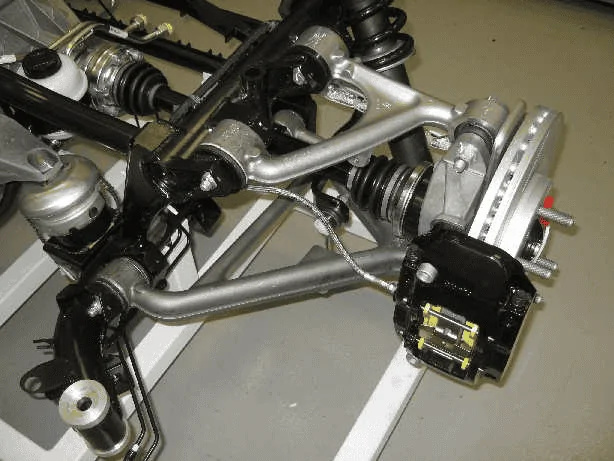
For a road car, I understand using big, stupid bushings. If the designer is clever on how they build those bushings, they can make the compliances do some pretty neat things. I don't see much evidence of that here, unfortunately. To your point, there are way better designs. This is off the last generation of Aston Martin Vantage V8. Why not something like this? It would have made our lives easier.

Aston's base GT4 car had poly bushings at each of these suspension points. The spherical upgrade was an expensive upgrade that was only worthwhile if you were really at the pointy end of the stick. It's much easier to pull off with this layout, though, than ours, because all the motion is planar.

1599613690825.webp
 

SAY WHAT

Well-Known Member
Joined
Jan 29, 2019
Threads
13
Messages
308
Reaction score
145
Location
Maryland
First Name
Tim
Vehicle(s)
2016 mustang Gt
@SAY WHAT hey Tim did you get these fitted up?
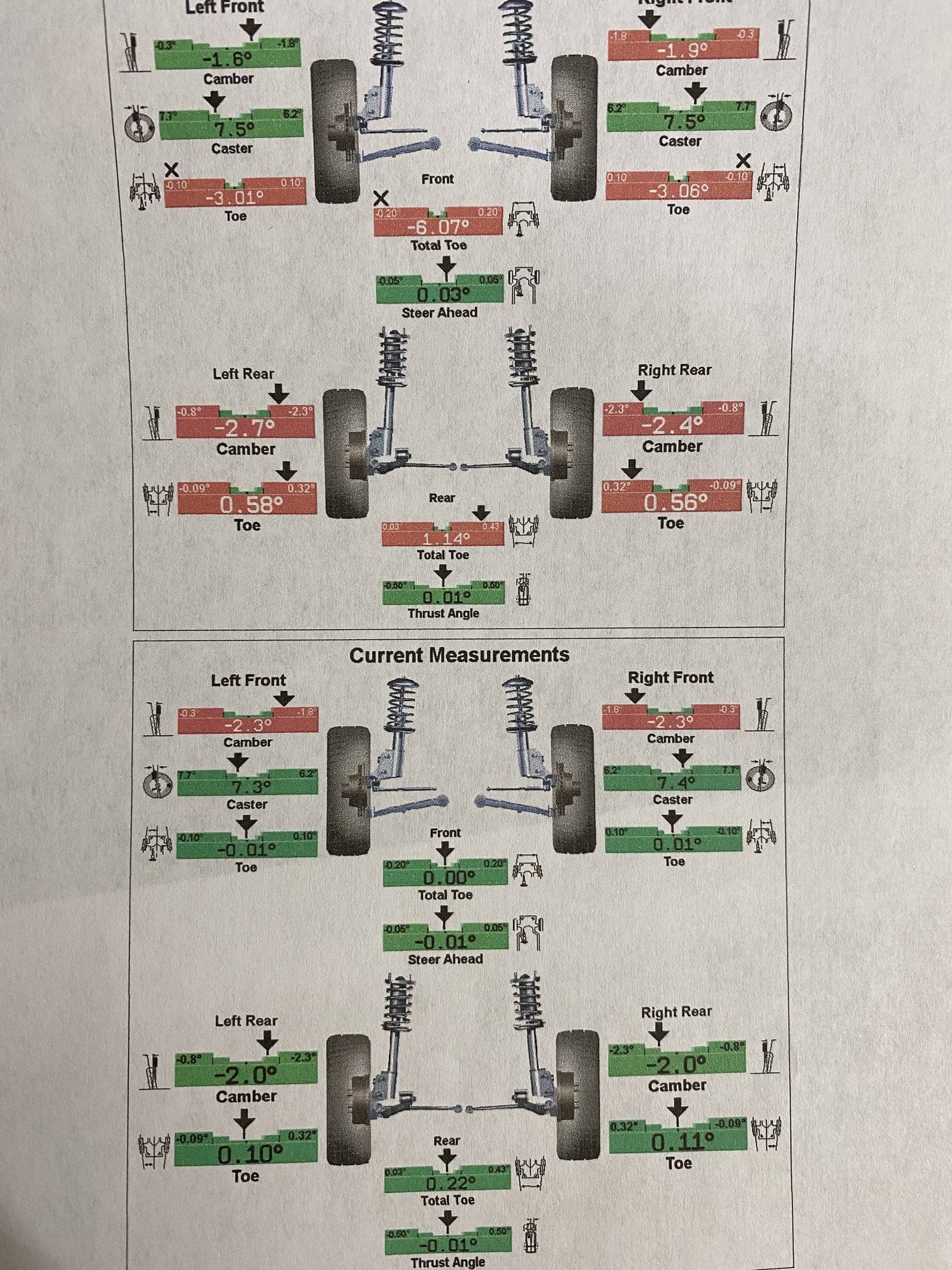
Yep, I had most of the weekend to drive it. I changed a lot on the car but overall I am happy with it. That being said I don't really know what to look for but the rear did seem to articulate more than before the super pro bushing was installed.

The car is definitely more composed while taking turns at speed. I'll need more time to evaluate.
Things I had done
  • Camber plates
  • J&M bearing on the tension link
  • steeda extended ball joint on the lateral link
  • cb005
  • bmr irs alignment kit
  • bmr adjustable camber links
  • bmr camber lockout
  • Super pro bushing
Here is a picture of my alignment. I mostly went with this aggressive alignment in anticipation of a track cross coming up in November. Ill most likely switch back to a street alignment at some point.


F205E430-6D0B-4530-A543-9F35E7EA19F6.jpeg
 
Last edited:

Bluemustang

Well-Known Member
Joined
Nov 6, 2015
Threads
151
Messages
3,969
Reaction score
2,348
Location
Maryland
First Name
Ryan
Vehicle(s)
2015 Mustang Base GT
^ That's a fantastic alignment sheet.
 

Sponsored

fatbillybob

Well-Known Member
Joined
Apr 1, 2017
Threads
43
Messages
554
Reaction score
273
Location
SoCal
Vehicle(s)
'19 GT pp1 A10 Orange
Wow! Away one day and this trhead got interesting with civil discourse. Rare! My comments are yes sphericals all the way when you can. Rules change the game and create limitations. Racing is maximizing advantages and minimizing disadvantages. There are no absolutes regardless of how many years you have in the sport. Decades in the sport can lead you down certain pathways but just as you win with your path someone else is winning with theirs. Tee's point about stresses is unquestioned. When we develop one part we often find the next weak link. Brian is right suspension is a beancounters' dream. What else could it be? No designer would do that. I give Ford engineers the benfit of a doubt that they truely are capable of engineering a good car. I blame the results on the S550 on beancounters. I'm pretty convinced this is my last Ford product. I'm pretty sure Ford deserves its near penny stock price.
 

Brian@BMVK

Well-Known Member
Joined
Apr 27, 2020
Threads
7
Messages
951
Reaction score
973
Location
Illinois
Vehicle(s)
2015 GT - Sold
I'm just kicking ideas around with a couple bright guys who are somehow as nerdy about this shit as I am. We're good.

I don't know who the primary designer of this suspension was, but it's the same basic package that was on the SN95 Cobras 20 years ago, so that guy is probably living on a Florida golf course somewhere enjoying his retirement. It appears he was kind of in love with the whole virtual ball-joint thing front and rear. I haven't dug into the numbers at all on this thing at all. Sometimes it's fun to just be a hot-rodder.

For a road car, I understand using big, stupid bushings. If the designer is clever on how they build those bushings, they can make the compliances do some pretty neat things. I don't see much evidence of that here, unfortunately. To your point, there are way better designs. This is off the last generation of Aston Martin Vantage V8. Why not something like this? It would have made our lives easier.

Aston's base GT4 car had poly bushings at each of these suspension points. The spherical upgrade was an expensive upgrade that was only worthwhile if you were really at the pointy end of the stick. It's much easier to pull off with this layout, though, than ours, because all the motion is planar.

1599613690825.webp
Yeah you know why all the car pundits say that the Camaro Alpha chassis is so much better? It's nothing to do with the front...those are nearly identical conceptually. The GM multilink is far superior from the perspective of balancing road manners, longevity and performance. No joints forced off axis. Smaller voids. A subframe that has a lot less movement. Once you've fixed a lot of this on the S550, it becomes apparent how much the performance and subjective handling gap is closed.

So @SAY WHAT , review of the Superpro bushing? I'm honestly tempted to try it.
 

SAY WHAT

Well-Known Member
Joined
Jan 29, 2019
Threads
13
Messages
308
Reaction score
145
Location
Maryland
First Name
Tim
Vehicle(s)
2016 mustang Gt
So @SAY WHAT , review of the Superpro bushing? I'm honestly tempted to try it.
I'm loving it so far. Id ask Ryan what he thinks since he drove it already. You guys definitely know more than me, so I don't think I can say much else. After some time evaluating the car I may add the bmr shock mount's and change the springs and sway bars. Its like driving and new car :rockon:
 

TeeLew

Banned
Banned
Banned
Joined
Apr 27, 2020
Threads
15
Messages
3,396
Reaction score
2,609
Location
So Cal
First Name
Tim
Vehicle(s)
Honda Odyssey, Toyota Tacoma, 89 GT project, 2020 Magnetic EB HPP w/ 6M
The GT4 version of the car has been relatively successful in racing. The Camaro hasn't had much team consistency, but they're always very quick.

I bet the difference isn't that big from behind the wheel. At least it's not on the watch.


Top