Forestlump
Well-Known Member
You're the one that said we aren't talking about doing 10 pulls back to back. I was just agreeing. I've logged 3 and saw minimal temp rise, but never 10.
It all depends on how the tune is set up. You can run a lot of boost on pump gas as long as the timing is well controlled. Most tuners take the lazy way out and just let it ride a hard limit regardless of load, mapped point, lambda, and even charge temp. If you account for all those plus humidity, you can run a lot more than 8 or 10 psi safely. I'd seen as much as 19 deg timing even at 14 psi boost and 21 deg at 11 psi with zero knock when the conditions were right.
Well under 5 deg rise on these short pulls we're talking about. And I have plenty of datasets from plenty of cars. It simply blows my mind how highly you regard the word-of-mouth qualitative anecdotes that supports your view, while attempting to pick apart detailed data that doesn't. Confirmation bias it is. I was quite surprised by my data as well because of all I had heard and assumed, which is why I went to the lengths I did to test the sensor and transfer function. You can also imagine I was surprised when I first saw data from a centrif setup that showed a rapid temp rise, again because it went against all that is said.
But alas, you have several folks participating in this thread who have owned or even tuned all varieties and they're telling you the same thing I am. When you get actual data and review a couple thousand logs, you start to see patterns.
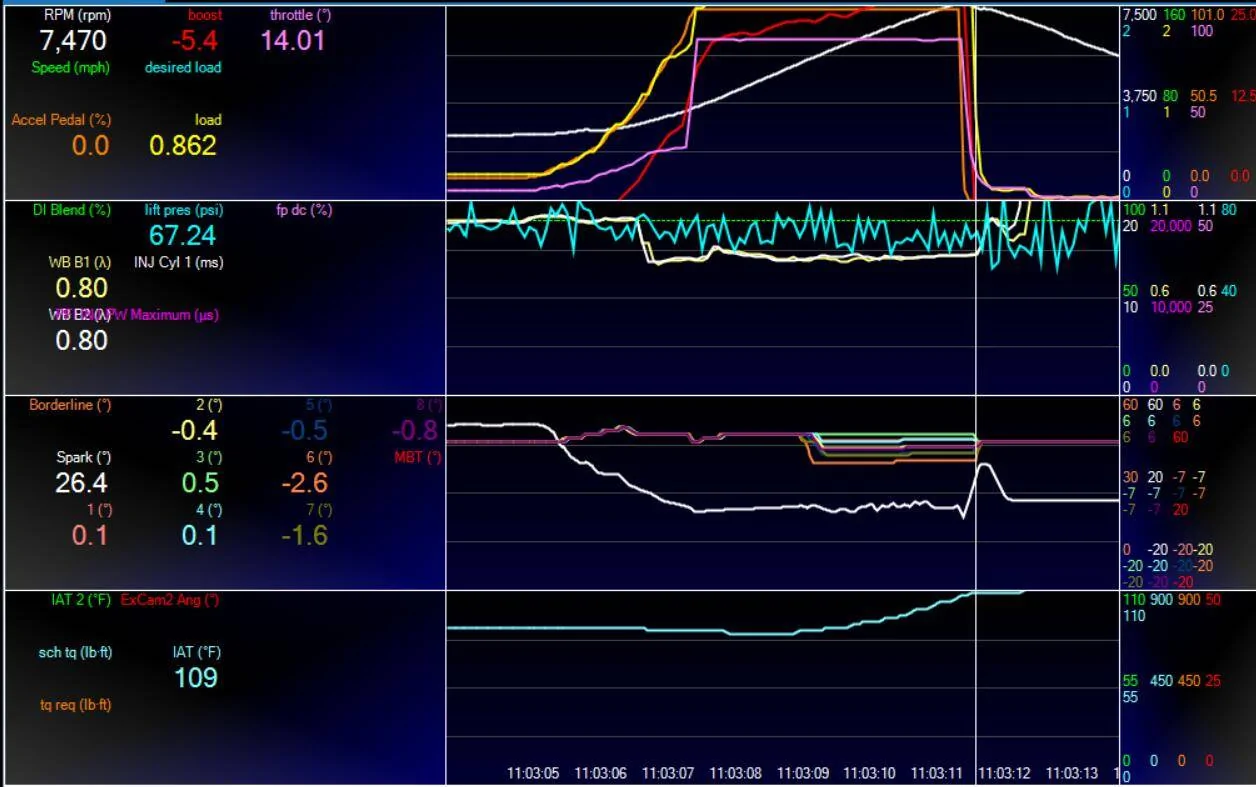
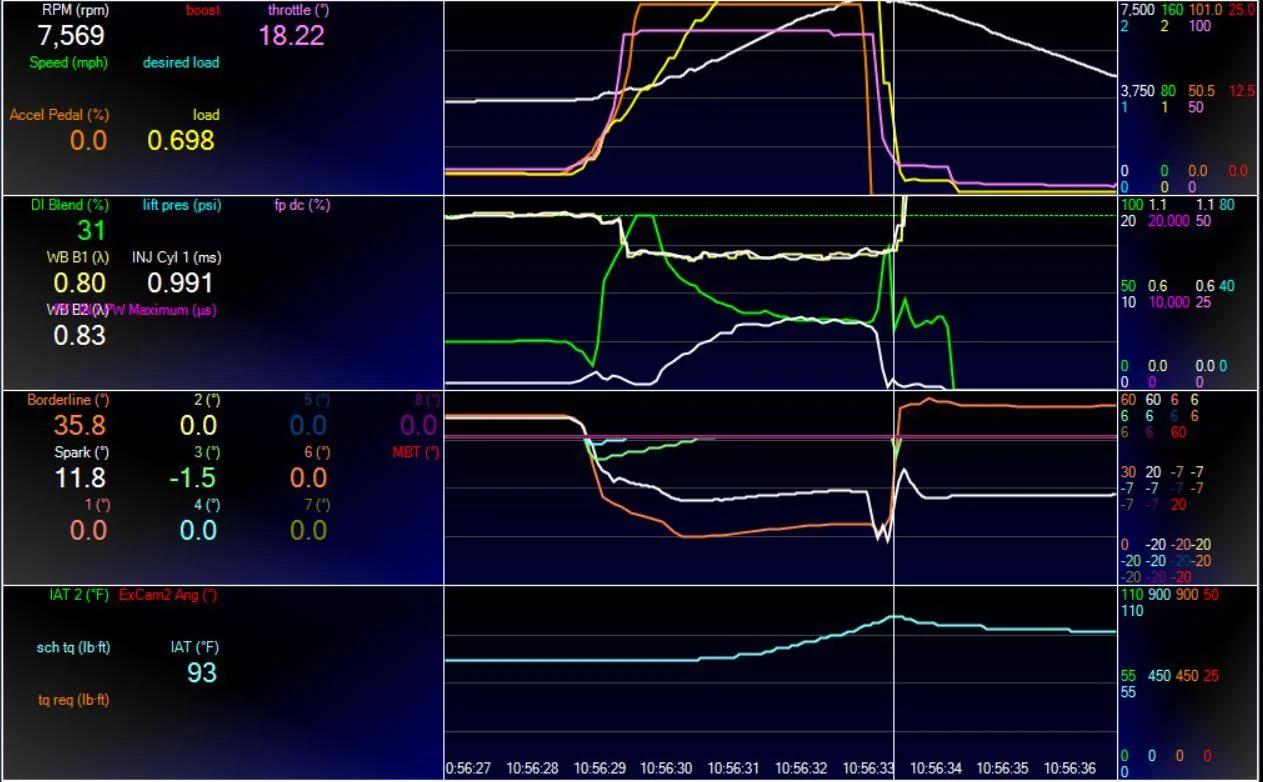
Just for fun at higher boost levels, and these are cars I've tuned:
For transparency, this is very over-spun VMP Odin, running literally off the compressor map at around 23 psi boost and 60% efficiency, with the single-pass non-counter-flow intercooler (better than Roush but not as good as Whipple). This is what happens when you push a PD too far. Temp rise during the pull was about 23 deg.

This is a Hellion running 21-22 psi boost, 25 deg rise during the pull:

And this is a Whipple 3.8, dual-pass counter-flow intercooler, also around 22 psi boost. Temp rise was about 6 deg.

The ambient temp was the coldest for the Hellion (winter dyno), warmer for the VMP (spring), and hottest for the Whipple 3.8 (early summer).
Lots of people stuck in the old mind-set of yesteryear. I see it all the time. And I don't discount the centrif. It has its advantages...just not the ones you think.
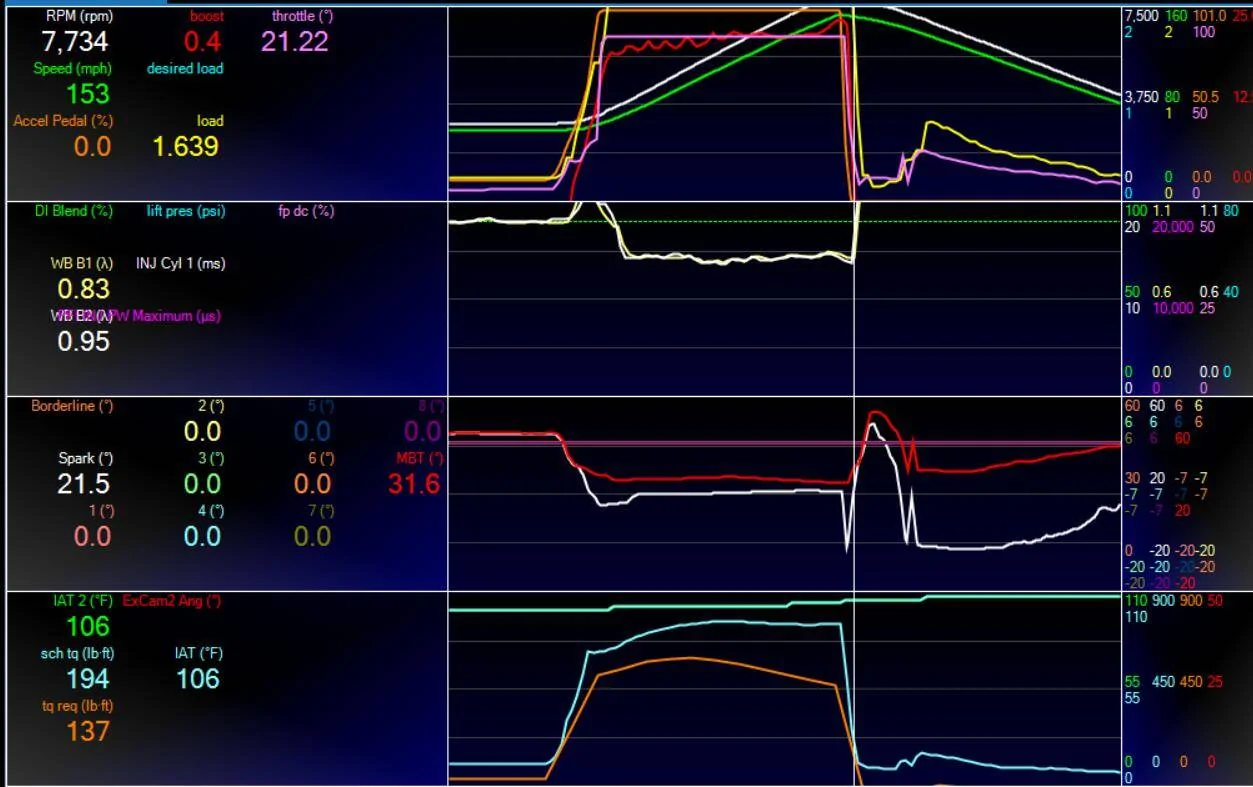
Yes you are right about noticing the patterns, they are different. The whipple does have an almost minute rise, you didn't believe this yourself when you saw it and that led you to investigate by testing the Mapt accuracy. However, that convinced you to believe something untrustworthy.
Like if I put my iat sensor hidden at the back of my manifold, surrounded by a heatsink and cooled by the water cooler, it would also make it numb and skew the readings. It will give a higher reading off boost but also a lower reading in a wot pull. It's working like a capacitor in electronics or an accumulator in hydraulics and smoothing out the signal, which you are reading wrong and believing the data from it to be truthful of what's happening.
That location will make it rise and fall slower compared to the Maf which is reacting much faster. We are talking about a few seconds of heating, the Mapt and it's location is buffered by the aluminium all around it.
You also have to remember that the more the air flow increases through the pull, the less time the boost is sat in contact with the cooler and the more heat is being generated by the supercharger, so you get less and less cooling effect. The speed at which the cooler can conduct heat from the charge is determined by the temperature difference between the boost and coolant (delta T) and the time it's in contact with the cooling fins, which is why you have killer chillers to increase the delta T and make the energy transfer faster, increasing cooling effect.
Heat will only lose energy to something colder. Once you move towards temperature parity, there's no more transfer of heat, no matter how long the boost touches the cooler and at wot 4krpm+ we are talking milliseconds. I know your data says otherwise but you are being fooled by it. It's impossible to cool the boost that fast with such a small cooler and so little delta T. It defies physics. I know your data says different but it's wrong because of how it's being collected.
The only way to have reliable data from the whipple setup is to have a sensor in the intake runner, but noone will want that so if it was me I'd put a coolant temp sensor at the hot side of the whipple coolant pipe (exactly like a boiler or the engines own coolant sensor). It's impossible to have a boost temperature lower than the temperature of the hottest water leaving to cooler.
(think coolant temp Vs cylinder head temp, the coolant is always cooler than the cylinder head it's cooling, to be the other way around defies physics as you go above 100% efficiency and Einstein won't let that happen.)
I know it won't show in real time the temperature rise from a wot pull, but it will give you a better idea of what's happening.
It was a few days ago but there was a thread on here about insulating the whipple from the cylinder heads with a thermal gasket, and another thread about the whipples slow reacting Mapt not giving reliable data, all backing up what's going on here.
There's no doubt Whipple have made great advancements with the gen 5 and the counter flow cooler and the rotor design against the competition but it still has to behave in the realms of physics, it's still working on the principle of a spur gear pump and they can never be 100% efficient because they leak from high side to low. That's why they get worse with higher and higher pressures, the leak gets more and more. It's not an attack on you or the brand, it's physics.
Sponsored
Last edited: