AlmostFamous
Well-Known Member
So you save $200 a year? :shrug:I noticed no difference when running 87 v 93 octane in mine. I like the cost savings, so I run 87octane 99.9% of the time. As stated above, the manual says 87 octane.
Sponsored

So you save $200 a year? :shrug:I noticed no difference when running 87 v 93 octane in mine. I like the cost savings, so I run 87octane 99.9% of the time. As stated above, the manual says 87 octane.

I personally save over $350. Some people act like saving money is a bad thing.So you save $200 a year? :shrug:

Even if you do a dyno with both octane ratings. The results will be disregarded. Just like with the CAI debate. I posted a before and after in a CAI thread and because the runs weren't done at the exact same time. (They were done with in 1.5 hours of taking the air box off and putting the CAI on)! still no buano the doubters said. Or you'll get the dyno has an margin of error argument. So even if you get a 5hp gain. To the doubters. It's just margin of error. :doh: The doubters will want you to make 100 dyno pulls and then take an average. Who has the time and money for that nonsense???Why bother using a dyno at all? If you refuse to believe the results?"Modern engines not only don’t need lead but have sophisticated antiknock technologies that sense a fuel’s octane rating and adjust their ignition timing to prevent damage."
So I guess that adjusting timing will NOT affect HP ???
This thread is really just based on every ones PERSONAL opinion...and to each their own...some post they do not feel a difference when going from 87 to 93 but I highly doubt that the awesome butt dyno they have can tell the difference of +/- 5 HP...this debate will rage on until some one actually does a thorough test on a dyno to justify the difference, until then we are all beating a dead horse.....
guess if I read this on the internet it MUST be TRUE.... lol lol
I'm all for money savings, but in this case, it's a pretty weak argument in relation to the type of vehicle we own and how much our vehicles cost imo. If money savings from gas was that big of an issue, I would have bought a Honda Civic.I personally save over $350. Some people act like saving money is a bad thing.
You do realize the price of the mustang is on par with the average new auto across the country don't you? This is not a super car priced vehicle, or even a corvette priced vehicle.I'm all for money savings, but in this case, it's a pretty weak argument in relation to the type of vehicle we own and how much our vehicles cost imo. If money savings from gas was that big of an issue, I would have bought a Honda Civic.

So you save $200 a year? :shrug:
Not saying saving is bad but $300 a year in the general scheme of things of owning a Mustang is pretty much nothing if you consider insurance, cost, and interest if you have a car loan.I personally save over $350. Some people act like saving money is a bad thing.
That covers half of my insurance for the year. It covers 4 lunches per month, or half of my internet bill. Money that you save adds up. While it may seem insignificant on its own, in the grand scheme it is most certainly not. I myself would love to have a vacation home on the breach when I retire.Not saying saving is bad but $300 a year in the general scheme of things of owning a Mustang is pretty much nothing if you consider insurance, cost, and interest if you have a car loan.
I have no problems with you using 87 octane and I wouldn't argue against you if that's your choice, but telling others it's a great money saving financial decision is an extremely weak argument.There really isn't any argument here. 93 octane will not make your engine live longer and will not give you any appreciable performance difference on the road. I myself don't understand why people don't want to save money, but to each their own. It's funny, if this was a $100k vehicle it wouldn't change my mind.

Yes sir....you are correct, that's why I feel this conversation is done..:lol:Even if you do a dyno with both octane ratings. The results will be disregarded. Just like with the CAI debate. I posted a before and after in a CAI thread and because the runs weren't done at the exact same time. (They were done with in 1.5 hours of taking the air box off and putting the CAI on)! still no buano the doubters said. Or you'll get the dyno has an margin of error argument. So even if you get a 5hp gain. To the doubters. It's just margin of error. :doh: The doubters will want you to make 100 dyno pulls and then take an average. Who has the time and money for that nonsense???Why bother using a dyno at all? If you refuse to believe the results?

Hold on! $600/yr... $50/mo. for a '16 mustang GT!? :eyebulge:That covers half of my insurance for the year. It covers 4 lunches per month, or half of my internet bill. Money that you save adds up. While it may seem insignificant on its own, in the grand scheme it is most certainly not. I myself would love to have a vacation home on the breach when I retire.
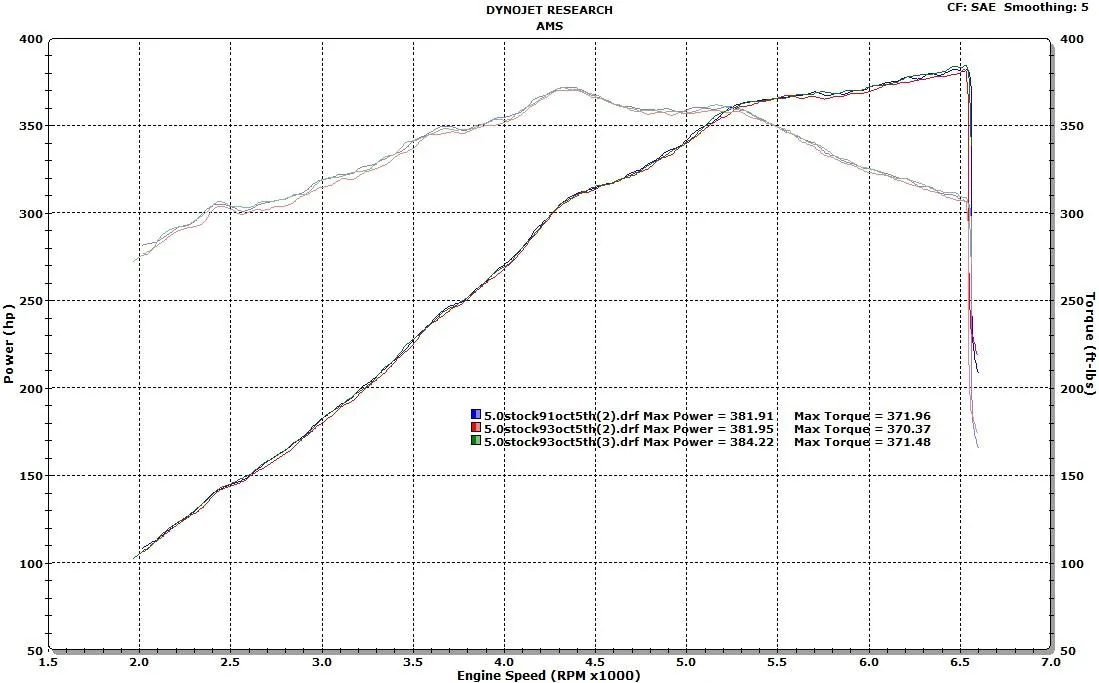
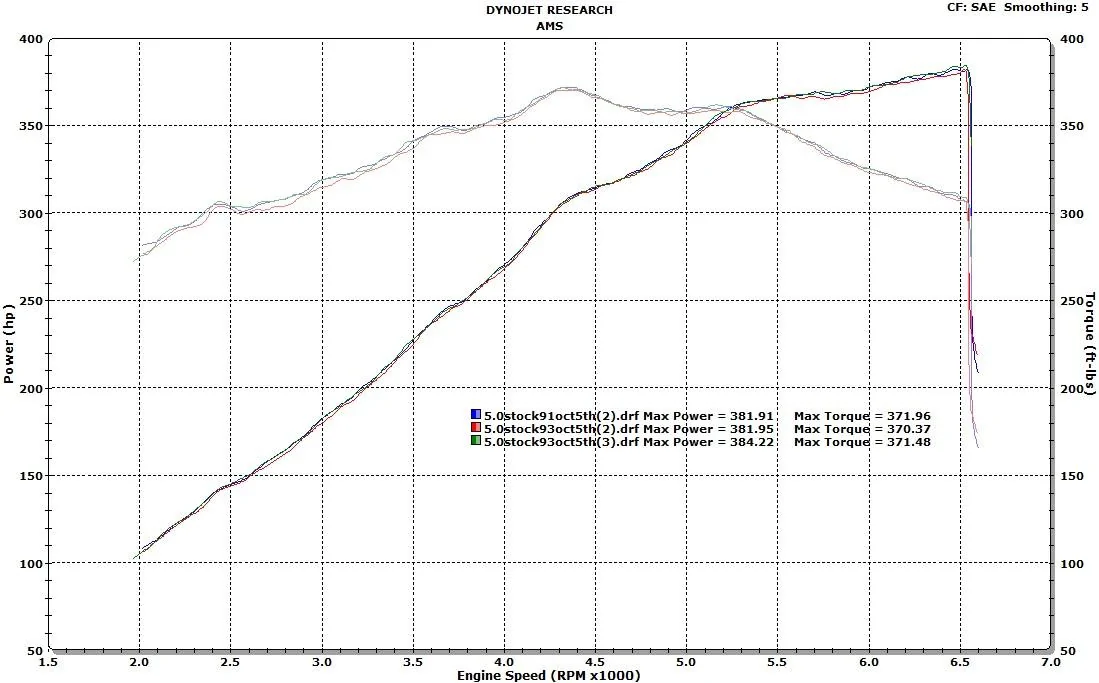
First two runs the car made essentially NO more power.
Then on the third and final run it made like 3 rwhp more and 0 rwtq more than the two best 91 octane runs.
They probably put in the ability to adjust up to 91.5-92 on the high rpm range which gives it a couple extra hp but no additional torque.
I think we can safely say using 93 octane instead of 91 octane gains you 3-4 hp up in the higher rpms for a bit, but as you can see it's not sustained over a large rpm range. So it just may be an anomaly that it made the additional 3 rwhp at the peak.
So 91 octane state people don't need to feel bad, without a tune, guys in 93 octane states aren't getting really any more power out of their stock 5.0's
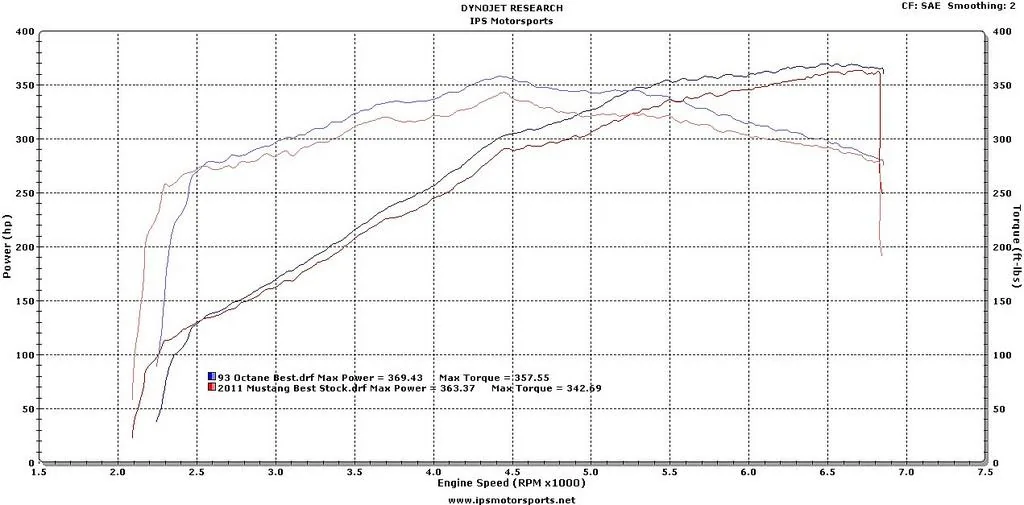
87 vs 93 Octane Dyno Graph
Below is a dyno graph showing the difference between 87 octane and 93 octane. According to the shop, no other changes were made to the car/tune/etc. Similar weather for both passes, car at normal operating temperatures.
Note: 6 RWHP peak difference. Not that much, but look at the difference in the mid range, especially 4500-6000 rpm. Looks to be ~20 RWHP difference in places (corresponding increase in torque, of course).
In Texas, there's only .15 to .20 difference at many gas stations. I'm sure in New York or California, there's a much bigger difference.It's very simple math. Premium is about 50 cents more per gallon on average right now.
The tank is 16 gallons so say you put 14 in. That's $7 per fill up.
The math is simple, one tank per week is 52 times $7 or $364 saved per year. BUT that is 1 tank per week, some people drive more/further for work etc.
2 tanks a week is now nearly $800 saved per year. Insignificant? No. Not unless you are personally passing out $800 to the people you are bashing on as a yearly stipend to them.
Here in South FL it's 50. Im sure it varies lower and higher than 50.In Texas, there's only .15 to .20 difference at many gas stations. I'm sure in New York or California, there's a much bigger difference.