Sponsored

Help about 5w-20, 5w-30, 5w-40 and 5w-50 oil

robvas

Well-Known Member
Joined
Nov 18, 2023
Threads
16
Messages
3,579
Reaction score
3,385
Location
MI
Vehicle(s)
2011 GT
Hello; My take has been the opposite. The multi weight (viscosity) oils are thin when cold and additives cause the oil to thicken when hot. This is the opposite of what happens naturally to oils. A sort or petrochemical "magic". The idea, as I understand it, is to have a less viscous oil (thinner)at start up. The oil flows easier and the engine turns over better.
Then the additives increase viscosity with heat.

About time for some sort of link to clear this up.
Just look at a viscosity chart. or, drain some hot oil out of your car and see how much thinner it is :)

"30 weight" at 100 degrees celsius is a way, way, thinner weight than "30 weight" at the cooler temperature (where the first number is from, 0W, 5W, etc).

cSt = centistokes
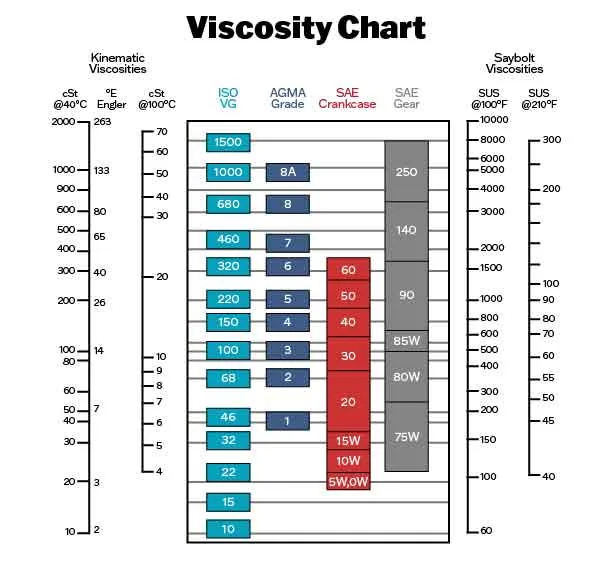
Lube-School-Infographics-02.webp
Sponsored


sk47

Well-Known Member
Joined
Nov 12, 2020
Threads
32
Messages
6,859
Reaction score
3,191
Location
North Eastern TN
First Name
Jeff
Vehicle(s)
Chevy Silverado & Nissan Sentra SE
What Is Multi-Viscosity Oil and How Does It Work? - Engineer Fix

Hello; The link seems to me to support my contention of multi viscosity oil actions. Thinner when cold and getting thicker when warm and hot.

Untreated oil such as the old straight 30 weight do as you say. Start out thick and get thinner as it warms up. I am old enough to have had experience with straight 30 weight. Go out on a cold winter morning and the starter would struggle to turn the engine over. Same for the old gear oils in a manual trans.

You did catch me in a post a few posts back. As mentioned in the link the warm/hot viscosity number is not exact. So, I was not spot on when I said 0-w-20 weight oil thickens to 20 weight. The link points out the 20 number reflects a thickening tendency. (I may be misquoting so read the link.)

Life with 5-w-30 weight oil is so very much easier than with straight 30 weight. Life is even better than the 10-w-30 I ran for a few decades. 5-w-30 does better on a below zero F morning than 10-w-30.
 

robvas

Well-Known Member
Joined
Nov 18, 2023
Threads
16
Messages
3,579
Reaction score
3,385
Location
MI
Vehicle(s)
2011 GT
What Is Multi-Viscosity Oil and How Does It Work? - Engineer Fix

Hello; The link seems to me to support my contention of multi viscosity oil actions. Thinner when cold and getting thicker when warm and hot.

Untreated oil such as the old straight 30 weight do as you say. Start out thick and get thinner as it warms up. I am old enough to have had experience with straight 30 weight. Go out on a cold winter morning and the starter would struggle to turn the engine over. Same for the old gear oils in a manual trans.

You did catch me in a post a few posts back. As mentioned in the link the warm/hot viscosity number is not exact. So, I was not spot on when I said 0-w-20 weight oil thickens to 20 weight. The link points out the 20 number reflects a thickening tendency. (I may be misquoting so read the link.)

Life with 5-w-30 weight oil is so very much easier than with straight 30 weight. Life is even better than the 10-w-30 I ran for a few decades. 5-w-30 does better on a below zero F morning than 10-w-30.
From your link:

It is a common misconception that the two numbers are directly proportional or that they represent the same unit of measure. In reality, they are two separate, standardized performance metrics ensuring the oil meets minimum requirements for both cold flow and hot film strength.

The base oil alone would thin excessively when heated, failing the 30-weight test.

To counteract this thinning, specialized polymer additives known as Viscosity Index Improvers (VIIs) are blended into the base oil.


Like I said, check how how much thinner hot oil is when you drain it out compared to 'cold' oil from the bottle on your shelf. The oil is never 'thicker' than when it's cold.

The additives make the oil thicker at 100 degrees than it would be without them, but it's still way, way thinner than it is when it's cold.
 

sk47

Well-Known Member
Joined
Nov 12, 2020
Threads
32
Messages
6,859
Reaction score
3,191
Location
North Eastern TN
First Name
Jeff
Vehicle(s)
Chevy Silverado & Nissan Sentra SE
From your link:

It is a common misconception that the two numbers are directly proportional or that they represent the same unit of measure. In reality, they are two separate, standardized performance metrics ensuring the oil meets minimum requirements for both cold flow and hot film strength.

The base oil alone would thin excessively when heated, failing the 30-weight test.

To counteract this thinning, specialized polymer additives known as Viscosity Index Improvers (VIIs) are blended into the base oil.


Like I said, check how how much thinner hot oil is when you drain it out compared to 'cold' oil from the bottle on your shelf. The oil is never 'thicker' than when it's cold.

The additives make the oil thicker at 100 degrees than it would be without them, but it's still way, way thinner than it is when it's cold.
Hello; We are discussing two different things it appears. You are saying the oil being poured out of a bottle is "thicker" than the oil being drained from a hot engine during an oil change. Such is correct.
The thickening of an oil film when hot is the action of the polymer additives. The idea is to have a stable oil film at high operating temperatures. This is the oils' ability to keep the metal parts from touching during operation. In the old days a straight 30 weight had to be much "thicker" (more viscous) when cold so that when at operating temp it maintained a protective oil film rated at 30 weight. We are talking semantics of words. My summary- in 5 w-30 the 30 is an approximation of the oil film strength to prevent metal to metal touching when hot.
I will try to be more careful with the language but even the person writing the link resorted to using the word "thickening"

From the link I provided
"The second number, appearing after the hyphen, quantifies the oil’s viscosity at the standard high operating temperature of 100°C (212°F). This is the hot viscosity grade, representing the oil’s ability to maintain a protective film under normal running conditions. An oil rated as 30 will maintain a lower viscosity at 100°C than an oil rated as 40, which is a thicker fluid designed for higher shear forces and heat loads."


The ability for a single oil to satisfy both the low-viscosity cold requirement and the higher-viscosity hot requirement is accomplished through sophisticated chemical engineering. Multi-viscosity oils begin with a base stock that naturally possesses a low viscosity, often comparable to the cold-rated number (e.g., a 5W-30 starts near a 5-weight base). The base oil alone would thin excessively when heated, failing the 30-weight test.

"To counteract this thinning, specialized polymer additives known as Viscosity Index Improvers (VIIs) are blended into the base oil. These VII molecules are long, coiled hydrocarbon chains that react dynamically to temperature changes within the engine sump. When the oil is cold, the VII molecules remain tightly coiled, having minimal impact on the fluid’s resistance to flow."

"This coiled state allows the oil to maintain the low-viscosity flow characteristics necessary for rapid lubrication during a cold start, satisfying the ‘W’ rating. As the engine temperature rises, heat energy causes these polymer chains to uncoil and expand significantly. The expanded polymers increase the oil’s internal friction, effectively thickening the fluid."

"This thickening action works to offset the natural tendency of the base oil to thin out as it gets hot. The result is a fluid that resists excessive thinning, maintaining a stable viscosity that corresponds to the required higher rating (e.g., the 30-weight). The effectiveness of the VIIs allows the oil to bridge a large temperature gap while maintaining performance specifications."
 

Sponsored

horsepower addiction

Well-Known Member
Joined
Jan 30, 2023
Threads
14
Messages
304
Reaction score
104
Location
Arizona
First Name
Nate
Vehicle(s)
s550
It doesn't thicken, it just doesn't thin as much
This is correct.
The 5w30 starts out as a 5 weight. A 5 weight cold is thicker than a 30 weight warm. So it’s as thick as a 5 weight oil at start up and thins out to the same thickness as a 30 weight would be when it is warm. Still gets thinner though. If a 5 weight got thicker as it warmed up it would end up being a 100 weight oil when warm. The point of a 5 or 0 weight oil is so it is thin enough to get in and protect the bearings asap. If the oil got thicker when warm then it would not be able to get in the tight tolerance to protect the bearings
 

HKusp

Well-Known Member
Joined
Jul 22, 2021
Threads
37
Messages
2,251
Reaction score
2,886
Location
Hampton, Md.
First Name
Jason
Vehicle(s)
2018 Mustang GT
Hello; Afraid I cannot buy into this statement.
Simply put the 5 weight is a standard oil viscosity (the ability to hold a shape and resist thinning out when poured out of a container) measurement at a pre-set cold temperature. Oil does NOT thicken as it warms up despite any packages. The 30 weight is a standard measurement at a certain high temperature and will ABSOLUTELY be thinner when warm every 30 weight marked oil will have the same viscosity when new and warm when compared to other oils with the same weight, as will every 40 weight, every 50 weight, etc.

Don't believe me put some in the fridge for a couple of hours and try and pour it out, then pour some in a pan on the stove and heat it up to 200 degrees F and try and pour it out. It will be MUCH easier to pour at 200 degrees F, than it will at 35 degrees F, I promise you. The 30/40/50, is basically the oil acts as any other oil rated at that same temperature and weight 30 to 30 weight, 40 to 40 weight, 50 to 50 weight when compared to each other at that warm temperature. They will ALL be thicker when at 35 degrees F than at 200 degrees.
 

sk47

Well-Known Member
Joined
Nov 12, 2020
Threads
32
Messages
6,859
Reaction score
3,191
Location
North Eastern TN
First Name
Jeff
Vehicle(s)
Chevy Silverado & Nissan Sentra SE
This is correct.
The 5w30 starts out as a 5 weight. A 5 weight cold is thicker than a 30 weight warm. So it’s as thick as a 5 weight oil at start up and thins out to the same thickness as a 30 weight would be when it is warm. Still gets thinner though. If a 5 weight got thicker as it warmed up it would end up being a 100 weight oil when warm. The point of a 5 or 0 weight oil is so it is thin enough to get in and protect the bearings asap. If the oil got thicker when warm then it would not be able to get in the tight tolerance to protect the bearings
Hello; Read the link again. Says the base oil stock starts out at near a 5 W (winter) which flows good at the low temperature that rating is tested at. Continues to say if you used only the 5W base oil it would become too thin with engine heat to provide a film and prevent metal to metal contact. The various surfaces which need a substantial film would touch.
Multi-viscosity oils begin with a base stock that naturally possesses a low viscosity, often comparable to the cold-rated number (e.g., a 5W-30 starts near a 5-weight base). The base oil alone would thin excessively when heated, failing the 30-weight test.
Additives are in the oil which change as the oil base heats up the additives.
counteract this thinning, specialized polymer additives known as Viscosity Index Improvers (VIIs) are blended into the base oil. These VII molecules are long, coiled hydrocarbon chains that react dynamically to temperature changes within the engine sump. When the oil is cold, the VII molecules remain tightly coiled, having minimal impact on the fluid’s resistance to flow."
"This thickening action works to offset the natural tendency of the base oil to thin out as it gets hot. The result is a fluid that resists excessive thinning, maintaining a stable viscosity that corresponds to the required higher rating (e.g., the 30-weight). The effectiveness of the VIIs allows the oil to bridge a large temperature gap while maintaining performance specifications."
Hello; Again, there are two different things happening with the oil & additives. I made a technical wording mistake back several posts with generic language about 5W-30 weight oils function. The base oil is thin enough flow well at cold temperatures.
The additives allow the mixture along with the base oil to work as at 212 F much like straight 30 weight would at 212 F without having to start at freezing temperatures with straight 30 weight oil which is thick like molasses.
 

Sponsored

horsepower addiction

Well-Known Member
Joined
Jan 30, 2023
Threads
14
Messages
304
Reaction score
104
Location
Arizona
First Name
Nate
Vehicle(s)
s550
Hello; Read the link again. Says the base oil stock starts out at near a 5 W (winter) which flows good at the low temperature that rating is tested at. Continues to say if you used only the 5W base oil it would become too thin with engine heat to provide a film and prevent metal to metal contact. The various surfaces which need a substantial film would touch.


Additives are in the oil which change as the oil base heats up the additives.


Hello; Again, there are two different things happening with the oil & additives. I made a technical wording mistake back several posts with generic language about 5W-30 weight oils function. The base oil is thin enough flow well at cold temperatures.
The additives allow the mixture along with the base oil to work as at 212 F much like straight 30 weight would at 212 F without having to start at freezing temperatures with straight 30 weight oil which is thick like molasses.
Correct
 

falcongtho3

Well-Known Member
Joined
Dec 15, 2013
Threads
16
Messages
555
Reaction score
356
Location
La.
Vehicle(s)
2003 Mach 1 ; 2013 Boss 302
Interestingly GM has an issue with their V8s in their SUV and truck line. If you bring it in and have it inspected and it doesn't require replacement then they change the oil cap and recommendations...from 0W20 to 0W40!!!
 

GregO

Well-Known Member
Joined
Mar 5, 2018
Threads
41
Messages
3,345
Reaction score
2,483
Location
Illinois
Vehicle(s)
S550 GTPP
Interestingly GM has an issue with their V8s in their SUV and truck line. If you bring it in and have it inspected and it doesn't require replacement then they change the oil cap and recommendations...from 0W20 to 0W40!!!
Interesting
0W-40 has been spec’ed for the corvette for awhile, Mobil Supercar 0W-40 if i’m not mistaken approved for track and street.
 

Mustangpursuit

Well-Known Member
Joined
Jan 17, 2017
Threads
57
Messages
1,570
Reaction score
629
Location
California
Vehicle(s)
Mustang GT/CS 2019
Vehicle Showcase
1
5w-20 here for the past 8 years since new and no issues which asks for that and never went to the revised 5w-30 for later years. Per my dealer when inquiring about changing up, they just said stick with the factory spec 5w-20 and use full synthetic.
 

Hack

Well-Known Member
Joined
Nov 26, 2014
Threads
86
Messages
12,849
Reaction score
8,269
Location
Minneapolis
Vehicle(s)
Mustang, Challenger
Interestingly GM has an issue with their V8s in their SUV and truck line. If you bring it in and have it inspected and it doesn't require replacement then they change the oil cap and recommendations...from 0W20 to 0W40!!!
I was going to mention this. The pickups were losing main bearings quickly due to the 0W-20 not having enough film strength when the engine is warmed up. The Camaros and Corvettes GM recommended 0W-40 from the beginning, and they didn't have the high failure rate of main bearings. Same engine.

I run 5w 50 in the Mustang, but it's mostly due to some track use. I don't think it's needed for street driving.

Manufacturers recommended 5W 30 in most cases prior to all the CAFE madness. And they recommended more frequent oil changes. I believe those recommendations from the past were intended to maximize engine life. Current recommendations from manufacturers have different goals in my opinion.
Sponsored


Top