Sponsored

So what can a DW400 really do?

Angrey

Well-Known Member
Joined
Jun 21, 2020
Threads
104
Messages
2,794
Reaction score
2,984
Location
Coral Gables
Vehicle(s)
2016 GT350
I went to DeatschWerks’ website and found this today. Now I’ll have to do some digging to see what it can do and if there are any end users with feedback.

https://deatschwerks.com/products/9-401-604-7032
It's more of a pain in the ass, but you're better off building your own with a Radium bucket. The Radium bucket has a better hat (more provisions for 4 wire brushless and variable control setups) and the bucket itself has one way bladder valves which allow fuel in but not out. I don't see anything on the DW bucket other than over the top fill.

The internal plumbing isn't all that difficult (a little tedious, but certainly within most people's abilities).

And then again, the classic conundrum here is with triple pumps, do you run all 3 pumps full boogie on a return system? Do you run staged with a hobbs switch on a return system. Or do you run variable returnless with a dead head system? All have pros/cons and benefits and drawbacks.

I gave everyone the answers to the test a couple of years ago. A return style, brushless variable system that has all the benefits of immediate response in a return system but with near efficiencies and low power draw of a true variable returnless system.

Get a Radium Bucket, get a Fuelab electronic regulator, get either one DW440 and a booster of your choice. (or you can use the Fuelab brushless, but I saw some sorta issues with start delays, not sure if they were resolving those). A single boosted DW440 will support in the neighborhood of 1000rwhp intermittent boosting.

With the fuelab electronic regulator, you can repurpose the OE line as a return (no need for ginormous return size because it's not sending that much fuel back to the pumps).

That setup gives you the best fuel baffling on the market, runs low draw when cruising or off power and has the ability to flow when needed.

Best of all, you take the tuner OUT OF THE EQUATION. The tuner needs to only observe some logs to smooth out very minor inconsistencies with the injectors (as always) but as far as fuel delivery to the rails, the system provides an index referenced fuel flow and pressure, all the time. So if you want a net 55 psi at the rail, you simply set the base pressure and away you go.

No more running around with pumps all running crazy all the time or dealing with the risk of a hobbs switch failure. No worrying about dampening issues with a dead head or returnless setup on big power.

If I was gonna spend $2500+ on a fuel system, I'd do it the right way, the BEST way. Variable control from the regulator.

Lastly, if you REALLY want it great (but a little more complicated), then modify the passenger side hanger and eliminate the inconsistent and slow siphon system and put in a cheap, low (free flow) lift pump to constantly send fuel from the passenger side over to the active driver's side. Again, a little more complicated, but not beyond what most people are capable of doing. You dremel off some of the base of the pickup, you clamp a lift pump or two, you wire it and you either put it on a switch OR you can repurpose the level sender on that side as an auto on/off switch (so it automatically shuts off when the fuel level on that side is bottomed out).

No more holes in your primary feed side to bleed off to run the siphon and no more trickle flow from the passenger side back over (after a long spirited left turn).

That system is a stomp whenever, wherever at any fuel level, run the least amount of power and draw necessary at all times, remove the complexity from the tune system.
Sponsored

 

NGOT8R

Well-Known Member
Joined
Jul 19, 2020
Threads
153
Messages
9,229
Reaction score
7,705
Location
Florida
First Name
Adrian
Vehicle(s)
2019 Bullitt
It's more of a pain in the ass, but you're better off building your own with a Radium bucket. The Radium bucket has a better hat (more provisions for 4 wire brushless and variable control setups) and the bucket itself has one way bladder valves which allow fuel in but not out. I don't see anything on the DW bucket other than over the top fill.

The internal plumbing isn't all that difficult (a little tedious, but certainly within most people's abilities).

And then again, the classic conundrum here is with triple pumps, do you run all 3 pumps full boogie on a return system? Do you run staged with a hobbs switch on a return system. Or do you run variable returnless with a dead head system? All have pros/cons and benefits and drawbacks.

I gave everyone the answers to the test a couple of years ago. A return style, brushless variable system that has all the benefits of immediate response in a return system but with near efficiencies and low power draw of a true variable returnless system.

Get a Radium Bucket, get a Fuelab electronic regulator, get either one DW440 and a booster of your choice. (or you can use the Fuelab brushless, but I saw some sorta issues with start delays, not sure if they were resolving those). A single boosted DW440 will support in the neighborhood of 1000rwhp intermittent boosting.

With the fuelab electronic regulator, you can repurpose the OE line as a return (no need for ginormous return size because it's not sending that much fuel back to the pumps).

That setup gives you the best fuel baffling on the market, runs low draw when cruising or off power and has the ability to flow when needed.

Best of all, you take the tuner OUT OF THE EQUATION. The tuner needs to only observe some logs to smooth out very minor inconsistencies with the injectors (as always) but as far as fuel delivery to the rails, the system provides an index referenced fuel flow and pressure, all the time. So if you want a net 55 psi at the rail, you simply set the base pressure and away you go.

No more running around with pumps all running crazy all the time or dealing with the risk of a hobbs switch failure. No worrying about dampening issues with a dead head or returnless setup on big power.

If I was gonna spend $2500+ on a fuel system, I'd do it the right way, the BEST way. Variable control from the regulator.

Lastly, if you REALLY want it great (but a little more complicated), then modify the passenger side hanger and eliminate the inconsistent and slow siphon system and put in a cheap, low (free flow) lift pump to constantly send fuel from the passenger side over to the active driver's side. Again, a little more complicated, but not beyond what most people are capable of doing. You dremel off some of the base of the pickup, you clamp a lift pump or two, you wire it and you either put it on a switch OR you can repurpose the level sender on that side as an auto on/off switch (so it automatically shuts off when the fuel level on that side is bottomed out).

No more holes in your primary feed side to bleed off to run the siphon and no more trickle flow from the passenger side back over (after a long spirited left turn).

That system is a stomp whenever, wherever at any fuel level, run the least amount of power and draw necessary at all times, remove the complexity from the tune system.
Very detailed info here! I will research this more in-depth. Thanks!
 

NGOT8R

Well-Known Member
Joined
Jul 19, 2020
Threads
153
Messages
9,229
Reaction score
7,705
Location
Florida
First Name
Adrian
Vehicle(s)
2019 Bullitt
I believe that is a new offering from them. I have an Arcane fuel system in my car from Juggernaut and see they now offer the DeatschWerks X3 setup for their triple pump system. They used a Fore hat previously: https://juggernautpower.com/collect...-pump-15-24-mustang-gt?variant=43380321484982

A good option for big power, although I believe you were initially looking for a returnless type setup.
I would prefer to stay returnless if possible, but will go return if I have to.
 

NGOT8R

Well-Known Member
Joined
Jul 19, 2020
Threads
153
Messages
9,229
Reaction score
7,705
Location
Florida
First Name
Adrian
Vehicle(s)
2019 Bullitt
It's more of a pain in the ass, but you're better off building your own with a Radium bucket. The Radium bucket has a better hat (more provisions for 4 wire brushless and variable control setups) and the bucket itself has one way bladder valves which allow fuel in but not out. I don't see anything on the DW bucket other than over the top fill.
Deatschwerks advertises that they have accounted for low level fuel pickup. Take a look here.


cbrtrx

Well-Known Member
Joined
Nov 23, 2014
Threads
33
Messages
957
Reaction score
636
Location
tampa fl
Vehicle(s)
2016 mustang gt
3 pumps in a small basket you'd definitely want to stage them, other then that I'm sure it will work ok. With brushless becoming more popular now I think the radium hat with 1 brushless pump would be one of the better options in my opinion. The newer KPM systems seem to be popular now as well.
 

Sponsored

Angrey

Well-Known Member
Joined
Jun 21, 2020
Threads
104
Messages
2,794
Reaction score
2,984
Location
Coral Gables
Vehicle(s)
2016 GT350
Deatschwerks advertises that they have accounted for low level fuel pickup. Take a look here.

Thanks. So it has the one way baffles in the back, but the height is a little less than the Radium bucket, but seems to be a little bigger in diameter, so it would be interesting to see what the volumetric differences are.

But fuel in the bucket is only part of the story. On long, sweeping left hand turns, the fuel rushes UP and OVER the saddle to the passenger side. At half (total) fuel levels, you can basically send nearly all the fuel to the passenger side. With the siphon system, it's a slow trickle back to the driver's side.

So imagine taking a long sweeping left turn (like a circular onramp to get on the freeway) or at a track event, wherevs, and then you want to mash the throttle (or worse yet, you want to mash the throttle at the exit) now you're sitting with virtually no fuel on the driver's side and only a slow siphon fill. With a low level lift pump, I'm pushing 400 liters per hour INTO the bucket and it's not degrading my primary fuel flow. Between the in flowing lift feed and what's stored in the bucket I'm much better covered.

I'm not resistant to the idea that DW has reduced many of the low level fuel concerns, but the dreaded "long left" turn issue is still present (with high HP setups) because there's just not a lot of volume in that little bucket and the siphon system is a double edged sword.

In order for the siphon system to flow more, the primary fuel pumps have to bleed off more more. Even at 100% efficiency (which is impossible) you need 1 liter per hour bleed off your primary fuel flow for 1 liter per hour of siphoning from the other side.

That means if you want some decent or significant flow, you're going to have to run WAY WAY more flow on the primary side.

Or think of it this way. Your tank has 8 gallons of fuel, roughly half (4 gallons on each side). You take a long hard left onramp and now 2 gallons from the driver's side are over on the passenger side. So you have 2 gallons in the primary saddle and 6 gallons on the passenger side. To move that fuel back over, at the measly 40 liters/hour would take 11 minutes and that's just to restore the fuel that was sent over in the turn. Then consider if you happen to take ANOTHER left hand turn in those 11 minutes and you're right back starting again.

And while you might have fuel in the bucket, it's not inexhaustible. For long rips like 1/2 mile or very long rips in Mexico, it's best to not do it unless you have either medium to high fuel level OR you have an ACTIVE feed system (like either a surge tank or lift pumps from the passenger side.)

I've essentially turned my passenger side into an internal surge tank. When fuel rushes over the lift pumps are fed and they push back (right into my bucket). When fuel sloshes the other way, (passenger to drivers) then I really don't care if my lift pumps temporarily starve, all the fuel is on the good side feeding my motor already.
 

NGOT8R

Well-Known Member
Joined
Jul 19, 2020
Threads
153
Messages
9,229
Reaction score
7,705
Location
Florida
First Name
Adrian
Vehicle(s)
2019 Bullitt
Thanks. So it has the one way baffles in the back, but the height is a little less than the Radium bucket, but seems to be a little bigger in diameter, so it would be interesting to see what the volumetric differences are.

But fuel in the bucket is only part of the story. On long, sweeping left hand turns, the fuel rushes UP and OVER the saddle to the passenger side. At half (total) fuel levels, you can basically send nearly all the fuel to the passenger side. With the siphon system, it's a slow trickle back to the driver's side.

So imagine taking a long sweeping left turn (like a circular onramp to get on the freeway) or at a track event, wherevs, and then you want to mash the throttle (or worse yet, you want to mash the throttle at the exit) now you're sitting with virtually no fuel on the driver's side and only a slow siphon fill. With a low level lift pump, I'm pushing 400 liters per hour INTO the bucket and it's not degrading my primary fuel flow. Between the in flowing lift feed and what's stored in the bucket I'm much better covered.

I'm not resistant to the idea that DW has reduced many of the low level fuel concerns, but the dreaded "long left" turn issue is still present (with high HP setups) because there's just not a lot of volume in that little bucket and the siphon system is a double edged sword.

In order for the siphon system to flow more, the primary fuel pumps have to bleed off more more. Even at 100% efficiency (which is impossible) you need 1 liter per hour bleed off your primary fuel flow for 1 liter per hour of siphoning from the other side.

That means if you want some decent or significant flow, you're going to have to run WAY WAY more flow on the primary side.

Or think of it this way. Your tank has 8 gallons of fuel, roughly half (4 gallons on each side). You take a long hard left onramp and now 2 gallons from the driver's side are over on the passenger side. So you have 2 gallons in the primary saddle and 6 gallons on the passenger side. To move that fuel back over, at the measly 40 liters/hour would take 11 minutes and that's just to restore the fuel that was sent over in the turn. Then consider if you happen to take ANOTHER left hand turn in those 11 minutes and you're right back starting again.

And while you might have fuel in the bucket, it's not inexhaustible. For long rips like 1/2 mile or very long rips in Mexico, it's best to not do it unless you have either medium to high fuel level OR you have an ACTIVE feed system (like either a surge tank or lift pumps from the passenger side.)

I've essentially turned my passenger side into an internal surge tank. When fuel rushes over the lift pumps are fed and they push back (right into my bucket). When fuel sloshes the other way, (passenger to drivers) then I really don't care if my lift pumps temporarily starve, all the fuel is on the good side feeding my motor already.
Great info.! I usually only do normal street driving, no aggressive cornering. I prefer 1/4 mile work and always fill up beforehand to make sure I have more than enough fuel to support that type of driving.
 
OP
OP

engineermike

Well-Known Member
Joined
Jul 15, 2018
Threads
31
Messages
6,198
Reaction score
6,483
Location
La
Vehicle(s)
2018 GTPP A10
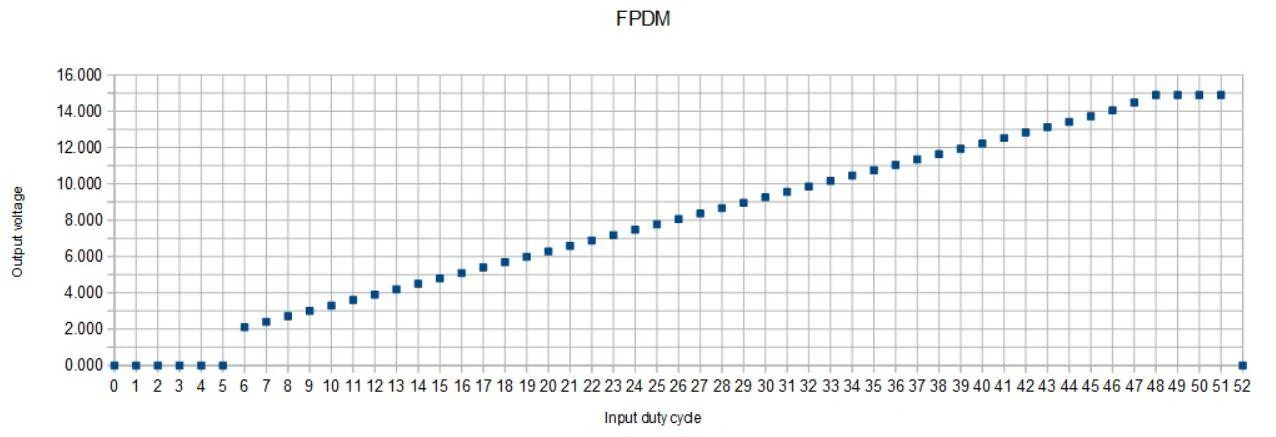
There’s a parameter in the tune for max duty cycle sent to the fpdm. It’s understood that the output to the pump is double this number since the range is 6.5 - 49 in the stock tune. Many, myself included, have increased this to 49.9 or even 50 to try to get a tiny bit more out of the pump. In this particular case, it only requested 49% in the log and the flow was still rising rapidly as the duty cycle ramped up, so we wanted to know if there was more on the table. So, the owner bench tested a stock fpdm and actually learned that the fpdm output hit max at only 48% commanded, and that it loses around .2 volts in all cases. Suffice to say, he’s right at the limit of the pump at 18 psi boost, e85, 55 psi lift pressure, and low 40’s ambient. There’s more available at lower pressure but he’d probably need bigger injectors to allow it.

It is interesting though, that the 22v bap “ez” ramps up voltage all the way to 49% so the 1% between 48 and 49 may not change the fpdm output but it does increase the voltage fed to it.

In this setup, due to current limitations the max bap output is 21.1 volts but only 20.9 is actually delivered to the pump and it only touched it briefly.

1732476693560-de.webp
 
OP
OP

engineermike

Well-Known Member
Joined
Jul 15, 2018
Threads
31
Messages
6,198
Reaction score
6,483
Location
La
Vehicle(s)
2018 GTPP A10
One more update, the owner did some voltage drop testing on the fpdm and found that the dw400 is actually only being fed a little over 19 volts at peak. So, it supporting this power level on e85 at only ~19.2 volts so I don’t think longevity is much of a concern.
 
OP
OP

engineermike

Well-Known Member
Joined
Jul 15, 2018
Threads
31
Messages
6,198
Reaction score
6,483
Location
La
Vehicle(s)
2018 GTPP A10
I found where DW officially endorses running the DW400 at 20 volts:

1733152612111-jj.jpg


So with a 22 volt BAP and power wire upgrade, only about 19.3 volts actually makes it to the pump due to BAP current limitations and FPDM voltage drop.

Conclusion: it's being run in the recommended voltage range, and still successfully supporting 18 psi boost on E85.
 

Sponsored

NGOT8R

Well-Known Member
Joined
Jul 19, 2020
Threads
153
Messages
9,229
Reaction score
7,705
Location
Florida
First Name
Adrian
Vehicle(s)
2019 Bullitt
I found where DW officially endorses running the DW400 at 20 volts:

1733152612111-jj.jpg


So with a 22 volt BAP and power wire upgrade, only about 19.3 volts actually makes it to the pump due to BAP current limitations and FPDM voltage drop.

Conclusion: it's being run in the recommended voltage range, and still successfully supporting 18 psi boost on E85.
What does 18 psi of boost equate to in horsepower?
 

K4fxd

Well-Known Member
Joined
Apr 2, 2020
Threads
121
Messages
13,455
Reaction score
12,262
Location
NKY
First Name
Dan
Vehicle(s)
2017 gt, 2002 FXDWG, 2008 C6,
OP
OP

engineermike

Well-Known Member
Joined
Jul 15, 2018
Threads
31
Messages
6,198
Reaction score
6,483
Location
La
Vehicle(s)
2018 GTPP A10
I returned to DW400/BAP tuning, as we came up with a better idea for control. There are two issues with the typical setup and tuning:

1. OEM fuel pressure runs 65 psi most of the time, but attempts to control to 73 psi at 3500+ rpm. However, if you're running a high power system and stock bucket, you can't reach 73 psi at high rpm and load anyway.
2. The OEM uses a feedforward and feedback control, which if tuned improperly can cause pressure oscillation. Then throw in a dynamic switching BAP, like the JMS Fuelmax, and now you have essentially 3 things trying to control pressure which can fight each other.

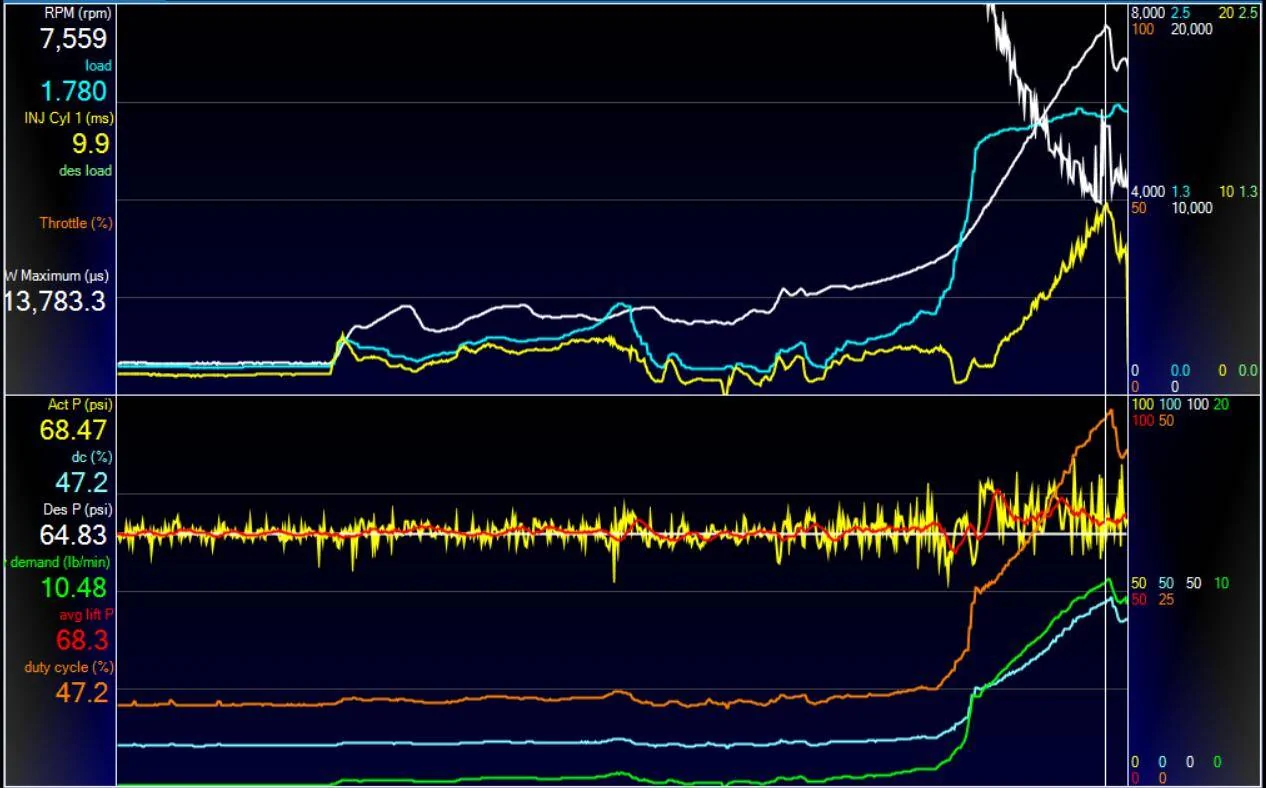
The JMS Fuelmax can operate at 14.5v and 22v, switching to high voltage a number of different possible triggers. However, most likely the BAP is always generating 22v and using PWM to cut it to 14.5v when in low voltage mode. Then we use the FPDM to control by cutting it down further most of the time but the PCM and FPDM don't know whether the input voltage is 14.5 or 22v. Rather than using multiple means of controlling voltage, why not just run 22v all the time and use one PWM (in the PFDM) to cut it down and control with it? So, this is exactly what I did. I made a jumper to trigger the JMS Fuelmax to run 22v constantly, then retuned the feedforward table to control pressure at this higher, constant input voltage. I also set it up to run 65 psi all the time. Once the feedforward table was calibrated, I turned feedback control back on and it controls beautifully, not to mention I was able to delete the pedal position intercept harness.

1747781324227-yn.jpg


I'm very happy with the result, the simiplification of the system, and the improvement in control. Also, I checked temps of the BAP and FPDM and neither are building up much heat at all.

If anyone is interesting in replicating this setup, I'd be happy to share the tuning parameters and details on the BAP high-output trigger jumper and settings.
 
Last edited:

SheepDog

Well-Known Member
Joined
Nov 3, 2018
Threads
26
Messages
4,193
Reaction score
5,259
Location
Colorado
First Name
Dax
Vehicle(s)
Iconic Silver 2022 MACH 1 HP, 2023 F150 Powerboost
I returned to DW400/BAP tuning, as we came up with a better idea for control. There are two issues with the typical setup and tuning:

1. OEM fuel pressure runs 65 psi most of the time, but attempts to control to 73 psi at 3500+ rpm. However, if you're running a high power system and stock bucket, you can't reach 73 psi at high rpm and load anyway.
2. The OEM uses a feedforward and feedback control, which if tuned improperly can cause pressure oscillation. Then throw in a dynamic switching BAP, like the JMS Fuelmax, and now you have essentially 3 things trying to control pressure which can fight each other.

The JMS Fuelmax can operate at 14.5v and 22v, switching to high voltage a number of different possible triggers. However, most likely the BAP is always generating 22v and using PWM to cut it to 14.5v when in low voltage mode. Then we use the FPDM to control by cutting it down further most of the time but the PCM and FPDM don't know whether the input voltage is 14.5 or 22v. Rather than using multiple means of controlling voltage, why not just run 22v all the time and use one PWM (in the PFDM) to cut it down and control with it? So, this is exactly what I did. I made a jumper to trigger the JMS Fuelmax to run 22v constantly, then retuned the feedforward table to control pressure at this higher, constant input voltage. I also set it up to run 65 psi all the time. Once the feedforward table was calibrated, I turned feedback control back on and it controls beautifully, not to mention I was able to delete the pedal position intercept harness.

1747781324227-yn.jpg


I'm very happy with the result, the simiplification of the system, and the improvement in control. Also, I checked temps of the JMS and BAP and neither are building up much heat at all.

If anyone is interesting in replicating this setup, I'd be happy to share the tuning parameters and details on the BAP high-output trigger jumper and settings.
Someone buy this man some bigger injectors. lol
Sponsored


Top