engineermike
Well-Known Member
There's this Whipple phenomenon where the supercharger sets off the knock sensors in the 1000-2000 rpm light-throttle acceleration from a dead stop. The Whipple remedy is to limit knock retard to .5 deg at that load and speed range. I decided I didn't like that solution so I started using PCMTec to try to find a better solution. What I learned is just how little I knew about how the knock sensing works on these.
PCMTec allows you to log dozens of parameters that lead up to knock retard, not just raw per cylinder retard.
Apparently, the PCM is always calculating a "reference level", or a rolling average vibration from the engine. There is a running "knock integration" that represents the current level of vibration. It then divides the knock integration by the reference level to determine a ratio. When this ratio exceeds the "knock threshold" in the tune, it is interpreted as knock. The "knock intensity" is the ratio minus the knock threshold. The knock intensity is used to determine the amount of timing removed, which comes from another table in the tune.
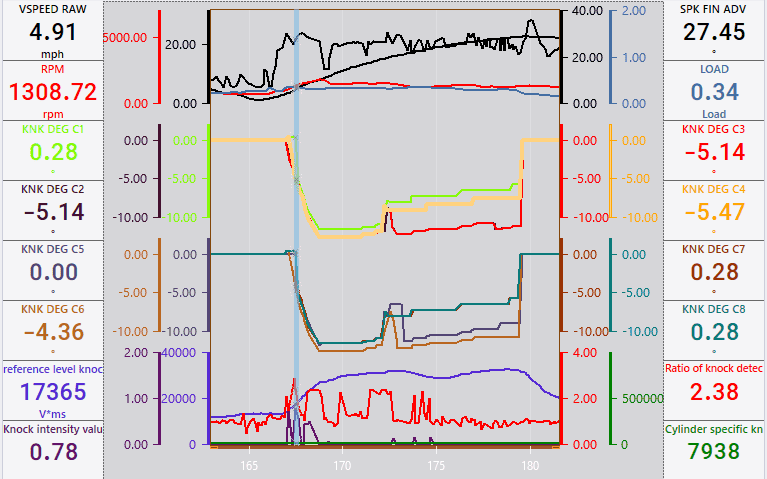
I was able to catch the whipple SC rattle in a log and you can see the knock reference level, knock ratio, and intensity. This is false knock, but still a good graphic showing how the algorithms work.

PCMTec allows you to log dozens of parameters that lead up to knock retard, not just raw per cylinder retard.
Apparently, the PCM is always calculating a "reference level", or a rolling average vibration from the engine. There is a running "knock integration" that represents the current level of vibration. It then divides the knock integration by the reference level to determine a ratio. When this ratio exceeds the "knock threshold" in the tune, it is interpreted as knock. The "knock intensity" is the ratio minus the knock threshold. The knock intensity is used to determine the amount of timing removed, which comes from another table in the tune.
I was able to catch the whipple SC rattle in a log and you can see the knock reference level, knock ratio, and intensity. This is false knock, but still a good graphic showing how the algorithms work.
Sponsored