Sponsored

E85 worth it?

HKusp

Well-Known Member
Joined
Jul 22, 2021
Threads
37
Messages
2,226
Reaction score
2,871
Location
Hampton, Md.
First Name
Jason
Vehicle(s)
2018 Mustang GT
Ok cool, thank you! Did you remove your old line or just installed the new one alongside of it?
I haven't run the lines yet, but I will probably remove the old line.
Sponsored


Cordero1

Well-Known Member
Joined
Nov 28, 2021
Threads
8
Messages
1,101
Reaction score
1,073
Location
Kansas
First Name
Vic
Vehicle(s)
2021 Mustang
I haven't run the lines yet, but I will probably remove the old line.
Is it possible to leave line in & use it or the other it comes with as a return line & just reroute the fuel rails for a return? Just curious
 

HKusp

Well-Known Member
Joined
Jul 22, 2021
Threads
37
Messages
2,226
Reaction score
2,871
Location
Hampton, Md.
First Name
Jason
Vehicle(s)
2018 Mustang GT
I haven't fooled with it in weeks so I'm not really sure, but it seems like you SHOULD be able to do that.
 

Pistol_91

Well-Known Member
Joined
Oct 25, 2023
Threads
12
Messages
1,379
Reaction score
1,401
Location
Clearwater
Vehicle(s)
2020 mustang GT
engines are fuel and air..

car - 40-50k
blower - 8k
fuel - how cheap can i go...

see this all the time

hightly recommend a fuel system....
Ok I will not do an experiment on my own and will go with your advice directly and order a fuel system immediately. While im at it i will order off your website. Thank you for the help
 

Sponsored

Coosawjack

Well-Known Member
Joined
Dec 18, 2019
Threads
17
Messages
704
Reaction score
572
Location
Beaufort, SC
First Name
Jack
Vehicle(s)
2022 Mustang GT Convertible
Just curious.......I've heard that Ethanol/Gasoline mixtures between 10% and 80% were not very stable and separation was a problem!!

Have any of you with mixtures in between 10% and 80% had separations??
 

Coosawjack

Well-Known Member
Joined
Dec 18, 2019
Threads
17
Messages
704
Reaction score
572
Location
Beaufort, SC
First Name
Jack
Vehicle(s)
2022 Mustang GT Convertible
Atmospheric water is always present....Ethanol always carries about 5% water......see Azeotrope info below!!

https://pubs.rsc.org/en/content/articlelanding/2022/cp/d2cp03145k

I talked to a Citgo/Valero distributor and at that time they did not stock Ethanol blends of any mixture since separation is storage tanks is a mess!! He said once it separated it cannot be restored and must be disposed of!!

Just curious about in between mixtures that he said were very unstable??
 

andrewtac

Well-Known Member
Joined
Feb 24, 2021
Threads
62
Messages
1,194
Reaction score
625
Location
TX
First Name
mark
Vehicle(s)
F250. 2020 GT 400A
Atmospheric water is always present....Ethanol always carries about 5% water......see Azeotrope info below!!

https://pubs.rsc.org/en/content/articlelanding/2022/cp/d2cp03145k

I talked to a Citgo/Valero distributor and at that time they did not stock Ethanol blends of any mixture since separation is storage tanks is a mess!! He said once it separated it cannot be restored and must be disposed of!!

Just curious about in between mixtures that he said were very unstable??
Perhaps I have just been lucky, but I haven't seen any storage, gas pumps, or tanker trucks that have open storage of e85, or any petrochemicals. I thought that had been outlawed years ago. The atmosphere contains water, but I suspect for the water vapor to be absorbed into the e85 it would have ro have a concentration gradient that would drive it that direction. I have two 50 gallon drums in my garage, they've been in there over a year. I pumped some out the other day to test. No visible separation and the e content measured the same as when I bought it.
Also I think the concentration is between 50 and 90 or something closer to that to be legally sold as e85. 10% concentration would be 87 octane gasoline.
 

Sponsored

Coosawjack

Well-Known Member
Joined
Dec 18, 2019
Threads
17
Messages
704
Reaction score
572
Location
Beaufort, SC
First Name
Jack
Vehicle(s)
2022 Mustang GT Convertible
Glad everything is OK and you guys have had no problems.......I was just curious!!:fingerscrossed:
 

Angrey

Well-Known Member
Joined
Jun 21, 2020
Threads
104
Messages
2,794
Reaction score
2,984
Location
Coral Gables
Vehicle(s)
2016 GT350
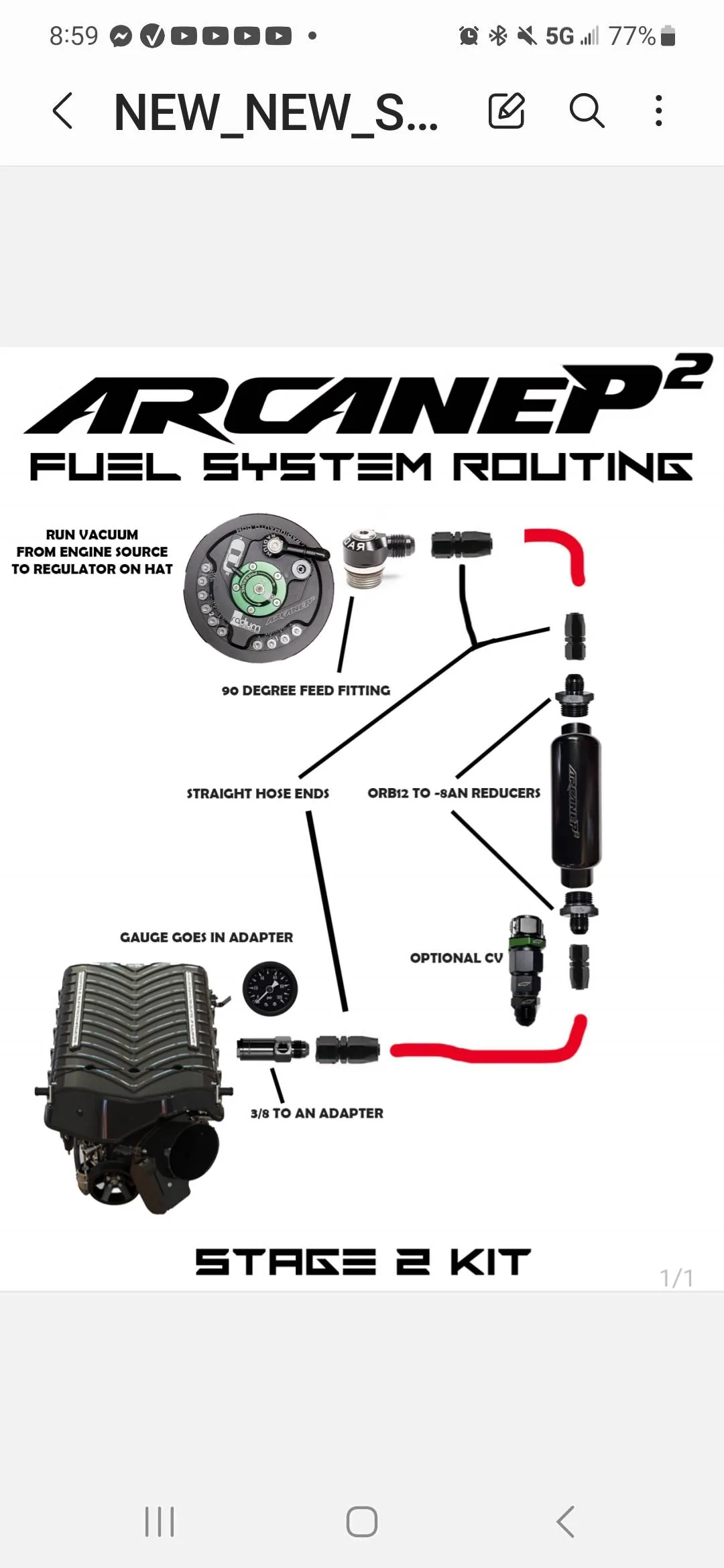
It's a dead head system. I know guys with this system that run mid to low 9's on full weight cars. North of 850whp on ethanol. It supports way more than that.

Screenshot_20231122_205941_Samsung Notes.jpg
Technically speaking, all the available fuel systems are dead head. There's always a dead line between the regulator and the rail. The difference here is simply that the distance is further between the regulator and the rails.

If I were to run this kit on big injectors, I think I'd probably want to run at least a fuel pulse dampener on each branch between the Y and the rails. Tried to do that on my system anyway but with the whipple we just couldn't get them to fit. The further away from the rail you get, the less effective they are.

The benefit of having the regulator closer to the rail is the reduction in "noise" or variance that comes with a lesser volume of compressible fluid. On an initial hit, when the injectors open up and the pressure at the rail dips, there's a lag time associated for that physical pressure drop to communicate all the way to the physical mechanism in the regulator (the spring) and have it adjust.

With an actual fuel pressure sensor, this issue is probably less of a noise headache for the tuner to smooth things out. The injector simply applies the sauce based upon whatever pressure update is currently available and so it can adjust in fairly close to real time (assuming the pressure sensor is on the rail). For older models that do not have a sensor, the tuner might have a little extra headaches trying to smooth out part throttle and anywhere rapid changes in load because injectors are operating off of crude tables/maps (which may or may not be exactly precise on tip in/hit).

At any rate, seems like this is proven to be a good alternative to the old school feed/return line setup with the regulator in the engine bay. I'm wondering how far the power could be pushed before the lag becomes a real issue. One of the reasons tuners favor the return style over a returnless is that gap in real pressure (maybe with a pressure sensor that's eliminated). In essence, why doesn't everyone just upsize the returnless system? (i.e. bigger pumps, bigger feed line, etc).
 

Angrey

Well-Known Member
Joined
Jun 21, 2020
Threads
104
Messages
2,794
Reaction score
2,984
Location
Coral Gables
Vehicle(s)
2016 GT350
@andrewtac is correct. The idea is to not allow atmospheric moisture in. The mustang fuel system is sealed.
It's only partially "sealed." It still has to purge in the event of a big pressure delta for expansion/contraction to keep the system from bursting or collapsing. This is where the burp/gulp of large daily temp swings acts like an air pump in/out of the fuel system and that's where you get the available moisture for the hydrophilic alcohol to grab and hold. If we were able to store them in a steady temperature state, the issue would largely go away.

Furthermore, the issue become more complicated with fuel level/volume. When the system is topped off, it has very little gaseous volume to buffer expansion and contraction. But it also has much more fuel to accommodate more H20. When the system is near empty, there's very little fuel to accommodate a moist air swap, however, at the same time, there's very little fuel so the expansion/contraction is less and because of the large volume of air, it's able to buffer more.

It'd be a curious experiment to see what poses more of a hydro risk, storing at topped off or storing at near empty (with large daily temp swings).
 

engineermike

Well-Known Member
Joined
Jul 15, 2018
Threads
31
Messages
6,183
Reaction score
6,442
Location
La
Vehicle(s)
2018 GTPP A10
I don’t know what the vacuum breaker and pressure relief valves are set to but I’ve never walked by my car and heard the sound of a vent relieving or smelled fuel like a car from the 60’s. My educated guess is that the system pressure min/max settings accommodate most pressure fluctuations.
 

Angrey

Well-Known Member
Joined
Jun 21, 2020
Threads
104
Messages
2,794
Reaction score
2,984
Location
Coral Gables
Vehicle(s)
2016 GT350
I don’t know what the vacuum breaker and pressure relief valves are set to but I’ve never walked by my car and heard the sound of a vent relieving or smelled fuel like a car from the 60’s. My educated guess is that the system pressure min/max settings accommodate most pressure fluctuations.
Moisture gets into the system somehow, the most likely culprit is pressure relief. People that have stored their car for long lengths with E85 will verify that if you keep it long enough, it will poison with water. You can clearly see the parts on the fuel system and the "filter" or capture to prevent expelled vapors for EPA purposes. Whether or not it activates and how often, I'm open to discussion, but again, the provisions are there and someone would have to explain where else the continuous moisture source comes from. There's a reason every fuel can has a max fill line, because if it's not vented, it needs enough expansion volume for when the can gets warmer. 15 gallons of fuel, when heated from 70F to 95F. The rate of expansion for gasoline is roughly .7% for every degree of F. Not sure what it would be for E85, but in any case, 15 gallons heated from 70 to 95F would mean over 2.5 gallons of additional volume that has to go SOMEWHERE. As someone who's accustomed to fully topping off for long trips, I can assure you there isn't 2.5 gallons of extra volume in the filler neck.
Sponsored


Top