Sponsored

Max compression ratio (static) for pump gas?

TX5OH

Well-Known Member
Joined
Sep 21, 2020
Threads
6
Messages
104
Reaction score
47
Location
Texas
First Name
Nathan
Vehicle(s)
2016 Mustang GT Convertible
Yes, but thats pretty difficult compare.

Each engine reacts very differently.
4.6, you would be lucky to get over 9:1 lol
True, but considering even the Gen 1 starts out at 11:1 and the Gen 3 at 12:1, I think if an LS can do it with the right setup the Coyote should be able to.
Sponsored

 
OP
OP

D K

Well-Known Member
Joined
May 16, 2015
Threads
15
Messages
280
Reaction score
43
Location
Denver
Vehicle(s)
Popemobile
My FRS was 12.5:1.
THEN we superchaged it....

Made 550 @ 13.5 psi


True, but considering even the Gen 1 starts out at 11:1 and the Gen 3 at 12:1, I think if an LS can do it with the right setup the Coyote should be able to.
FRS.webp
 

WildHorse

N/A or GO HOME
Joined
Jun 28, 2017
Threads
270
Messages
10,297
Reaction score
8,350
Location
Home World: CLASSIFIED
First Name
Puddintane
Vehicle(s)
'17 S550
Vehicle Showcase
1
DCR with the coyote VCT is pointless. The only number to concern yourself with is SCR. I wouldn't go nut with shaving the heads beyond to make sure they're true, deck the block, thicker/thinner head gaskets blah blah cause of the DOHC. those chains don't like too much variance despite the tensioners. Piston compression height is all one should be concerned about. Just my 2 cents.
 

engineermike

Well-Known Member
Joined
Jul 15, 2018
Threads
31
Messages
6,188
Reaction score
6,449
Location
La
Vehicle(s)
2018 GTPP A10
...If you consider that the rpm range where detonation is more likely the dynamic effects are less. .....If it is on the edge timing and fuel can be tweaked. At 3000 rpm and lower is where I would be most concerned with having the detonation.
The coyote, even bone stock, is always on the edge of detonation at WOT. The goal of the PCM is to run right at the knock limit, so I don't think it's correct to say that detonation is more likely at this rpm or that.

Simplifying it down to just the effective stroke based on IVC you can get a good enough approximation of what "dynamic" compression ratio you have at low speeds. Assume a target of 8:1 "DCR" and work backwards based on the cam timing to see what "static" compression ratio is required...
The stock coyote DCR is over 9/1 at low rpm, so if this were the case then he would need to drop it a number to achieve 8/1. Obviously, this isn't the case.

Very high compression ratios can be chosen and tuned to run perfectly fine on 93. However, the tune might be required to sacrifice power. Does it make more power at 14/1 and 12 deg of total timing than 12/1 and 25 deg? I don't think so. It's like when adding boost, you get to a point where the reduction in spark timing more-than-offsets the power gained from the increased boost. The point is that you want to choose a compression ratio that doesn't cause a net loss in power due to timing retard or non-optimal cam timing. I believe that number is between 13 and 13.5 on a Gen3 or 12 and 12.5 on a Gen2.
 

K4fxd

Well-Known Member
Joined
Apr 2, 2020
Threads
121
Messages
13,455
Reaction score
12,262
Location
NKY
First Name
Dan
Vehicle(s)
2017 gt, 2002 FXDWG, 2008 C6,
I think you will be fine at 13 or even 13.5. When on the street the computer will keep it out of knock and when you are using race gas or E85 on the track, you will get the benefit of the increased compression.
 

Sponsored

TX5OH

Well-Known Member
Joined
Sep 21, 2020
Threads
6
Messages
104
Reaction score
47
Location
Texas
First Name
Nathan
Vehicle(s)
2016 Mustang GT Convertible
The coyote, even bone stock, is always on the edge of detonation at WOT. The goal of the PCM is to run right at the knock limit, so I don't think it's correct to say that detonation is more likely at this rpm or that.


The stock coyote DCR is over 9/1 at low rpm, so if this were the case then he would need to drop it a number to achieve 8/1. Obviously, this isn't the case.

Very high compression ratios can be chosen and tuned to run perfectly fine on 93. However, the tune might be required to sacrifice power. Does it make more power at 14/1 and 12 deg of total timing than 12/1 and 25 deg? I don't think so. It's like when adding boost, you get to a point where the reduction in spark timing more-than-offsets the power gained from the increased boost. The point is that you want to choose a compression ratio that doesn't cause a net loss in power due to timing retard or non-optimal cam timing. I believe that number is between 13 and 13.5 on a Gen3 or 12 and 12.5 on a Gen2.
For the Gen 1's at least. The parked low rpm centerlines on the intake give a IVC of 90.5. So the DCR for that version at low speed is in the 7's.

Using this method of figuring out the DCR is just a quick and dirty method to help you get in the ballpark of what is feasible. You need a starting off point to make sure you are close. There is no point in my opinion to just pick a SCR and roll with it. It needs to be compatible with the system as a whole. I know from experience that if I go with "A" cam, that then I almost know I will need to be in the ballpark of "X" SCR. Regarding the the rpm for knock, engine speed helps reduce the window for the detonation to occur. Which I would say goes hand in hand with the PCM trying to keep it on the edge. The reduced potential just allows to be more aggressive to push things to the edge and then you could say there is an equal chance for knock. I think you could get away with 13:1 on the Gen 2. But it would be on the ragged edge. At least with looking at the simulated pressures in one. But when they look way better at 12.5:1 when I run it.
 

Elp_jc

Well-Known Member
Joined
May 2, 2020
Threads
48
Messages
3,527
Reaction score
805
Location
USA
Vehicle(s)
None
I believe the PTWA lining is also harder and wears slower than cast iron.
Probably, but you only have a fraction of a millimeter of it, vs several millimeters on the other, so which one is likely to last longer? :) Plus the application process can be botched, even in a minor way, leading to cylinder wall issues (chipping, scoring, etc). I'd much rather have iron liners than PTWA, but it is what it is. At least my car is not consuming oil so far in 4K miles, so hope it stays that way.

 
  • Like
Reactions: D K
OP
OP

D K

Well-Known Member
Joined
May 16, 2015
Threads
15
Messages
280
Reaction score
43
Location
Denver
Vehicle(s)
Popemobile
my thinking exactly!


Probably, but you only have a fraction of a millimeter of it, vs several millimeters on the other, so which one is likely to last longer? :) Plus the application process can be botched, even in a minor way, leading to cylinder wall issues (chipping, scoring, etc). I'd much rather have iron liners than PTWA, but it is what it is. At least my car is not consuming oil so far in 4K miles, so hope it stays that way.
 

engineermike

Well-Known Member
Joined
Jul 15, 2018
Threads
31
Messages
6,188
Reaction score
6,449
Location
La
Vehicle(s)
2018 GTPP A10
For long term use, I would rather have a thin coating that does not wear over a thicker one that does.

20-30 years ago, 2-strokes were transitioning from thick iron liners to thin, hard coatings like nikasil and chrome. The blocks were noticeably lighter and, in all but the most dramatic failures there was never any measurable wear in the cylinder. You could wipe them down with muratic acid and put a new piston in with no machine work required. The older iron sleeves would be worn out of round and require boring.
 
OP
OP

D K

Well-Known Member
Joined
May 16, 2015
Threads
15
Messages
280
Reaction score
43
Location
Denver
Vehicle(s)
Popemobile
I dont really think wearing out cast iron bores is an issue for a coyte?

anyway, for me, I would be happy if a block lasted 2 seasons for what Im about to do with it.


For long term use, I would rather have a thin coating that does not wear over a thicker one that does.

20-30 years ago, 2-strokes were transitioning from thick iron liners to thin, hard coatings like nikasil and chrome. The blocks were noticeably lighter and, in all but the most dramatic failures there was never any measurable wear in the cylinder. You could wipe them down with muratic acid and put a new piston in with no machine work required. The older iron sleeves would be worn out of round and require boring.
 

Sponsored

engineermike

Well-Known Member
Joined
Jul 15, 2018
Threads
31
Messages
6,188
Reaction score
6,449
Location
La
Vehicle(s)
2018 GTPP A10
I dont really think wearing out cast iron bores is an issue for a coyte?
This is correct, so why are we worried about the thickness of the harder PTWA if wear isn’t a concern? Strength isn’t the issue, as we’ve seen broke gen2 bores but not gen3. Ford added stiffeners in the load zone of gen3 blocks, right where the gen2’s were failing.
 
OP
OP

D K

Well-Known Member
Joined
May 16, 2015
Threads
15
Messages
280
Reaction score
43
Location
Denver
Vehicle(s)
Popemobile
I didnt know about extra strengthening.

But, if all things were equal, I would choose cast iron liners.

there is a reason why the highest powered coyotes in the world get cast iron sleeves, not plasma arc.

Maybe they added the extra webbing to account for the fact that plasma cylinders are not as rigid as cast iron?

I dont know, Im guessing


This is correct, so why are we worried about the thickness of the harder PTWA if wear isn’t a concern? Strength isn’t the issue, as we’ve seen broke gen2 bores but not gen3. Ford added stiffeners in the load zone of gen3 blocks, right where the gen2’s were failing.
 

engineermike

Well-Known Member
Joined
Jul 15, 2018
Threads
31
Messages
6,188
Reaction score
6,449
Location
La
Vehicle(s)
2018 GTPP A10
...there is a reason why the highest powered coyotes in the world get cast iron sleeves, not plasma arc.
Those race engines aren’t using oem materials or geometry so I don’t believe it to be a 1:1 comparison to a stock block.

Just the other day, a Lethal rep recommended a 3-2-1 build, which includes a gen 3 short block, gen 2 heads, and gen 1 timing components. Interesting they would recommend a gen 3 short block over gen 2.

Maybe they added the extra webbing to account for the fact that plasma cylinders are not as rigid as cast iron?
Or maybe they added it because the cast-iron sleeved gen 2 blocks were failing. We’re only guessing but qualitatively the gen 3 blocks appear to be stronger than gen 2’s. We used to hear about gen 1 rods failing and then gen 2 blocks, but i don’t recall hearing about any failed gen 3 blocks outside of factory defects, with many of them making over 800 rwhp.
 

WildHorse

N/A or GO HOME
Joined
Jun 28, 2017
Threads
270
Messages
10,297
Reaction score
8,350
Location
Home World: CLASSIFIED
First Name
Puddintane
Vehicle(s)
'17 S550
Vehicle Showcase
1
his is correct, so why are we worried about the thickness of the harder PTWA
Because only a coating on an aluminum block bore with move around, expand, contract, way more than a iron sleeve in an aluminum block. Gen 2's generally don't fail unless your putting a stupid amount of horsepower into it.
 

Idaho2018GTPremium

Well-Known Member
Joined
Nov 20, 2018
Threads
20
Messages
1,550
Reaction score
1,407
Location
Idaho
Vehicle(s)
2021 Camaro ZL1 A10
Those race engines aren’t using oem materials or geometry so I don’t believe it to be a 1:1 comparison to a stock block.

Just the other day, a Lethal rep recommended a 3-2-1 build, which includes a gen 3 short block, gen 2 heads, and gen 1 timing components. Interesting they would recommend a gen 3 short block over gen 2.


Or maybe they added it because the cast-iron sleeved gen 2 blocks were failing. We’re only guessing but qualitatively the gen 3 blocks appear to be stronger than gen 2’s. We used to hear about gen 1 rods failing and then gen 2 blocks, but i don’t recall hearing about any failed gen 3 blocks outside of factory defects, with many of them making over 800 rwhp.
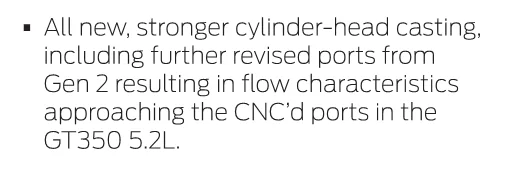
I wonder why the rep recommended Gen 2 heads? Gen 3 heads flow more and have slightly bigger valves, and they are stronger than Gen 2. From the Ford Coyote Technical reference:
1605821798028.webp
Sponsored


Top