Sponsored

Transmission Tuning (advanced tech)

OP
OP

engineermike

Well-Known Member
Joined
Jul 15, 2018
Threads
31
Messages
6,188
Reaction score
6,450
Location
La
Vehicle(s)
2018 GTPP A10
… Camaro Shifts were blended nicely and consistently up and down. When commanded they executed promptly. Even rapid fire down shifts didn't involve neck snapping.
So the shift schedule is the issue in your view?
Sponsored

 
OP
OP

engineermike

Well-Known Member
Joined
Jul 15, 2018
Threads
31
Messages
6,188
Reaction score
6,450
Location
La
Vehicle(s)
2018 GTPP A10
I am not a transmission engineer, so yes?
You just seem to have some strong opinions on the ford version of the 10r80, so I was wondering if was calibration, logic, or mechanical differences. If it’s calibration then I can probably “fix it” with tuning. Id heard it said before that the Camaro 10r was better but have yet to understand what specifically what they do better. I’m happy with mine after personally tuning but also wondering if it could be even better if I could learn something from GM, but the differences need to be articulated clearly.
 
Last edited:

Robottrainer

Well-Known Member
Joined
Apr 25, 2021
Threads
79
Messages
992
Reaction score
422
Location
Canada
First Name
John
Vehicle(s)
2018 Ford Escape. 2020 Jeep Cherokee. 2021 Ford Mustang GT Stage 2 Roush
So the shift schedule is the issue in your view?
FWIW, setting LID in shift characteristics for Sport mode to Alt 0 or normal makes the shifts in mine positive, quick AND barely noticeable AND it eliminated the 3 to 4 and 4 to 5 shift intermittent flare. Setting the same in mud mode makes for the same but the shift is harder. Changing the upshift, downshift and coast tables in mud mode to the same as sport mode makes mud mode (track) like super sport plus. In my case you get a stiffer magnaride and the exhaust at the loudest setting.
 
OP
OP

engineermike

Well-Known Member
Joined
Jul 15, 2018
Threads
31
Messages
6,188
Reaction score
6,450
Location
La
Vehicle(s)
2018 GTPP A10
Ok folks, I've dug into this quite a bit more and satisfied my curiosity. Yet again, I find myself fascinated by the controls.

The graphs I posted earlier regarding boost phase, stroke phase, torque phase, and inertia phase is all correct to my knowledge. Inertia phase is the only one that you can really "sense" because that's when the rpm drops. There appears to be 5 sub-phases of the inertia phase, with times assigned to each. The different shift characters shorten these by as much as 80%, and also shorten up the torque phase as well.

I was still unclear on how the pressure is controlled but I've learned a lot recently by logging and comparing to the tune file. The following is what I've learned:

- There are no pressure sensors in the transmission. There are only pressure control solenoids with that open based on pressure-to-current tables. There is one for each of the 6 clutches, and one for line pressure. The line pressure is just a header "source" pressure that the individual clutch solenoids have access to.

- For any given shift, 4 clutches remain in their existing state (though pressure is modulated before, during, and after the shift), 1 releases, and 1 engages.

- The line pressure during an upshift is simply looked up on the "base line pressure" tables as described by hptuners. It increases to this number well before the shift takes place right when the boost phase starts. It might use the "power on up" (typ. 1150 kpa) or the "high gain power on up" (typ. 1700 kpa) depending on what shift it is and possibly the torque input at the time. Also, there are two tables defined in PCMTec for min shifting line pressure in alt1 or alt2 characters that's set higher (1800 kpa) than the two previously mentioned tables. At WOT, and I'm not sure what triggers it, it could also go to the maximum line pressure as spelled out in the trans calibration, which is usually 2100-2200 kpa but is a function of rpm and temp. Again, this isn't the actual clutch pressure, but it's the pressure available to the clutch solenoids.

- During the entire shift, it appears as the 4 clutches that remain in their existing position either command 0 ma current if disengaged or 1.2 ma if engaged, which means max or min solenoid current. I suppose the safe answer it to command full clamping force on the clutches that remain engaged through the shift. As a side note, anything over 1.1 ma is essentially max pressure.

- During the shift, the engaging and releasing solenoids follow the boost pressure and time, stroke pressure and time, torque transfer ramp, and inertia times. These were discussed earlier in the thread.

- How the pressures are determined between shifts is the really interesting part (to nerds like me, at least). The logic starts with the torque input into the transmission and uses the different ratios and combinations of ratios to determine the torque that's being transmitted by each engaged clutch. The clutch transmitted torque is converted to a hydraulic actuation pressure, which is then converted to an electrical current, which is sent to the solenoid using PWM. All of the clutch geometry and coefficient of friction have to be hard coded into the calculations. As far as I can tell, there is no feedback slip closed loop control of pressure.

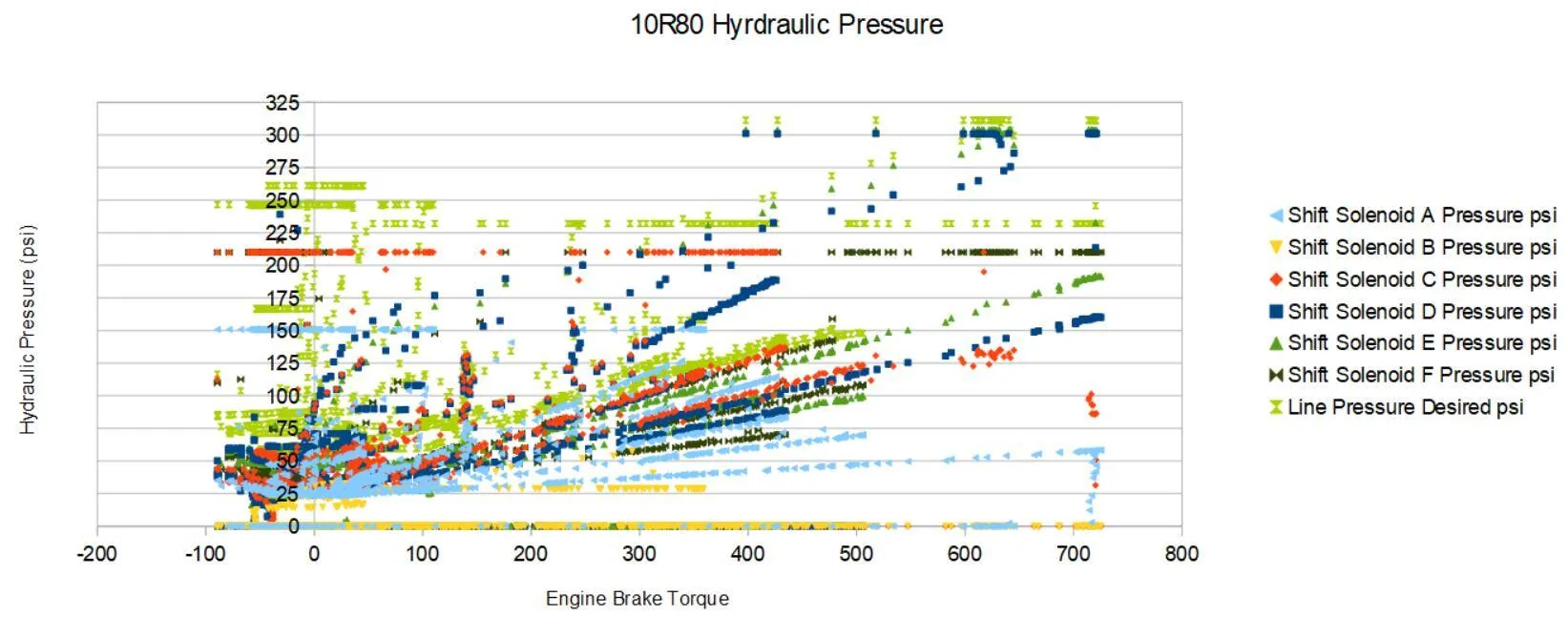
I ran through a series of gears while varying the torque and plotted the clutch pressure vs engine torque and the following resulted:

1740358910696-ju.jpg


Two things jump out at me from this graph. One is that each clutch has a different torque-to-pressure slope, depending on which gear you're in. The second is that the pressure directly proportional to the engine brake torque.

I went into this wondering how one might address something like the 7th gear slippage some have reported. After scouring PCMTec parameters for parameters that don't exist and reviewing data logs, I realized that the pressures are determined mathematically rather than using tables of lookups, for the most part. And the single most significant input to the clutch pressure calculation, that we can control using tuning, is the engine brake torque. The above graph is from a mostly-stock transmission tune and you can see the commanded pressure responds up past 700 ftlb. I have another similar log showing the mostly-stock programming can actually respond well beyond 800 ftlb of engine brake torque. So, at a minimum, the engine brake torque calculation in your file needs to be somewhat accurate in order for the transmission pressures to react accordingly. I have actually seen a couple of major supercharger company's tunes that leaves the torque tables stock or close to it, which will undoubtedly result in low clutch pressure.

If you're experiencing clutch slip between shifts, I would recommend modifying the torque model by increasing the torque in the load-to-torque table, and correcting the torque-to-load table to match. You might run into some limiters, but those can be increased along the way. This should result in increased clutch pressure and less slippage.
 
Last edited:

Sponsored

K4fxd

Well-Known Member
Joined
Apr 2, 2020
Threads
121
Messages
13,455
Reaction score
12,262
Location
NKY
First Name
Dan
Vehicle(s)
2017 gt, 2002 FXDWG, 2008 C6,
Leads right back to Banish when he says most trans tuning problems are actually engine tuning problems.
 

Weezox

Member
Joined
Apr 7, 2026
Threads
0
Messages
10
Reaction score
1
Location
New Jersey
First Name
Matt
Vehicle(s)
2019 Mustang GT
Ok folks, I've dug into this quite a bit more and satisfied my curiosity. Yet again, I find myself fascinated by the controls.

The graphs I posted earlier regarding boost phase, stroke phase, torque phase, and inertia phase is all correct to my knowledge. Inertia phase is the only one that you can really "sense" because that's when the rpm drops. There appears to be 5 sub-phases of the inertia phase, with times assigned to each. The different shift characters shorten these by as much as 80%, and also shorten up the torque phase as well.

I was still unclear on how the pressure is controlled but I've learned a lot recently by logging and comparing to the tune file. The following is what I've learned:

- There are no pressure sensors in the transmission. There are only pressure control solenoids with that open based on pressure-to-current tables. There is one for each of the 6 clutches, and one for line pressure. The line pressure is just a header "source" pressure that the individual clutch solenoids have access to.

- For any given shift, 4 clutches remain in their existing state (though pressure is modulated before, during, and after the shift), 1 releases, and 1 engages.

- The line pressure during an upshift is simply looked up on the "base line pressure" tables as described by hptuners. It increases to this number well before the shift takes place right when the boost phase starts. It might use the "power on up" (typ. 1150 kpa) or the "high gain power on up" (typ. 1700 kpa) depending on what shift it is and possibly the torque input at the time. Also, there are two tables defined in PCMTec for min shifting line pressure in alt1 or alt2 characters that's set higher (1800 kpa) than the two previously mentioned tables. At WOT, and I'm not sure what triggers it, it could also go to the maximum line pressure as spelled out in the trans calibration, which is usually 2100-2200 kpa but is a function of rpm and temp. Again, this isn't the actual clutch pressure, but it's the pressure available to the clutch solenoids.

- During the entire shift, it appears as the 4 clutches that remain in their existing position either command 0 ma current if disengaged or 1.2 ma if engaged, which means max or min solenoid current. I suppose the safe answer it to command full clamping force on the clutches that remain engaged through the shift. As a side note, anything over 1.1 ma is essentially max pressure.

- During the shift, the engaging and releasing solenoids follow the boost pressure and time, stroke pressure and time, torque transfer ramp, and inertia times. These were discussed earlier in the thread.

- How the pressures are determined between shifts is the really interesting part (to nerds like me, at least). The logic starts with the torque input into the transmission and uses the different ratios and combinations of ratios to determine the torque that's being transmitted by each engaged clutch. The clutch transmitted torque is converted to a hydraulic actuation pressure, which is then converted to an electrical current, which is sent to the solenoid using PWM. All of the clutch geometry and coefficient of friction have to be hard coded into the calculations. As far as I can tell, there is no feedback slip closed loop control of pressure.

I ran through a series of gears while varying the torque and plotted the clutch pressure vs engine torque and the following resulted:

1740358910696-ju.webp


Two things jump out at me from this graph. One is that each clutch has a different torque-to-pressure slope, depending on which gear you're in. The second is that the pressure directly proportional to the engine brake torque.

I went into this wondering how one might address something like the 7th gear slippage some have reported. After scouring PCMTec parameters for parameters that don't exist and reviewing data logs, I realized that the pressures are determined mathematically rather than using tables of lookups, for the most part. And the single most significant input to the clutch pressure calculation, that we can control using tuning, is the engine brake torque. The above graph is from a mostly-stock transmission tune and you can see the commanded pressure responds up past 700 ftlb. I have another similar log showing the mostly-stock programming can actually respond well beyond 800 ftlb of engine brake torque. So, at a minimum, the engine brake torque calculation in your file needs to be somewhat accurate in order for the transmission pressures to react accordingly. I have actually seen a couple of major supercharger company's tunes that leaves the torque tables stock or close to it, which will undoubtedly result in low clutch pressure.

If you're experiencing clutch slip between shifts, I would recommend modifying the torque model by increasing the torque in the load-to-torque table, and correcting the torque-to-load table to match. You might run into some limiters, but those can be increased along the way. This should result in increased clutch pressure and less slippage.
So is there any danger to putting Shift Map 0's torque modulation data into ALT 1? As I think some of us digging into this mess have realized; ALT 1's torque modulation for the 1,2,3,4,5 shifts have the 4000+ rpm number absolutely gutted at all Turbine torque output. I am assuming this is the reason for the little blip of "no power" feeling between WOT shifts.

I think I am attempting to try to firm the quick sport shifts even more (less car feeling like its dragging when mid 3-4 or 4-5) but I do not want my eyeballs exploded like drag mode 24/7

So sport mode inherently changes other properties other than torque modulation (where everyone says to start adjusting). Setting the Sport/Track to 0s in the table results in a really bland, not sporty at all experience BUT also does not have that power loss feeling.

Would copying all of the upshift desired torque tables from Normal to Alt 1 cause other issues because of the line pressure, ramp rates, inertia ect.? Why did they gut the top end in the first place, I don't want to tune out a purposeful safeguard I guess.
 
OP
OP

engineermike

Well-Known Member
Joined
Jul 15, 2018
Threads
31
Messages
6,188
Reaction score
6,450
Location
La
Vehicle(s)
2018 GTPP A10
So is there any danger to putting Shift Map 0's torque modulation data into ALT 1? As I think some of us digging into this mess have realized; ALT 1's torque modulation for the 1,2,3,4,5 shifts have the 4000+ rpm number absolutely gutted at all Turbine torque output. I am assuming this is the reason for the little blip of "no power" feeling between WOT shifts.

I think I am attempting to try to firm the quick sport shifts even more (less car feeling like its dragging when mid 3-4 or 4-5) but I do not want my eyeballs exploded like drag mode 24/7

So sport mode inherently changes other properties other than torque modulation (where everyone says to start adjusting). Setting the Sport/Track to 0s in the table results in a really bland, not sporty at all experience BUT also does not have that power loss feeling.

Would copying all of the upshift desired torque tables from Normal to Alt 1 cause other issues because of the line pressure, ramp rates, inertia ect.? Why did they gut the top end in the first place, I don't want to tune out a purposeful safeguard I guess.
I've learned a lot more about these things since the original post. I don't know if the transmission tuning is more complicated than the engine, but it very well could be.

I've theorized that the low torque mod in alt1 is set so low to reduce tire shock on something like a road course, but still execute quick shifts. That's just a guess though.

You have to decide what exactly you want before deciding what to do about it. There are literally hundreds (possibly thousands) of trans tuning parameters, 5 shift phases, up to 5 sub-phases in each phase, etc. There are probably a dozen torque interupts during the shift and the lowest one wins. Torque modulation is only active during the inertia phase of the shift. The time it takes the inertia phase to complete is specified in a literal amount of time for each of the 5 sub-phases. Drag mode in gen3 just multiplies all the base/0 times by 0.2 so inertia phase takes 1/5 as long to execute. S650 is a little more elegant than that.

Anyway, what exactly are you trying to accomplish? Changing torque modulation isn't supposed to change the time it takes to complete the inertia phase.

I believe, and I don't have any proof, that the fastest car will be drag shifts with zero modulation. However, this makes me very nervous on a modified/supercharged car because I don't know that the trans strength was really designed for full-torque WOT upshifts at 600++ ftlb. I know I'm sacrificing performance, but I prefer to run Alt2 at wot but cut torque to around 450 ftlb because I know it's designed for that torque level during shifts.
 

Weezox

Member
Joined
Apr 7, 2026
Threads
0
Messages
10
Reaction score
1
Location
New Jersey
First Name
Matt
Vehicle(s)
2019 Mustang GT
I've learned a lot more about these things since the original post. I don't know if the transmission tuning is more complicated than the engine, but it very well could be.

I've theorized that the low torque mod in alt1 is set so low to reduce tire shock on something like a road course, but still execute quick shifts. That's just a guess though.

You have to decide what exactly you want before deciding what to do about it. There are literally hundreds (possibly thousands) of trans tuning parameters, 5 shift phases, up to 5 sub-phases in each phase, etc. There are probably a dozen torque interupts during the shift and the lowest one wins. Torque modulation is only active during the inertia phase of the shift. The time it takes the inertia phase to complete is specified in a literal amount of time for each of the 5 sub-phases. Drag mode in gen3 just multiplies all the base/0 times by 0.2 so inertia phase takes 1/5 as long to execute. S650 is a little more elegant than that.

Anyway, what exactly are you trying to accomplish? Changing torque modulation isn't supposed to change the time it takes to complete the inertia phase.

I believe, and I don't have any proof, that the fastest car will be drag shifts with zero modulation. However, this makes me very nervous on a modified/supercharged car because I don't know that the trans strength was really designed for full-torque WOT upshifts at 600++ ftlb. I know I'm sacrificing performance, but I prefer to run Alt2 at wot but cut torque to around 450 ftlb because I know it's designed for that torque level during shifts.
To be completely honest, I went from an over the air tune from one of the big name tuners and enjoyed the car for some good milage. I had some complaints but it was fast, firm, and fun.

I took the tune off and replaced it with the FPP2 tune I already had in a box with the intake and throttle body(Can confirm this doesnt change the trans at all as you know) . I figured what the hell and decided to use HPT and PCMTec to start customizing to my own tastes because there was plenty in the "canned tune" that was too aggressive for my daily use after thousands of miles.

Unfortunately the trans is just so goddamn complicated that I can't get back the feeling of the previous tune's 10r80. Essentially I'm looking for that little lurch forward in the 70% pedal to WOT in 2-3, 3-4, 4-5. I'd settle for just firm, fast shifts like all the other shifts of sport mode. It just seems like the car really struggles with the adaptive learning in 3-4 and the 4-5 on the stock trans tune in sport mode.

Drag mode ALT 2 flashed over Sport is great, but that theory you just posted may hold alot of weight. I just ran some twisty roads and every 4000-5000 rpm shift felt like I was going to break traction on a turn. Immediately flashing that back to stock.
 
OP
OP

engineermike

Well-Known Member
Joined
Jul 15, 2018
Threads
31
Messages
6,188
Reaction score
6,450
Location
La
Vehicle(s)
2018 GTPP A10
If it makes you feel any better, many aftermarket tuners don't really understand it either. They either just apply alt2 to all drive modes or start jacking up things like boost pressure. Raising boost pressure is definitely not the way to do it, because boost pressure is intended to purge the empty passages. Raising boost pressure causes tie-up which then leads to earlier engagement of the oncoming clutch and the shift feels firmer. At best, the learning will recognize the tie-up and reduce boost pressure as part of the learning and you lose your firm shifts. At worst, tie-up causes clutch heat and premature wear.
 

Sponsored

Weezox

Member
Joined
Apr 7, 2026
Threads
0
Messages
10
Reaction score
1
Location
New Jersey
First Name
Matt
Vehicle(s)
2019 Mustang GT
If it makes you feel any better, many aftermarket tuners don't really understand it either. They either just apply alt2 to all drive modes or start jacking up things like boost pressure. Raising boost pressure is definitely not the way to do it, because boost pressure is intended to purge the empty passages. Raising boost pressure causes tie-up which then leads to earlier engagement of the oncoming clutch and the shift feels firmer. At best, the learning will recognize the tie-up and reduce boost pressure as part of the learning and you lose your firm shifts. At worst, tie-up causes clutch heat and premature wear.
Funny enough I have also been playing with it every day more and more, so the spark cut at the top of the table in sport mode almost always corresponds with the "Burps" that the 10r will do under heavier pedal similar to a DSG. And I've tuned enough Dual Clutches to know what causes those burps.
Playing with that table doesn't seem to change much of the "dead zone" feeling I have.

Playing with the Base line pressures, stroke adders, and boost pressure adders DOES.

So, has anyone ever found out if the 21-23 MY 10rs stock configs (which are much more detailed) are compatible with the 18-20 MY 10r? I know it will work and probably work well, I just don't want to kill my trans over a long term because I didn't realize that they changed solenoids or steels or something else that was not public info. That's probably a long shot and a half that someone has that info anyway
 
OP
OP

engineermike

Well-Known Member
Joined
Jul 15, 2018
Threads
31
Messages
6,188
Reaction score
6,450
Location
La
Vehicle(s)
2018 GTPP A10
Depends on the parameter. Some stuff can be stolen while others shouldn’t.

Be careful modifying boost and base line pressures. I don’t think those do what you think they do.

The shift constitutes numerous phases.

Boost phase fills the passages with fluid.

Stroke phase moves the clutches into position.

Torque transfer phase starts engaging the oncoming clutch and releasing the offgoing clutch. Note: At the end of torque transfer phase, the engine is still at sync speed with the offgoing gear even though alll the torque is being transferred through the oncoming clutch.

Inertia phase is when the engine rpm is finally reduced to sync speed of the oncoming gear. Inertia phase has 5 sub-phases, each with a specified time to complete.

So you can see how changing boost pressure really isnt how the shift “feel”
should be changed.
 

Cobra Jet

Well-Known Member
Joined
Feb 12, 2015
Threads
771
Messages
17,562
Reaction score
19,993
Location
NJ
Vehicle(s)
2018 EB Prem. w/PP and 94 Mustang Cobra
@engineermike

Great thread and I’ll update the 10R80 FAQ thread with your thread/info so it’s out there for future research by other 10R80 owners.

I don’t know if you came across my 10R80 FAQ thread on here, but a while back these threads within it had interesting info about the 10R80 shift strategies:
Shout out to @andrewtac for the Forscan info for valve body strategy access:
https://www.mustang6g.com/forums/threads/changing-valve-body-startegy-in-forscan.170382/

and this one had internal info (PDF’s attached in thread):
https://www.mustang6g.com/forums/threads/10r80-internal-technical-info.141611/

This is the original Post 1, Page 1. If you just zip to the very bottom of Post #1, I had included more PDF’s there that had info about the 10R80 and 10L90 shift strategies and other important info regarding the shifting functions:
https://www.mustang6g.com/forums/th...tions-to-harsh-or-no-shift-conditions.135463/

@ZXMustang was also posting some good shift strategy info starting here:
https://www.mustang6g.com/forums/th...o-harsh-or-no-shift-conditions.135463/page-69

I don’t know if the above helps, but hopefully it’s relevant to your research.
 
Last edited:

Pistol_91

Well-Known Member
Joined
Oct 25, 2023
Threads
12
Messages
1,381
Reaction score
1,407
Location
Clearwater
Vehicle(s)
2020 mustang GT
Weezox like Mike is saying you need to change the inertia phase if you want faster shifts for alt 1. You can go through the inertia phase tables and change the 5 sub phases if you choose, or you can just use the inertia phase multiplier tables that blanket all 5 sub phases for each gear shift.
Ive had good success at moving all the shifts at the WOT range down 20% (from 1.0 to .8).

You can leave the torque modulation tables stock with this simple change. If this still isn't fast enough, try raising torque modulation (less torque reduction) or take a look at torque rate oncoming tables.

Similar to the torque mod tables they also gut these tables on most of the gears. If you raise these a bit for shifts like 2-3 you should get a faster shift.

It doesn't take much to get the sport mode to shift good. Lowering the inertia multiplier tables is about 90% of the change you'll notice. Raising oncoming rate tables will just "clean up" the torque/spark cut for the shift. It will keep the source out of "tq+ from trans" and keep it in "shift modulation".

Shift modulation is key for higher HP cars. It is safer for your trans like Mike states.

People that have boosted cars running no torque modulation for their shifts (like using stock drag mode) are asking for trouble by either smoking their transmission or becoming a statistical crowd killer.

I personally like how the Chevy's shift. I like the pause for their lower gears. It's cleaner has more character and is safer than what drag mode gives you. Hope this helps.
 
Last edited:

Weezox

Member
Joined
Apr 7, 2026
Threads
0
Messages
10
Reaction score
1
Location
New Jersey
First Name
Matt
Vehicle(s)
2019 Mustang GT
Weezox like Mike is saying you need to change the inertia phase if you want faster shifts for alt 1. You can go through the inertia phase tables and change the 5 sub phases if you choose, or you can just use the inertia phase multiplier tables that blanket all 5 sub phases for each gear shift.
Ive had good success at moving all the shifts at the WOT range down 20% (from 1.0 to .8).

You can leave the torque modulation tables stock with this simple change. If this still isn't fast enough, try raising torque modulation (less torque reduction) or take a look at torque rate oncoming tables.

Similar to the torque mod tables they also gut these tables on most of the gears. If you raise these a bit for shifts like 2-3 you should get a faster shift.

It doesn't take much to get the sport mode to shift good. Lowering the inertia multiplier tables is about 90% of the change you'll notice. Raising oncoming rate tables will just "clean up" the torque/spark cut for the shift. It will keep the source out of "tq+ from trans" and keep it in "shift modulation".

Shift modulation is key for higher HP cars. It is safer for your trans like Mike states.

People that have boosted cars running no torque modulation for their shifts (like using stock drag mode) are asking for trouble by either smoking their transmission or becoming a statistical crowd killer.

I personally like how the Chevy's shift. I like the pause for their lower gears. It's cleaner has more character and is safer than what drag mode gives you. Hope this helps.
Very interesting, I hadn't played with the inertia phase tables as that's one of the only places that does not change between the 18-20s and the 21-23s

Did you drop the overall base inertia phase tables from 1.0 to .8?

For example I can see how any real torque load on a 4>5 in Alt 2 is set to .2 vs Alt 1's 1.0 - .75 - .8

Are there are no dangers to cutting the durations without changing any of the other supporting like 17 table changes that Alt 2 has vs Alt 1?
Sponsored


Top