Sponsored

Transmission Tuning (advanced tech)

engineermike

Well-Known Member
Joined
Jul 15, 2018
Threads
31
Messages
6,180
Reaction score
6,431
Location
La
Vehicle(s)
2018 GTPP A10
I started down the path of transmission tuning using PCMTec and, man, there's a lot here. I have had success transplanting shift characters and even making hybrid shift characters (normal shifts at part throttle and drag shifts at full throttle, for example), but I might just give up understanding how the tuning logic actually works. There are something like 15 parameters that control shift properties, not including shift schedule, torque modulation, or shift pressures (significantly more parameters). I was hoping to figure out how they all work together to control a shift. Parameter names are like oncoming ramp (time), offgoing ramp (delta time), torque rate offgoing, torque transfer offgoing, torque rate oncoming, inertia phase with 5 sub-phases (time), and many more.

Couple things I figured out:
- There are no pressure sensors in the transmission. All of the pressures are assumed based on the electrical power sent to the solenoids.
- There are 3 speed sensors in the trans. The logic calculates the slip of all the clutches based on these 3 speeds.
- There are 6 clutches and combinations of them create each gear. For every upshift, 4 clutches stay in their same state, one releases, and another applies simultaneously. For the clutches that remain applied before during and after the shift, the pressure is increased, presumably to prevent them from slipping during the shock of the shift.
- There is line pressure, and there is solenoid pressure. The line pressure is supplied to the solenoids, then the solenoids modulate it from there. So adding line pressure doesn't necessarily increase pressure applied to the clutch.

For the sake of logistics and logging, I decided to study the 3-4 shift. In that shift, the E clutch releases and the F clutch is applied. As I often preach, you have to reduce the channel list to a bare minimum if you want a high enough data rate to log things that happen quickly.

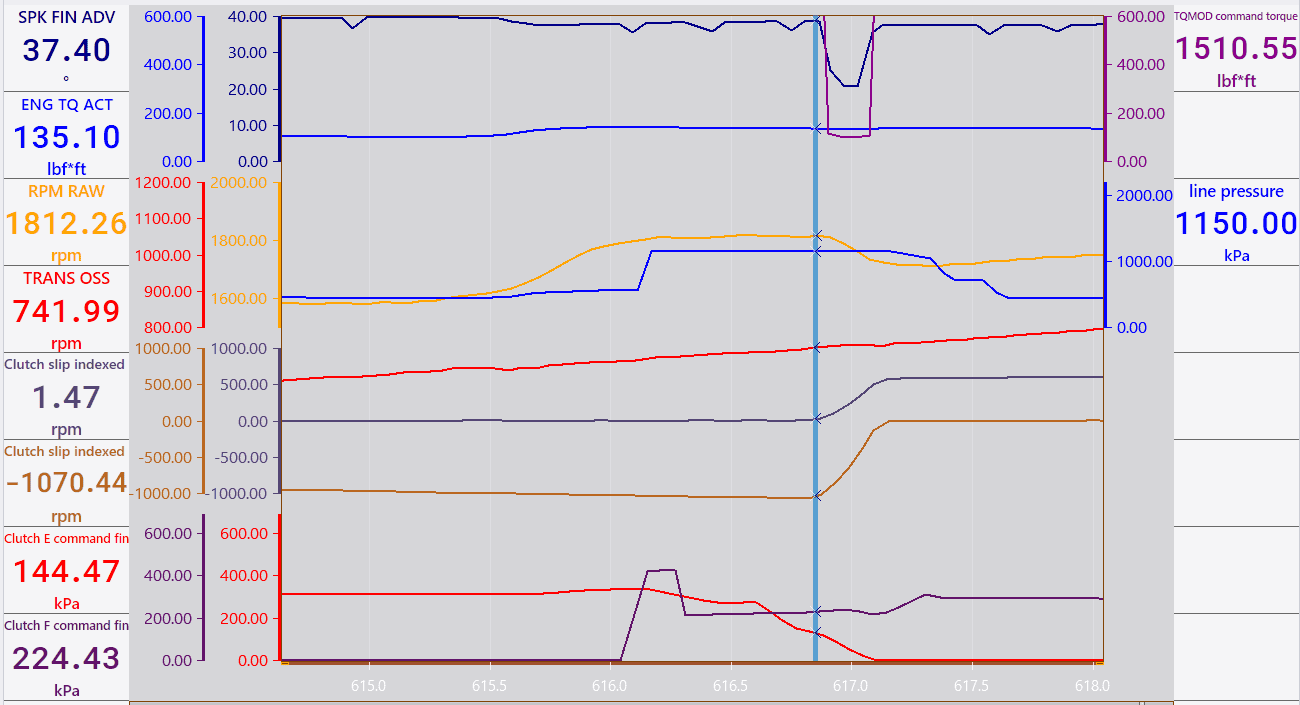
This is what a part-throttle 3-4 shift looks like:

1725053381364-cy.png


The cursor is placed at the point in time where the E clutch starts releasing and the F clutch starts grabbing. What's initially striking to me about this is that the clutches don't actually start swapping until a solid .7 seconds after the F solenoid sends pressure, while the actual shift only took about .3 seconds to complete. I guess this explains why part throttle paddle shifts are so laggy. Also noteworthy is that the line pressure is increased to 1150 kpa during the entirety of the shift. 1150 coincides with the "Trans Line Pressure Power On Upshift" table in HPT. Also, the initial pressure spike from the F solenoid appears to align with the "Trans boost pressure element F" table. Boost pressure is the pressure intended to just fill the cavities with fluid before the clutches are applied. You can also see that the torque modulation takes place just during the clutch swap time period. What I can't quite grasp is a) the fact that nothing in the way of solenoid actuation seems to trigger the switch from clutch E to F and b) how the dozens of torque rate, torque transfer, ramp time, inertia time, and other parameters play into this specifically.

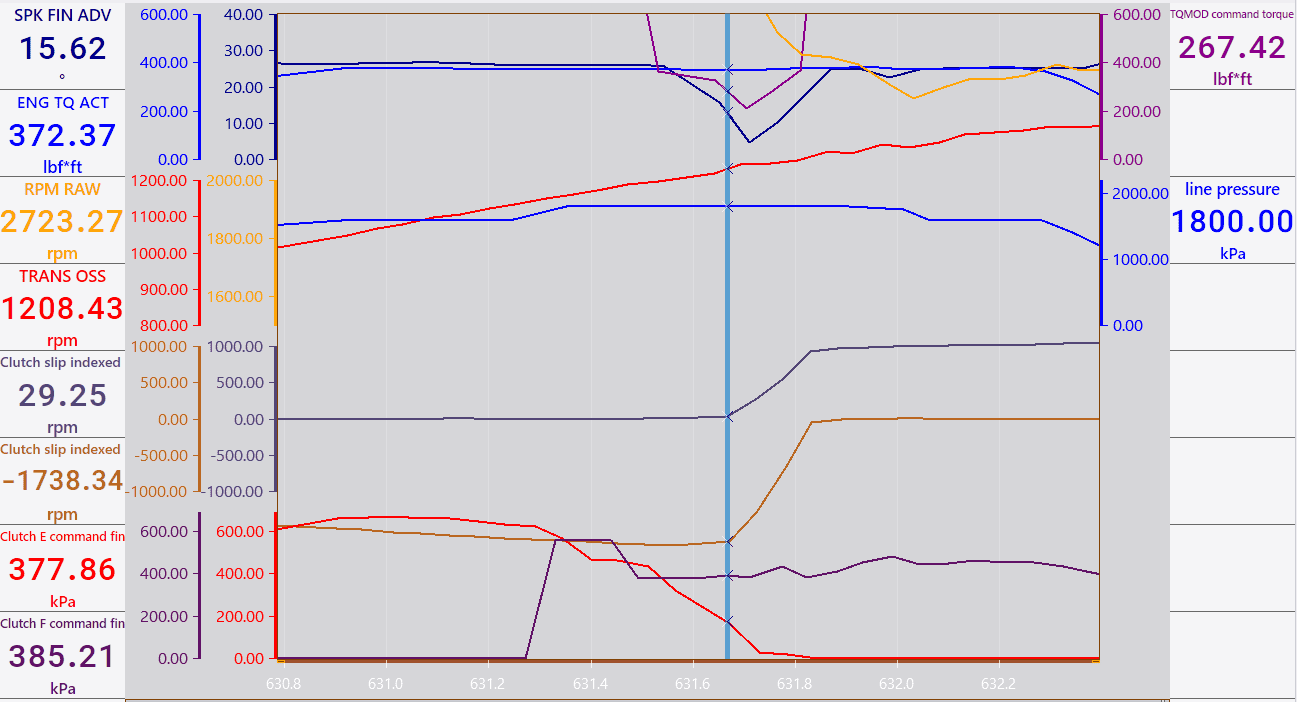
The following is a similar snip of a higher torque shift:
1725059652813-ux.png


On this shift, the actual shift only took about .1 seconds to complete, but the solenoids started moving about .4 seconds before the shift. The boost pressure and line pressure do not seem to follow the tables identified above that appeared to control it. Torque modulation appears to have started earlier, and once again no real defining event on the solenoid side indicating it should switch gears at that moment; just the pressure balance I guess.

Another thing I wondered about is what governs the clutch pressure between shifts.

1725060124215-qc.png


In this 3rd gear steady part of the log, it appears as though line pressure and clutch pressure modulate with torque, but there is also a minimum "floor" they aren't dropping below. However, the floor for the E clutch pressure of 313 kpa and line pressure of 410 kpa don't seem to appear in the tune file so I don't know where they are sourced from. To make matters more complicated, we know there is some "adaptive" learning that takes place, which can only happen if there are PID feedback loops. However, the only input to the transmission is solenoid electrical power and the only measurable output is clutch slip, which would imply the PID feedback loop is to relate clutch slip to solenoid power. This adds another layer of complexity.

So basically, after all that, I only have observations and definitely no explanation as to what all of the torque rates, torque transfers, ramp times, etc. do and how they interact to control the slip and shift firmness.

If anyone knows anything about how the shifts are controlled, I'd be interested in hearing it.
Sponsored


Robottrainer

Well-Known Member
Joined
Apr 25, 2021
Threads
79
Messages
992
Reaction score
421
Location
Canada
First Name
John
Vehicle(s)
2018 Ford Escape. 2020 Jeep Cherokee. 2021 Ford Mustang GT Stage 2 Roush
I started down the path of transmission tuning using PCMTec and, man, there's a lot here. I have had success transplanting shift characters and even making hybrid shift characters (normal shifts at part throttle and drag shifts at full throttle, for example), but I might just give up understanding how the tuning logic actually works. There are something like 15 parameters that control shift properties, not including shift schedule, torque modulation, or shift pressures (significantly more parameters). I was hoping to figure out how they all work together to control a shift. Parameter names are like oncoming ramp (time), offgoing ramp (delta time), torque rate offgoing, torque transfer offgoing, torque rate oncoming, inertia phase with 5 sub-phases (time), and many more.

Couple things I figured out:
- There are no pressure sensors in the transmission. All of the pressures are assumed based on the electrical power sent to the solenoids.
- There are 3 speed sensors in the trans. The logic calculates the slip of all the clutches based on these 3 speeds.
- There are 6 clutches and combinations of them create each gear. For every upshift, 4 clutches stay in their same state, one releases, and another applies simultaneously. For the clutches that remain applied before during and after the shift, the pressure is increased, presumably to prevent them from slipping during the shock of the shift.
- There is line pressure, and there is solenoid pressure. The line pressure is supplied to the solenoids, then the solenoids modulate it from there. So adding line pressure doesn't necessarily increase pressure applied to the clutch.

For the sake of logistics and logging, I decided to study the 3-4 shift. In that shift, the E clutch releases and the F clutch is applied. As I often preach, you have to reduce the channel list to a bare minimum if you want a high enough data rate to log things that happen quickly.

This is what a part-throttle 3-4 shift looks like:
1725053381364-cy.png


The cursor is placed at the point in time where the E clutch starts releasing and the F clutch starts grabbing. What's initially striking to me about this is that the clutches don't actually start swapping until a solid .7 seconds after the F solenoid sends pressure, while the actual shift only took about .3 seconds to complete. I guess this explains why part throttle paddle shifts are so laggy. Also noteworthy is that the line pressure is increased to 1150 kpa during the entirety of the shift. 1150 coincides with the "Trans Line Pressure Power On Upshift" table in HPT. Also, the initial pressure spike from the F solenoid appears to align with the "Trans boost pressure element F" table. Boost pressure is the pressure intended to just fill the cavities with fluid before the clutches are applied. You can also see that the torque modulation takes place just during the clutch swap time period. What I can't quite grasp is a) the fact that nothing in the way of solenoid actuation seems to trigger the switch from clutch E to F and b) how the dozens of torque rate, torque transfer, ramp time, inertia time, and other parameters play into this specifically.

The following is a similar snip of a higher torque shift:
1725059652813-ux.png


On this shift, the actual shift only took about .1 seconds to complete, but the solenoids started moving about .4 seconds before the shift. The boost pressure and line pressure do not seem to follow the tables identified above that appeared to control it. Torque modulation appears to have started earlier, and once again no real defining event on the solenoid side indicating it should switch gears at that moment; just the pressure balance I guess.

Another thing I wondered about is what governs the clutch pressure between shifts.
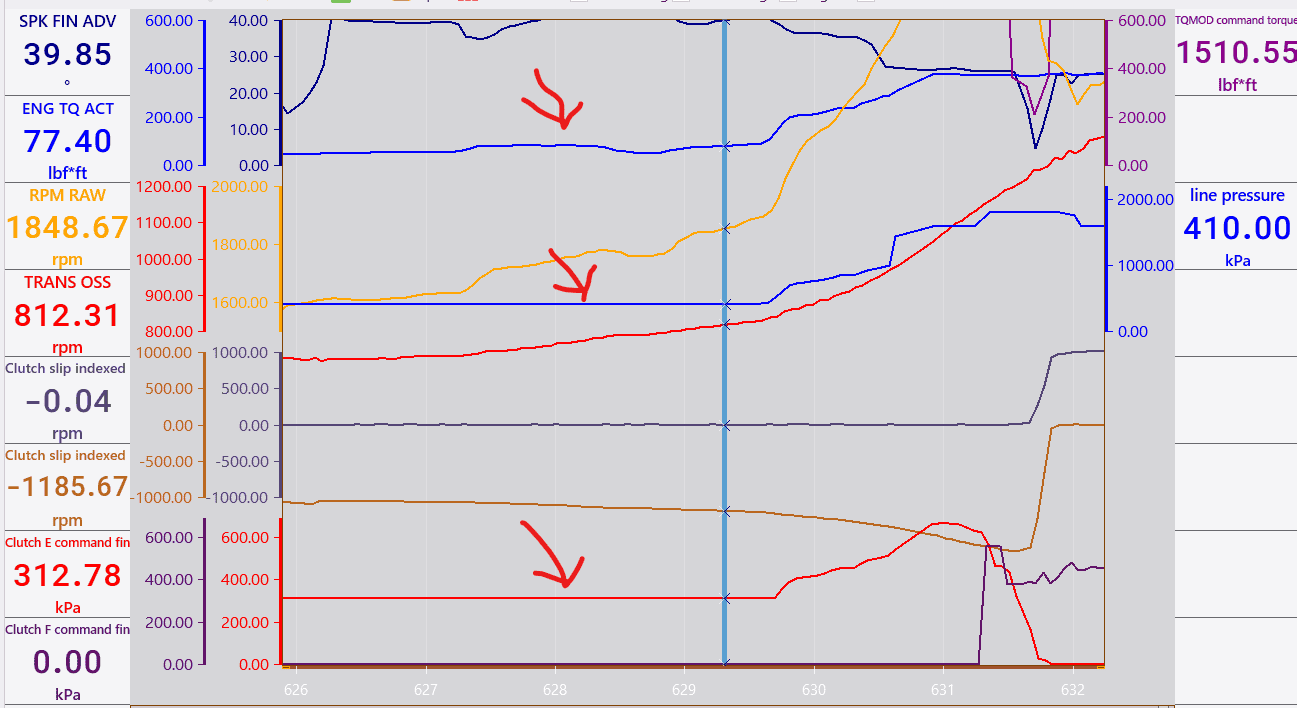
1725060124215-qc.png


In this 3rd gear steady part of the log, it appears as though line pressure and clutch pressure modulate with torque, but there is also a minimum "floor" they aren't dropping below. However, the floor for the E clutch pressure of 313 kpa and line pressure of 410 kpa don't seem to appear in the tune file so I don't know where they are sourced from. To make matters more complicated, we know there is some "adaptive" learning that takes place, which can only happen if there are PID feedback loops. However, the only input to the transmission is solenoid electrical power and the only measurable output is clutch slip, which would imply the PID feedback loop is to relate clutch slip to solenoid power. This adds another layer of complexity.

So basically, after all that, I only have observations and definitely no explanation as to what all of the torque rates, torque transfers, ramp times, etc. do and how they interact to control the slip and shift firmness.

If anyone knows anything about how the shifts are controlled, I'd be interested in hearing it.
Funny you should bring this up. I've been struggling with a 4th to 5th flair up that ranges from 100rpm to 500rpm if you lean it on it harder. The funny thing is it's only in sport/sport plus. And it seems to happen more when it gets above 170 degrees indicated AND it's intermittent. Sometimes it doesn't happen at all.

I have a rebuild manual and looked at what clutches/solenoids are on switching during the shifts. As you said, their are combinations of clutches/solenoids for each gear, a one way clutch and converter lock up.

Sport mode increased the line pressure and throttle response and holds the gears longer.

I took a Ford trans tech out for a ride. He agreed that if it were a sticky valve or clutch piston, I should see the same thing in other gear shifts. He said this could be from any number of thing. He's seen clutch clearances from the factory out by quite a bit. He also said the new CDF drum, while fixing the bushing moving, it hasn't stopped it from rotating in then drum. He agree the thermal bypass was a stupid idea.

I mentioned this thing hasn't thrown a code yet and he said it would need to go completely out to lunch before that happens.

As for the sensors. You would think the adaptive learning would see the 4th 5th flair up and move to another table. It doesn't seem to do that. Contrary to what people think, I don't think the adaptive learning adapts to your driving style. I think it's suppose to adapt and correct things like what I'm experiencing.

By the way, in normal mode the shifts are flawless. The throttle response and short shifts suck!
 

WildHorse

N/A or GO HOME
Joined
Jun 28, 2017
Threads
270
Messages
10,297
Reaction score
8,350
Location
Home World: CLASSIFIED
First Name
Puddintane
Vehicle(s)
'17 S550
Vehicle Showcase
1
Inadequate pressure applying at the clutches is why it flairs. If it does it in some modes, but not others that's a software problem.

However the 10R80 clutch packs are so finicky, they likely sustained some damage already.
 

Pistol_91

Well-Known Member
Joined
Oct 25, 2023
Threads
12
Messages
1,379
Reaction score
1,401
Location
Clearwater
Vehicle(s)
2020 mustang GT
Interesting read. I don't have much experience with the 10 speeds and they seem finicky to say the least. All I know is it seems like GM has theirs dialed in
 

Sponsored

Robottrainer

Well-Known Member
Joined
Apr 25, 2021
Threads
79
Messages
992
Reaction score
421
Location
Canada
First Name
John
Vehicle(s)
2018 Ford Escape. 2020 Jeep Cherokee. 2021 Ford Mustang GT Stage 2 Roush
Inadequate pressure applying at the clutches is why it flairs. If it does it in some modes, but not others that's a software problem.

However the 10R80 clutch packs are so finicky, they likely sustained some damage already.
I'm on my 3rd Roush re-flash. Roush doesn't touch the trans strategy. They piggy back on ford's. It it here software a refresh should fix it if it were flawed and if flawed many would see the same and it wouldn't be intermittent. 4th to 5th has the E clutch activate. The e clutch switches on and off with second, 3rd and 4th. I should see issues there too. If it's line pressure, why just 4th to 5th and why intermittently?

@Robottrainer do you have hptuners or pcmtec?
don't have anything yet. I can't get proof that they can read roush's tune in a 2021. I get should be able to. Nothing definite. Too much money for a gamble.
 
OP
OP

engineermike

Well-Known Member
Joined
Jul 15, 2018
Threads
31
Messages
6,180
Reaction score
6,431
Location
La
Vehicle(s)
2018 GTPP A10

Robottrainer

Well-Known Member
Joined
Apr 25, 2021
Threads
79
Messages
992
Reaction score
421
Location
Canada
First Name
John
Vehicle(s)
2018 Ford Escape. 2020 Jeep Cherokee. 2021 Ford Mustang GT Stage 2 Roush
@Robottrainer seems like they’re pretty confident. @Rolls

https://www.mustang6g.com/forums/threads/pcmtec.190584/page-22#post-4096048

Get me your osid and I’ll look in their cal library and see if, by chance, it’s already in there.

Pcmtec plus dongle is about $300 and includes credits.

If it only does it in sport mode I’m nearly certain it can be tuned out.
Not sure how to read that. It's a 2021 Mustang GT. Not sure of I can read the OSID with the Roush RTD. I've been talking to Wenegerd, but to be honest, I like the Roush tune for my purposes. The only thing I'd change is the fan thresholds. The normal mode shifts are perfect. If the sport mode was the same except a little tighter and hold the gear longer, It would be great. All I would want wenegerd to do is just that. The fans, and the trans strategy. Not sure if he works that way. I wouldn't know what to look at to adjust the 4th/5th shift in sport mode if I had a read writer. This is where Roush is useless. Their tune is their tune. They won't modify anything.
 

Robottrainer

Well-Known Member
Joined
Apr 25, 2021
Threads
79
Messages
992
Reaction score
421
Location
Canada
First Name
John
Vehicle(s)
2018 Ford Escape. 2020 Jeep Cherokee. 2021 Ford Mustang GT Stage 2 Roush
I'm finding I'm spending more time and money fixing Fords shortcomings whether it's from accountants or engineers. My buddy has a 16 Hellcat. Only issues he's had is blown rear diff/axles. Alot cheaper to fix than an 10R80. Thinking I should have spent the extra money on one.
 
OP
OP

engineermike

Well-Known Member
Joined
Jul 15, 2018
Threads
31
Messages
6,180
Reaction score
6,431
Location
La
Vehicle(s)
2018 GTPP A10
Not sure how to read that. It's a 2021 Mustang GT.
How are you reading it?

Not sure of I can read the OSID with the Roush RTD.
I think you can. It’s a 5-character code like FMJJ5.

I've been talking to Wenegerd, but to be honest, I like the Roush tune for my purposes.
The inner workings of the Roush tune are fantastic.

The only thing I'd change is the fan thresholds. The normal mode shifts are perfect. If the sport mode was the same except a little tighter and hold the gear longer, It would be great. All I would want wenegerd to do is just that. The fans, and the trans strategy. Not sure if he works that way. I wouldn't know what to look at to adjust the 4th/5th shift in sport mode if I had a read writer.
Fan thresholds can easily be done yourself. For the shift flare, the first thing I would try is using character 0 or 2 in sport mode. It’s a super easy change. You could also consider @DRP Motorsports because I know he uses the Roush tune as a baseline and goes from there, plus does actual custom tuning not just cut and paste.

This is where Roush is useless. Their tune is their tune. They won't modify anything.
Their tune is emissions certified and every change has to go through the cert process. They’re not in the custom tuning business.
 

Sponsored
OP
OP

engineermike

Well-Known Member
Joined
Jul 15, 2018
Threads
31
Messages
6,180
Reaction score
6,431
Location
La
Vehicle(s)
2018 GTPP A10
@Robottrainer the E clutch engages for 5th but also 3rd, you never see the flare issue on the 1-3 or 2-3 shift?
 

Robottrainer

Well-Known Member
Joined
Apr 25, 2021
Threads
79
Messages
992
Reaction score
421
Location
Canada
First Name
John
Vehicle(s)
2018 Ford Escape. 2020 Jeep Cherokee. 2021 Ford Mustang GT Stage 2 Roush

WildHorse

N/A or GO HOME
Joined
Jun 28, 2017
Threads
270
Messages
10,297
Reaction score
8,350
Location
Home World: CLASSIFIED
First Name
Puddintane
Vehicle(s)
'17 S550
Vehicle Showcase
1

Robottrainer

Well-Known Member
Joined
Apr 25, 2021
Threads
79
Messages
992
Reaction score
421
Location
Canada
First Name
John
Vehicle(s)
2018 Ford Escape. 2020 Jeep Cherokee. 2021 Ford Mustang GT Stage 2 Roush
It's a flaw as I said. Intermittently depending on drive mode, load, blah, blah.
Take a look at this, should answer your question as to what's actually at fault.

https://www.transmissiondigest.com/10r80-10l90-10-speed-solenoid-function/
This adds another layer of questions. If the strategy is flawed, it could explain this. The solenoid getting the wrong voltage value leading to a pressure variation during certain shift conditions. So how to correct this?

Since there is no TCM and everything resides in the PCM, and Roush doesn't modify the trans data, what happens when a new roush version is loaded? I suspect nothing....unless it's built on a revised Ford strategy and the revised strategy has a trans update that fixes the problem. Which brings me around again to the "if it is flawed, shouldn't other cars have the same problem?"

OR

Does mine have the wrong solenoid strategy? Can it be verified and if wrong, can the right one be loaded and does the Roush strategy need reloading? So many questions...
 

Robottrainer

Well-Known Member
Joined
Apr 25, 2021
Threads
79
Messages
992
Reaction score
421
Location
Canada
First Name
John
Vehicle(s)
2018 Ford Escape. 2020 Jeep Cherokee. 2021 Ford Mustang GT Stage 2 Roush
This adds another layer of questions. If the strategy is flawed, it could explain this. The solenoid getting the wrong voltage value leading to a pressure variation during certain shift conditions. So how to correct this?

Since there is no TCM and everything resides in the PCM, and Roush doesn't modify the trans data, what happens when a new roush version is loaded? I suspect nothing....unless it's built on a revised Ford strategy and the revised strategy has a trans update that fixes the problem. Which brings me around again to the "if it is flawed, shouldn't other cars have the same problem?"

OR

Does mine have the wrong solenoid strategy? Can it be verified and if wrong, can the right one be loaded and does the Roush strategy need reloading? So many questions...
And then again, if the solenoid match programming were wrong, I would see this problem in all drive modes, not just sport, sport plus or track. If it's software, the flaw resides in the Sport, sport plus and track settings, specifically whatever controls the 4/5 shift. Again, I come back to other would also be seeing this, so it might be a specific mechanical aspect of this transmission not playing well with strategy. In this case it two choices. Fix the mechanical aspect, or modify the strategy to cope with the mechanical side being out of spec which is what Mike engineer has said. You'd think the adaptive learning would take care of it. Obviously it must be seeing the rpm differences in the 3 sensors and recording the slip values. Maybe it needs longer to figure it out? I would think 5000 miles would be enough
Sponsored


Top