dpAtlanta
Well-Known Member
- Joined
- Apr 30, 2019
- Threads
- 35
- Messages
- 2,372
- Reaction score
- 5,733
- Location
- Atlanta, GA
- First Name
- Dave
- Vehicle(s)
- '19 GT350 (#K2503), '17 Cayman, '24 Bronco Badlands 2-door, '26 Ranger Raptor
- Thread starter
- #1
Here is a little primer on the mysterious Black Box in our cars.
The "Black Box" goes by many names: Event Data Recorder (EDR), and Crash Data Recorder (CDR) are the two most commonly used.
History
In 1994, General Motors was the first to allow the data in the EDR to be accessed. The software was by a company called Vetronix; Bosch acquired Vetronix and is the current largest player. The software and equipment is available to the public.
Ford came on board next in 2001, and Chrysler followed in 2006. The government started getting involved in 1997, but it wasn't until the NHTSA recently required that all vehicles that record data make it accessible. Porsche is the ONLY manufacturer that does not "record" the data.
The original data was sparse. The EDR print outs were typically 5 - 6 pages. It only recorded longitudinal delta V from a frontal impact. It gave both Pre-crash and crash data. The pre-crash data would typically be 5 seconds prior to the event and give: 1. Vehicle speed, 2. Engine rpm, 3. % throttle, 4. Brakes on/off, 5. Seat belt status. The crash data is measured in milliseconds (msec), and gives delta V over time. The average crash pulse is over in 100 to 150 msec (.1 to .15 seconds).
Stability control, side airbags, and electronic assist steering has made the EDR printouts as many as 70 pages now. The same 5 things are still present, but now I commonly see steering angle of the steering wheel, lateral delta V's, yaw rate, and a lot more.
What wakes it up?
The system wakes up when there is an airbag deployment, or a near deployment event. There are multiple sensors on the vehicle to sense changes in velocity. In order to wake up the system, there needs to be approximately a 5 to 8 mph delta V within 100 to 150 msec in order to wake up the system. This will be recorded as a non-deployment event and will save 5 seconds of data prior to waking up. If the vehicle senses approximately 8 to 15 mph within 100 to 150 msec, then the airbags will typically deploy. The data 5 seconds prior will be permanently saved, and the EDR module is now ka-put! If you slam on your brakes while hitting a speed bump, there is a good chance you will create a non-deployment event. The only way to know however, would be to download the data... no airbag light or check engine light will illuminate.
The system woke up during this event... but should the bags have deployed?

Still say yes?
They didn't! They didn't need to.

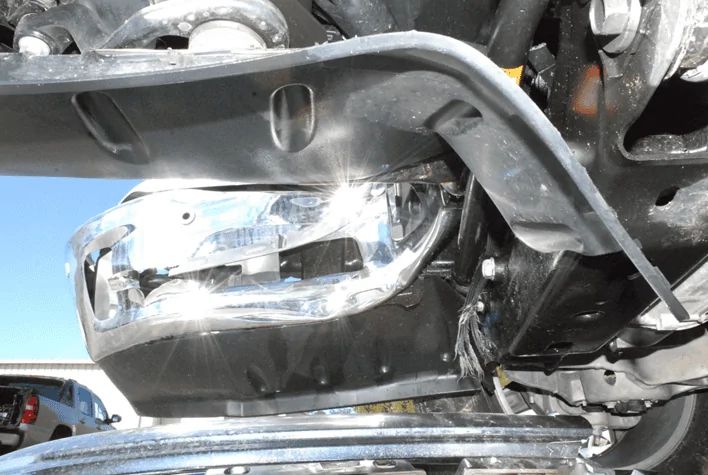
The slope of the curve on the top graph is too gradual. The vehicle slowed down gradually and never hit structure. The photo looking up at the bumper shows the tree never got to the cross member.
The systems are so smart, they perform calculations every 10 msec during the beginning of the crash. The calculations attempt to determine what the speed is going to be at 100 msec into the crash. These calculations start as soon as the system wakes up and does it's first calculation at 0.01 seconds into the impact. If the calculations show that the threshold to deploy the bag will be reached, then the bags will deploy earlier. Here is the crash pulse with the math added in red to explain what I'm describing:

The threshold for this Ram truck was greater than 8.1 mph.
The driver was NOT injured. His new truck was not totaled and he said it was defective because his bags didn't deploy, and he did not want it repaired. Once again, he was NOT injured.
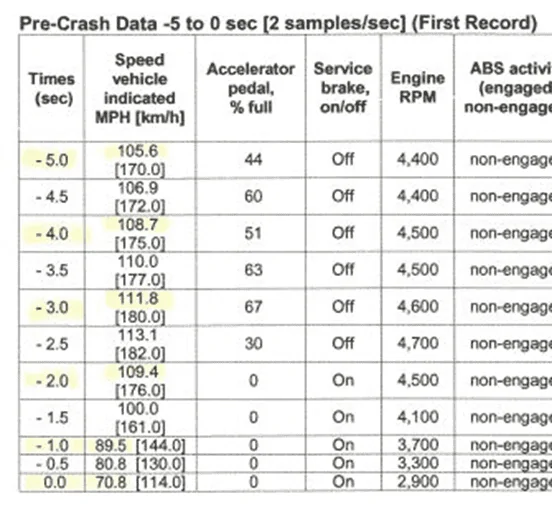
Sometimes the data is not helpful for the owner. Below is a close up of the pre-crash data from a 2010 Mustang GT driven by a 16 year old who told the police and his father that he was only going 45 mph (posted) when the accident occurred:

How do you get the data?
I'll post this later... this post is getting pretty long.
The "Black Box" goes by many names: Event Data Recorder (EDR), and Crash Data Recorder (CDR) are the two most commonly used.
History
In 1994, General Motors was the first to allow the data in the EDR to be accessed. The software was by a company called Vetronix; Bosch acquired Vetronix and is the current largest player. The software and equipment is available to the public.
Ford came on board next in 2001, and Chrysler followed in 2006. The government started getting involved in 1997, but it wasn't until the NHTSA recently required that all vehicles that record data make it accessible. Porsche is the ONLY manufacturer that does not "record" the data.
The original data was sparse. The EDR print outs were typically 5 - 6 pages. It only recorded longitudinal delta V from a frontal impact. It gave both Pre-crash and crash data. The pre-crash data would typically be 5 seconds prior to the event and give: 1. Vehicle speed, 2. Engine rpm, 3. % throttle, 4. Brakes on/off, 5. Seat belt status. The crash data is measured in milliseconds (msec), and gives delta V over time. The average crash pulse is over in 100 to 150 msec (.1 to .15 seconds).
Stability control, side airbags, and electronic assist steering has made the EDR printouts as many as 70 pages now. The same 5 things are still present, but now I commonly see steering angle of the steering wheel, lateral delta V's, yaw rate, and a lot more.
What wakes it up?
The system wakes up when there is an airbag deployment, or a near deployment event. There are multiple sensors on the vehicle to sense changes in velocity. In order to wake up the system, there needs to be approximately a 5 to 8 mph delta V within 100 to 150 msec in order to wake up the system. This will be recorded as a non-deployment event and will save 5 seconds of data prior to waking up. If the vehicle senses approximately 8 to 15 mph within 100 to 150 msec, then the airbags will typically deploy. The data 5 seconds prior will be permanently saved, and the EDR module is now ka-put! If you slam on your brakes while hitting a speed bump, there is a good chance you will create a non-deployment event. The only way to know however, would be to download the data... no airbag light or check engine light will illuminate.
The system woke up during this event... but should the bags have deployed?
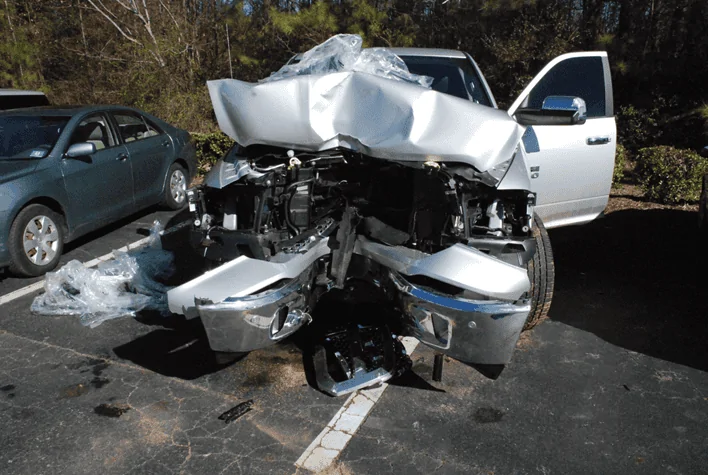
Still say yes?
They didn't! They didn't need to.
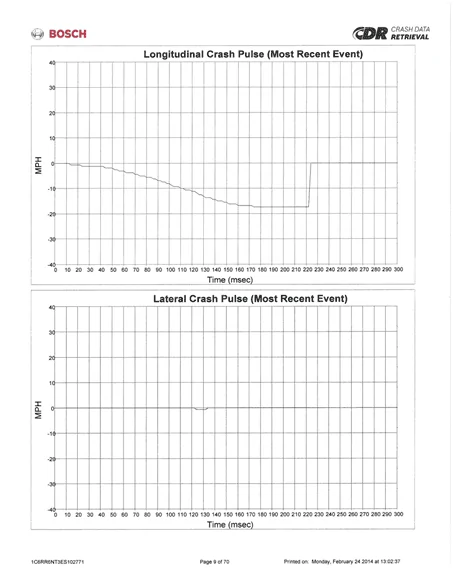
The slope of the curve on the top graph is too gradual. The vehicle slowed down gradually and never hit structure. The photo looking up at the bumper shows the tree never got to the cross member.
The systems are so smart, they perform calculations every 10 msec during the beginning of the crash. The calculations attempt to determine what the speed is going to be at 100 msec into the crash. These calculations start as soon as the system wakes up and does it's first calculation at 0.01 seconds into the impact. If the calculations show that the threshold to deploy the bag will be reached, then the bags will deploy earlier. Here is the crash pulse with the math added in red to explain what I'm describing:
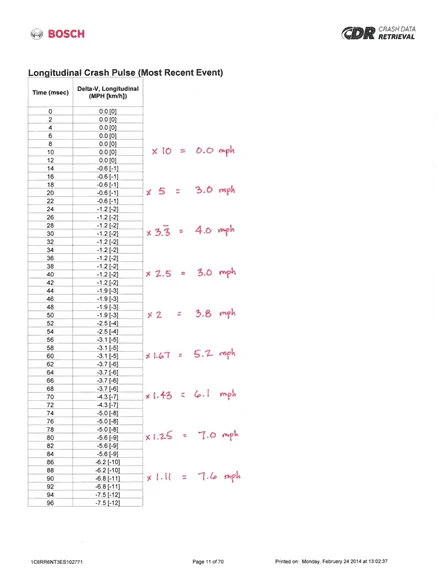
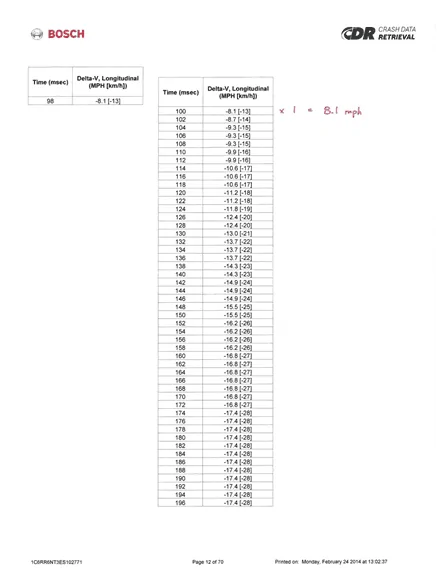
The threshold for this Ram truck was greater than 8.1 mph.
The driver was NOT injured. His new truck was not totaled and he said it was defective because his bags didn't deploy, and he did not want it repaired. Once again, he was NOT injured.
Sometimes the data is not helpful for the owner. Below is a close up of the pre-crash data from a 2010 Mustang GT driven by a 16 year old who told the police and his father that he was only going 45 mph (posted) when the accident occurred:
How do you get the data?
I'll post this later... this post is getting pretty long.
Sponsored
Last edited: