Sponsored

RLCA Help: Spherical Bearing vs. Poly Bushing

RLCA: Poly Bushing or Spherical Bearing?


  • Total voters
    47

fatbillybob

Well-Known Member
Joined
Apr 1, 2017
Threads
43
Messages
554
Reaction score
273
Location
SoCal
Vehicle(s)
'19 GT pp1 A10 Orange
I'm very hopeful Ford will catch up in the IRS game and make multi link IRS on the new S650

They are not capable of balancing performance with bean counting as evidenced by the S550.
Sponsored


Norm Peterson

corner barstool sitter
Joined
Jul 22, 2013
Threads
11
Messages
8,852
Reaction score
4,652
Location
On a corner barstool not too far from I-95
First Name
Norm
Vehicle(s)
'08 GT #85, '19 WRX
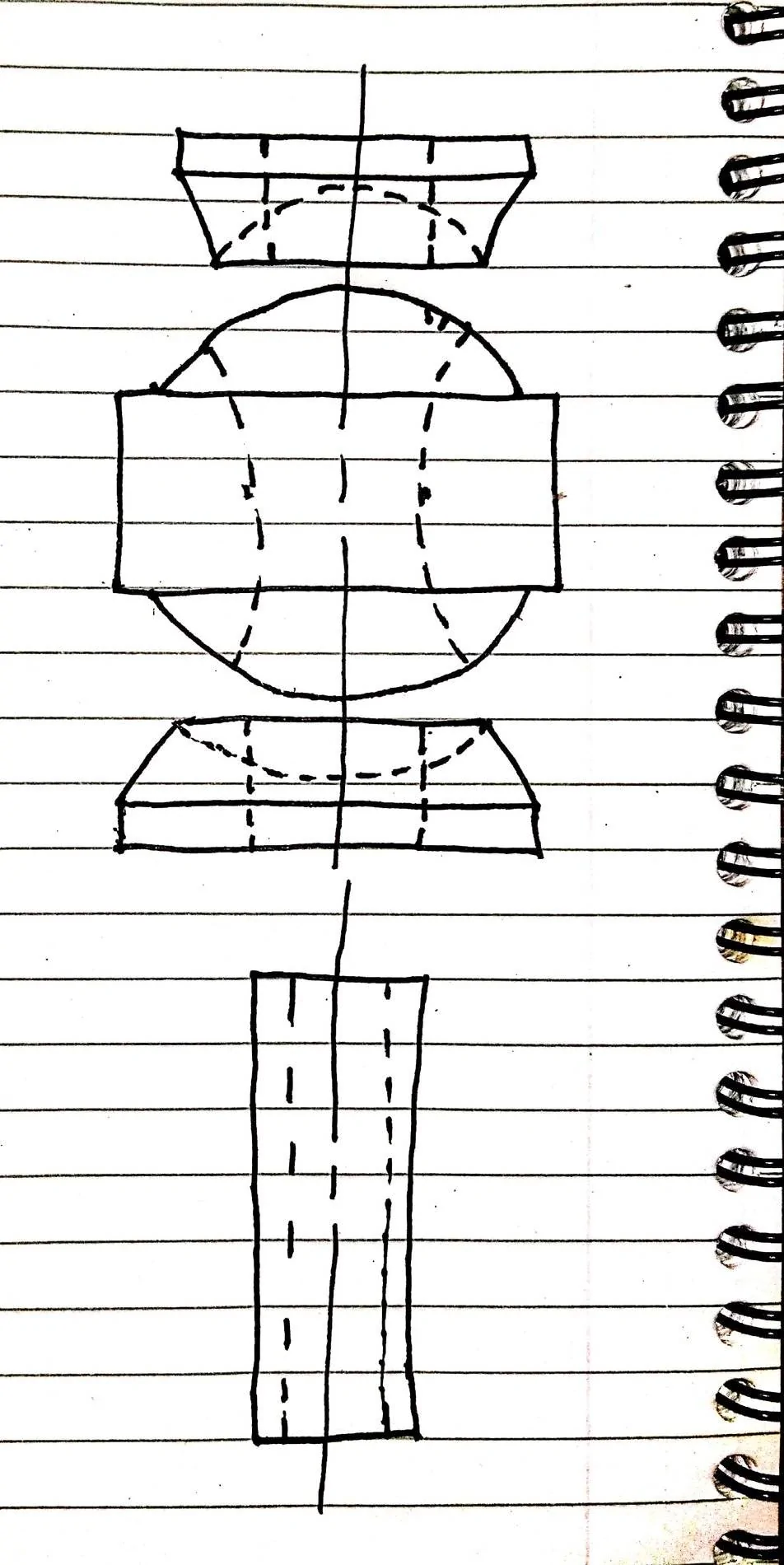
This is something along the lines of what I'm thinking. The two outer races would stay fixed in their position. The 'ball' has a through hole with a curved profile which pressed into the tension link & accommodates a couple degrees of off-axis motion.

The inner sleeve would be steel and sized to accept the compression load of the bolt clamping load. An alternative approach would be to have the through hole with straight sides and machine the compression sleeve to accept the off-axis motion.

For what it's worth, I have a local machinist who could produce this, but low numbers are always expensive. I'm a little concerned about the ability of the Delrin to accept the bearing loads, so we'd want to limit the amount of curve on the hole & it would probably have some sort of interference fit.

Keep in mind that this is what popped into my mind when you posed the question. I'm sure there are many other ways of doing it.
CamScanner 09-03-2020 21.13.24_1.webp
I think you've just designed a Johnny-joint (Currie) or Roto-joint (UMI). It's definitely a valid approach, as long as the class rules don't specify that bushings that accommodate off-axis rotation through bushing material compliance must remain that way. IOW, you wouldn't be allowed to use this approach if you're not allowed to substitute sliding on a spherical surface for bushing distortion. I'm pretty sure this thinking exists for at least some classes with SCCA.


FWIW, I have Johnny-jointed rear LCAs on my '08.


Norm
 

Norm Peterson

corner barstool sitter
Joined
Jul 22, 2013
Threads
11
Messages
8,852
Reaction score
4,652
Location
On a corner barstool not too far from I-95
First Name
Norm
Vehicle(s)
'08 GT #85, '19 WRX
Interesting idea. So the holes in delrin would allow the delrin to sort of yield and free up for the off axis. I wonder how many bend cycles the delrin could take? I think if delrin as pretty rigid vs poly u which is more elastic.
I have no idea how well Delrin would fare, but then again I wasn't sure how well poly was going to hold up either (and never would have guessed how well it actually did).

There are other approaches that might work better, involving tapering the ends on either the sleeves or the Delrin (or both) while leaving both "cylindrical" over some length in the middle. I'd expect a certain amount of experimentation to be necessary, given that it took me at least two tries with the poly before I was satisfied.


Norm
 

TeeLew

Banned
Banned
Banned
Joined
Apr 27, 2020
Threads
15
Messages
3,396
Reaction score
2,609
Location
So Cal
First Name
Tim
Vehicle(s)
Honda Odyssey, Toyota Tacoma, 89 GT project, 2020 Magnetic EB HPP w/ 6M
I think you've just designed a Johnny-joint (Currie) or Roto-joint (UMI). It's definitely a valid approach, as long as the class rules don't specify that bushings that accommodate off-axis rotation through bushing material compliance must remain that way. IOW, you wouldn't be allowed to use this approach if you're not allowed to substitute sliding on a spherical surface for bushing distortion. I'm pretty sure this thinking exists for at least some classes with SCCA.
I never knew the name, but it's certainly not something I invented. It's just a way to do what needs done.


It would be a little strange to mandate delrin & say it had to deform. That's not its strong suit.

I did have the thought that instead of machining this, maybe I could print it. I could get more clever with the shapes, but I trust the strength of the material less. Maybe that skepticism is misplaced, but, regardless, it would be good to use for mock up.
 

Norm Peterson

corner barstool sitter
Joined
Jul 22, 2013
Threads
11
Messages
8,852
Reaction score
4,652
Location
On a corner barstool not too far from I-95
First Name
Norm
Vehicle(s)
'08 GT #85, '19 WRX
I never knew the name, but it's certainly not something I invented. It's just a way to do what needs done.
Exactly. Once you've even seen pictures of rod ends/Heim joints used in this or similar applications it's pretty easy to go from there.

At least within the SCCA's basic rules philosophy of "if it doesn't specifically allow it, it is not permitted", you have to be careful.


Norm
 

Sponsored

308 Cal. Bullitt

Well-Known Member
Joined
May 3, 2020
Threads
9
Messages
408
Reaction score
465
Location
Midwestern-former Left coast
First Name
Dee
Vehicle(s)
'22 GT500 + other 2/4/& 6 wheeled trash barges
From Bonneville to the Baja.
W/heavy emphasis on Several decades of
NHRA/& IHRA World Championship Car Builds, under our belt. & prof. Drag race car construction being the bulk of our
60k plus hours of experience.

We know these truths to be self evident.

The rules are beyond simple.

If its a real race car..
or u want "real race car" handling characteristics.

You use ;
Teflon lined Spherical bearings.

Stainless steel preferably for corrosion resistance.
Every NHRA/IHRA Pro Stock car for decades has gotten Stainless steel Teflon lined Spherical Rod ends. PERIOD!@!

Regular Spherical bearings are just "ok".

They are generally reserved for ametuer car builder status.. & cheap manufacturers goids..
at least in competitive racing circles they are not competitive. Unless teflon lined 1st.
Stainless is just a topping..

If on the other hand its considered a daily driver.
or street enthusiasts driver veh.
.. & you want the least amount of anything transmitting thru the any link points in ur suspension ( issues now referred to as NHV these days)
You can use Poly if you want. Some designs are better than others. We often build our own. Not always thou.

The mild steel outer containment "housings" of poly bushings are considered junk.. by most who care about quality.
...but they do work for people....

You just wont get mild steel (aka- pig iron) of any type components, on your car, unless there ametuer built pcs.

Professionals use primarily 4130. In some cases Alum. of coarse. Magnesium & still some Titanium. And stainless as well in proper areas. As materials go in general. Not for ROD ENDS... in most of above materials.. obviously.

If your car is both (street driven and see's track wrk),
you must decide for yourself what You want.

( U want Teflon lined Spherical.. in case u needed to be told.
Preferably in Stainless, if you can afford them).

Whether your needs are
COMFORT OR PERFORMANCE. Can you get comfort w/race quality rod ends? Depends on your definition of comfort. The builder design has an effect as well.
2 Link? 3 Link?? 4 link? Or our S550 IRS SETUP..??

.. Since everybody has an "Opinion"...
u can go that route & ask everyone..

& then u can also go with people w/over 60,000+ hrs of experience in this field, and a ton of experience on this exact topic. Your choice.

This topic comes up in the business end of many race / high end street builder shops,
that must placate there clients w/street cars.

clients who often hav real race cars 1st and foremost.. & still own some street driven hi perf. Veh... & they do not trust anyone else..
but there preferred race car builder..
to do there daily driver suspension updates. So u will often see daily driver cars in Professional race shops. As these clients pay like rigged slot machines.

So you must not turn them away based on your moral high ground of a street car being beneath you. $125 an hr is $125 an hr. Regardless of what your working on. Street beater or racecar. Your gonna wrk on it fir a good paying client.

( No builder is gonna say no too $100+an hr..
cash paying client, who only wants it done correctly. Cost is like 3rd or 4th, on there list of priorities.

w/proper materials welding/ fabrication/ machining skills & equipment in any good shop.

Most $100 an hr shops. are much cheaper than the these $50 an hour shops.
Just do to the huge disparities in quality & amt of equipment between the 2 program types.

We hav 3 bead rollers. Do we need 3. Well yes.
1 for 1/4 rolls. 1 for beads. 1 for tube lips & large radius's. While other guys are changing dies. Are bead rolling is already done & we are off doing the next operation.

Grinders? We have likely 30+.
You never change tools in a grinder. You change the grinder your holding in your hand in 2 seconds.

Thats just a few simple examples of the diff. between a $50 an hr shop
& a $100+hr shop.

A $100 an hr shop will have over 8/12+ GOOD WAYS to put a hole in a pcs of material. None of these apparatuses will be made in China...
or bought from 'The Devils Toolbox'
<Aka- harbor freight.>

As an example.. Poly vs Spherical.
NOT one of Bob Gliddens 10 World Championship, his NHRA pro stock cars.

NON OF THOSE 10 DIFF cars that secured those points championships, had any type of poly in the 4 link systems... Ladder bars on like 1 of the early cars. All his 80s/90s cars had Stainless steel teflon lined Rod ends.

Spherical bearings on suspension date way bk beyond the early 1970s...
. For those who dont know who he is. Mad Dog was a winner of 85+National event wins..
.. and most were done back when we didn't have 27 races a yr. Many of his were done when we had only 8 races a yr.
I participated in the build of the car Bob won his last of the 10 -- NHRA W/C'ships with..

That car won its 1st 7 --- of its first 11 National events that yr.. Countless other achievements as well.. of just that 1 car alone..
All Spherical rod ends on that car.
All stainless steel teflon lined Spherical's from Roger Lamb's inventory.

This was bk when many of u were barely born I suspect.. In 1989. It had no --ZERO--
Poly suspension ends on it..
31 yrs ago.. WHY? Cuz it was a real race car.

Only rarely will the occasional exception to the normally
"hard & fast rules", of Spherical vs poly be over ridden.

In the realm of some $500k Trophy Truck builders ... Guys who did infact use some custom made proprietary poly type ends on a few areas...

Mostly what we saw or participated on construction of that was a variation to
"the rule"...
Was using poly on the 'front end of the rear lower control arms the shocks mnt'd on'..
that were several foot long..

These were the rear lower 4 link trailing arms that went from chassis to rear end housings.

Custom 4" diam. Axle tube housings we built for Trophy Truck racers after they broke there $10,000 units from the supposedly best guy in the country who couldnt even keep the face plates flat.

We did 100% of the welding on the nain housing. Then machined the face flat to correct dept. The bolt holes to Fords Blue print on a 9". So all critical hole locations were done after welding. Nobody was doing that on these $500k trucks 20 yrs ago.

Except for us. We were. We did. And are design is still copied to this day. As the strongest 9" housings design ever built thats also light. ( there is a loint to these trucks being mentioned as they used poly on occasion..

A small group of Baja & offroad type Trophy Truck racers & builders/vehicles.. Used poly on a few places w/ these..but not for NHV reasons at all.

[these are $1/2 million+ plus rides, BEFORE support equipment is bought.. on that half Mil bill.
Just to construct.. google Robbie Gordon -Baja ... sometime]

...but.. just because Poly ends were used @ the time.. by a small group of racers... builders..
does not make it correct for that purpose either.. from an engineering standpoint..

They have other reason's than an S550 owner would hav.. for using Poly..
& for using hand built,
1 off Poly suspension link ends.

Where in this design constraint, it was done for a different reason all together than this topic of NHV.

Noise & vibration wise. Poly will always be a more absorb-ment sub assembly part in the connection of the big picture... of anything between the
"rear tires- forward - to say... - the transmission",

POLY IS Better at absorption than anything that has NEARLY ALL metallic transference property's built into the ROD END.... itself.

THE RULES ARE SIMPLE FOR ALL PROFESSIONAL
CHASSIS BUILDERS;

Race car ON ASPHALT : A Spherical Bearing...
A TRUELY REAL "RACE CAR"...
goes 1 step further with a
"TEFLON LINED", & GENERALLY STAINLESS
SPHERICAL BEARINGS.

Application where people might...??
or will likely.. whine.. or cry.. about the transfer of ANYTHING thru the suspension links..

That they deem annoying. Those people are the candidates for the POLY END style of components. Whether made by your own hands or bought on open market. We build most of our own stuff. Becauseyou cannot usuallybuy what you need that is properly engineered. You can buy mass produced cheap chit all day.. Thats a given..

You can argue this topic till we put a colony on Mars that has reproductive capabilities..

Yet. Still. The truth of how these 2 DIFF components... & how they ea. work, will never change.

Only ON THE POLY WILL the "durometer"..
or the clearances built into the materials final assembly, hav cause and effect that are not the same as an all metallic..or better yet. A Teflon lined setup.

Best yet. STAINLESS STEEL TEFLON LINED Spherical bearings. PERIOD. THE BEST. & MOST EXPENSIVE AS WELL.

@well over $120 per end of a link.

Without including any wrk done to produce the arm or 'bar' from any materials of billet or 4130 or Titanium.

We spec our "tightness " of our Teflon lined Rod ends on occasion for specific use..

They can be made / (built) either from a spec thats somewhat loose on the 52100 monoball...
to a spec that is so tight.. The 52100 ball,
inside the Spherical rod end bearings are considered an
*additional chassis dampener* , due too increased friction of movements.. in some cases so stiff its well beyond the traditional shock absorbers own responsibilities..

This can be known as an extra dampener that cannot be controlled or adjusted like a typical dampener... That is not what we want or try to achieve in most cases. We need a fairly free moving suspension system.

So you must be careful when using very tightly fitted teflon lined Spherical Rod ends and there degree of clearance..or lack of we should say..

Although once you get IN & OUT Of the several mikes of WHOOPS of ' San Felipe ' Mexico..,
Your very tightest of teflon lined rod ends, are likely no longer so... tight..

On a drag car.. it can take a yr+ to loose up a too tightly procured teflon lined rod end,
causing additional dampener inhibited characteristics into the chassis setup. Not good.

We practice what we preach. Poly & Spherical.

Our 600hp+ N/A- daily driver trk w/36k miles..
That we built 11+ yrs ago.. Uses poly outer bodys that are made from
'17-4 - Investment Cast - Stainless Stl housing's',

(threaded for adjustment w/jam nut, just like any typical Spherical rod end would hav.)

& we have integrated into them, a poly we like quite well for daily street driving veh.... ( these are not cheap either)..
These are attached to our own proprietary - 4 link design system.

We should also note.. Not the single most important thing about 'poly' is..
or isn't.. I should say...
even the housing materials .. or the Durometer ( hardness) of the Poly itself, in most cases..

Its in the fitting of the inner metal 'thru tube' you often use instead of just a 'bolt' only..going thru the poly bushing. A thru tube is nearly always a MUST.

Your THRU Bushings Will usually be between your double shear brackets.

We say 'brackets'.. plural...
cuz anything on a suspension..
mounted in Single Shear is...
Is yet again... Another marker/indicator, of an ametuer car builder or manufacturer/vendor.

Including a car built by OEMs who do this EXTREMELY POOR ENGINEERING DETAIL in there own builds.. using single shear suspension links.
Shame on those cheap bastards !@!

If you built the greatest ever .. Most spectacular engineering feat of any racecar ever seen by man... and put just 1 or more of the suspension links in 'single shear'. Any & all World Championship
"crew chief's or team engineer's".. would likely not EVER GIVE THAT BUILDER THE Nod.. EVER..
to build them a race car.. EVER...

Stainless rod end use are primarily used against Fighting the possibility of corrosion.
A real race car short of a Rally car or offroad car should never see corrosion on it if uts life is on asphalt. But it can happen over time.

They ( stainless rod ends) hav no increased radial load properties or axial load strength increases, either.
A bit less % wise than 4130 heat treated materials in most cases.
They just fight something that most ametuer car racers /builders usually have under there veh's after a few yrs.

Corrosion. Of some sort if not well maintained.

Our proprietary 4 link, on our own Drag racecar we constructed for use in NHRA Pro Stock...
Has nothing but Stainless steel teflon lined Spherical's everywhere.

Radial load strength is a bit less on stainless body's vs 4130 heat treated body's. As most wsntbto argue this miniscule amt when looked at as a % difference.

We & everyone else over engineer's all Spherical Rod end area's enuff anyway to withstand severe tire shake.. Probably something few here on 6G have ever had the pleasure of experiencing.

Our own drag car.. nothing short of a real turd boiler..
runs .97 & .98 - 60fts. Regularly.
w/ a single 4 barrel.
632" Dart block Tall deck.

Our '53 GMC Trk daily.. on the other hand.
Is Nearly all poly.. Except for the Koni, SPA1, Dbl adj. Rear coil over shock mnt ends.

As its a daily. Not a race truck.. close to 40,000 miles on that trash barge.

The only absolute HUGE NO NO in all this suspension business besides all the obvious..
..IS the guys who still put old school
ladders bars on a street car builds,
(Absolutely the worst idea ever)
& use a Spherical type end link point on the front single pick up points of each side. Poly is bad too overall on these setups.

That setup will drive nearly anyone mad ...noise wise..on a street beater.
<or nhv> as u young-sters call it.
That setup will work until they 1 day hav either physically torn the welds apart on the axle tube,
or torn the bracket materials near the housing axle tube welds,....
Torn or tearing off the rear end housing usually.

Street car or race car. Enuff laps and it will cause failures from fatigue of 2 triangles that cannot rotate freely about there own individual axis points.
So 2 fixed triangles wanting to move independently every time you hammer the throttle.

They then 1 day will break 1 of the front rod ends at some point in/on most cars trying to use the 1970s technology known as Ladder bars. If brackets dont tear 1st.

Hence why NHRA REQUIRES AN ADDITIONAL SAFETY DEVICE to secure the front mnts on this suspension design..

ON THIS SETUP alone.. per NHRA rule book..
ON A RACECAR that has 1 point Per side up front, on that single pivot location per side. Poly or Spherical. Makes no matter.
. Must hav AN NHRA APPROVED ADDITIONAL SAFETY DEVICE, TO CATCH ASSEMBLY WHEN IT BREAKS. NOT IF..WHEN..

Seen many drag cars break that area running
ladder bar suspensions. Poly or not.

Many more street cars break as well using it.
A good estimate is that about one - 40 mile road trip on the street ..
equals bout 4 yrs at the track only on these setups.

When buying and installing a typical .. mail order..
ladder bar suspension setup..
Most guys buy cuz they are cheap.. & put on car builds not knowing what they are getting into. Ifvits in a magazine it must be safe..yes?? Nope..

Its still a good setup ( ladder bars)
for a slower type drag car ..
Running say.. high 7's or slower.. in the 1/4 mile.

Not so good AT ALL, on ANY daily street car.

You need More points of pivot that a total of 2..
on the front end, of the chassis end of things ..

Which any Mustang built since '79 has...a 4 link. Or 3 link..later in mid 2000s. w/solid axles...
You can run stk rubber.. poly or Spherical on them..
& its up to u what u can afford & tolerate.

What you will never find is a professional race car that runs mid to low 7s ...(in the 1/4 mile)..
or even qwiker... that uses poly rod ends or poly links on the main suspension ends.

If so.. the builder of this veh. is worse off than being called ametuer.

I'D be more concerned about putting all your fabricated suspension links into double shear,
more so than almost anything else.
1st and foremost.
Double Shear it ALL -- PEOPLE !@!

Just cuz Ford or GM puts a part in single shear. ..does not make it correct TO DO YOURSELF.

The next big issue that is rarely discussed..
is the type of hardware/fasteners,
used on any suspension system.

(the actual "shoulder length", & "grip length"
of each and every fastener's importance,
is beyond what words can describe. )

Hardware going thru all suspension bracketry we are speaking of.
THIS IS YET ANOTHER
"HUGE TOPIC OF GREAT IMPORTANCE"---
IN THESE SUSPENSION LINK SETUPS..
POLY OR NOT POLY.. STILL VERY CRITICAL.

..AN entirely diff topic for another time... Perhaps.

If anyone wants a better understanding of this rather critical issue. Track car or street driver. Both are hard on bracketry thats not properly bolted together using correct hardware in type and lengths of grip /shoulder.

We still see improper fasteners all the time on both new and older builds, by guys who claim to be professionals.. If your working on other people's cars for money. That usually means you should be a behaving as a professional would be.

So behave like 1 & use proper fasteners.
Both in grade, lengths, & grips. Correct hardness fasteners for there responsibility.

Likely the most overlooked aspect of any well built car. An still be its hardware. & not saying that blanket grade 8 is what you need either. Thats far from correct thought processes.

WJ said yrs ago..
all he had to do was walk past a car w/front end off and look at the quality of the hardware/bolts/nuts/ type of washers..ect.. Used to assemble it.
That told him for sure. Who too Never buy a car from.. if seeing the inability to just use correct hardware on your car builds.

Even if they are all correct for the application.
Then that just gets you a 'possibility'..
of a 2nd look.. someday.. possibly.

& NO COARSE THREAD FASTENERS ON A RACE CAR PERIOD.. EXCEPT IN Cast iron and Alum eng parts. Never COARSE thread fasteners anywhere..
except for Wt# bars on cars... & yes. There is a reason why we use coarse..

Theres a reason for absolutely EVERYTHING DONE ON A RACE CAR. & on your S550, if you care enuff.

BTW. For those who do not know. NAS Bolts are expected. AN Bolts are acceptable in most places.
Locking fasteners of aerospace grade hardware are the expected norm.

Stainless fasteners are ok.. Only for non structural items like holding in polycarbonate windows. Never used them on suspension bolts, thou.
Titanium can be accepted in certain cases.

We used to use Alum. Lug nuts..
till we got caught.. and they banned those.

Lots of magnesium was used till a car fire @ NHRA EVENT ruined that awesome material choice.

If its not a real race car. Poly is fine. And usually a better choice if your not COMPETING in anything with the vehicle.

That said. Most guys will still say u need hard mnts.
Well ...
Want..
& need...
are 2 diff things.

Use ur DAILY drivers for driving.
Ur racecars for racing.
When u can anyways.

When in doubt? Build it like a racecar is built.
Then your covered from a safety & performance standpoint.
Nuff said
 

TeeLew

Banned
Banned
Banned
Joined
Apr 27, 2020
Threads
15
Messages
3,396
Reaction score
2,609
Location
So Cal
First Name
Tim
Vehicle(s)
Honda Odyssey, Toyota Tacoma, 89 GT project, 2020 Magnetic EB HPP w/ 6M
I feel like I've been violated.
 

Norm Peterson

corner barstool sitter
Joined
Jul 22, 2013
Threads
11
Messages
8,852
Reaction score
4,652
Location
On a corner barstool not too far from I-95
First Name
Norm
Vehicle(s)
'08 GT #85, '19 WRX
From Bonneville to the Baja.
W/heavy emphasis on Several decades of
NHRA/& IHRA World Championship Car Builds, under our belt. & prof. Drag race car construction being the bulk of our
60k plus hours of experience.
OK, that at least tells me where you're coming from.


The rules are beyond simple.

If its a real race car..
or u want "real race car" handling characteristics.
The rules in those activities may very well be that simple. It's not like that with other racing organizations.


Its in the fitting of the inner metal 'thru tube' you often use instead of just a 'bolt' only..going thru the poly bushing. A thru tube is nearly always a MUST.
I've never seen a poly bushing that did not use its own sleeve for the bolt to run through. It would be a hard pass on such a part or assembly if I ever saw it.


Your THRU Bushings Will usually be between your double shear brackets.

We say 'brackets'.. plural...
cuz anything on a suspension..
mounted in Single Shear is...
Is yet again... Another marker/indicator, of an ametuer car builder or manufacturer/vendor.

Including a car built by OEMs who do this EXTREMELY POOR ENGINEERING DETAIL in there own builds.. using single shear suspension links.
I've never seen an OEM design that did not use double shear for suspension attachments, unless you're thinking about front sta-bar endlinks. But at least those things do not provide any kind of wheel location.


We & everyone else over engineer's all Spherical Rod end area's enuff anyway to withstand severe tire shake.. Probably something few here on 6G have ever had the pleasure of experiencing.

Our own drag car.. nothing short of a real turd boiler..
runs .97 & .98 - 60fts. Regularly.
w/ a single 4 barrel.
632" Dart block Tall deck.
All that is fine, but it's also well outside what OP needs to duplicate. As far as we know today, he's not building his car for any drag strip time at all.


Use ur DAILY drivers for driving.
Ur racecars for racing.
When u can anyways.
That last bit is exactly the situation that many drag-racers and autocrossers/HPDE'ers find themselves in, where the same car has to be able to do both.


When in doubt? Build it like a racecar is built.
Then your covered from a safety & performance standpoint.
Nuff said
Of course. What I'll say here is that the more you push your car's build toward being a "real race car", the more it is on you to build it like it was going to be a real race car. But there's quite a lot of room between what a newbie to whatever activity actually needs and what an advanced amateur or higher who actually is racing can't afford not to do. And there's still the matter of what any class rules allow.

I would not separate the idea of corrosion resistance from a build aimed at a car for road course duty even if it's not going to see much (or any) street driving. HPDE events (and autocross, for that matter) run rain or shine, unlike drag racing or Bonneville.


Norm
 
Last edited:

Sponsored

TeeLew

Banned
Banned
Banned
Joined
Apr 27, 2020
Threads
15
Messages
3,396
Reaction score
2,609
Location
So Cal
First Name
Tim
Vehicle(s)
Honda Odyssey, Toyota Tacoma, 89 GT project, 2020 Magnetic EB HPP w/ 6M
That post was a bit crazy. I'm pretty certain it was some sort of cut & paste dump.

Anyway, any car that originally came off of a street car production line will never be a race car. It may be a car one races. Those are not the same thing.

I don't have many issues with the NVH of a couple spherical suspension joints, but I am concerned about the chassis itself. I want to have my car for a while and feeding loads into the suspension points with a monoball suspension, while the best we can do in terms of installation stiffness, can also put some nasty loads into the chassis. Calming that down just a little through the use of some sort of bushing, even if quite stiff, will be much better for overall chassis life.

When a race car starts to develops stress cracks through the chassis, you can throw it away and retub the car. Not many people are interested in doing that with a double duty street/track car.
 

TeeLew

Banned
Banned
Banned
Joined
Apr 27, 2020
Threads
15
Messages
3,396
Reaction score
2,609
Location
So Cal
First Name
Tim
Vehicle(s)
Honda Odyssey, Toyota Tacoma, 89 GT project, 2020 Magnetic EB HPP w/ 6M
The OEM bushing binds about several axes: the rotational axes and the off-axis motion because of the orientation of the fastener relative to the wheel & centerline of the car. The combination of the two creates a huge amount of wheel rate in the suspension. It's really quite remarkable that the car works at all with this design.
We have different definitions of the word 'bind'. I don't think the deformations you're speaking about here are 'good' per say, but I do believe they were accounted for in the design process. I don't consider them to 'bind'. I'm sure these have been on a K&C rig to determine the effects. The designers might have made different compromises than we would have, but the were known compromises, none the less.

To me a 'bind' is a reference to metal on metal contact which causes loads which are not only non-linear, but discontinuous. For instance, if a 15 degree spherical is asked to articulate 20 degrees...that's a bind. A bushing wabbling around like a bowl of Jello is just shitty kinematic control. It's undesirable, but I don't see it as quite the travesty you do.
 

Norm Peterson

corner barstool sitter
Joined
Jul 22, 2013
Threads
11
Messages
8,852
Reaction score
4,652
Location
On a corner barstool not too far from I-95
First Name
Norm
Vehicle(s)
'08 GT #85, '19 WRX
I agree that the term 'bind' isn't the best way to describe what's going on with compliant bushings. We're just sort of stuck with it, partly out of casual nontechnical usage being so common, and partly because a more accurate description takes too many words.


Norm
 

Brian@BMVK

Well-Known Member
Joined
Apr 27, 2020
Threads
7
Messages
951
Reaction score
973
Location
Illinois
Vehicle(s)
2015 GT - Sold
We have different definitions of the word 'bind'. I don't think the deformations you're speaking about here are 'good' per say, but I do believe they were accounted for in the design process. I don't consider them to 'bind'. I'm sure these have been on a K&C rig to determine the effects. The designers might have made different compromises than we would have, but the were known compromises, none the less.

To me a 'bind' is a reference to metal on metal contact which causes loads which are not only non-linear, but discontinuous. For instance, if a 15 degree spherical is asked to articulate 20 degrees...that's a bind. A bushing wabbling around like a bowl of Jello is just shitty kinematic control. It's undesirable, but I don't see it as quite the travesty you do.
Having worked at FoMoCo, I think you're giving their design team a bit too much credit. They came up with a cheap way to hit their NVH targets. Rubber bushings by themselves aren't bad, and I don't see their use as a problem provided they don't deflect excessively in their intended loading conditions (i.e. a camber arm or toe arm with tenths of degrees of change just from deflection in cornering). Using them in a way that will degrade ride, performance and bushing life is the problem with what they've done. This extends to the subframe mounting which does move around like jello when you apply power. All this just made their shock tuning that much more difficult and makes the car unnecessarily unpredictable to drive near the limit.

The Alpha chassis is really that much better, and they use bushings in their multi-link design too, of course, but their replacement with a spherical or similar aren't at all a must-do to make the car work properly.

On the term bind, well, if I take out the spring, shock and disconnect the swaybar, and it takes 100+ lbs of force to barely move the control arm, that's bound up!! It may be 'causal' but it is real. What would you call a spherical bearing or a sleeved bushing that had degraded enough (crudded up with dirt/corrosion/dust etc) to where it can move, but doesn't do so without excessive force? I'd call it bind. There is no one designing a suspension anywhere that would choose that without it being forced on them.
 

Brian@BMVK

Well-Known Member
Joined
Apr 27, 2020
Threads
7
Messages
951
Reaction score
973
Location
Illinois
Vehicle(s)
2015 GT - Sold
I agree that the term 'bind' isn't the best way to describe what's going on with compliant bushings. We're just sort of stuck with it, partly out of casual nontechnical usage being so common, and partly because a more accurate description takes too many words.


Norm

I think you'd feel differently if you got hands-on with the S550 IRS.
Sponsored


Top
