Sponsored

FBO, Non-Cobrajet Intake Optimal Shift Points, A10

deanm11

Well-Known Member
Joined
Oct 27, 2020
Threads
54
Messages
485
Reaction score
318
Location
Northern NJ
First Name
Dean
Vehicle(s)
2020 Mustang GT A10
It seems that a number of the fastest FBO E85 10r80 cars choose to shift up toward 7800rpm. Cobrajet intake or cams, different story of course.

Based on the power curve, I don't see a justification of going beyond 7500rpm beginning with the 3-4 at least. Starting in 3rd gear on a roll, shifting around 7500, I (logged) drop to around 6500-6600 rpm on the 3-4, 4-5 and 5-6 shifts. 6-7 would be beyond my 1/4 mi trap speed. The pure gear math (Gear-Next/Gear-Previous * Shift RPM = "pick back up" rpm) would say I should be dropping more toward 6200 on a few of those.) The math on the 1-2 and 2-3 do suggest 7500rpm shifts will drop me to 4765 and 5386 rpm respectively. Even 8000rpm doesn't get you to an optimal pickup point it seems you should go as high as you dare to rev your motor on those first two shifts.

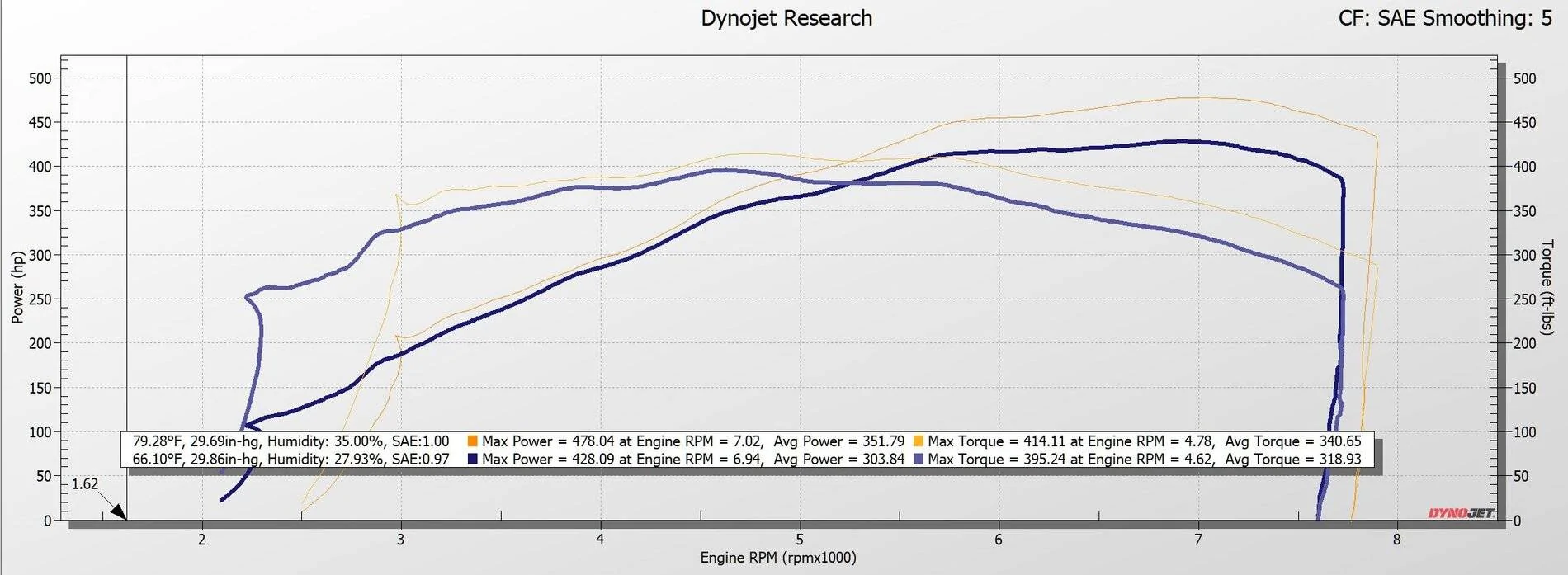
Here's my dyno. Blue line is Borla S-type cat-back only. Blue is FBO on E85. Power at 7500 is 462.51 and at 6500 is 465.97. at 7400 is 468.75 and at 6400 is 462.90


Baseline SType to FullE85BoltOn 2020 MustangGT.webp
Sponsored


engineermike

Well-Known Member
Joined
Jul 15, 2018
Threads
31
Messages
6,188
Reaction score
6,452
Location
La
Vehicle(s)
2018 GTPP A10
You’re definitely on the right track. There are two ways to calculate optimal shift points. One is based on torque applied to the output shaft before and after shifts, and the other aims to achieve the same power before and after the shift. They both yield the same result.

It’s easier on a phone to use the power method.

1-2, if you shift around 8000 then rpm falls about 3000. To get the same power before and after the shift, the shift point would need to be about 8100, extrapolating a bit.

2-3, rpm will drop about 2200. That would require a shift point of about 7800.

3-4, rpm will drop about 1300, so shifting at 7600 looks best.

4-5, rpm drops 1000 and 7500 looks best.

5-6 is a 1200 rpm drop so back to 7600.

All this assumes no tire or torque converter slip.

Now, there’s one big problem with the above. In the low gears a large amount of power is absorbed overcoming drivetrain rotational inertia. The actual power transmitted to the road is deeply reduced in 1st gear and significantly in 2nd. Think about how on a dynojet it reads out higher in higher gears; for the same reason. As a result, the lower gears should be shifted out of earlier than the simple math suggests. Honestly you’d probably be really close to optimal commanding all shifts at about 7550.
 

markmurfie

Well-Known Member
Joined
Jun 6, 2015
Threads
15
Messages
1,320
Reaction score
625
Location
Hawaii
First Name
Mark
Vehicle(s)
2015 Ford Mustang GT
Now, there’s one big problem with the above. In the low gears a large amount of power is absorbed overcoming drivetrain rotational inertia. The actual power transmitted to the road is deeply reduced in 1st gear and significantly in 2nd. Think about how on a dynojet it reads out higher in higher gears; for the same reason. As a result, the lower gears should be shifted out of earlier than the simple math suggests. Honestly you’d probably be really close to optimal commanding all shifts at about 7550.
I don't agree with short shifting.Gears give you leverage. I wouldn't describe the actual power delivered at the tire as being reduced in 1 and 2, but artificially higher seeing as the time for it's application is shorter, not a lower torque force being absorbed over coming inertia.
 

engineermike

Well-Known Member
Joined
Jul 15, 2018
Threads
31
Messages
6,188
Reaction score
6,452
Location
La
Vehicle(s)
2018 GTPP A10
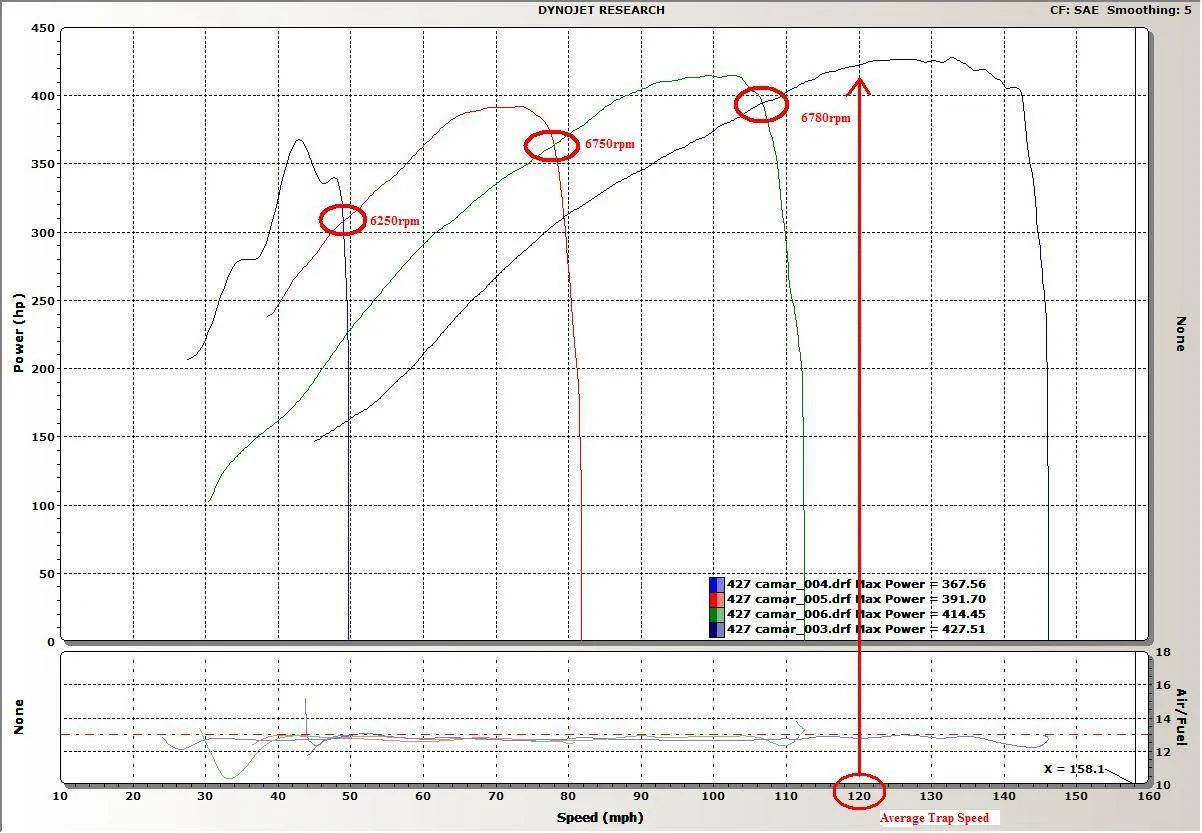
Yes, I am keenly aware that gears multiply torque, but they do not multiply power. The objective is to be in the gear that applies the most power to the ground AT THAT TIME. The provided dyno curve is only correct for that gear, and if dynod in lower gears the power curve would be shifted down. I’ve done this test myself and it’s due to power used to accelerate mainly internal engine rotating components. The a10 with 3.55’s only takes about 2 seconds to accelerate through 1st gear stock, and all those engine parts have to go from 1000 to 7500 rpm and require energy input to get there. This effect would move shift points to a lower rpm in the lower gears. There are tons of data on this out there but this one probably demonstrates it best:

52CE493D-70DD-4F78-95B3-724725343F74.webp
 

Sponsored

OP
OP

deanm11

Well-Known Member
Joined
Oct 27, 2020
Threads
54
Messages
485
Reaction score
318
Location
Northern NJ
First Name
Dean
Vehicle(s)
2020 Mustang GT A10
Stock rpm shift ('Trans WOT Shift RPM vs. Shift ID vs. Gear) are 7300 up to the 4-5 shift. If you check the OSS (Transmission output shaft speed) tables (Base Upshift Map OSS vs. Shift vs. TPS), the OSS in the 1-2 and 2-3 imply around 8000rpm. Anyone know why this is the case? If I move the first table up to 8000 (and rpm limiters) will I achieve that shift speed in the 1-2 and 2-3 or do I need to move the OSS tables up from stock also?
 

engineermike

Well-Known Member
Joined
Jul 15, 2018
Threads
31
Messages
6,188
Reaction score
6,452
Location
La
Vehicle(s)
2018 GTPP A10
@deanm11 I *think* the shift points work the same way as spark timing, torque request, and gdi blend, in that it looks at all the possible values and does a low-select. In other words, whichever shift point is lowest is when it will command the shift.
 

markmurfie

Well-Known Member
Joined
Jun 6, 2015
Threads
15
Messages
1,320
Reaction score
625
Location
Hawaii
First Name
Mark
Vehicle(s)
2015 Ford Mustang GT
Torque / Time = Power.
You just wrote gear ratios multiply torque, but not power...

Like I said it's the time that changes, not the engines torque or power output. Not the inertia of the rotating assembly, or the drive train components. Their mass and rotating radius do not change.

Think of the strategy used in CVT's. You are targeting the highest peak power. Short shifting lower gears does not do this.
 

engineermike

Well-Known Member
Joined
Jul 15, 2018
Threads
31
Messages
6,188
Reaction score
6,452
Location
La
Vehicle(s)
2018 GTPP A10
Torque / Time = Power.
Correct.

You just wrote gear ratios multiply torque, but not power...
Also correct.

Like I said it's the time that changes, not the engines torque or power output. Not the inertia of the rotating assembly, or the drive train components. Their mass and rotating radius do not change.
Correct as well. However, the rate of acceleration (rpm per unit time) of the engine’s rotating components does change in every gear.

Think about this…if you put a car in neutral and floor it, it will quickly rev through the rpm range. It hits the limiter fast but it does take some non-zero amount of time to get there. 100% of the engine’s available power is produced, 100% goes into overcoming the inertia of the rotating parts and accelerating them to max rpm, and 0% is used to accelerate the car.

Conversely, on a brake dyno set for steady state speed (or cvt, if you will), 0% of the engine’s power is used to accelerate the internals and 100% is transmitted to the brake or transmission.

We can conclude from this comparison that the quicker you allow the engine to rev, the more power that will go into accelerating the crankshaft and such, and the less that makes it to the tires. This explains the well-documented phenomenon that we see when cars are dynod in different gears on inertial dynos, where lower gears put less power to the wheels.

In fact, when the dynojet was first being developed, the original version that used strictly the mathematical inertia of the drum to measure power read out very low. They had to apply a fudge factor to account for the dynamic nature of the dyno and the fact that power used to accelerate the rotating parts of the vehicle wasn’t making it to the drum.

Think of the strategy used in CVT's. You are targeting the highest peak power. Short shifting lower gears does not do this.
They aren’t all calibrated this way, but I personally would tune a cvt to put the engine at peak power at all times wot. This, of course, is different from the stated question because the engine is once again at steady state and none of the power must go into accelerating internal engine parts.
 
Last edited:

markmurfie

Well-Known Member
Joined
Jun 6, 2015
Threads
15
Messages
1,320
Reaction score
625
Location
Hawaii
First Name
Mark
Vehicle(s)
2015 Ford Mustang GT
You are confusing inertia with friction.

inertia is a function of mass and radius. All a figure skater has to do to rotate faster is pull their arms in. to slow down, they stick them back out. The mass of the engines rotating assembly and drive train are not changing, nor are its rotating radius's so the engines inertia is a constant at all RPMs. Its friction does increase with RPM.

Again, the engines friction at 2000RPM is the same in all gears or in no gear. The torque and power output of the engine does not change with gearing. The torque and power at the output shaft does. meaning yes the engine will accelerate through RPM range faster with no load attached, and accelerate slower and slower as lower gear ratios are used with a load. Because it is losing its mechanical advantage gained from gear ratios.

The engine goes from 1000 to 7000 RPM in every gear. This is what a dyno is trying to show you.
in 3rd gear the wheels RPM would go from 130 RPM to 1000 RPM, that ratioed from wheel size to drum size is what the dyno sees.

in 5th 180 RPM to 1400 RPM.

in 7th 280 RPM to 2100 RPM.

the dyno seeing a different RPM range in each gear, and a different amount of time it takes to go through that RPM range, gives you the difference when extrapolated out to the engines 1000 RPMs to 7000 RPMs. Its not an actual change in engine output.
 

Sponsored

Andy13186

Well-Known Member
Joined
Sep 19, 2018
Threads
110
Messages
2,523
Reaction score
1,565
Location
Florida
Vehicle(s)
2018 Mustang GT 10speed Aluminator Whippled
Pretty soon there will be an AI using dynographs to tune cars optimal shift points etc. Unless we just go all electric before that
 

FruityJudy

Well-Known Member
Joined
Nov 13, 2018
Threads
15
Messages
877
Reaction score
766
Location
South Alabama
Vehicle(s)
2018 Mustang GT A10
Couldnt you just use a draggy to monitor g forces in each gear and shift when the g force of the current gear falls below the shift of the next gear?
 

engineermike

Well-Known Member
Joined
Jul 15, 2018
Threads
31
Messages
6,188
Reaction score
6,452
Location
La
Vehicle(s)
2018 GTPP A10
I’m definitely not mixing up friction and inertia. Since I’m not getting through anecdotally, let’s put pen to paper, shall we?

Let’s assume a stock 3.55 geared coyote does 0-35 mph in 2 seconds in 1st gear. This data came from a magazine test. In this timespan, we can assume the engine goes from about 1000 rpm to about 7500 rpm in the same 2 seconds. I don’t know the moment of inertia of the torque converter, flexplate, crankshaft, rod big-ends, damper, pulleys, sprockets, phasers, and camshafts, so I would propose simulating them using a 5” diameter cylinder weighing 100 lb, which I believe to be on the low side.

Moment of inertia I = 1/2 m r^2 = 312.5 lbm in in = 2.17 lbm ft ft

Torque = moment of inertia x angular acceleration

Torque = 2.17 lbm ft ft x (7500-1000)revs/min / 2 seconds x 2pi radians/rev / 60 seconds/min / (32.2 ft lbm / lbf / s / s)

Torque = 23 ftlb. So, it takes 23 ftlb of torque to accelerate just the rotating engine parts at a rate of 3250 rpm/second, and this torque does not make it to the rear wheels to be used to linearly accelerate the mass of the car.

At 7500 rpm, this is 33 hp.

In second gear, this power loss would drop to 22 hp because the 2 seconds becomes 3 seconds due to slower acceleration resulting from less mechanical advantage. In each gear going up this number reduces, not due to changes in mass or inertia, but rather due to the angular acceleration rate.

So you can see that the moment of inertia is identical but the power required to accelerate the engine changes as a function of engine speed rate of change, which decreases every gear change.
Sponsored

 
Last edited:


Top