
Sponsored

FBO, Non-Cobrajet Intake Optimal Shift Points, A10

Andy13186

Well-Known Member
Joined
Sep 19, 2018
Threads
110
Messages
2,524
Reaction score
1,565
Location
Florida
Vehicle(s)
2018 Mustang GT 10speed Aluminator Whippled
I think only the total HP, not torque, under the dyno curve between the shift points are what matters. More hp for more time means more acceleration , torque numbers dont really matter if I understand it correctly
Sponsored
 

markmurfie

Well-Known Member
Joined
Jun 6, 2015
Threads
15
Messages
1,320
Reaction score
626
Location
Hawaii
First Name
Mark
Vehicle(s)
2015 Ford Mustang GT
Moment of inertia, does not change because of acceleration. Acceleration and torque are describing the motion of a physical mass.

It is a physical property. The physical mass and configuration of the engine is not changing because you accelerated it faster or slower. Same with the drive train. This is basic conservation of energy.
Half the energy goes into linear acceleration, the other half goes into rotational acceleration.

This can literally be broken down to the amount of air and fuel being trapped in a single cylinder and the energy released from it's combustion.
6077af35c24bbb19f4ef07c493b6c75f.png
 
Last edited:

engineermike

Well-Known Member
Joined
Jul 15, 2018
Threads
32
Messages
6,216
Reaction score
6,516
Location
La
Vehicle(s)
2018 GTPP A10
I think only the total HP, not torque, under the dyno curve between the shift points are what matters. More hp for more time means more acceleration , torque numbers dont really matter if I understand it correctly
I tried to show this earlier, but if you do it correctly the horsepower and torque methods yield the exact same answer.
 

engineermike

Well-Known Member
Joined
Jul 15, 2018
Threads
32
Messages
6,216
Reaction score
6,516
Location
La
Vehicle(s)
2018 GTPP A10
Moment of inertia, does not change because of acceleration. Acceleration and torque are describing the motion of a physical mass.

It is a physical property. The physical mass and configuration of the engine is not changing because you accelerated it faster or slower. Same with the drive train. This is basic conservation of energy.
Who are you arguing with here? It can't be me because I said....

2 days ago: "Moment of inertia is constant"
Yesterday: " Moment of inertial does not change"

But just like F=ma, T=Ia. "I" and "m" do not change, but they are only one piece of the equation. "a" does change, and "F" and "T" do as a result. But unlike "m" and "I", the relationship of angular a to linear a is different in every gear, so it affects every gear differently.

You have 2 acceleration problems going on at the same time; one accelerating the car linearly and one accelerating the drivetrain angularly. Whatever torque is used to accelerate the drivetrain angularly can not also accelerate the car linearly, and the ratio of the two is different in every gear.
 
Last edited:

markmurfie

Well-Known Member
Joined
Jun 6, 2015
Threads
15
Messages
1,320
Reaction score
626
Location
Hawaii
First Name
Mark
Vehicle(s)
2015 Ford Mustang GT
Who are you arguing with here? It can't be me because I said....

2 days ago: "Moment of inertia is constant"
Yesterday: " Moment of inertial does not change"

But just like F=ma, T=Ia. "I" and "m" do not change, but they are only one piece of the equation. "a" does change, and "F" and "T" do as a result. But unlike "m" and "I", the relationship of angular a to linear a is different in every gear, so it affects every gear differently.

You have 2 acceleration problems going on at the same time; one accelerating the car linearly and one accelerating the drivetrain angularly. Whatever torque is used to accelerate the drivetrain angularly can not also accelerate the car linearly, and the ratio of the two is different in every gear.

I'm arguing with you, cause you are trying to make up a concept that doesn't exist.

Now you are saying it is the ratio between the linear and rotational acceleration. Energy gets split between the two 50/50 it's doesn't matter what gear you are in.

The ratio between the rotational mass and linear mass certainly doesn't change with gears.
 
Last edited:

Sponsored

engineermike

Well-Known Member
Joined
Jul 15, 2018
Threads
32
Messages
6,216
Reaction score
6,516
Location
La
Vehicle(s)
2018 GTPP A10
I'm arguing with you, cause you are trying to make up a concept that doesn't exist.
That's strange, because you keep repeating that mass and moment of inertia don't change, as if you're disagreeing with someone. I know it's not me because I've repeatedly posted that they don't change.

Now you are saying it is the ratio between the linear and rotational acceleration. Energy gets split between the two 50/50 it's doesn't matter what gear you are in.
Wait, are you actually saying that 50% of the engine's output accelerates the rotating parts and the other 50% accelerate the non-rotating parts??? Dead on 50% each, huh? That's funny because the math here:

http://hpwizard.com/rotational-inertia.html

and here:

http://www.thecartech.com/subjects/auto_eng/car_performance_formulas.htm

both seem to indicate it's like 10% in low gears and less in higher gears.

No, I'm not saying 50% is impossible, but you'd have to have something like a 40/1 rear axle ratio for that to be true.

The ratio between the rotational mass and linear mass certainly doesn't change with gears.
There you go arguing against that straw man again. I never said mass changes. The rate of [angular] acceleration changes in each gear. You're somehow missing half of the equation. T = I x a. I = constant, but "a" is not, therefore torque required to accelerate rotating engine parts is not the same in each gear. To be 100% clear, moment of inertia does not have to change in order for Torque to change, so I am not saying and I never said or implied that moment of inertia changes per gear or rpm. Torque input to overcome rotational inertia does change as a function of gear because rotational acceleration changes as a function of gear.

This is described extremely well, mathematically, in post #30 by someone smarter than me. Their name for this is Inertia Resistance, which combines car weight with drivetrain moment of inertia and the result is different in every gear. Since the Inertia Resistance is different in every gear, then the acceleration rate can not be simply scaled by the ratio of the gear ratios to determine the optimal shift points.
 

markmurfie

Well-Known Member
Joined
Jun 6, 2015
Threads
15
Messages
1,320
Reaction score
626
Location
Hawaii
First Name
Mark
Vehicle(s)
2015 Ford Mustang GT
Inertia is not a force. Inertia is a physical property of matter.

Inertia resistance force or inertia torque correction is a made up, misconception.

Kinetic energy and rotational kinetic energy are what you seem to be thinking of as changing, they are being stored and released with changes in velocity, but you are completely using the wrong math formula to see that actual difference. The misconception comes from trying to see what is changing with applying extra variables, then attributing the change to those variables. Energy being applied over distance(torque aka N meters) or change in distance over time(acceleration m/ s^2) and not just the 0 distance and 0 time, potential energy difference between the two velocities of a given object.
What you and the misconceived evidence you are providing are describing is, there's free energy in slower accelerations.

50% of the energy going into the rotating parts, rotates them. The other 50% goes into moving them linearly. They are part of the car and moving linearly along with it. That is the parts we were talking about.
The parts of the car not rotating get 100% of the energy in their linear movement.
The total applied energy is distributed in all the moving mass.
Then you have losses to outside forces like friction.

That little tiny bump of acceleration you feel on the shift, thats the extra energy that went into the engines rotating mass. Its ok some of it was lost to the clutch friction and tire friction, but it made its way into your linear acceleration. The benefit you got from the gear far outweighs that little bump. The engines force exerted on the drive train going from 7500 down to 6500, would be equal in all gear changes. Of course the RPM change on each gear shift is a different RPM range, but you see my point in the energy is a constant amount.

I purpose designing a variable mass flywheel to slow the engine down on the shift rather than losing it to frictions, and use that flywheel to help accelerate the engine on the next gear, so its not having to do work twice. The mass rotation radius change would be determined by the RPM difference in each gear, not how fast you accelerated the engine in that gear.
Or just use a CVT transmission.
 
Last edited:

engineermike

Well-Known Member
Joined
Jul 15, 2018
Threads
32
Messages
6,216
Reaction score
6,516
Location
La
Vehicle(s)
2018 GTPP A10
What can I say....you don't have to believe me. While I did derive the "torque correction" formula myself based on basic physics and engineering, it turns out that I'm not alone. If you disagree with me, then you also disagree with William Toet (Professor of Motorsport Engineering and former F1 Engineer) and Thomas Gillespie (Doctor of Mechanical Engineering, Professor, Automotive Consultant, and Author of SAE's "Fundamentals of Vehicle Dynamics"), who's equations I posted yesterday in this thread. The equations demonstrate exactly what I've been trying to explain.

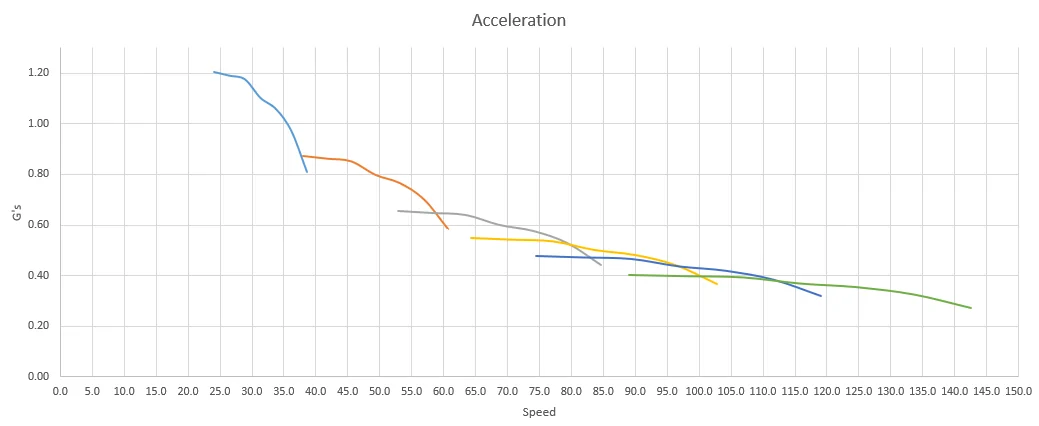
Gillespie went about it from the opposite end, deriving Inertia Resistance rather than my simplistic torque debit method. I went ahead and used his formulas-proper to determine shift points using the OP's torque curve to see how the results compared to mine. Using his equations had the added benefit of boiling shift points down to maximizing acceleration rate at all times, as opposed to confusing the issue discussing power vs torque:

1636549298944.png


Convert the intersections to rpm and you get:
1-2: 7750
2-3: 7650
3-4: 7500
4-5: 7550
5-6: 7550

I can't say that I'm surprised (ok maybe a little relieved) that they yield nearly identical results to my method working from the other direction.
 
Last edited:

markmurfie

Well-Known Member
Joined
Jun 6, 2015
Threads
15
Messages
1,320
Reaction score
626
Location
Hawaii
First Name
Mark
Vehicle(s)
2015 Ford Mustang GT
They are not saying correct for it on shift points.

They are saying reduce weight. Then they are saying weight removed from rotating parts is equivalent to twice non rotating parts. Just like me saying 50/50 for energy.
 

engineermike

Well-Known Member
Joined
Jul 15, 2018
Threads
32
Messages
6,216
Reaction score
6,516
Location
La
Vehicle(s)
2018 GTPP A10
They are not saying correct for it on shift points.

They are saying reduce weight. Then they are saying weight removed from rotating parts is equivalent to twice non rotating parts. Just like me saying 50/50 for energy.
The experts are saying that engine rotational inertia increases the car's resistance to acceleration, and that this resistance is a function of the gear ratio, no? Gillespie also tells us exactly how to account for it when calculating acceleration, agree?
 
Last edited:

Sponsored

markmurfie

Well-Known Member
Joined
Jun 6, 2015
Threads
15
Messages
1,320
Reaction score
626
Location
Hawaii
First Name
Mark
Vehicle(s)
2015 Ford Mustang GT
The experts are saying that engine rotational inertia increases the car's resistance to acceleration, and that this resistance is a function of the gear ratio, no?
Rotational inertia is describing an objects physical properties. Mass and it's radius of rotation. If one or both of these two properties change, the resistance to acceleration will change. No, a gear change is not changing either of those properties, so the resistance to acceleration is a constant.

Gillespie also tells us exactly how to account for it when calculating acceleration, agree?
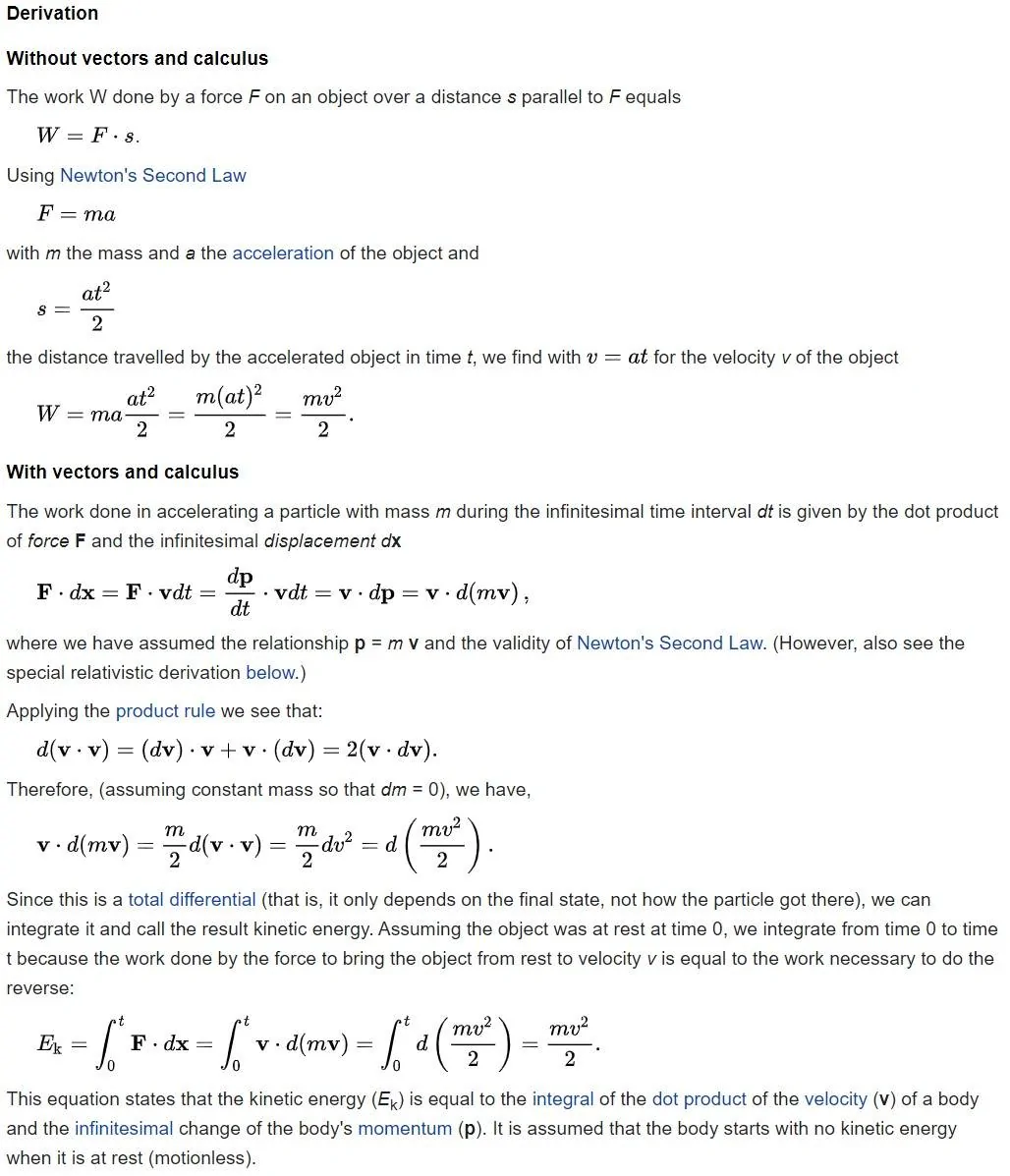
Work- energy theorem, which is a theory derived from newtons second law, is what should be used, before acceleration or torque are calculated. This breaks it down to work and energy, eliminating the truly unknown variables of distance and time in that second law.
Torque is telling you the distance traveled the kinetic energy changed in.
Acceleration does the same, but for time.
What you think you are compensating for is a fixed quantifiable energy differential, that will only change if mass and radius of rotation changes. The rate at which energy is going into it, is being described in acceleration and torque values. The total energy is coming from the amount of air and fuel being burned on each combustion stroke, and that is all you get to distribute to the entire cars mass, twice for its rotating parts. Then you have losses to external friction forces, and the like, because thats reality of masses moving at different rates interacting with one another.
You probably don't want to go into discussing enthalpy and entropy.

1/2 I Vf^2- 1/2 I Vi^2= difference in kinect energy, you can use it for the whole car or just parts of it, just know its only half the story for rotational parts. replace I with mass for the other half and the rest of the car.

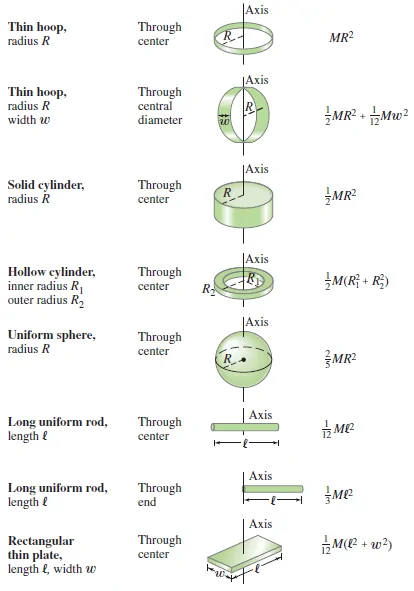
I= moment of inertia, I gave examples in a previous post on how this changes with different shapes.

Vf= final speed

Vi= initial speed

Do not confuse a constant speed/velocity with acceleration. I know the formulas look very similar, it's derived from that second law and is more fundamental.

Kinetic energy.jpg


The only thing missing in this Derivation is under the "without vectors and calculus" section, it should be
s= vt + (at^2)/2

or even

s= start point + vt + (at^2)/2

as it may not be clear that displacement s equals original velocity times time, plus one-half acceleration times time squared, (or times the square of time). but just like in the "with vectors and calculus" section assume the mass starts with 0 velocity and start point can be 0.

The only three things that are not external force related that you can do to improve acceleration are reduce the mass, move the mass closer to the center of rotation, or burn more fuel on the combustion stroke. There is no compensation based on inertia or acceleration rates per gear that you need to apply to shift points.
 
Last edited:

FruityJudy

Well-Known Member
Joined
Nov 13, 2018
Threads
15
Messages
877
Reaction score
766
Location
South Alabama
Vehicle(s)
2018 Mustang GT A10
Typical engineers trying to make it work on paper while the blue collar boys just make it work......
 

engineermike

Well-Known Member
Joined
Jul 15, 2018
Threads
32
Messages
6,216
Reaction score
6,516
Location
La
Vehicle(s)
2018 GTPP A10
Typical engineers trying to make it work on paper while the blue collar boys just make it work......
Interesting you say that. I did it for years "your way". Shift by feel, or maybe try different shift points and see how the trap speed is affected. Then I got the Auto Math Handbook by John Lawler decades ago. His math is identical to what I described in the first half of my first post in this thread. I attempted to use his math and it didn't seem to be right because the shift points worked out to be very high, as the OP noticed as well. I knew something else was affecting it but I didn't know what. It took over 10 years before I realized that it was rotational resistance to acceleration that was affecting optimal shift points, especially in the lower gears. Then, it all made sense and the math added up to more reasonable shift points. I had never actually researched the moment of inertia of a reciprocating engine until now, so I appreciate threads like these because now I have a very accurate math model I can use to optimize shift points.
 

Meatball

Well-Known Member
Joined
Apr 21, 2018
Threads
20
Messages
590
Reaction score
349
Location
CA
Vehicle(s)
17 GT
What can I say....you don't have to believe me. While I did derive the "torque correction" formula myself based on basic physics and engineering, it turns out that I'm not alone. If you disagree with me, then you also disagree with William Toet (Professor of Motorsport Engineering and former F1 Engineer) and Thomas Gillespie (Doctor of Mechanical Engineering, Professor, Automotive Consultant, and Author of SAE's "Fundamentals of Vehicle Dynamics"), who's equations I posted yesterday in this thread. The equations demonstrate exactly what I've been trying to explain.

Gillespie went about it from the opposite end, deriving Inertia Resistance rather than my simplistic torque debit method. I went ahead and used his formulas-proper to determine shift points using the OP's torque curve to see how the results compared to mine. Using his equations had the added benefit of boiling shift points down to maximizing acceleration rate at all times, as opposed to confusing the issue discussing power vs torque:

1636549298944.png


Convert the intersections to rpm and you get:
1-2: 7750
2-3: 7650
3-4: 7500
4-5: 7550
5-6: 7550

I can't say that I'm surprised (ok maybe a little relieved) that they yield nearly identical results to my method working from the other direction.
This plot makes me wonder what the usefulness of the concept of power is at all when describing car engines. All you need to know is the torque curve and gearing. What’s the relevance of the hp peak?
 

engineermike

Well-Known Member
Joined
Jul 15, 2018
Threads
32
Messages
6,216
Reaction score
6,516
Location
La
Vehicle(s)
2018 GTPP A10
Hey @markmurfie you sure went way down an unnecessary rabbit-hole there. Since you don't believe my formulas and I don't see the relevance of yours, can we go back to Dr. Gillespie's published equations that were derived specifically to solve the problem we are discussing?

All of these are straight from Gillespie:

Surplus Effort = Tractive Effort - Total Resistance

Surplus Effort = 0, so Tractive Effort = Total Resistance

Total Resistance = IR, assuming air and rolling resistances are negligible
So, Tractive Effort = IR

Tractive Effort = engine torque x trans gear ratio x rear gear ratio x efficiency/wheel radius. I assumed 100% efficiency for simplicity.

IR = (mcar + meq) x acceleration

Therefore, (mcar + meq) x acceleration = engine torque x trans gear ratio x rear gear ratio x efficiency/wheel radius

Solve for acceleration:

acceleration = engine torque x trans gear ratio x rear gear ratio/wheel radius/(mcar + meq)

Everything in the above equation is easy to find, except meq. meq happens to be the sticking point here and Gillespie defines it as the "equivalent mass of rotating parts". Mass doesn't change, but their affect on acceleration does change, as the equation shows:

meq = polar moment of inertia of the engine x gear efficiency x (trans gear ratio x rear gear ratio / wheel radius)^2. There are terms for wheel and driveshaft inertia but I am assuming 0 for simplicity. I also assume 100% efficiency to keep it simple.

Putting it all together....
acceleration = engine torque x trans gear ratio x rear gear ratio/wheel radius/(mcar + polar moment of inertia of the engine x (trans gear ratio x rear gear ratio/wheel radius)^2 )

If we solve for acceleration assuming 410 ftlb torque, 4.69 ratio, 3.55 gear, 1.125 ft wheel radius, 4000 lb car, and 4.7 lb ft ft engine moment of inertia, we get:

acceleration = 1.206 G's, which passes the gut check.

If we solve the same equation except substitute 2.98 for the transmission ratio, then we get:

acceleration = 0.873 G's

Here's the interesting part....

4.69/2.98 = 1.57
1.206/0.873 = 1.38

So even though 1st gear has 57% more mechanical advantage than 2nd, it only offers 38% better acceleration.

Since we can now very easily solve for acceleration as a function of torque curve and gear ratio, we can overlay each gear's curve onto a graph and choose shift points that give the maximum acceleration at that speed, then translate to rpm.
Sponsored

 
Last edited:


Top