Sponsored

FBO, Non-Cobrajet Intake Optimal Shift Points, A10

engineermike

Well-Known Member
Joined
Jul 15, 2018
Threads
31
Messages
6,198
Reaction score
6,482
Location
La
Vehicle(s)
2018 GTPP A10
Couldnt you just use a draggy to monitor g forces in each gear and shift when the g force of the current gear falls below the shift of the next gear?

The problem with draggy g-force is the data is too noisy. We’re really splitting hairs here trying to determine shift points based on gain or loss of a couple of hp on the shift and draggy g’s just aren’t precise enough. They are accurate for what they do because the peaks and valleys average out to a good number in the timespan of the pull.
 

markmurfie

Well-Known Member
Joined
Jun 6, 2015
Threads
15
Messages
1,320
Reaction score
625
Location
Hawaii
First Name
Mark
Vehicle(s)
2015 Ford Mustang GT
I’m definitely not mixing up friction and inertia. Since I’m not getting through anecdotally, let’s put pen to paper, shall we?

Let’s assume a stock 3.55 geared coyote does 0-35 mph in 2 seconds in 1st gear. This data came from a magazine test. In this timespan, we can assume the engine goes from about 1000 rpm to about 7500 rpm in the same 2 seconds. I don’t know the moment of inertia of the torque converter, flexplate, crankshaft, rod big-ends, damper, pulleys, sprockets, phasers, and camshafts, so I would propose simulating them using a 5” diameter cylinder weighing 100 lb, which I believe to be on the low side.

Moment of inertia I = 1/2 m r^2 = 312.5 lbm in in = 2.17 lbm ft ft

Torque = moment of inertia x angular acceleration

Torque = 2.17 lbm ft ft x (7500-1000)revs/min / 2 seconds x 2pi radians/rev / 60 seconds/min / (32.2 ft lbm / lbf / s / s)

Torque = 23 ftlb. So, it takes 23 ftlb of torque to accelerate just the rotating engine parts at a rate of 3250 rpm/second, and this torque does not make it to the rear wheels to be used to linearly accelerate the mass of the car.

At 7500 rpm, this is 33 hp.

In second gear, this power loss would drop to 22 hp because the 2 seconds becomes 3 seconds due to slower acceleration resulting from less mechanical advantage. In each gear going up this number reduces, not due to changes in mass or inertia, but rather due to the angular acceleration rate.

So you can see that the moment of inertia is identical but the power required to accelerate the engine changes as a function of engine speed rate of change, which decreases every gear change.
I’m definitely not mixing up friction and inertia. Since I’m not getting through anecdotally, let’s put pen to paper, shall we?

Let’s assume a stock 3.55 geared coyote does 0-35 mph in 2 seconds in 1st gear. This data came from a magazine test. In this timespan, we can assume the engine goes from about 1000 rpm to about 7500 rpm in the same 2 seconds. I don’t know the moment of inertia of the torque converter, flexplate, crankshaft, rod big-ends, damper, pulleys, sprockets, phasers, and camshafts, so I would propose simulating them using a 5” diameter cylinder weighing 100 lb, which I believe to be on the low side.

Moment of inertia I = 1/2 m r^2 = 312.5 lbm in in = 2.17 lbm ft ft

Torque = moment of inertia x angular acceleration

Torque = 2.17 lbm ft ft x (7500-1000)revs/min / 2 seconds x 2pi radians/rev / 60 seconds/min / (32.2 ft lbm / lbf / s / s)

Torque = 23 ftlb. So, it takes 23 ftlb of torque to accelerate just the rotating engine parts at a rate of 3250 rpm/second, and this torque does not make it to the rear wheels to be used to linearly accelerate the mass of the car.

At 7500 rpm, this is 33 hp.

In second gear, this power loss would drop to 22 hp because the 2 seconds becomes 3 seconds due to slower acceleration resulting from less mechanical advantage. In each gear going up this number reduces, not due to changes in mass or inertia, but rather due to the angular acceleration rate.

So you can see that the moment of inertia is identical but the power required to accelerate the engine changes as a function of engine speed rate of change, which decreases every gear change.

When teachers say the moment of inertia is like the mass, what they should actually say is, it's like a masses momentum. This is calculus and why Newton had to invent calculus for his laws to make sense and apply to rotating objects(like the solar system). You are taking a snap shot in time with out 0's. You need to take a snap shot at every rpm change, not just the start and final. The more you break it down the more you will then see what I'm saying. Or just do the integral. You have already agreed inertia is not changing, and that the mechanical advantage that's changing. I'm telling you it's a difference in time, but you don't understand that I'm referring to the infinite moments not the total duration of time.

The engines WOT flywheel power output, at any given RPM, is not changing with gear changes. You could even throw in going up a hill or down a hill. It's not changing, it is what it is. Do the math correctly, and understand dynos don't.
 

WildHorse

N/A or GO HOME
Joined
Jun 28, 2017
Threads
270
Messages
10,297
Reaction score
8,350
Location
Home World: CLASSIFIED
First Name
Puddintane
Vehicle(s)
'17 S550
Vehicle Showcase
1
The optimum shift point from a actual engineer;
 

engineermike

Well-Known Member
Joined
Jul 15, 2018
Threads
31
Messages
6,198
Reaction score
6,482
Location
La
Vehicle(s)
2018 GTPP A10
The optimum shift point from a actual engineer;
In the above video he is describing exactly what I was referring to in the first paragraph of my first post in this thread.

Interestingly, the same engineer explains the exact phenomenon I described in the last paragraph of my first post, and the principal markmurfie is taking exception to, here:


I am certain he does a better job of explaining it than I am. He really hits the nail on the head between about 4:35 and 5:05.
 

Sponsored

engineermike

Well-Known Member
Joined
Jul 15, 2018
Threads
31
Messages
6,198
Reaction score
6,482
Location
La
Vehicle(s)
2018 GTPP A10
not just the start and final.
I used the delta engine speed divided by dtime to simply calculate the average rate of change (angular acceleration), which turned out to be 3250 rpm/s. This is true (+/-10% since the engine torque isn’t constant) no matter how small the increment is, and can be used to calculate the torque required to achieve it.

This is calculus and why Newton had to invent calculus for his laws to make sense and apply to rotating objects ….Or just do the integral.
If you’re pulling calculus into this then you’re not understanding the basic principal I’m trying to get across.

You have already agreed inertia is not changing, and that the mechanical advantage that's changing.
This is taken out of context. The inertia of the internal parts does change when the engine rpm increases, and the rate of change of inertia is higher in lower gears.

Torque = moment of inertia x angular acceleration

Moment of inertia is constant

Angular acceleration is higher in low gears, so torque required to accelerate rotating components is higher in low gears as a result.

The engines WOT flywheel power output, at any given RPM, is not changing with gear changes.
This is 100% false. It would be true if the engine’s rotating components had a moment of inertia of zero or if the engine speed was constant (cvt or brake dyno), but neither are true. See the video I posted above.

The engine’s shaft power go into overcoming friction, wind resistance, rolling resistance, and angular acceleration of the rotating components. What’s left over is used to linearly accelerate the car, the goal.

Can we agree that the engine’s rotating parts and torque converter have mass?

Can we agree that the mass also has a non-zero distance from the axis of rotation? (Side note, I found a technical article estimating engine moment of inertia and it appears it’s about double my assumption from the math earlier, which I admitted at the time was probably a low estimate).

If both of the above are true, then can we agree that it takes torque to change the angular speed of those components?

Can we then agree that the torque applied to the rotating mass to achieve an angular speed increase can not also be used to linearly accelerate the car?

And finally, can we agree that it takes more torque to change the speed of rotational parts at a fast rate of change than a slow rate of change, since T = I x a?

Do the math correctly,
I posted the math earlier intentionally so that you could point out specifically which part you thought was incorrect.

and understand dynos don't.
My dyno examples were posted in an attempt to demonstrate the differences between inertial and brake/steady state, because the reason they read differently speaks to the reason power to the ground is different in different gears.
 
Last edited:

WildHorse

N/A or GO HOME
Joined
Jun 28, 2017
Threads
270
Messages
10,297
Reaction score
8,350
Location
Home World: CLASSIFIED
First Name
Puddintane
Vehicle(s)
'17 S550
Vehicle Showcase
1
K so to simplify;

engine torque x gear ratio x final ratio = ft-lbs + percent drop per shift

392 x 3.66 x 3.73 = 5352
392 x 2.43 x 3.73 = 3553 40%
392 x 1.69 x 3.73 = 2471 36%
392 x 1.31 x 3.73 = 1915 25%
392 x 1.00 x 3.73 = 1462 27%
392 x 0.65 x 3.73 = 950 43%

peak torque of 392 ft-lbs @4680 rpm / 310 ft-lbs @7500 rpm = 23% difference

If any % drop shift values fall below 23%, you're shifting at too high a rpm.
 

markmurfie

Well-Known Member
Joined
Jun 6, 2015
Threads
15
Messages
1,320
Reaction score
625
Location
Hawaii
First Name
Mark
Vehicle(s)
2015 Ford Mustang GT
Moment of inertia is the rotating masses resistance to acceleration.

It only changes if the mass changes or the radius the mass is rotating around changes. Increased RPMs of both the engine components or the drive train components change neither of those. The acceleration rate they have doesn't change those either.

If torque is 0 acceleration is 0 and vise versa.

But moment of inertia is a constant non varying amount at any moment in time and any given angular velocity.

So if you did torque divided by acceleration to find moment of inertia, when they were both 0, you would assume moment of inertia was 0? Or if they were really small, close to zero, you would say the moment of inertia was really small?
If we rotated an object with a high rate of acceleration, then slowly decelerated it... we wouldn't end up with a net positive amount of energy out of it.

I don't think you understand what
torque= moment of inertia x angular acceleration means. Which is why I suggested looking into the calculus math behind it.
FYI this is only used for a given moment of inertia for turning a known torque force into an acceleration. From that you can calculate a duration from initial speed to final speed.

Like this:


engine inertia.jpg


Just to be clear to make sure we are not off topic, you are arguing for short shift in lower gears, and i'm saying shift at redline.
 
Last edited:
OP
OP

deanm11

Well-Known Member
Joined
Oct 27, 2020
Threads
54
Messages
485
Reaction score
318
Location
Northern NJ
First Name
Dean
Vehicle(s)
2020 Mustang GT A10
Taking torque x Gear ratio method and picking torque off my dyno graph, it suggests about 8100rpm 1-2, 7950 2-3 and that the rest of my shifts at 7550 are close enough.
 

engineermike

Well-Known Member
Joined
Jul 15, 2018
Threads
31
Messages
6,198
Reaction score
6,482
Location
La
Vehicle(s)
2018 GTPP A10
Moment of inertia is the rotating masses resistance to acceleration.

It only changes if the mass changes or the radius the mass is rotating around changes. Increased RPMs of both the engine components or the drive train components change neither of those. The acceleration rate they have doesn't change those either.

If torque is 0 acceleration is 0 and vise versa.

But moment of inertia is a constant non varying amount at any moment in time and any given angular velocity.
I don't disagree with any of the above. Moment of inertial does not change as a function of engine speed or angular acceleration. Angular momentum does change, however, because it is proportional to moment of inertia and angular velocity. And in order to impose a change in angular momentum, you must input torque (that can not also be used to linearly accelerate the car).

Consider this for a minute - if you stored a 1000 lb pulley in the bed of your truck, the truck would accelerate at a certain rate. Now, take that 1000 lb pulley (assume the weight is situated along the edge and the diameter is large) and install it on the front of the crankshaft. Assume for a second that this is possible and doesn't break anything. Would the truck accelerate slower, the same, or faster? I think most would agree if the truck, if not a CVT, would accelerate slower because the massive increase in moment of inertia would hurt you more than it did when it was just laying in the bed. Does the engine make any less brake power? Nope. Does it make less inertial power? Definitely. Now think about how this might affect shift points. If it were CVT, it wouldn't affect the target rpm at all. However, the quicker you want the engine to rev, the worse it would hurt you. This would directionally push you towards shifting out of low gears sooner than you otherwise would. We can solve this and determine how much a more typical moment of inertia engine would be affected.

So if you did torque divided by acceleration to find moment of inertia, when they were both 0, you would assume moment of inertia was 0? Or if they were really small, close to zero, you would say the moment of inertia was really small?
I'm not sure I follow this logic path. T=I x a, so I = T/a. I'm arguing that, while I is constant, a is not zero in our case, so T is also not zero. a is easy to determine, and thus so it T. Therefore, it takes torque to accelerate rotating engine parts, which can not be used to accelerate the car linearly, and this affects lower gears more so than higher due to higher a.

Just to be clear to make sure we are not off topic, you are arguing for short shift in lower gears, and i'm saying shift at redline.
Correct, except that the term "short shift" might misconstrue this to think I'm saying you should shift sub-5000 rpm. In almost every case I've applied the simple "maximize power" math to, the result is some unreasonably high rpm 1-2 shift. The OP's case shows the same. If you apply the debit due to power absorbed by angular momentum changes, suddenly the results become very reasonable. I'll explain graphically below.
 
Last edited:

Sponsored

engineermike

Well-Known Member
Joined
Jul 15, 2018
Threads
31
Messages
6,198
Reaction score
6,482
Location
La
Vehicle(s)
2018 GTPP A10
Taking torque x Gear ratio method and picking torque off my dyno graph, it suggests about 8100rpm 1-2, 7950 2-3 and that the rest of my shifts at 7550 are close enough.
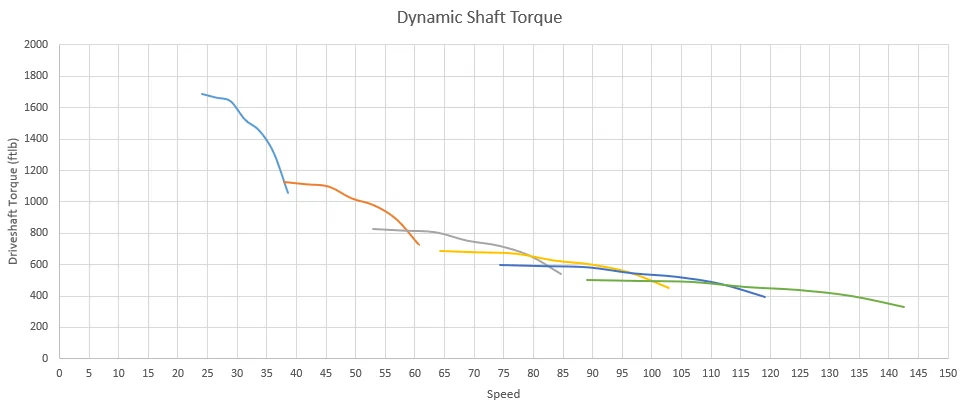
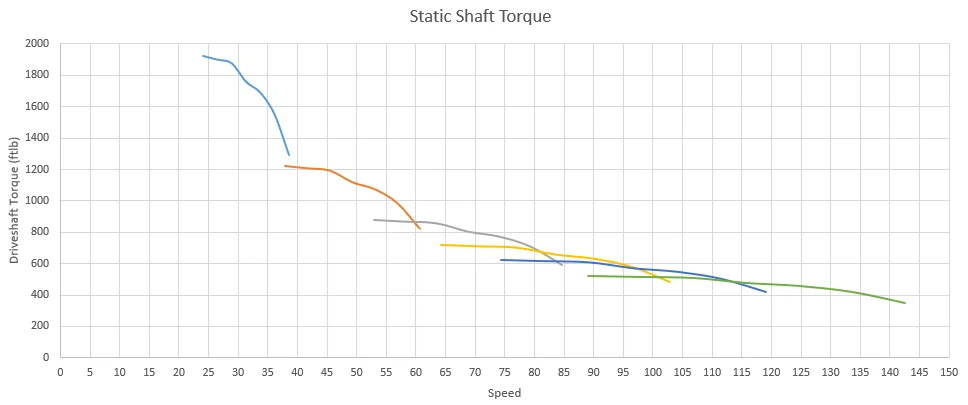
I went ahead and used your posted E85 torque curve to graphically demonstrate. The method you describe is the torque method, shown next. I used driveshaft torque.

1636383552338.png


Obviously you would want maximum torque applied to the driveshaft. If you convert intersection speeds to engine rpm, you would find approximate shift points as follows:

1-2: 8100 rpm
2-3: 7800 rpm
3-4: 7650 rpm
4-5: 7600 rpm
5-6: 7500 rpm
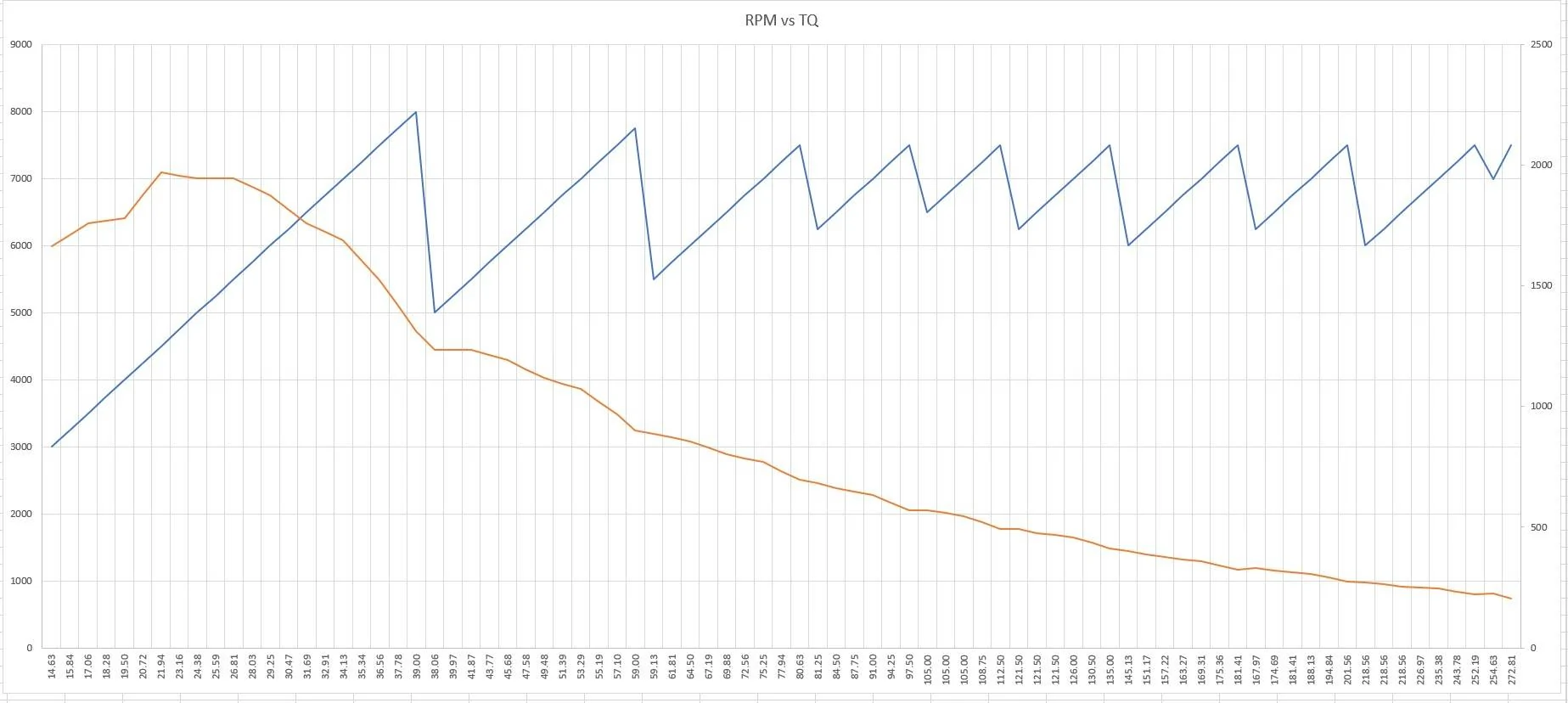
Now, if you apply the angular inertia correction as a function of engine speed rate of increase, the story changes a bit:

1636383586284.png


Revised shift points are:

1-2: 7750 rpm
2-3: 7650 rpm
3-4: 7500 rpm
4-5: 7500 rpm
5-6: 7500 rpm

You can see why I would say "short shifting" might not be the right term because you're still shifting 1-2 and 2-3 at higher rpm than the rest of the shifts. Just not as much higher as the basic method would lead you to.

As a side note, the power method yields the same results. The corrected graph looks as follows:

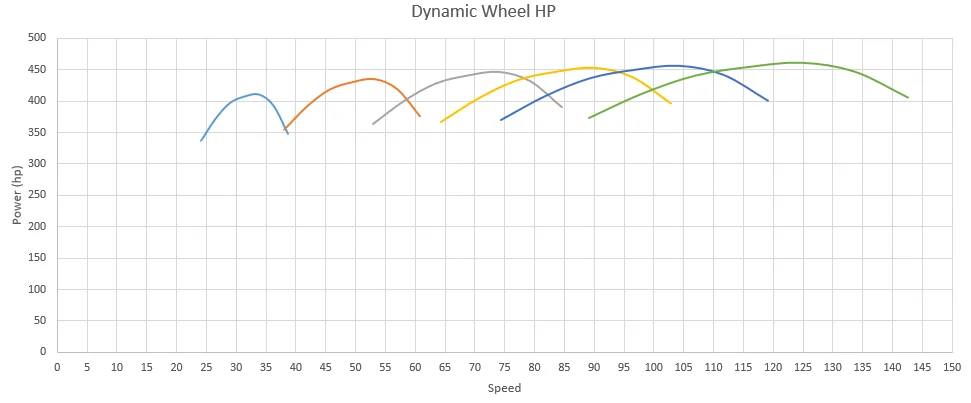
1636384024798.png


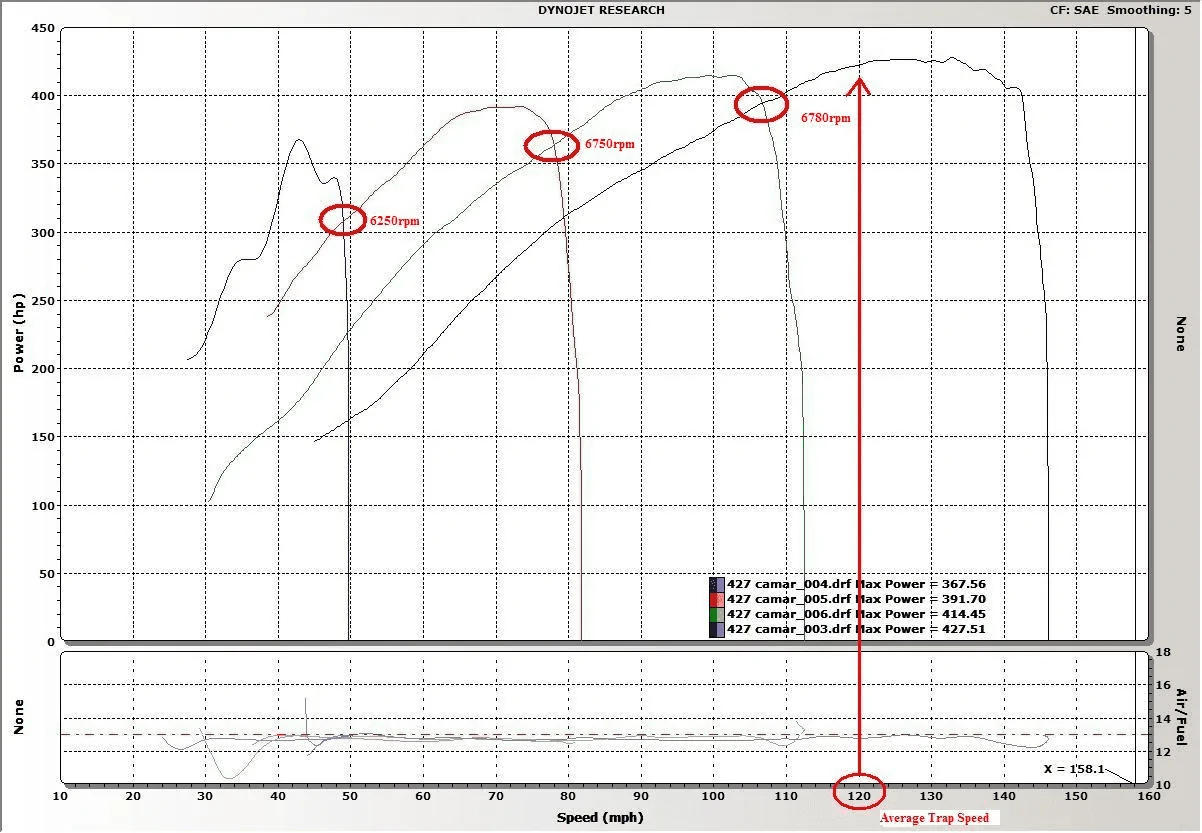
This also looks a lot like inertial dyno graphs where they dyno multiple gears and overlay them, such as:

1636385345986.webp
 
Last edited:

markmurfie

Well-Known Member
Joined
Jun 6, 2015
Threads
15
Messages
1,320
Reaction score
625
Location
Hawaii
First Name
Mark
Vehicle(s)
2015 Ford Mustang GT
Consider this for a minute - if you stored a 1000 lb pulley in the bed of your truck, the truck would accelerate at a certain rate. Now, take that 1000 lb pulley (assume the weight is situated along the edge and the diameter is large) and install it on the front of the crankshaft. Assume for a second that this is possible and doesn't break anything. Would the truck accelerate slower, the same, or faster? I think most would agree if the truck, if not a CVT, would accelerate slower because the massive increase in moment of inertia would hurt you more than it did when it was just laying in the bed. Does the engine make any less brake power? Nope. Does it make less inertial power? Definitely. Now think about how this might affect shift points. If it were CVT, it wouldn't affect the target rpm at all. However, the quicker you want the engine to rev, the worse it would hurt you. This would directionally push you towards shifting out of low gears sooner than you otherwise would. We can solve this and determine how much a more typical moment of inertia engine would be affected.
Right for the same amount of torque it would accelerate slower. It would not have any effect on shift points. To rev that engine quicker it would require a larger amount of torque.

But assuming a constant 400ftlbs of torque at 1000RPM, 400ftlb of torque at 7000RPM, or 400ftlb of torque at 25000 RPM, if this imaginary 1000lb mass would spin up that high but no higher.... I would say shift at 25000 RPM. Even if the lack of mechanical leverage from gearing made that take 5 minutes to get to that RPM. There would be no point in switching to less mechanical advantage early.


You are shifting by looking at the horsepower, which is correct, but you are not following why it's correct based on the torque value. Torque is acceleration, but torque is falling, yet HP tells you where the maximum acceleration will come from when you factor in the angular velocity RPM. I am saying it's not falling because of it's moment of inertia. You are not losing torque to rotation speed, rotational acceleration(aka torque), the mass of the engine, or it's radius of rotation, you are just gaining stored energy in the mass. Things like airflow, friction, ect. Are what's limiting torque output.

the torque the engine produces at 1000 RPM or 7000RPM will be the same, no matter the gear you have selected. So use the gear closest to 1:1 on the Dyno, find your engines peak HP, and shift as to have the RPMs see the highest HP the engine makes. This will be the same for each gear. Just like it's the same for the infinite gear ratios in a CVT.
 

markmurfie

Well-Known Member
Joined
Jun 6, 2015
Threads
15
Messages
1,320
Reaction score
625
Location
Hawaii
First Name
Mark
Vehicle(s)
2015 Ford Mustang GT
I went ahead and used your posted E85 torque curve to graphically demonstrate. The method you describe is the torque method, shown next. I used driveshaft torque.

1636383552338.webp


Obviously you would want maximum torque applied to the driveshaft. If you convert intersection speeds to engine rpm, you would find approximate shift points as follows:

1-2: 8100 rpm
2-3: 7800 rpm
3-4: 7650 rpm
4-5: 7600 rpm
5-6: 7500 rpm
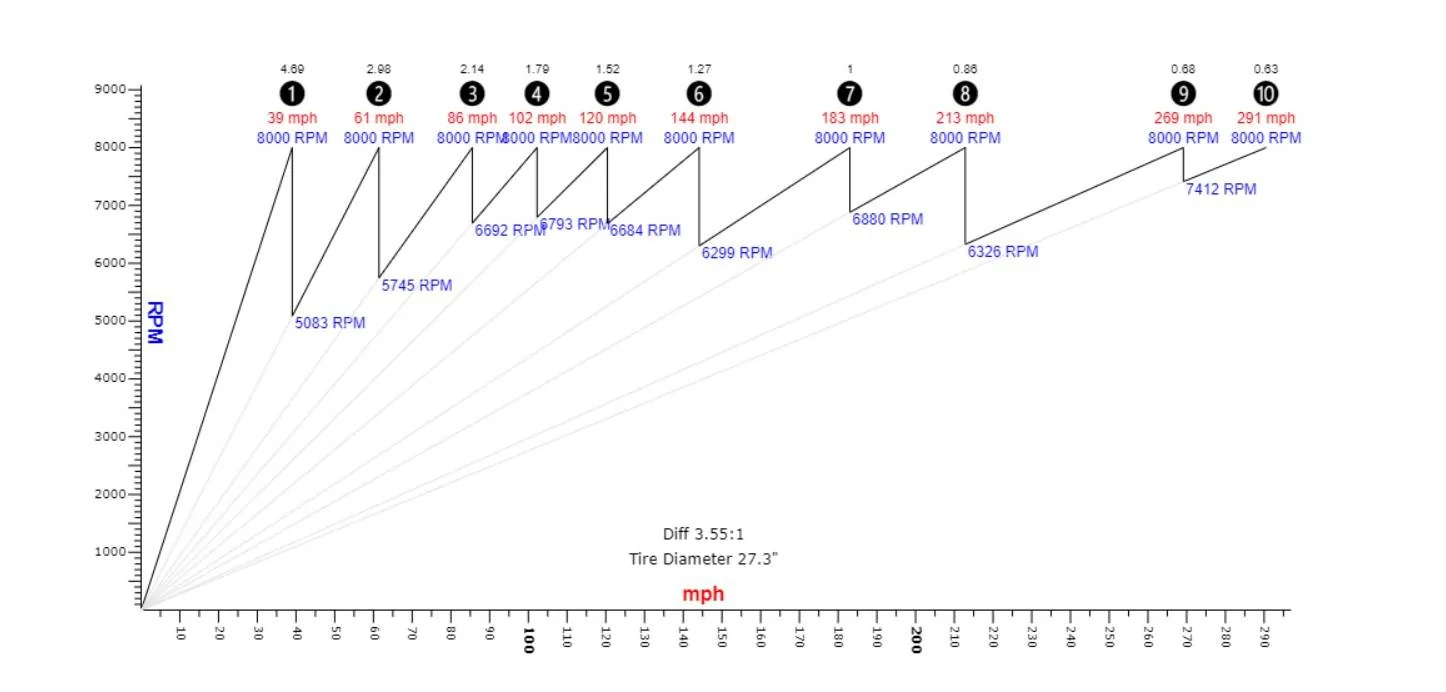
I agree with this method, but it should be engine RPM so you see where the next gear will start.
Some looking like this.
Then 8k 1-2, 7750 2-3, 7500for the rest.

1-8k,2-7750,R-7500 .jpg


I used the yellow line in the dyno graph of #1.
tried to follow this.
10R80 8kRPM.jpg


Now, if you apply the angular inertia correction as a function of engine speed rate of increase, the story changes a bit:
Inertia correction? The rest after this was made up from misunderstanding inertia and momentum.

Inertia is a function of mass and rotating radius. Neither of which change, so there is no "correcting" for it.

You don't apply a "mass correction" to objects that are accelerating faster/ slower in a straight line. Why would you do it to a rotating object?
you are incorrectly using this:
NEWTON’S SECOND LAW FOR ROTATION
If more than one torque acts on a rigid body about a fixed axis, then the sum of the torques equals the moment of inertia times the angular acceleration:
∑t=Iα.

When you should be using this:
The kinetic energy of an object is the energy that it possesses due to its motion. It is defined as the work needed to accelerate a body of a given mass from rest to its stated velocity.

Rotational kinetic energy= 1/2 I ω^2 where ω is the angular velocity and I is the moment of inertia around the axis of rotation.
 
Last edited:

engineermike

Well-Known Member
Joined
Jul 15, 2018
Threads
31
Messages
6,198
Reaction score
6,482
Location
La
Vehicle(s)
2018 GTPP A10
Right for the same amount of torque it would accelerate slower. It would not have any effect on shift points. To rev that engine quicker it would require a larger amount of torque.
So you agree that adding moment of inertia to the crankshaft would slow the acceleration rate. Try to quantify the effect numerically, then. I have and I can't get around using angular acceleration, which is determined using the gear ratio at the time.

... torque is falling, ... I am saying it's not falling because of it's moment of inertia.
I never said torque falls with rpm due to moment of inertia.

...find your engines peak HP, and shift as to have the RPMs see the highest HP the engine makes. This will be the same for each gear. Just like it's the same for the infinite gear ratios in a CVT.
With a CVT, rpm is static, so it's a different case. You continue to represent the engine's power curve as though it's at constant speed, but ours is not.

Inertia correction? The rest after this was made up from misunderstanding inertia and momentum.

Inertia is a function of mass and rotating radius. Neither of which change, so there is no "correcting" for it.

You don't apply a "mass correction" to objects that are accelerating faster/ slower in a straight line. Why would you do it to a rotating object?
Again, the mass and radius of the rotating components do not change - I never said any different. But the angular inertia does change with rpm which requires torque input, and it's a function of rate of change, which is a function of the gear in use.

The engine's power is used to linearly accelerate the car's mass, but also used to apply angular acceleration to the rotating components. This effect is more prevalent in lower gears because the acceleration rate is much faster.

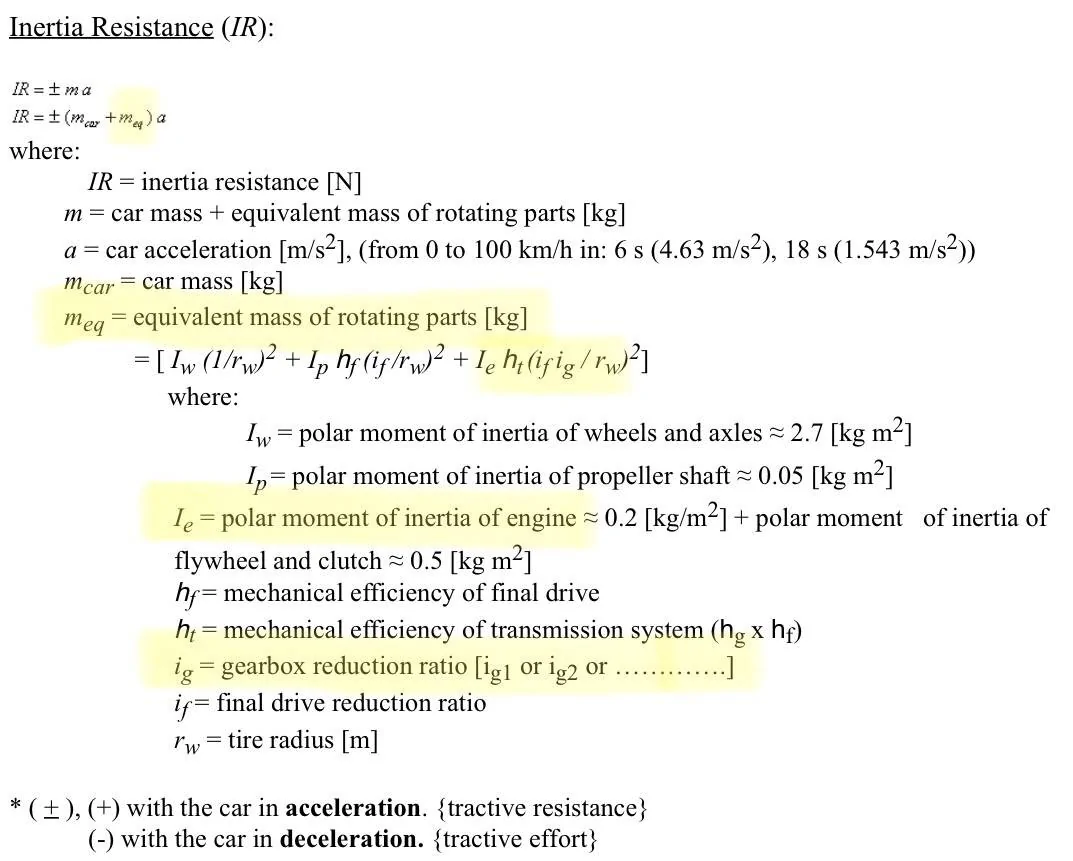
Here is a much more thorough mathematical representation of the phenomenon, that explains it better than I can:

607478-c84c0db5c5bd46418c4a59e42db5fdd8.jpg

IR.jpg

Reference:

Car Performance Formulas (thecartech.com)

Notice that the polar moment of inertia of the engine is multiplied by the gear ratio of the current gear, which is exactly what I've been trying to describe. The inertial resistance of the entire car is the mass that resists linear acceleration PLUS the mass that resists rotational acceleration, which is a function of the current gear. And, the mass's resistance to acceleration IS, in fact, different in every gear, and reducing in the higher gears. It doesn't typically completely over-rule the mechanical advantage of the low gear ratios, but it could affect shift points by a couple hundred rpm. This also completely explains the effect of incrementally increasing inertial hp readings (commonly found on Dynojets) in higher gears.

Others that have explained it better than me have described it as:

"the effective inertia of the drivetrain goes up by the square of the gear reductions and thus, the actual horsepower put to the ground in lower gears is much less than in the higher gears."

"...rotational inertia is reduced every time you upshift, which has the effect of lowering optimal shift points to some degree, more on the one-two shift, and less and less as the gears progress."

"For a Formula 1 car you are likely to be talking of well over 10% of the effective weight of the car which has been added due to the need to accelerate the car's rotating masses.....The effect of engine rotation changes when you change gear. In 1st gear the engine has to accelerate to high RPM over a small speed range so its rotational inertia has a greater impact than in top gear."

"make some adjustments for rotating inertia at different engine acceleration rates in the different gears also"

"Only the engine's...angular acceleration relative to the car's linear acceleration varies as a function of the selected gear..."

...and so on.

Here's another reference that discusses equivalent mass and resistance to acceleration of rotating components, and it IS a function of what gear you are in:

The Effects of Rotational Inertia on Automotive Acceleration (hpwizard.com)
Sponsored


Top