engineermike
Well-Known Member
- Thread starter
- #1
I'm posting this just because I got lucky and caught this in a log, so you can see exactly what goes on. Secondly, Roush uses an actual MAP sensor, so the data is more than what you'd get from a MAF car that fails in the same way.
This is a 2020 Roush Nitemare F-150. It's the same supercharger that's on the car, and the same Speed-Density style PCM logic. Other mods to the truck are a 2.8 pulley (+2 psi), Edelbrock 103mm TB, BAP, tstat, flex fuel, and months of custom-tuning. The cats are OEM cats with about 40k miles on them. I had just swapped the pulley and was tuning out a pre-mature shift modulation torque cut when this happened:

The measured boost sourced at the MAP sensor had been running around 15 psi flat, but you can see it rise to 19.8 psi before I let off. Basically, the exhaust restriction caused a backup of pressure to build in the intake plenum. Note that a MAF car will NOT show this, because the airflow will not change if PD blown so the SD model result will also not reflect the increase. Furthermore, and this could be why the Roush cars seem to survive cat failures more so than others, with the higher boost comes higher load, which causes lower spark timing and more fuel. The port injector PW peaked at 11.9 ms, while previously in the same log the iPW peaked at 9 ms. Long story short, a cat failure puts the spark and lambda in a safer state in speed density logic.
To confirm my suspicions, I did a cat test log:

For the cat test, Ford logic alternates lambda rich/lean and tests response of the rear narrow band O2's. If the rear O2 signal alternates like the front, then the cat is bad. In the log above, you can see the rear O2 voltage alternates in step with the front widebands, indicating both cats aren't functional.
Another interesting thing I saw in the log is regarding fuel trims:

At this slightly elevated airflow, the combined fuel trim of bank 1 was -8.6, while for bank 2 was -23.4. At lower airflows the banks were within a couple of percent. My take is that, while both sides were non-functional, the bank 2 cat was restricted and the backpressure was reducing airflow to that bank and the fuel trims had to cut to keep lambda at 1.0. For this reason, I decided to repair bank 2 first:

This just dumped out the inlet with no rodding at all. I went on to weld in a stock GT500 cat on bank 2 but ran out of time to repair both. The following is the log from afterwards:

Here you can see bank 2 rear narrow band O2 signal does not alternate with lambda, but bank 1 still does. The bank 2 blue line is what it's supposed to look like.

The airflow rate is similar to the earlier snip, but now the combined fuel trim is -11.7 for bank 1 and -13.2% for bank 2, a much better balance than before. While it appears as though the backpressure issue is resolved, I will still swap out the bank 1 cat with a GT500 cat as well.
I wanted to share this because I thought it was really interesting to have luckily actually caught the failure as it happened and logged all the diagnostic steps afterwards.
This is a 2020 Roush Nitemare F-150. It's the same supercharger that's on the car, and the same Speed-Density style PCM logic. Other mods to the truck are a 2.8 pulley (+2 psi), Edelbrock 103mm TB, BAP, tstat, flex fuel, and months of custom-tuning. The cats are OEM cats with about 40k miles on them. I had just swapped the pulley and was tuning out a pre-mature shift modulation torque cut when this happened:

The measured boost sourced at the MAP sensor had been running around 15 psi flat, but you can see it rise to 19.8 psi before I let off. Basically, the exhaust restriction caused a backup of pressure to build in the intake plenum. Note that a MAF car will NOT show this, because the airflow will not change if PD blown so the SD model result will also not reflect the increase. Furthermore, and this could be why the Roush cars seem to survive cat failures more so than others, with the higher boost comes higher load, which causes lower spark timing and more fuel. The port injector PW peaked at 11.9 ms, while previously in the same log the iPW peaked at 9 ms. Long story short, a cat failure puts the spark and lambda in a safer state in speed density logic.
To confirm my suspicions, I did a cat test log:

For the cat test, Ford logic alternates lambda rich/lean and tests response of the rear narrow band O2's. If the rear O2 signal alternates like the front, then the cat is bad. In the log above, you can see the rear O2 voltage alternates in step with the front widebands, indicating both cats aren't functional.
Another interesting thing I saw in the log is regarding fuel trims:
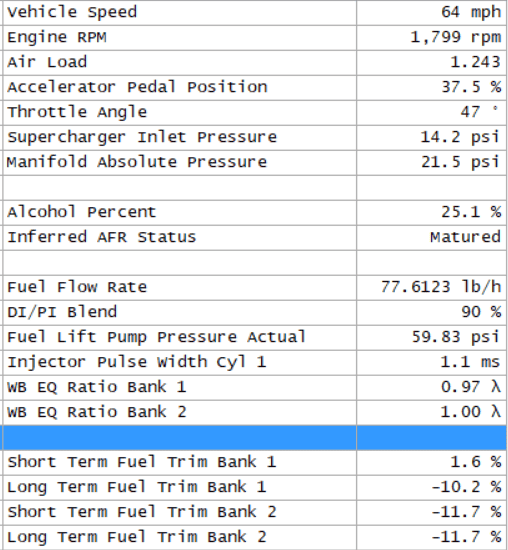
At this slightly elevated airflow, the combined fuel trim of bank 1 was -8.6, while for bank 2 was -23.4. At lower airflows the banks were within a couple of percent. My take is that, while both sides were non-functional, the bank 2 cat was restricted and the backpressure was reducing airflow to that bank and the fuel trims had to cut to keep lambda at 1.0. For this reason, I decided to repair bank 2 first:
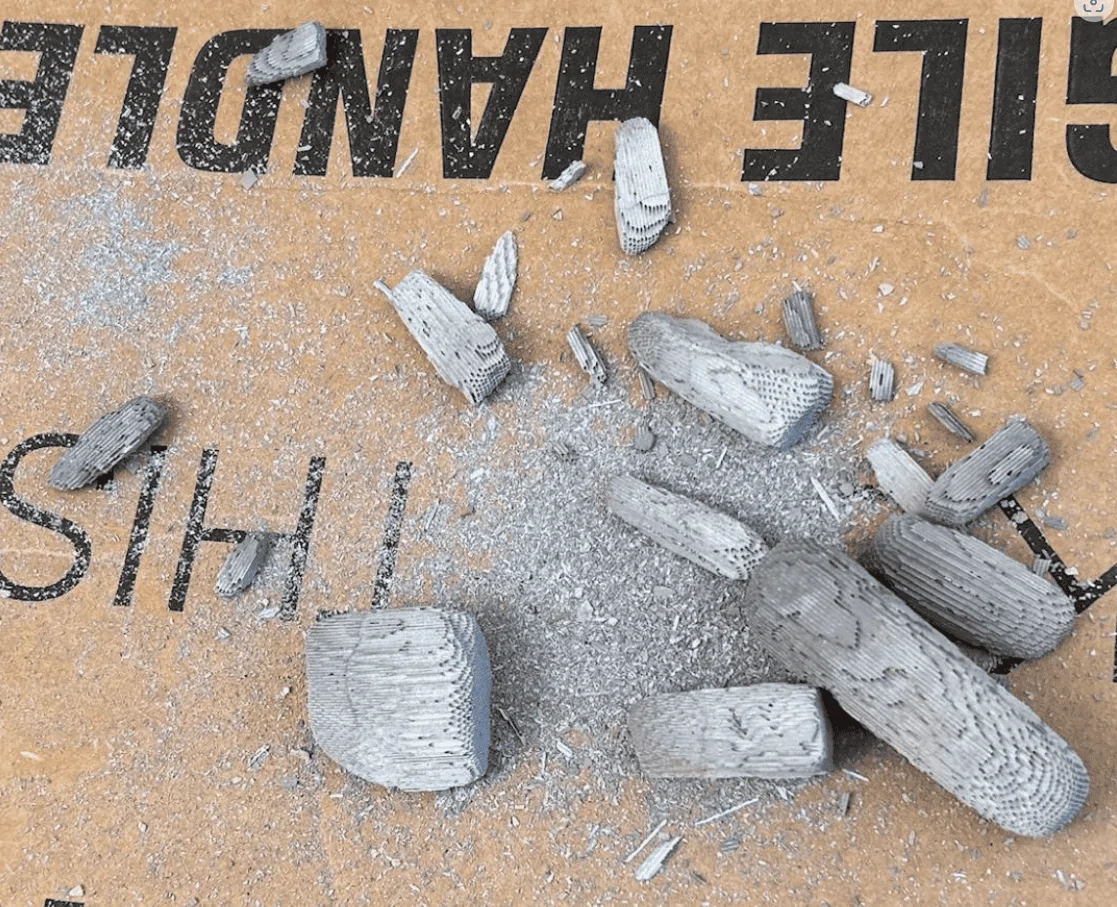
This just dumped out the inlet with no rodding at all. I went on to weld in a stock GT500 cat on bank 2 but ran out of time to repair both. The following is the log from afterwards:

Here you can see bank 2 rear narrow band O2 signal does not alternate with lambda, but bank 1 still does. The bank 2 blue line is what it's supposed to look like.
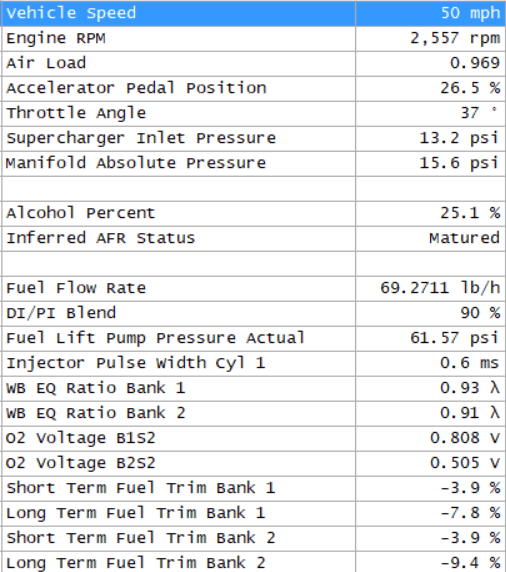
The airflow rate is similar to the earlier snip, but now the combined fuel trim is -11.7 for bank 1 and -13.2% for bank 2, a much better balance than before. While it appears as though the backpressure issue is resolved, I will still swap out the bank 1 cat with a GT500 cat as well.
I wanted to share this because I thought it was really interesting to have luckily actually caught the failure as it happened and logged all the diagnostic steps afterwards.
Sponsored
Last edited: