
Sponsored

Ultimate Headers vs Stainless Works

Cranky

Member
Joined
Jan 8, 2025
Threads
7
Messages
12
Reaction score
4
Location
Minnesota
First Name
Josh
Vehicle(s)
Mustang
For a ‘20 GT base model with 10A. The plan it to go LTH and an e85 tune this year and keep it NA. If I get the itch I may go forced induction with an ESS kit. It’s my daily so I don’t want to deal with cat failures. Are there any difference besides the kind of SS?
Sponsored
 

NGOT8R

Well-Known Member
Joined
Jul 19, 2020
Threads
153
Messages
9,231
Reaction score
7,717
Location
Florida
First Name
Adrian
Vehicle(s)
2019 Bullitt
Ultimate Headers LTHs uses 321 SS (found in airplane exhausts) on the primary pipes coming off of the header flange. Check this out here for a better explanation of 321 SS.

1756745692630-ru.webp


Overview

321 stainless steel is used in aircraft exhaust systems because its titanium stabilization makes it resistant to intergranular corrosion at high temperatures, a common issue for exhaust components like stacks, manifolds, and collectors. This makes it a durable, reliable, and versatile choice for the extreme conditions found in aircraft exhaust systems, outperforming 304 stainless steel in these specific applications.


Why 321 Stainless Steel is Ideal for Aircraft Exhausts
  • High-Temperature Strength & Fatigue Resistance:
    321 stainless steel maintains its strength and resistance to fatigue at the very high temperatures generated in an aircraft's exhaust system.

  • Intergranular Corrosion Resistance:
    Stabilized with titanium, 321 SS prevents the formation of chromium carbides within its structure, which can lead to intergranular corrosion when the metal is heated.

  • Durable & Reliable:
    This resistance to corrosion and heat allows 321 stainless steel components to provide reliable service in demanding, hot environments, such as exhaust stacks, manifolds, and collectors.

  • Good Weldability & Formability:
    The alloy is also easy to form and weld, making it practical for manufacturing complex exhaust components.
Comparison to Other Materials
  • 304 Stainless Steel:
    .
    While 304 is a common and cheaper stainless steel used for general purposes, 321's titanium content gives it superior high-temperature fatigue resistance and corrosion resistance in exhaust applications.

  • Carbon Steel:
    .
    For lower-powered aircraft, carbon steel systems may be used, but 321 stainless steel is a more durable and higher-performing option for high-reliability components.

  • Inconel:
    .
    For systems with even more extreme high-temperature requirements, such as those in turbocharged or turbo-normalized aircraft engines, Inconel (a high-nickel superalloy) is often substituted for portions of the exhaust system.
 
Last edited:

NGOT8R

Well-Known Member
Joined
Jul 19, 2020
Threads
153
Messages
9,231
Reaction score
7,717
Location
Florida
First Name
Adrian
Vehicle(s)
2019 Bullitt

NGOT8R

Well-Known Member
Joined
Jul 19, 2020
Threads
153
Messages
9,231
Reaction score
7,717
Location
Florida
First Name
Adrian
Vehicle(s)
2019 Bullitt
It looks like they switched to 304 like everyone else, no mention of 321 on their web site anymore.
The whole header was never 321, only the first 2-3” of inches of the primary tubes were. I doubt they changed that, but a quick call to the office would confirm for certain.
 

Sponsored

NGOT8R

Well-Known Member
Joined
Jul 19, 2020
Threads
153
Messages
9,231
Reaction score
7,717
Location
Florida
First Name
Adrian
Vehicle(s)
2019 Bullitt
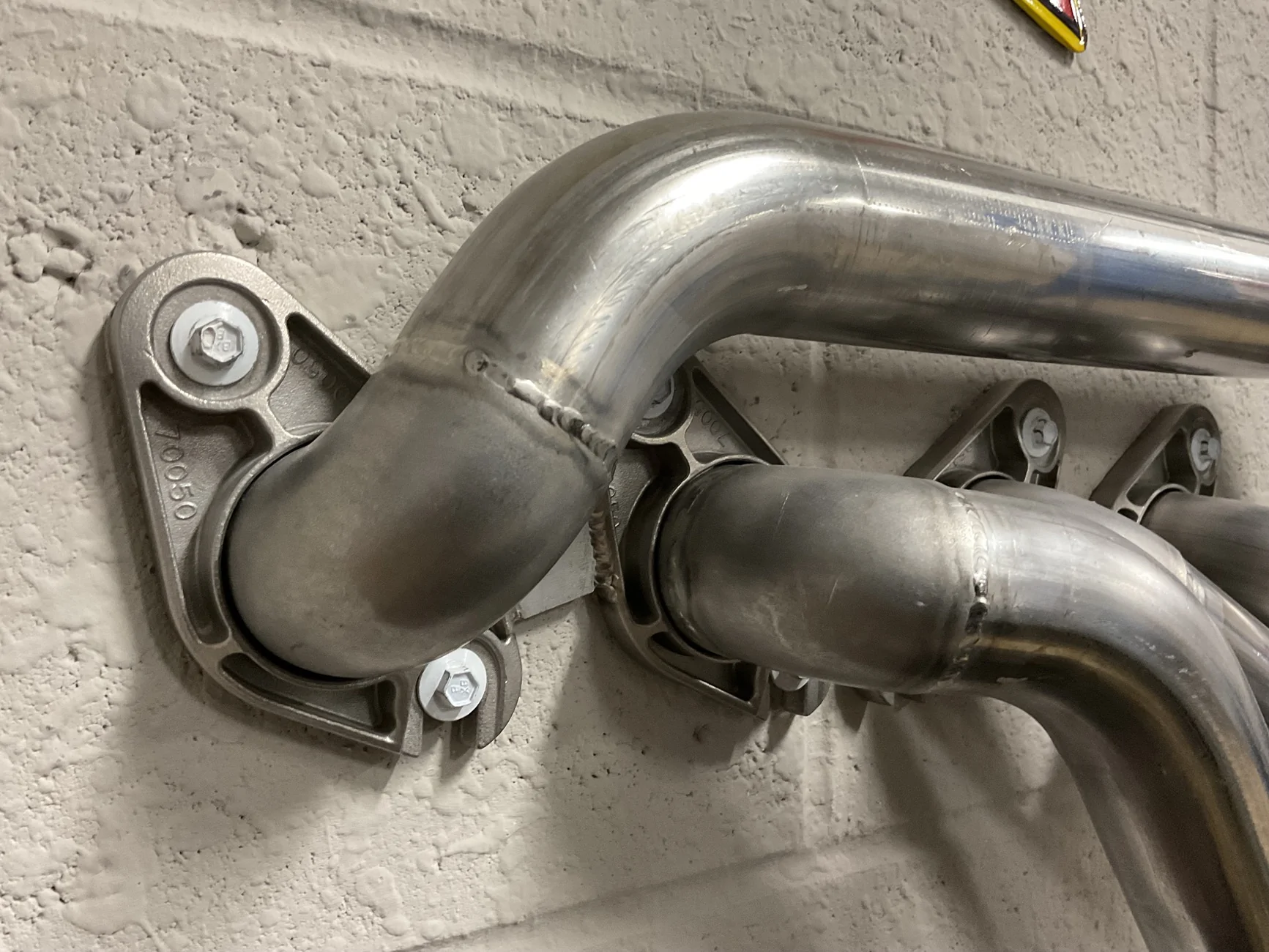
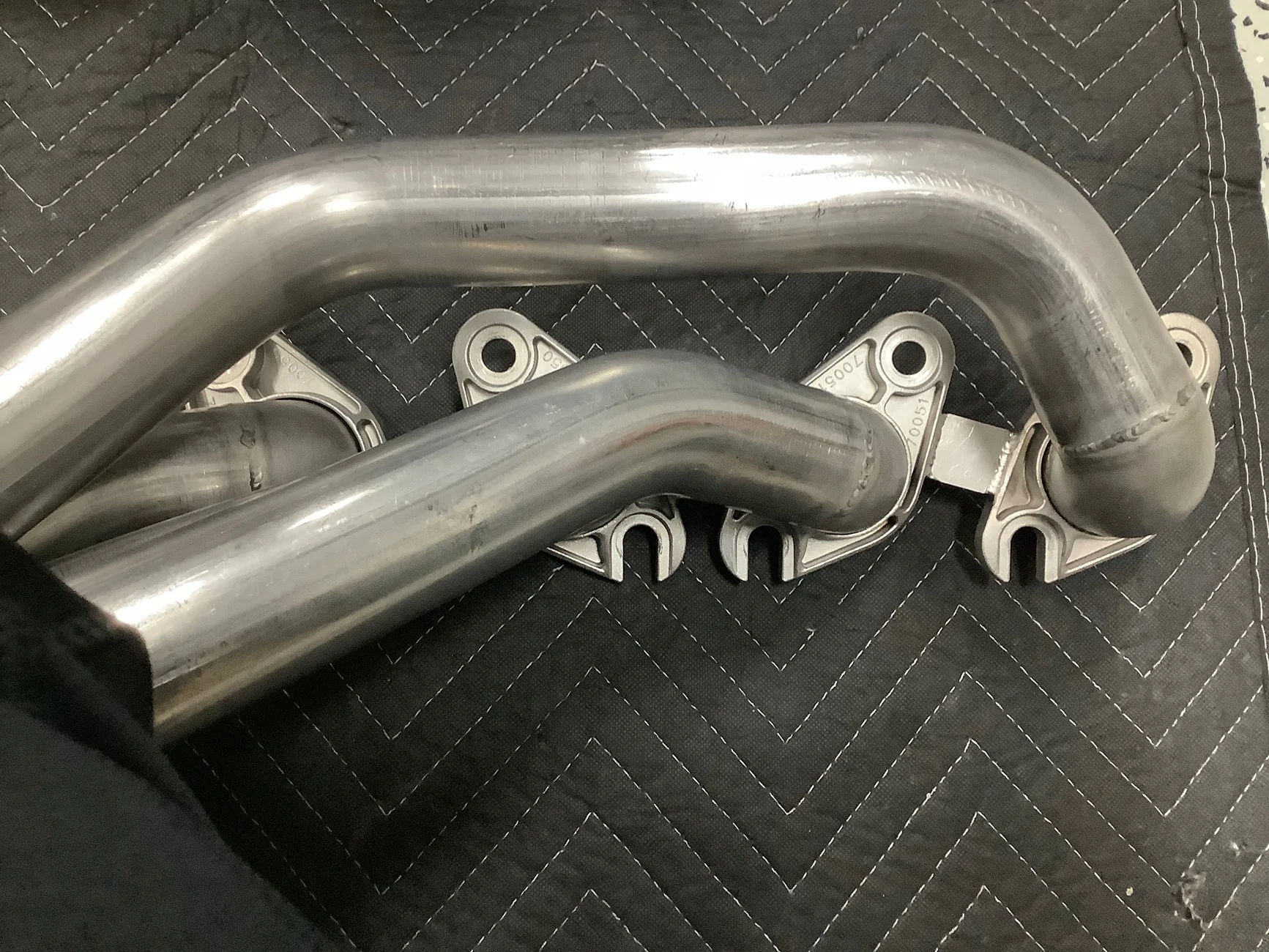
@John S here’s a pic of my spare Ultimate Headers header which I use as wall art. Look at the difference in material in the first couple of inches on the primaries.

1765236917956-e1.webp
 

I Bleed Ford Blue

Well-Known Member
Joined
Nov 24, 2018
Threads
50
Messages
2,662
Reaction score
3,178
Location
North East OHIO
First Name
Mike
Vehicle(s)
2023 grabber blue metallic Mach 1
FYI, both companies are Cleveland area companies. SW is in Chagrin Falls, an east side suburb part way between Cleveland and Akron, they used to be in Streetsboro. Ultimate headers is in Berea Ohio, a southwest burb and a mile or so down the street from Corsa which was founded by the owner of Ultimate headers before he left to start ultimate. And Flaming River is also on the same street between the two.
 

John S

Well-Known Member
Joined
Jul 26, 2022
Threads
42
Messages
624
Reaction score
469
Location
Novi, Michigan
First Name
John
Vehicle(s)
2022 Mach 1 HP
From what I recall of their previous literature of what differentiated their headers from everyone else was the thick, investment cast stainless flanges and cast stainless tight radius elbows welded to those flanges for better fitment. The tubing welded to the elbows was supposed to be 321 alloy instead of 304. Not that my naturally asperated exhaust manifolds will reach extreme temperatures, I've seen plenty of headers and turbo-charged exhaust systems glowing bright orange and I'd rather have 321 over 304 or 409 alloy if I had the choice. I e-mailed Ultimate, tonight, for further clarification.
 

Sponsored

80FoxCoupe

Well-Known Member
Joined
Mar 28, 2018
Threads
51
Messages
5,471
Reaction score
6,160
Location
Cincy, OH
Vehicle(s)
16 GT, 80 Fox
From what I recall of their previous literature of what differentiated their headers from everyone else was the thick, investment cast stainless flanges and cast stainless tight radius elbows welded to those flanges for better fitment. The tubing welded to the elbows was supposed to be 321 alloy instead of 304. Not that my naturally asperated exhaust manifolds will reach extreme temperatures, I've seen plenty of headers and turbo-charged exhaust systems glowing bright orange and I'd rather have 321 over 304 or 409 alloy if I had the choice. I e-mailed Ultimate, tonight, for further clarification.
I can't image 321 has an advantage over 304 in a long tube header street or drag race application. Possibly in a road race application. I suppose it's nice LTH offers 321 but I wouldn't pay any extra for it.
 

Pistol_91

Well-Known Member
Joined
Oct 25, 2023
Threads
12
Messages
1,390
Reaction score
1,415
Location
Clearwater
Vehicle(s)
2020 mustang GT
I don’t think anyone could argue that. The argument would be if the increase justifies the cost of them.
I don't think he understands that... It's like explaining something simple to a toddler.
 

NGOT8R

Well-Known Member
Joined
Jul 19, 2020
Threads
153
Messages
9,231
Reaction score
7,717
Location
Florida
First Name
Adrian
Vehicle(s)
2019 Bullitt
Headers can certainly be expensive. I presume that the more expensive brands have better fitment than the cheaper brands.

Before I purchased my ultimate headers, I had zero knowledge of 321 SS. I looked into it a little and saw that it was used in aircraft exhausts and had was supposed to be more tolerant of heat compared to other variations of SS. The flanges and primaries right off of the flanges see higher temps, so it sounded like a good idea for me to try them. Check out what AI had to say about 321 SS.

AI Overview

321 stainless steel is ideal for airplane exhausts because its titanium stabilization provides superior resistance to high-temperature corrosion (intergranular corrosion) and maintains strength and structural integrity from 800°F to 1500°F, unlike less stable steels, preventing cracking and failure in the extreme heat and stress of engine operation. It offers a great balance of performance, durability, weldability, and cost for general aviation exhaust systems.

Key Advantages:
  • High-Temperature Stability: Titanium addition stops chromium carbide formation, preventing "sensitization" (intergranular corrosion) at the temperatures (800-1500°F) common in piston engine exhausts.
  • Corrosion Resistance: It resists general corrosion and especially corrosion that occurs during sustained heating and cooling cycles, crucial for exhaust components.
  • Strength & Durability: Offers excellent creep and stress rupture strength, meaning it won't easily deform or break under continuous high heat and stress, ensuring reliability.
  • Formability & Weldability: It's easily formed and welded, making it practical for complex exhaust manifold and stack designs.
  • Cost-Effective: While more expensive than basic stainless, it's significantly cheaper than high-end alloys (like Inconel) used for even hotter sections, making it perfect for the bulk of general aviation exhausts.
In essence, 321 SS provides the necessary endurance for extreme temperatures and harsh conditions, ensuring aircraft safety and component longevity.
 

robvas

Well-Known Member
Joined
Nov 18, 2023
Threads
15
Messages
3,508
Reaction score
3,295
Location
MI
Vehicle(s)
2011 GT
Are the big-name headers failing, that don't use 321?

Sounds like a solution looking for a problem.
Sponsored


Top