Sponsored

Traction control S197 vs newer

Torque123

Member
Joined
Dec 9, 2023
Threads
2
Messages
24
Reaction score
2
Location
At home
Vehicle(s)
2013 GT
My 2013 6m does a nice, very controllable slide in 2nd gear with full TC/advanced track on. I can tell the traction control/advance track is regulating the power but it’s very smooth, and with reasonable counter steering not bad to correct for it and hold the line. This would be on a closed course obviously.

Are newer mustangs the same way, or did they ramp up the nannies to disallow this? Are there differences between years, models (for example is the Mach, gt 350 different), in this regard?

early in ownership I thought I needed to turn TC off, and learned quickly under some conditions things get out of hand quickly.
Sponsored
 

Grimreaper

Well-Known Member
Joined
Jan 23, 2019
Threads
15
Messages
640
Reaction score
315
Location
Dallas
Vehicle(s)
2017 GT
I can do the same with my gen2 pp. Oddly track mode shuts things down sooner when hanging the rear out a bit.

Can push through it though if not careful.. especially if people are on the side walk near by.
 

Trap

Well-Known Member
Joined
Jan 29, 2021
Threads
5
Messages
218
Reaction score
252
Location
Alberta
Vehicle(s)
2013 Boss 302
I just went from a 2020 GT with PP1, to a 2013 Boss 302, and have to say that the shift from 1-2 going around a corner with traction control on is pretty much the same controllable slide.
 

Angrey

Well-Known Member
Joined
Jun 21, 2020
Threads
104
Messages
2,794
Reaction score
2,984
Location
Coral Gables
Vehicle(s)
2016 GT350
There are two main issues with how Ford approaches traction control.

First, it's very reactive rather than proactive. It waits for you to get into trouble. By doing that, it then tends to be very OVERREACTIVE in order to have an affectual recovery.

A proactive approach, doesn't wait for you to get out of shape. It restricts the torque available depending on the system multiplication at the moment.

From a fundamental view, the static friction the chassis can handle (if we were to graph it) should be a fairly smooth line. Under harsh acceleration, the car shifts and adds more weight to the rear, thus increasing it's max static friction.

The problem is, the torque made by the motor and it's final multiplication vary greatly from 0 to top speed. To complicate matters, as you go up in velocity, the amount of torque necessary to maintain acceleration climbs because of wind resistance, which increases at an exponential rate once you get into high triple digits.

What does that all mean? It means if you were to plot the motor torque as multiplied through the drive train to the tires and patch, there are two things working against us simultaneously. The multiplication is vastly greater in lower gears AND at higher gears, not only is the multiplication less, the car isn't just fighting inertia at that point, it's fighting air resistance as well, so it can stomach more total torque without spinning.

In essence, the amount of torque at the fly wheel that results in spinning of the tires changes drastically upward with speed/gearing. That makes a "one size fits" all approach to TC stupid and inefficient and wildly unoptimized.

Without the ability to LIMIT the amount of torque BEFORE the system observes delta V (between the front and rear wheels), the reaction to regain control will have to be much harsher.

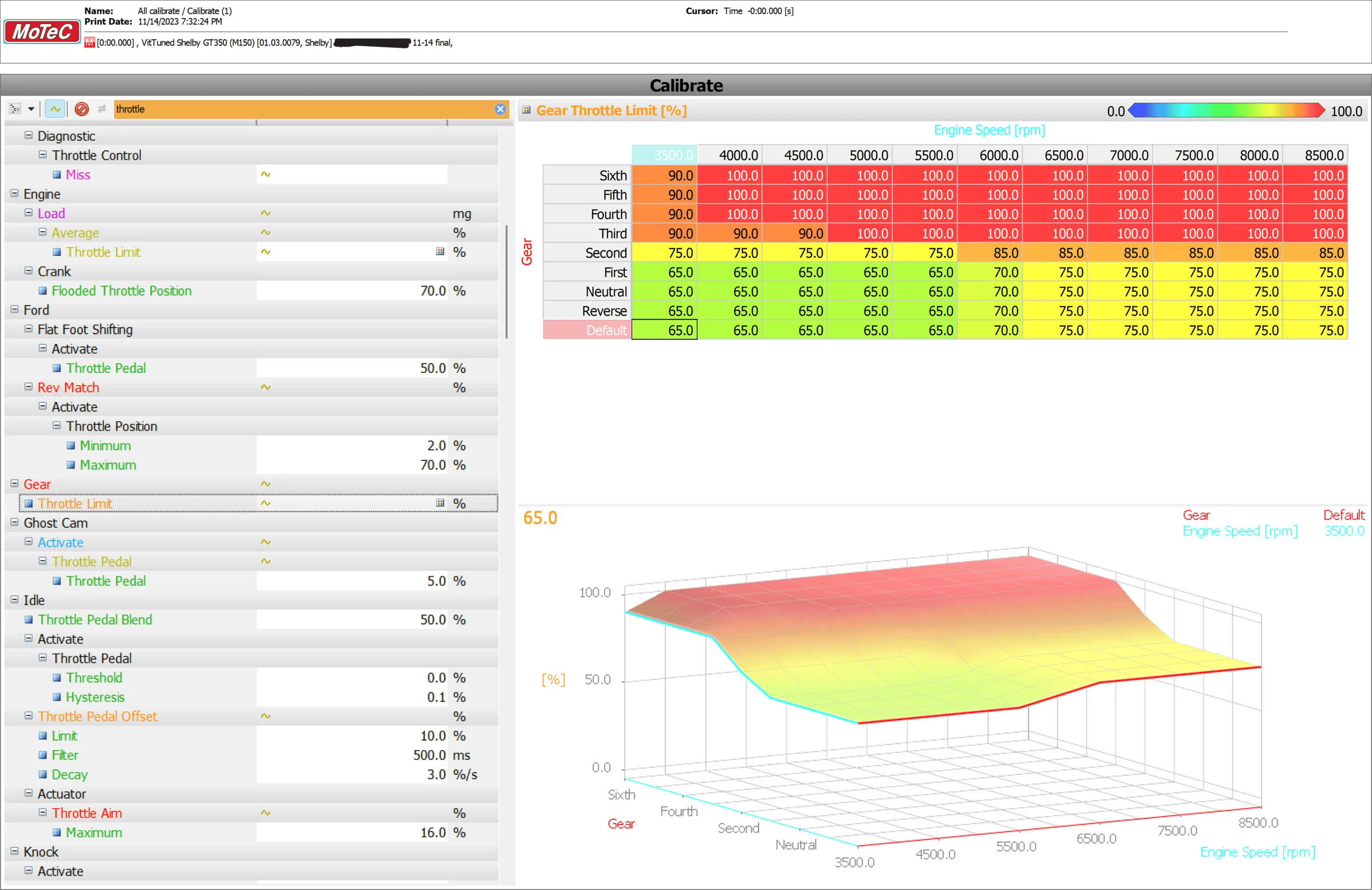
With the ability to limit the throttle body max angle by gear, the system could proactively prevent the driver from storming rapidly into trouble and therefore the corrections can be more graduated, with subtle corrections at first, followed by more intense corrections ultimately ending with the most drastic, which is cylinder cuts.

The video showing a built/modified GT500 attempting to launch with and without the MOTEC system is profound. The issue is big, but grows overwhelming the more torque you make available to the driver (with diminished improvements in chassis and grip comparatively).

What I also like about the MOTEC is that it's user configurable. I can adjust max throttle angle (per gear) and I can also adjust how much wheel slip I'm willing to accept before the system kicks in.

The travesty here is that the MOTEC doesn't add any additional sensors required to implement the much better strategy. It uses all the same sensor inputs available to Ford PCM. It just does it in a much more effective and elegant way.

So instead of the driver stomping the accelerator in 1st gear, getting whatever throttle blade angle he requested and the resulting spike in torque, the MOTEC system already resets the max angle limit, so instead of over-running the chassis, you just quickly run up to near the limit. Once the wheel slip is detected and beyond the current setting, it then first cuts timing (to limit torque) and if that doesn't work it then reduces throttle blade (to reduce air load and further torque production) and if that still isn't working, it cuts cylinders and shuts down the party. All of this is of course, MUCH closer to the physical limits when the car is setup properly.

Ford says "fugg it, let him have it all, we'll just watch him sprint toward the cliff and right after he's over the edge, we'll drastically overcorrect to yank him back."

Just for some perspective, my car made around 390 ft-lbs of torque (after losses) stock. It made nearly 900 ft-lbs of torque after a final draft tune. The stock total multiplication (in lowest gear) was approximately 4,700 ft-lbs to the tires. Now with the new trans, new power and new rear, the total torque the tires see (in lowest gear) is almost 9,700 ft-lbs. Without SOME form of computer control, the amount of torque change with even a tiny fraction of pedal input just becomes practically impossible to control.

Because Ford's strategy is so woeful, and reacts so undesirably, many guys simply turn it off. Which is why we see so many overtorque, spin, run off into people and poles incidents.
 
OP
OP

Torque123

Member
Joined
Dec 9, 2023
Threads
2
Messages
24
Reaction score
2
Location
At home
Vehicle(s)
2013 GT
Thanks. I’m still NA but figured you guys would be tuned into this as much as anyone considering the extra power of FI.

so in 1st gear mine does not control well. thinking maybe FI makes 2nd gear act like what my car does in 2nd.
 

Sponsored

Hack

Well-Known Member
Joined
Nov 26, 2014
Threads
86
Messages
12,802
Reaction score
8,209
Location
Minneapolis
Vehicle(s)
Mustang, Challenger
The answer is it depends heavily on the model Mustang you have and what mode you have it in how the Advancetrac behaves.

The models that are less performance oriented pull power immediately on any slight perceived loss of traction when the car is in normal mode.

The performance models like GT350 (and I assume Mach 1 and DH are this way as well) will let you get significantly sideways even in normal mode.


I'm not much of a power slide kind of guy - mostly because I'm cheap and hate to buy tires too often. However, I owned a 2011 V6 and a 2011 Brembo brake car (predecessor to the PP1). The Advancetrac on both of those cars would pull power very heavily, quickly and they would have a long, eternity of a wait before they gave power back.

I owned a base 2015 GT and it was similar. My GT350 tech pack I've tracked it in normal mode and it didn't pull power on me during 6 20 minute sessions (once I had the cooler issues Ford left us with straightened out). The PP1 I currently own is somewhere in between.

I think this is really smart that Ford engineers did it this way, as beginner Mustang owners are probably buying most of the lower optioned cars and those beginners probably also need the most assistance.

Plus, there is always the option to turn Advancetrac off if you believe you are a good enough driver and don't need it.
 
Last edited:

Hack

Well-Known Member
Joined
Nov 26, 2014
Threads
86
Messages
12,802
Reaction score
8,209
Location
Minneapolis
Vehicle(s)
Mustang, Challenger
First, it's very reactive rather than proactive. It waits for you to get into trouble. By doing that, it then tends to be very OVERREACTIVE in order to have an affectual recovery.
I get the impression that you want the car to somehow read your mind, look at the road and cars around you and figure out whether you are about to do something dumb with the car. And the car is supposed to pull power before you do that thing that will get you in trouble?

I think we are a few years away from that level of technology.
 

Angrey

Well-Known Member
Joined
Jun 21, 2020
Threads
104
Messages
2,794
Reaction score
2,984
Location
Coral Gables
Vehicle(s)
2016 GT350
I get the impression that you want the car to somehow read your mind, look at the road and cars around you and figure out whether you are about to do something dumb with the car. And the car is supposed to pull power before you do that thing that will get you in trouble?

I think we are a few years away from that level of technology.
Not exactly. Anything beyond what the car can handle in terms of traction isn't very useful. So limiting what it can make in each gear means that even IF the driver attempts to go beyond grip, it's already choked so it won't be so drastic of a correction.

If in 1st gear, you can overwhelm the tires with 50% throttle, then by setting it at 45% you prevent the driver from greatly exceeding the wheel slip speed between the front and rear tires.

The new electric motors do this almost by nature with their traction control. They simply continue to apply torque until the wheels slip and always stay on the edge of slip. That's why the Tesla plaid can run sub 10 quarter miles in the rain.
 

Austin1992

Well-Known Member
Joined
Sep 30, 2019
Threads
5
Messages
88
Reaction score
138
Location
Indiana
First Name
Austin
Vehicle(s)
2019 GT PP1
Mine is a 2019 pp1 with the base interior so no modes, wanted a muscle car, didn’t care about touch screens. My traction control button has 3 “modes” though. If I simply click it, screen says traction control off, it will blow the tires off at what ever speed and gear you feel like pushing the car to but the second you get even a little bit sideways it’s cutting power as you’re correcting. Next is a double tap, it says advance trac sport mode, this will allow moderate wheel slippage and some sideways action, I feel this should be the stock full time setting. If you hold the traction control button for 7 seconds it says advance trac off and just playing in empty lots a few times I have not had the computer intervene at all with this setting.
 

Hack

Well-Known Member
Joined
Nov 26, 2014
Threads
86
Messages
12,802
Reaction score
8,209
Location
Minneapolis
Vehicle(s)
Mustang, Challenger
Not exactly. Anything beyond what the car can handle in terms of traction isn't very useful. So limiting what it can make in each gear means that even IF the driver attempts to go beyond grip, it's already choked so it won't be so drastic of a correction.

If in 1st gear, you can overwhelm the tires with 50% throttle, then by setting it at 45% you prevent the driver from greatly exceeding the wheel slip speed between the front and rear tires.

The new electric motors do this almost by nature with their traction control. They simply continue to apply torque until the wheels slip and always stay on the edge of slip. That's why the Tesla plaid can run sub 10 quarter miles in the rain.
Yes that's a huge advantage of an electric motor is you can electronically control torque output very quickly. Gas engines take quite a bit longer to react, and setting a single number doesn't work. I'm sure you realize that and were just giving an example using 45%. Obviously the amount of traction the car has varies based on road surface, temperature, dirt or water on the road, etc. so it's constantly changing.

In theory you could vary the torque output by slipping clutch(es) on a gas engine, but in practice any clutches used that way would probably have a relatively short life.
 

Sponsored
OP
OP

Torque123

Member
Joined
Dec 9, 2023
Threads
2
Messages
24
Reaction score
2
Location
At home
Vehicle(s)
2013 GT
Not exactly. Anything beyond what the car can handle in terms of traction isn't very useful. So limiting what it can make in each gear means that even IF the driver attempts to go beyond grip, it's already choked so it won't be so drastic of a correction.

If in 1st gear, you can overwhelm the tires with 50% throttle, then by setting it at 45% you prevent the driver from greatly exceeding the wheel slip speed between the front and rear tires.
”isn’t useful” lol. True, but Is this why my Tesla friend is so intrigued by my mustangs ability to spin tires, even though his car is twice as fast?
 

Angrey

Well-Known Member
Joined
Jun 21, 2020
Threads
104
Messages
2,794
Reaction score
2,984
Location
Coral Gables
Vehicle(s)
2016 GT350
Yes that's a huge advantage of an electric motor is you can electronically control torque output very quickly. Gas engines take quite a bit longer to react, and setting a single number doesn't work. I'm sure you realize that and were just giving an example using 45%. Obviously the amount of traction the car has varies based on road surface, temperature, dirt or water on the road, etc. so it's constantly changing.

In theory you could vary the torque output by slipping clutch(es) on a gas engine, but in practice any clutches used that way would probably have a relatively short life.
WIth the capabilities of the DOHC VVT EFI motor, they use blade angle (which nearly instantly changes the air load), spark timing and cylinder ignition.

While it's not as capable as an electric motor control, it's still very capable and certainly within the goals of limiting wheel sleep. In fact, with modern computing, it can not only employ a graduated response, it can be tabled/incremented to increase the response as the wheel slip value increases.

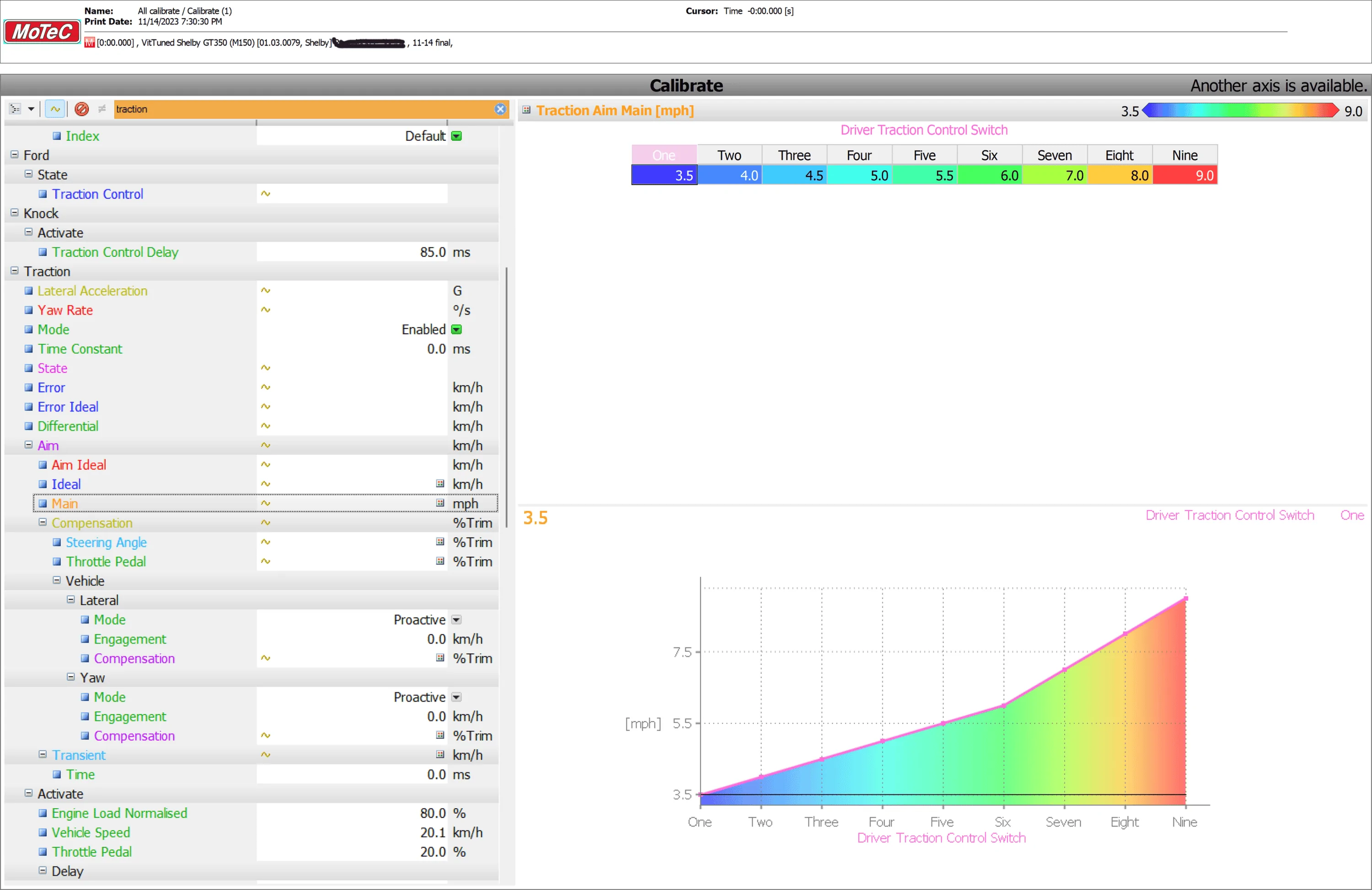
On the MOTEC, you set the "mode" or wheel slip allowable, and it can be user configurable from 0 to whatever. The modes came from the tuner/motec are shown below.

Again, it's helps TREMENDOUSLY to start off proactively by limiting how much overthrottle you allow by gear
MOTEC traction control aim by mode.webp
Motec Throttle Limit.webp
 

Hack

Well-Known Member
Joined
Nov 26, 2014
Threads
86
Messages
12,802
Reaction score
8,209
Location
Minneapolis
Vehicle(s)
Mustang, Challenger
WIth the capabilities of the DOHC VVT EFI motor, they use blade angle (which nearly instantly changes the air load), spark timing and cylinder ignition.

While it's not as capable as an electric motor control, it's still very capable and certainly within the goals of limiting wheel sleep. In fact, with modern computing, it can not only employ a graduated response, it can be tabled/incremented to increase the response as the wheel slip value increases.

On the MOTEC, you set the "mode" or wheel slip allowable, and it can be user configurable from 0 to whatever. The modes came from the tuner/motec are shown below.

Again, it's helps TREMENDOUSLY to start off proactively by limiting how much overthrottle you allow by gear
Angle of what blade?
 

engineermike

Well-Known Member
Joined
Jul 15, 2018
Threads
31
Messages
6,188
Reaction score
6,446
Location
La
Vehicle(s)
2018 GTPP A10
@Angrey ford actually does what you speak of on the stock 2020+ gt500, and it can be done on the gt as well. However, it’s done in terms of engine torque not just blade angle. Ford doesn’t do it on the stock gt because in many circumstances it has the potential to get traction in 1st gear.
Sponsored


Top