Sponsored

Single brushed deadhead pump testing

engineermike

Well-Known Member
Joined
Jul 15, 2018
Threads
31
Messages
6,188
Reaction score
6,449
Location
La
Vehicle(s)
2018 GTPP A10
I've been doing a lot of testing on E85 using single brushed pumps and thought I would share some interesting results.

In my 2018 car, I'm running a Whipple on the 3.25 pulley and E85 using my own flex tuning. I'm running a DW400 and initially tried it using an 18volt vmp bap and 55 lb predator injectors. It works well enough but was somewhat marginal at cold temps. I upgraded to the 22volt JMS unit and on the initial data set it did better, holding about 60 psi at cold temps where traction was super-sketchy even in 5th gear. I still need to ensure it's repeatable with more data.

In my 2020 truck, I'm running a Roush supercharger on the stock F150 pump and Roush supplied 47 lb injectors. As supplied, the pressure was dropping into the 30's on gasoline because Roush limits the pump voltage to 12 volts. I made some tune changes to send 15.2 volts to the pump without a bap. On E85 (again, my own flex tuning) it's also dropping to about 50 psi so I may install an 18 volt bap on it.

The gen3 measures rail pressure and extends pulsewidth when it falls. In both cases above, the port injector pw had some margin before going static.

This of course generated more questions and my friend offered to do some bench testing of the stock and a leftover DW400 (sans check valve). The results were very interesting. The significant learnings were:

***SEE POST 9 FOR UPDATES***

1. The DW400 really takes off at 22 volts. It repeatably gained 125 lph just increasing from 18 to 22 volts. He ran it for a minute at a time twice and it held up.

2. The stock pump performed well at 18 volts but fried almost immediately at 22 volts. I would not run 22 volts from the JMS on a stock pump based on this.

3. At 22 volts, the DW400 was drawing 33-34 amps. This means the stock wire and fuse location could be seeing 55-60 amps. The stock 30 amp fuse will only last around 6 seconds at 60 amps. However, this was at 70 psi and at lower pressures the fuse will last longer.

4. The stock pump appears to perform just as good as the DW400 at lower voltages (non-bap), but as voltage increases the DW400 pulls ahead.

Hope this information is useful.
Sponsored

 
Last edited:

Angrey

Well-Known Member
Joined
Jun 21, 2020
Threads
104
Messages
2,794
Reaction score
2,984
Location
Coral Gables
Vehicle(s)
2016 GT350
I've been doing a lot of testing on E85 using single brushed pumps and thought I would share some interesting results.

In my 2018 car, I'm running a Whipple on the 3.25 pulley and E85 using my own flex tuning. I'm running a DW400 and initially tried it using an 18volt vmp bap and 55 lb predator injectors. It works well enough but was somewhat marginal at cold temps. I upgraded to the 22volt JMS unit and on the initial data set it did better, holding about 60 psi at cold temps where traction was super-sketchy even in 5th gear. I still need to ensure it's repeatable with more data.

In my 2020 truck, I'm running a Roush supercharger on the stock F150 pump and Roush supplied 47 lb injectors. As supplied, the pressure was dropping into the 30's on gasoline because Roush limits the pump voltage to 12 volts. I made some tune changes to send 15.2 volts to the pump without a bap. On E85 (again, my own flex tuning) it's also dropping to about 50 psi so I may install an 18 volt bap on it.

The gen3 measures rail pressure and extends pulsewidth when it falls. In both cases above, the port injector pw had some margin before going static.

This of course generated more questions and my friend offered to do some bench testing of the stock and a leftover DW400 (sans check valve). The results were very interesting. The significant learnings were:

1. The DW400 really takes off at 22 volts. It repeatably gained 125 lph just increasing from 18 to 22 volts. He ran it for a minute at a time twice and it held up.

2. The stock pump performed well at 18 volts but fried almost immediately at 22 volts. I would not run 22 volts from the JMS on a stock pump based on this.

3. At 22 volts, the DW400 was drawing 33-34 amps. This means the stock wire and fuse location could be seeing 55-60 amps. The stock 30 amp fuse will only last around 6 seconds at 60 amps. However, this was at 70 psi and at lower pressures the fuse will last longer.

4. The stock pump appears to perform just as good as the DW400 at lower voltages (non-bap), but as voltage increases the DW400 pulls ahead.

Hope this information is useful.
The stock pump has an internal check valve no? So technically, at lower voltages it's outperforming the DW400 if it was without CV.
 
OP
OP

engineermike

Well-Known Member
Joined
Jul 15, 2018
Threads
31
Messages
6,188
Reaction score
6,449
Location
La
Vehicle(s)
2018 GTPP A10
The stock pump has an internal check valve no? So technically, at lower voltages it's outperforming the DW400 if it was without CV.
Yes the stock one has the check valve. I’d say at stock voltages with check valves the two are too close to call a winner.
 

LOL WUT

Well-Known Member
Joined
Aug 31, 2015
Threads
45
Messages
1,859
Reaction score
2,615
Location
Illinois
Vehicle(s)
19 GT
Very interesting results! Thank you for sharing!
 
OP
OP

engineermike

Well-Known Member
Joined
Jul 15, 2018
Threads
31
Messages
6,188
Reaction score
6,449
Location
La
Vehicle(s)
2018 GTPP A10
For clarification, this is a 2018 stock pump. I believe the gen3 pump is bigger than gen1/2.
 

Sponsored

OP
OP

engineermike

Well-Known Member
Joined
Jul 15, 2018
Threads
31
Messages
6,188
Reaction score
6,449
Location
La
Vehicle(s)
2018 GTPP A10
Our testing was cut short by the failure of the stock pump at 22 volts. If anyone wants to volunteer another stock gen3 pump to complete the flow testing please PM me.
 

horsepower addiction

Well-Known Member
Joined
Jan 30, 2023
Threads
14
Messages
236
Reaction score
83
Location
Arizona
First Name
Nate
Vehicle(s)
s550
Our testing was cut short by the failure of the stock pump at 22 volts. If anyone wants to volunteer another stock gen3 pump to complete the flow testing please PM me.
I would donate a 2019 f150 pump. My understanding is that it outflows the mustang pump. I would like to know if this is true
 
OP
OP

engineermike

Well-Known Member
Joined
Jul 15, 2018
Threads
31
Messages
6,188
Reaction score
6,449
Location
La
Vehicle(s)
2018 GTPP A10
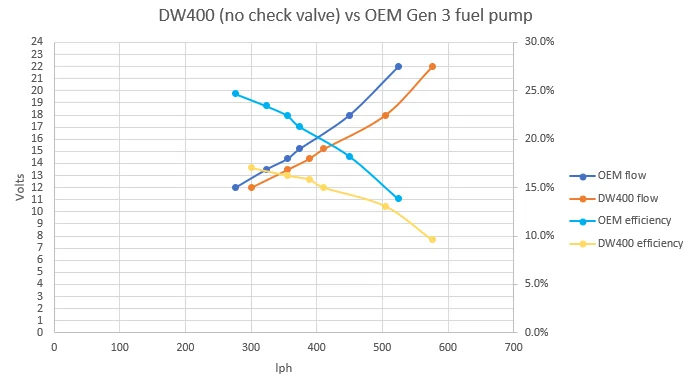
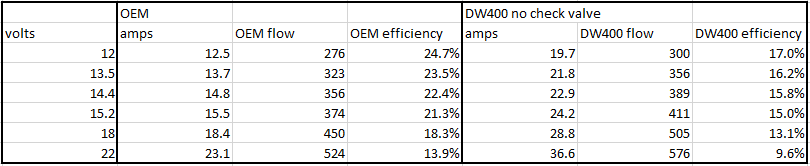
Ok folks, big update and new learnings. @mejohn50 sent me a stock pump to test and we also determined the venturi flow was causing inaccurate readings.

Notes on the test:
- No filters or fuel pump module buckets were used.
- Venturi connection was plugged.
- DW400 was the non-check valve model. I understand the check valve reduces flow by 20-30 lph
- All test were set to 70 psi discharge pressure.
- Test done using water.

1706907786252.png


1706907807470.png


The OEM pump ran fine at 22 volts this time around. I'm not sure why the first one failed. A couple of new conclusions here are:
- The DW400 performs better at all voltages, though the margin is pretty slim if you factor in the effects of the check valve. At low voltage there may be no difference.
- The gains due to increasing voltage start to diminish above 18 volts.
- The DW400 efficiency is quite a bit lower than stock.
- A pair of stock pumps in parallel, such as is likely in the GT500, would pull under 30 amps at stock voltages. Actually, the stock tune limits the pump voltage to 12-12.5, so it would be around 25 amps but not more than 32 with tuning. A DW400 on an BAP is pushing 29-37 amps through the stock FPDM and pulling 36-57 amps through the stock power wire and fuse box. This means we've basically proven you could run two stock pumps (like an entire GT500 bucket) off of a single stock FPDM and still be less amps than what people are running today with BAPs. This could supply up to 700 lph and retain stock PWM control.
 

Sponsored

Grimreaper

Well-Known Member
Joined
Jan 23, 2019
Threads
15
Messages
640
Reaction score
315
Location
Dallas
Vehicle(s)
2017 GT
I've never seen evidence the f150 pumps are higher output. Would love confirmation. Would be surprised if gen2 was smaller pump on gt. Expect all gts/f150 are the same. Gt350 and gt500 dual pump versions.

I have a take out gen2 pump you can have. Send me address if you want to test it.

https://www.f150forum.com/f123/2018-f150-5-0-fuel-pump-testing-dw400-also-424774/


So dual gt pumps runs less than one dw400 on bap? That's nuts.
 
OP
OP

engineermike

Well-Known Member
Joined
Jul 15, 2018
Threads
31
Messages
6,188
Reaction score
6,449
Location
La
Vehicle(s)
2018 GTPP A10
Even through the factory 3/8" feed line and tiny fuel rails?
700 would be in the rated condition. None of the flow numbers above account for losses in the bucket, venturi, line, or rail. However, keep in mind the gt500 also runs a 3/8” line and they’re making over 900 rwhp on an untouched fuel system sans injectors.
 
OP
OP

engineermike

Well-Known Member
Joined
Jul 15, 2018
Threads
31
Messages
6,188
Reaction score
6,449
Location
La
Vehicle(s)
2018 GTPP A10
@Grimreaper my understanding is that all gen2 pumps and the dual gt350 pumps are the same, and that all gen3 pumps and the dual gt500 pumps are the same (but not the same as gen2).
 

SheepDog

Well-Known Member
Joined
Nov 3, 2018
Threads
26
Messages
4,191
Reaction score
5,252
Location
Colorado
First Name
Dax
Vehicle(s)
Iconic Silver 2022 MACH 1 HP, 2023 F150 Powerboost
700 would be in the rated condition. None of the flow numbers above account for losses in the bucket, venturi, line, or rail. However, keep in mind the gt500 also runs a 3/8” line and they’re making over 900 rwhp on an untouched fuel system sans injectors.
I'd love to be able to ditch the return system. Too complicated, too many connections, too expensive, hot fuel etc.
Sponsored

 
Last edited:


Top