engineermike
Well-Known Member
- Thread starter
- #1
I've been doing a lot of testing on E85 using single brushed pumps and thought I would share some interesting results.
In my 2018 car, I'm running a Whipple on the 3.25 pulley and E85 using my own flex tuning. I'm running a DW400 and initially tried it using an 18volt vmp bap and 55 lb predator injectors. It works well enough but was somewhat marginal at cold temps. I upgraded to the 22volt JMS unit and on the initial data set it did better, holding about 60 psi at cold temps where traction was super-sketchy even in 5th gear. I still need to ensure it's repeatable with more data.
In my 2020 truck, I'm running a Roush supercharger on the stock F150 pump and Roush supplied 47 lb injectors. As supplied, the pressure was dropping into the 30's on gasoline because Roush limits the pump voltage to 12 volts. I made some tune changes to send 15.2 volts to the pump without a bap. On E85 (again, my own flex tuning) it's also dropping to about 50 psi so I may install an 18 volt bap on it.
The gen3 measures rail pressure and extends pulsewidth when it falls. In both cases above, the port injector pw had some margin before going static.
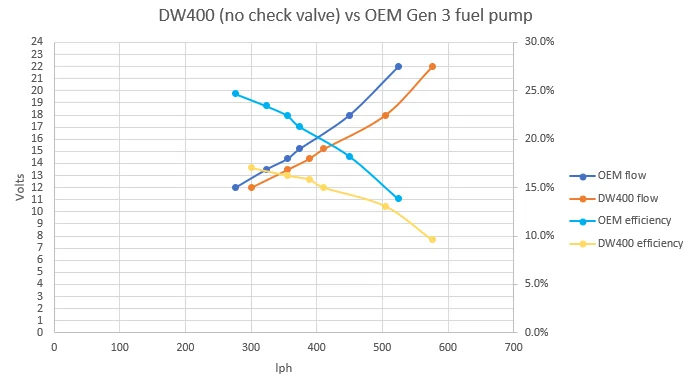
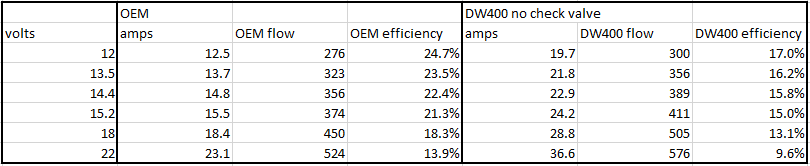
This of course generated more questions and my friend offered to do some bench testing of the stock and a leftover DW400 (sans check valve). The results were very interesting. The significant learnings were:
***SEE POST 9 FOR UPDATES***
1. The DW400 really takes off at 22 volts. It repeatably gained 125 lph just increasing from 18 to 22 volts. He ran it for a minute at a time twice and it held up.
2. The stock pump performed well at 18 volts but fried almost immediately at 22 volts. I would not run 22 volts from the JMS on a stock pump based on this.
3. At 22 volts, the DW400 was drawing 33-34 amps. This means the stock wire and fuse location could be seeing 55-60 amps. The stock 30 amp fuse will only last around 6 seconds at 60 amps. However, this was at 70 psi and at lower pressures the fuse will last longer.
4. The stock pump appears to perform just as good as the DW400 at lower voltages (non-bap), but as voltage increases the DW400 pulls ahead.
Hope this information is useful.
In my 2018 car, I'm running a Whipple on the 3.25 pulley and E85 using my own flex tuning. I'm running a DW400 and initially tried it using an 18volt vmp bap and 55 lb predator injectors. It works well enough but was somewhat marginal at cold temps. I upgraded to the 22volt JMS unit and on the initial data set it did better, holding about 60 psi at cold temps where traction was super-sketchy even in 5th gear. I still need to ensure it's repeatable with more data.
In my 2020 truck, I'm running a Roush supercharger on the stock F150 pump and Roush supplied 47 lb injectors. As supplied, the pressure was dropping into the 30's on gasoline because Roush limits the pump voltage to 12 volts. I made some tune changes to send 15.2 volts to the pump without a bap. On E85 (again, my own flex tuning) it's also dropping to about 50 psi so I may install an 18 volt bap on it.
The gen3 measures rail pressure and extends pulsewidth when it falls. In both cases above, the port injector pw had some margin before going static.
This of course generated more questions and my friend offered to do some bench testing of the stock and a leftover DW400 (sans check valve). The results were very interesting. The significant learnings were:
***SEE POST 9 FOR UPDATES***
1. The DW400 really takes off at 22 volts. It repeatably gained 125 lph just increasing from 18 to 22 volts. He ran it for a minute at a time twice and it held up.
2. The stock pump performed well at 18 volts but fried almost immediately at 22 volts. I would not run 22 volts from the JMS on a stock pump based on this.
3. At 22 volts, the DW400 was drawing 33-34 amps. This means the stock wire and fuse location could be seeing 55-60 amps. The stock 30 amp fuse will only last around 6 seconds at 60 amps. However, this was at 70 psi and at lower pressures the fuse will last longer.
4. The stock pump appears to perform just as good as the DW400 at lower voltages (non-bap), but as voltage increases the DW400 pulls ahead.
Hope this information is useful.
Sponsored
Last edited: