PremiumT
Guest
So we know the 4 cyl will be lighter and more balanced. Question is how much so? Are we talking 100+ pounds and near 50/50?
Sponsored

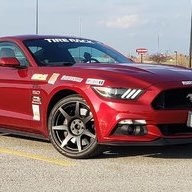
For autocross only? I'd chose the floating calipers and 13.2" rotors (or whatever they are) for the 2.3L. Less overall weight and I don't need the 15" brakes because autocross is not hard on brakes. This provides me with the option of "upgrading" to one of Wilwood's lightweight brake setups with the smaller diameter rotors. The class I'm in stipulates that brake rotor diameter does not decrease for your optioned car so this would allow me to use their 13.5" setup (it's a drag racing setup IIRC) and keep weight down.Assuming the 15" brakes are legal in the class you want the Mustang to compete in, which setup would you choose?
We already know that the 2.0L Ecoboost is around 478lbs (per:http://www.fordracingparts.com/parts/part_details.asp?PartKeyField=22999), the 5.0L is 544lbs (per:http://www.fordracingparts.com/parts/part_details.asp?PartKeyField=13113) and those are dry weights, no oil. Somewhere between 75-100 less in just the engine. My 2009 sits at 52.6/47.4 weight distribution and 100lbs off the nose would throw it at 49.9/50.1.So we know the 4 cyl will be lighter and more balanced. Question is how much so? Are we talking 100+ pounds and near 50/50?

((( OT WARNING )))For autocross only? I'd chose the floating calipers and 13.2" rotors (or whatever they are) for the 2.3L. Less overall weight and I don't need the 15" brakes because autocross is not hard on brakes. This provides me with the option of "upgrading" to one of Wilwood's lightweight brake setups with the smaller diameter rotors. The class I'm in stipulates that brake rotor diameter does not decrease for your optioned car so this would allow me to use their 13.5" setup (it's a drag racing setup IIRC) and keep weight down.

Well it looks like they have their bases covered, 13.2" brakes for the auto-x crowd fitting into their chosen class, 14" for higher classes, HPDE enthusiasts and club racers fitting their class, and 15" brakes for peak performance wherever it can be used.For autocross only? I'd chose the floating calipers and 13.2" rotors (or whatever they are) for the 2.3L. Less overall weight and I don't need the 15" brakes because autocross is not hard on brakes. This provides me with the option of "upgrading" to one of Wilwood's lightweight brake setups with the smaller diameter rotors. The class I'm in stipulates that brake rotor diameter does not decrease for your optioned car so this would allow me to use their 13.5" setup (it's a drag racing setup IIRC) and keep weight down.
What will I actually be getting if Ford hits my weight goal? The 14" brakes are more than capable on a 3700lb (with driver) Mustang GT with some attention paid to cooling on a road course. That is all I'll need since I will want to take the car on a roadcourse eventually. I have the floating calipers on my GT and they work fine for autocross but they are NOT up to snuff for roadcourse duty. I just don't like the idea of the base 2.3L either if there are going to be differences in the drivetrain.
My gripe with the 6 piston, 15" rotors has more to do with wheel selection and then the drastic reduction in tire selection than it does actual performance. If more 18" wheels fit the 15" rotors (the Ford Racing BBS wheels on the FR500/Boss302R clear them in 18" and are the only confirmed 18" that does) I might have changed my mind but since barely any do the 14" is my choice. 19" tires are expensive, the wheels are still heavy and even if they weigh the same the rotational inertia is more because the weight is another half inch further from the hub. Stopping distance wise there is no difference between the 14" setup and the 15" setup. Will it feel like there is? Yes, but there wont be a measurable distance so long as they are on the same tires and weigh the same with the same weight distribution. The tires have been a limiting factor in stopping distance tests on the Mustang since well before 2005. What it will do is take the repeated abuse of road coursing longer. In autocross we don't get brakes hot enough to justify massive brakes with cooling ducts unless the car is dual purpose. We use the brakes a lot but they never get that hot since the speeds are significantly lower.
We already know that the 2.0L Ecoboost is around 478lbs (per:http://www.fordracingparts.com/parts/part_details.asp?PartKeyField=22999), the 5.0L is 544lbs (per:http://www.fordracingparts.com/parts/part_details.asp?PartKeyField=13113) and those are dry weights, no oil. Somewhere between 75-100 less in just the engine. My 2009 sits at 52.6/47.4 weight distribution and 100lbs off the nose would throw it at 49.9/50.1.
May, probably not, September, I'm going to try my damndest. I'm going to try and be there for the regular events too. If you are in the Omaha/Lincoln area, www.nrscca.com is our local region.((( OT WARNING )))
I see you are from the land of the Corn, will you be entered/driving at the Airbase in Lincoln this May & Or September-August?
SCCA
That's some serious balance right there. I guess we won't know for sure until they tell us as it has to factor in the IRS and the changes made to proportions. I think a few they mentioned was the A pillar being shifted forward if I'm not mistaken. either way the lower CoG and wider track should help with weight transfer. It makes the I4 a very very attractive option for those that are not all about pure hp and can live without the V8 note.We already know that the 2.0L Ecoboost is around 478lbs (per:http://www.fordracingparts.com/parts/part_details.asp?PartKeyField=22999), the 5.0L is 544lbs (per:http://www.fordracingparts.com/parts/part_details.asp?PartKeyField=13113) and those are dry weights, no oil. Somewhere between 75-100 less in just the engine. My 2009 sits at 52.6/47.4 weight distribution and 100lbs off the nose would throw it at 49.9/50.1.
My guess is base GT will have the same performance as the B302 and the PP would handily beat it. He did say "for sure" outperform. Exciting times, I can't wait to see it get tested. :hail:I was under the impression that the regular base GT would beat the Boss 302 around a track. Does this mean that only the PP equipped GT can?
Any car with an electronically restricted speed can be electronically unrestricted.but cars equipped with the optional high performance Track Pack will be able to hit 145 mph, which a Ford spokesperson tells FoxNews.com is also an electronically restricted speed.
Great! I can see a 2015 convertible GT California Special with lots of carbon fiber trim!Q: Any plans for a Boss 302 replacement?
A: We've been in (Mustang) business for 50 years and if you look at what we've done, the Mustang has always had specialty cars and performance vehicles. You can expect that we're going to stay on the same path. Today, we're here talking about the new Mustang, so we're not talking about any plans for future cars at the moment, but it would be wrong for me to say that we're not going to do that. It's been in our blood, it's been in our history, so stay tuned.
I don't recommend doing that with the V6 Mustang if they chose a driveshaft that comes apart a few MPH after the electronic limiter!
Any car with an electronically restricted speed can be electronically unrestricted.



Sir, the exact weight of the Coyote 5.0, ready to run is 429lbs.We already know that the 2.0L Ecoboost is around 478lbs (per:http://www.fordracingparts.com/parts/part_details.asp?PartKeyField=22999), the 5.0L is 544lbs (per:http://www.fordracingparts.com/parts/part_details.asp?PartKeyField=13113) and those are dry weights, no oil. Somewhere between 75-100 less in just the engine. My 2009 sits at 52.6/47.4 weight distribution and 100lbs off the nose would throw it at 49.9/50.1.
Sir, the exact weight of the Coyote 5.0, ready to run is 429lbs.
Ok, my point still stands as the important part was the delta between weights.Sir, the exact weight of the Coyote 5.0, ready to run is 429lbs.
I have yet to hear what the Ecoboost 2.0L weighs with turbo plumbing and all that... hell I can't even find what just the block weighs so that packaged weight is as close as we get.