Sponsored

Power Pack pinging/detonation poll

Do you have it?

  • 93 octane - I do have it

  • 91 octane - I do have it

  • 93 - no detonation

  • 91 - no detonation

  • I had it but managed to fix it - post details in the thread

  • I had it initially, but the car re-learned at 91 octane

  • I had it initially, but the car re-learned at 93 octane

  • I do not have power pack


Results are only viewable after voting.
OP
OP
accel

accel

Well-Known Member
Joined
May 19, 2017
Threads
76
Messages
1,281
Reaction score
319
Location
USA
Vehicle(s)
'17 GT PP
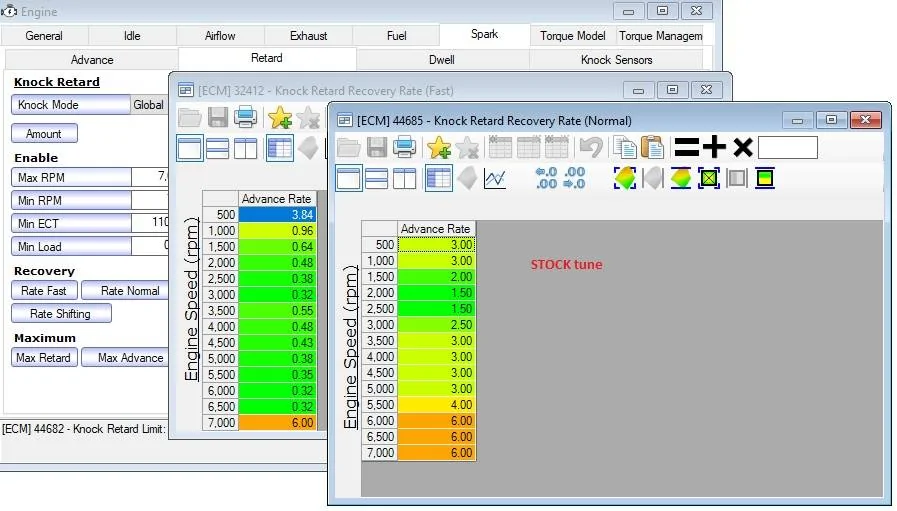
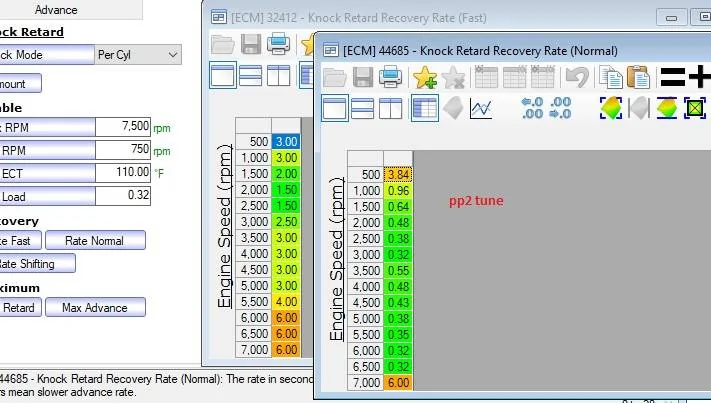
The adaptive octane learn takes time and repeated events for the ecu to store a set amount of KR for a given load/ rpm. Seems to be supported by what you guys are saying with a reflash as well (which i believe wipes the KAM where these things are usually stored). the process starts over again. see the attached photo, from a 2015 PP2 tune, adaptive knock settings are the same compared to a stock tune. but those are the parameters the ecu is working with.

i have not been able to compare the 2 versions of the ford pp2 tunes but plan to once i get to that point this upcoming year.
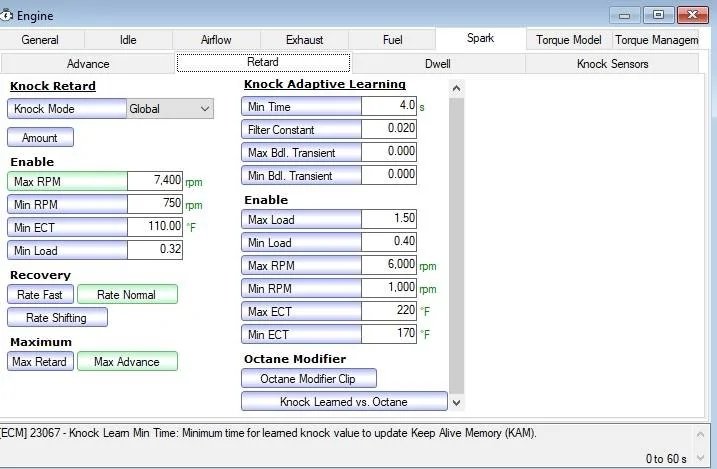
adaptive knock.webp
given the engine is in adaptation period, what should I do? Drive like a grandma? I'm watching detonation, let it happen a little, but not much.

I actually enrolled in some HPDE in a couple of weeks and wonder what I should do... I definitely do not want to whip the engine that is detonating at that event. Should I wait for one more week and if not adjusted then rollback oem?
Sponsored
 

1MeanZ

Well-Known Member
Joined
Sep 7, 2019
Threads
9
Messages
230
Reaction score
309
Location
Indiana
First Name
Jeremy
Vehicle(s)
2016 Mustang GT PP M6 1986 Camaro IROC-Z
I've been doing EFI tuning on OBD1 GM cars for about 10 years now, so while I'm not well versed in the gen2 Coyote, I know ping and know how to address it.

When I first loaded my PP2 tune, I heard some pinging. As others have mentioned I just drove the car normally, being nice sometimes and playing a little bit other times and the car eventually came out of it. I'd say you have to get on it some or you never access the areas of the map that need the spark correction.

If I were in your shoes, I'd drive the car in a spirited fashion and see what happens. I'd say it will re-learn and come out of it in preparation for your track day.

My final comment is more of a question for the tuners here. Don't these modern controls have a knock retard attack rate when detonation is detected? As a last resort this should protect the engine. I know the old GM stuff won't learn/store ignition timing changes like it will learn fuel trims, but there was knock retard routines that protected against damage. I know some of the early 2000s GM stuff also had a semi-permanent knock retard where it won't restore full ignition timing until it sees the fuel level in the tank raised.
 
OP
OP
accel

accel

Well-Known Member
Joined
May 19, 2017
Threads
76
Messages
1,281
Reaction score
319
Location
USA
Vehicle(s)
'17 GT PP
I've been doing EFI tuning on OBD1 GM cars for about 10 years now, so while I'm not well versed in the gen2 Coyote, I know ping and know how to address it.

When I first loaded my PP2 tune, I heard some pinging. As others have mentioned I just drove the car normally, being nice sometimes and playing a little bit other times and the car eventually came out of it. I'd say you have to get on it some or you never access the areas of the map that need the spark correction.

If I were in your shoes, I'd drive the car in a spirited fashion and see what happens. I'd say it will re-learn and come out of it in preparation for your track day.

My final comment is more of a question for the tuners here. Don't these modern controls have a knock retard attack rate when detonation is detected? As a last resort this should protect the engine. I know the old GM stuff won't learn/store ignition timing changes like it will learn fuel trims, but there was knock retard routines that protected against damage. I know some of the early 2000s GM stuff also had a semi-permanent knock retard where it won't restore full ignition timing until it sees the fuel level in the tank raised.
Ok, two users suggest it will eventually adapt per their experience. That is good.

It is also weird that google is full of information on hopeless ping and I am the only one who has problems according to the poll so far.
 

thelostotter

Well-Known Member
Joined
Sep 13, 2017
Threads
31
Messages
435
Reaction score
223
Location
AZ
Vehicle(s)
2017 GTPP
You are probably paying more attention than most people, which is good. I felt like you when I initially loaded the tune. But pretty shortly after I never heard it even though I was listening for it constantly.

My opinion is drive it in a manner where the ECU will see the ping before you take it to the track. I drove mine hard because I was having fun with my new power.
 

J17GT

Well-Known Member
Joined
Apr 21, 2019
Threads
9
Messages
838
Reaction score
739
Location
IL
Vehicle(s)
2017 Mustang GT PP
As others have experienced, I noticed some ping right after flashing the tune. I also connected with Ford Performance and was told not to worry. I would hear it slightly in the car, lower rpms with high load, so did my best to avoid that scenario. When going past a cement barrier with the windows down, you sure could hear it. Going WOT I would notice it just on throttle tip in. Then it would clear up almost instantly. Running 93 here.

Then I realized after a few hundred miles that I didn’t hear it anymore. I ran a drag race event with the car in the heat of July. Temps were in the upper 90s and air intake temps were way up after idling in the staging lanes. No pinging at all.

I agree with others that say give it more time. I bet the majority of it, if not all, will clear up.
 

Sponsored

Grimreaper

Well-Known Member
Joined
Jan 23, 2019
Threads
15
Messages
640
Reaction score
315
Location
Dallas
Vehicle(s)
2017 GT
My final comment is more of a question for the tuners here. Don't these modern controls have a knock retard attack rate when detonation is detected? As a last resort this should protect the engine. I know the old GM stuff won't learn/store ignition timing changes like it will learn fuel trims, but there was knock retard routines that protected against damage. I know some of the early 2000s GM stuff also had a semi-permanent knock retard where it won't restore full ignition timing until it sees the fuel level in the tank raised.
not a professional tuner but always into the ecus/software of any car i own.
the intensity of the knock is considered when the timing is pulled. heavier knock, higher reduction. and it is supposed to take more timing reduction to stop knock once it starts than would be needed if you never entered into it to begin with. Better to get close but not tip the boat for that last degree of timing. These things i take from others experience though as i have not intentionally tried them out myself... have built a few motors but would rather drive it instead.

that is rather intuitive of GM to get around needing a low octane/high octane map and subsequent blends, but what a blow if you were on a dyno trying to tune!!

there is no knock control like that on the coyote that i have found. Ill have to go dig on what has been shared about the core level functionality of the system. My understanding is it is much like the fuel system, closed loop in nature and reacts with stored values for known areas that needed attention the last revolution or even cylinder.

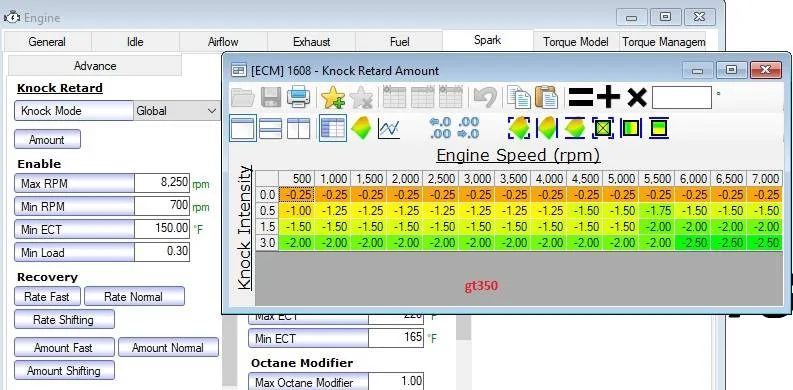
something else i came across with the FRPP tune vs stock in regard to knock retard/timing addition. compare these tables, first one is stock tune, second is pp2. pay attention to the table names, then values. i double checked this across 3 different MY pp tunes and 2 stock tunes. all look exactly the same as whats shown. Knock Retard Recovery Rate (Normal): The rate in seconds/degree that spark is added when no knock is detected. Higher numbers mean slower advance rate.
stock tune.webp
pp2 tune.webp
 
Last edited:

1MeanZ

Well-Known Member
Joined
Sep 7, 2019
Threads
9
Messages
230
Reaction score
309
Location
Indiana
First Name
Jeremy
Vehicle(s)
2016 Mustang GT PP M6 1986 Camaro IROC-Z
not a professional tuner but always into the ecus/software of any car i own.
What software are you using?


the intensity of the knock is considered when the timing is pulled. heavier knock, higher reduction.
Are you sure of this? I've never heard of knock intensity before. I thought knock sensors picked up knock or they didn't, it's a binary thing.


and it is supposed to take more timing reduction to stop knock once it starts than would be needed if you never entered into it to begin with.
That is 100% correct. When pre-ignition starts, combustion temps skyrocket and further perpetuates more pre-ignition. Then you really have to kill timing to calm things down. It's way better to just not get into detonation in the first place.


there is no knock control like that on the coyote that i have found. Ill have to go dig on what has been shared about the core level functionality of the system. My understanding is it is much like the fuel system, closed loop in nature and reacts with stored values for known areas that needed attention the last revolution or even cylinder.
I think there is most certainly knock control. Based on looking at your maps and my semi-related previous experience, when knock is detected there is a specified attack rate to pull timing immediately. Then as your maps also show, there is a recovery rate to restore timing. There could be no stored timing values unless knock was attacked and corrected in the first place, so there has to be some method of instant detonation mitigation. My assumption then is that the ECM remembers when/where/how/what conditions the previous detonation took place, and it pulls timing from that spot on the map. This is how many of us have commented that we had initial knock but it went away over time. I expect if I unhook my battery, the detonation will return until the ECM re-learns where the detonation occurs.
 

Grimreaper

Well-Known Member
Joined
Jan 23, 2019
Threads
15
Messages
640
Reaction score
315
Location
Dallas
Vehicle(s)
2017 GT
you asked about a knock retard system that canned the timing until fuel was refilled past a certain point, a failsafe it would seem that senses if the fuel is low octane and then it is assumed that the entire tank is bad. At least based on what was posted, thats what im gathering. no there is nothing in the tunes to indicate that. knock system will certainly try and reduce timing but you can still rattle the piston enough to cause damage even with e85 as others have unfortunately experienced. relying on sensors is always reactive.
i believe we are in agreement , but looking at opposite ends or the wording or something.

knock sensors raw output is analog, youd need an oscilloscope to see it. back probing the pin is best as punching through the insulated wires can ground out the signal if the insulation is broken. Most sensors are unpowered and generate a voltage themselves that is fed to an input on the ecu. an ADC translates/filters and the ecu interprets it further to determine if its true knock, what cylinder, as well as intensity etc. some OEMs use knock sensors that only send a signal when a certain frequency is picked up that is tuned very specifically to that bore size and engine. others have a wider spectrum that send all sorts of noises through and let the ecu sort it out. very interesting stuff

the patents on google are a wealth of knowledge when you get into some of these. very clever guys here and across the pond when it comes to the sensors on cars. toyota was using an optical lens to view air vortexes to measure the air flow in an intake in the early 80's. something id never consider to say the least!

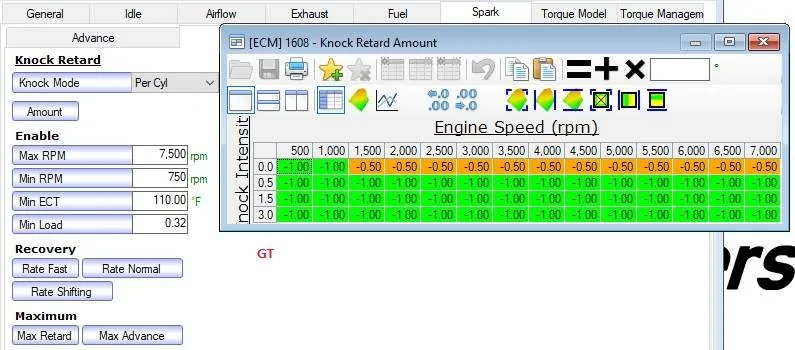
there is a map for intensity that i did not post. the coyote one is pretty basic, the gt350 one gets interesting though as its very aggressive at pulling timing for med-high knock events.

ill post them later. you can download the hp tuners software for free and find these tunes on their boards or in the repository.


map attached,top GT< bottom gt350 View attachment 420426 View attachment 420426 View attachment 420426 View attachment 420429
gt.webp
gt350.webp
 

Attachments

  • 0 bytes Views: 0
  • 0 bytes Views: 0
Last edited:

CrashOverride

Well-Known Member
Joined
Aug 18, 2018
Threads
45
Messages
680
Reaction score
376
Location
Under a hood
Vehicle(s)
2015 Mustang GT
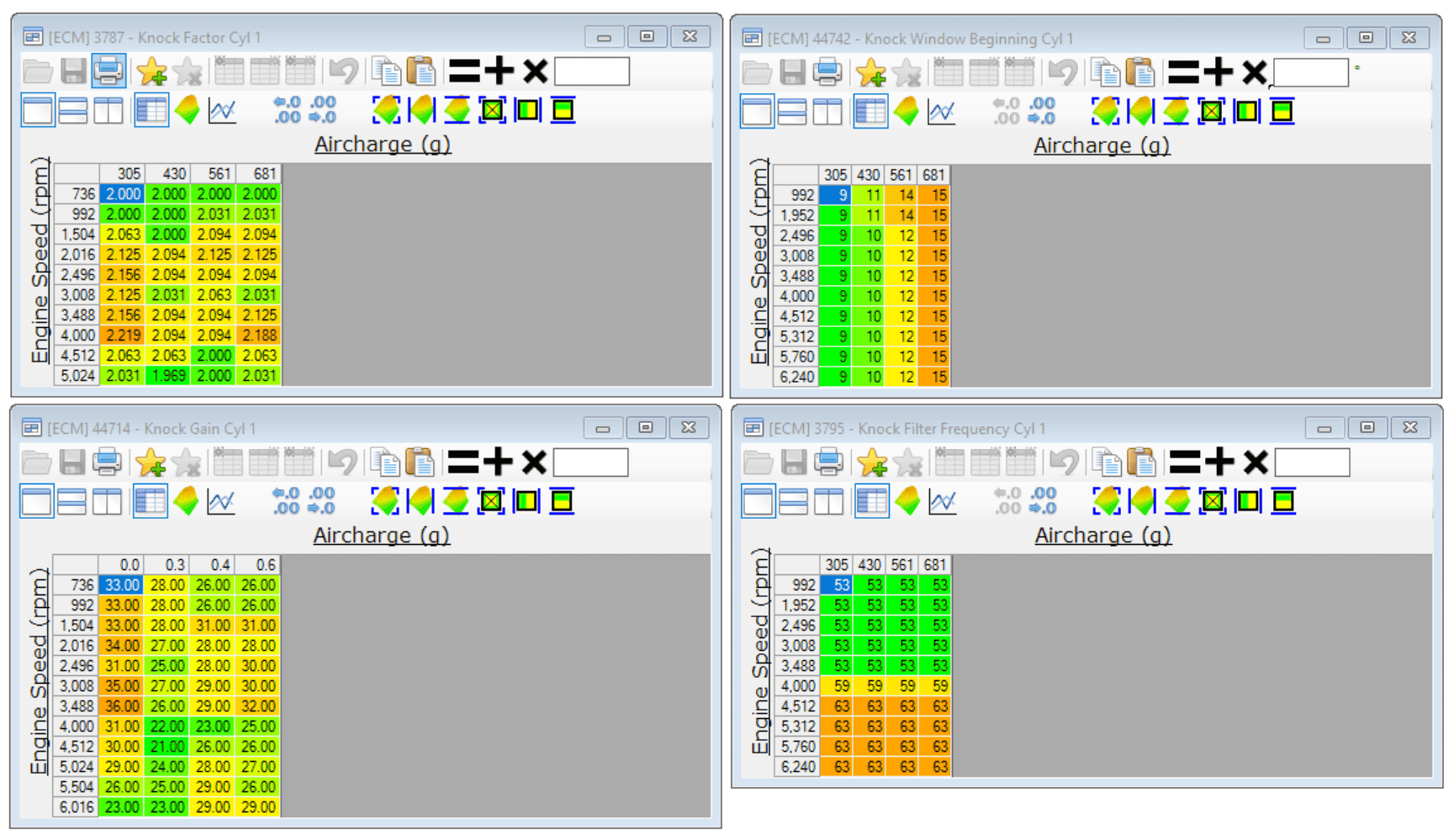
To further this, like Grimreaper said, you can adjust the knock sensors quite a bit as well. These four tables are just for tuning the knock sensor for cylinder #1 (So there are 7 more sets!).

upload_2019-12-19_15-53-51.png
 
OP
OP
accel

accel

Well-Known Member
Joined
May 19, 2017
Threads
76
Messages
1,281
Reaction score
319
Location
USA
Vehicle(s)
'17 GT PP
you asked about a knock retard system that canned the timing until fuel was refilled past a certain point, a failsafe it would seem that senses if the fuel is low octane and then it is assumed that the entire tank is bad.
with me being not the most knowledgable car computer expert... are you saying that the more tanks I refuel, the faster the tune should adapt? If so, would it be benefitial to refuel more frequently? Like, every half tank?
 

Sponsored

CrashOverride

Well-Known Member
Joined
Aug 18, 2018
Threads
45
Messages
680
Reaction score
376
Location
Under a hood
Vehicle(s)
2015 Mustang GT
Grimreaper knows this stuff far better than I do, but they key is to know that HP Tuners and other tuning suites only expose a portion of the computer (Called the "OS" in HP Tuners). So we see what we see, and that's it. For example, we know the Power Pack has the no-lift-shift feature, but there isn't an option anywhere within HP Tuners to en/disable (or tweak) it. We have gearshift hang, but so does the stock tune.

There aren't any tables (That I know of) that would indicate a learning procedure or ignition advance lock on a per-tank feature. It's possible there is a PID for it using the VCM Scanner, but I think you would have to log it continuously in order to see anything meaningful taking place after you get gas. Because the car has wideband o2 sensors, guessing/testing/inferring octane after a re-fuel event isn't needed.

I think the curiosity is whether there is an internal table (We believe in the KAM) that records knock based on inferred MAP (Or something thereof) and uses that when calculating the final spark values. If there is such a thing (We can't see what's in the KAM...At least I don't think we can) then it is more than likely triggered simply by time spent in each cell. In other words, if you never go 90% throttle below 2000 RPM, then the car will never "learn" how much spark the engine can take in those high load/low-rpm cells. To get a complete set of data, just drive the car in a random fashion. Mix in high and low loads, at high and low RPMs. I know when I heard my buddy's car, it was always knocking in the <2500 (Probably less than 2200) RPM range. So you could tell yourself never to lug the engine and not worry about knock...But the tune is advertised to make all this extra low end torque, so to do so would be a bit silly.

I hope this helps at least somewhat.
 

1MeanZ

Well-Known Member
Joined
Sep 7, 2019
Threads
9
Messages
230
Reaction score
309
Location
Indiana
First Name
Jeremy
Vehicle(s)
2016 Mustang GT PP M6 1986 Camaro IROC-Z
Grim, we are in agreement. This is a complicated topic and I probably didn’t word things the best. I didn’t mean to infer that the timing would come back based on an increase in fuel level. That’s an older GM thing I was just using to compare/contrast.

I also didn’t mean the knock sensor was actually putting out a binary signal, I meant they I thought it picked up knock or it didn’t. I am aware that they are tuned for a frequency and that bore size for example can make a difference. I didn’t realize they could detect knock intensity however, so I learned something there.

This is a good discussion that is helping me and will hopefully help others, and is searchable. This is why web forums are 100x better than stupid Facebook groups...
 

Grimreaper

Well-Known Member
Joined
Jan 23, 2019
Threads
15
Messages
640
Reaction score
315
Location
Dallas
Vehicle(s)
2017 GT
@CrashOverride that is a great consideration. I do wonder if a pid could be had for the octane learn. Could plot a histogram and while you drive and hit these areas it could build a map of what's being stored. Much like the maf transfer tuning. I agree though. Drive it. Let it hit those areas a bit or avoid lugging altogether.
Are the rest of you guys finding it pings at similar rpms and with really heavy throttle too? Guess I should clarify we talking 80%+ trying to pass someone at 2000rpm? Or light 30 to 40% maintaining speed throttle?

As you mentioned I agree access to the stored /learned values would most likely require a ram or sram dump(KAM). I'm not sure obdii is capable of reaching that low level data. Maybe, worth an ask to the guys at hp.

@1MeanZ agreed its not an easy topic at all! Always learning on this end too. Hop over to the tuner boards and download the software when you get time. Its the right price (free to read/ open tunes) and any observations you find while reading the tunes are welcome! To flash you'll need an ngauge or mpv2 and $100 in credits

@Jed S. You have someone tune this tune for e85 or you get a new tune? Or did you do it yourself?
 

Stang 19

Well-Known Member
Joined
Sep 5, 2018
Threads
95
Messages
890
Reaction score
378
Location
Ca
First Name
Mike
Vehicle(s)
2020 GT500 Ford Performance Blue
I just wish we could be assured more positively by Ford that the extremely loud knock for low rpm/high load is actually fine as they say. I've never heard knock this bad before. This isn't "listen really hard and maybe hear it". This is your car illiterate co-worker going "what's that noise" when you're going up a hill at a high load with low RPM.
If Forc is saying not to worry about it you can be sure that they mean it ONLY if they put it in writing . I will pretty much bet that you will never see that in writing from them .
Sponsored


Top