Sponsored

Octane/Timing relationships

engineermike

Well-Known Member
Joined
Jul 15, 2018
Threads
31
Messages
6,188
Reaction score
6,450
Location
La
Vehicle(s)
2018 GTPP A10
Off topic a little bit speaking of engine brake torque... Is this derived from just the MBT tables?
I believe the engine brake torque calculation is corrected for mbt minus actual timing. There is a lookup table for the torque ratio as a function of load and (mbt - actual timing).
Sponsored


Pistol_91

Well-Known Member
Joined
Oct 25, 2023
Threads
12
Messages
1,381
Reaction score
1,407
Location
Clearwater
Vehicle(s)
2020 mustang GT
I believe the engine brake torque calculation is corrected for mbt minus actual timing. There is a lookup table for the torque ratio as a function of load and (mbt - actual timing).
Where is this table? Increasing MBT or decreasing MBT will effect desired brake torque?
 

engineermike

Well-Known Member
Joined
Jul 15, 2018
Threads
31
Messages
6,188
Reaction score
6,450
Location
La
Vehicle(s)
2018 GTPP A10
Where is this table? Increasing MBT or decreasing MBT will effect desired brake torque?
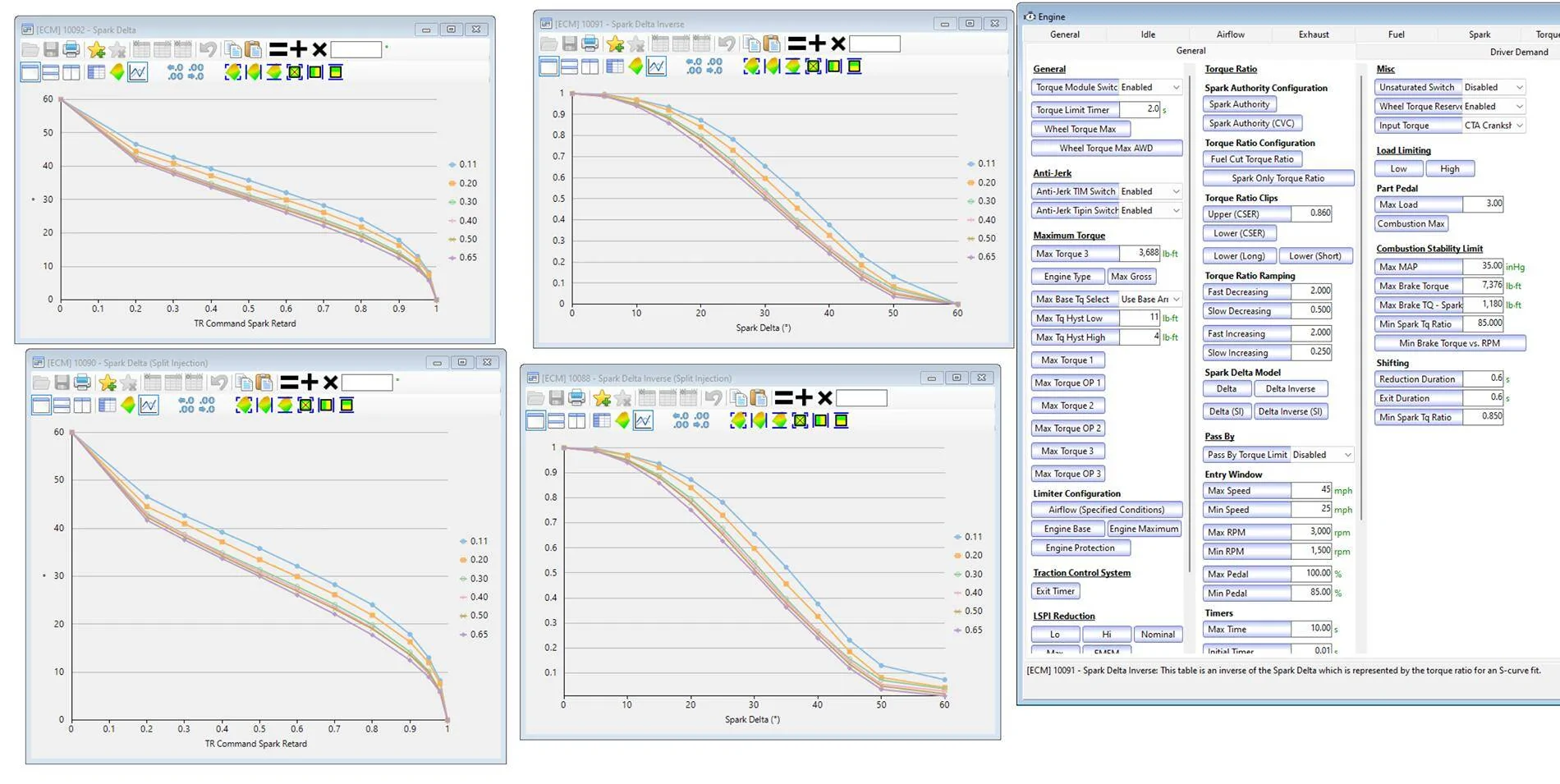
I don’t have my laptop in front of me. The tables are under the torque management/general tab usually center column at the bottom. Some call them the spark torque S-curves. There are 4 of them.
 

Pistol_91

Well-Known Member
Joined
Oct 25, 2023
Threads
12
Messages
1,381
Reaction score
1,407
Location
Clearwater
Vehicle(s)
2020 mustang GT
I don’t have my laptop in front of me. The tables are under the torque management/general tab usually center column at the bottom. Some call them the spark torque S-curves. There are 4 of them.
So, changing these values will increase/decrease desired brake torque ?
 

engineermike

Well-Known Member
Joined
Jul 15, 2018
Threads
31
Messages
6,188
Reaction score
6,450
Location
La
Vehicle(s)
2018 GTPP A10
So, changing these values will increase/decrease desired brake torque ?
I don’t think so, but they will change the calculation for engine brake torque. They’re mainly there so it knows how much timing to pull for torque control.
 

Sponsored

K4fxd

Well-Known Member
Joined
Apr 2, 2020
Threads
121
Messages
13,455
Reaction score
12,262
Location
NKY
First Name
Dan
Vehicle(s)
2017 gt, 2002 FXDWG, 2008 C6,
So, changing these values will increase/decrease desired brake torque ?
Not sure what you are asking. Desired torque is through the driver demand tables. Calculated torque is through the spark tables and others.
 

Pistol_91

Well-Known Member
Joined
Oct 25, 2023
Threads
12
Messages
1,381
Reaction score
1,407
Location
Clearwater
Vehicle(s)
2020 mustang GT
Not sure what you are asking. Desired torque is through the driver demand tables. Calculated torque is through the spark tables and others.
DD doesn't seem to effect engine brake torque under WOT, that I have found. Double values, leave stock, no difference. Wondering what exactly effects desired/actual engine brake torque. I have messed around with quite a bit of everything and have yet to figure those 2 out. Like I said, off topic.. lol.
 

K4fxd

Well-Known Member
Joined
Apr 2, 2020
Threads
121
Messages
13,455
Reaction score
12,262
Location
NKY
First Name
Dan
Vehicle(s)
2017 gt, 2002 FXDWG, 2008 C6,
WOT you get what you get. Pulling timing will reduce brake torque and advancing will increase it to a point, then it will fall off again.

Making the engine more efficient will increase brake torque also, but I think you already know this.
 

engineermike

Well-Known Member
Joined
Jul 15, 2018
Threads
31
Messages
6,188
Reaction score
6,450
Location
La
Vehicle(s)
2018 GTPP A10
DD doesn't seem to effect engine brake torque under WOT, that I have found. Double values, leave stock, no difference. Wondering what exactly effects desired/actual engine brake torque. I have messed around with quite a bit of everything and have yet to figure those 2 out. Like I said, off topic.. lol.
Ford forces the throttle plate wide open in the coyote regardless of torque demand (with exceptions) using wot start and wot end parameters. If the blade is wide open, as k4fxd aaid, you get what you get and the only way to change it is to cheat the calc or make more power.

If you do torque by gear or torque by drive mode you have to disable wot start and end and let driver demand torque control the throttle. If you did this you would see the dd torque request affect the dd torque, throttle angle, and ebt. The ecoboost is actually set up this way stock.
 

Pistol_91

Well-Known Member
Joined
Oct 25, 2023
Threads
12
Messages
1,381
Reaction score
1,407
Location
Clearwater
Vehicle(s)
2020 mustang GT
Ford forces the throttle plate wide open in the coyote regardless of torque demand (with exceptions) using wot start and wot end parameters. If the blade is wide open, as k4fxd aaid, you get what you get and the only way to change it is to cheat the calc or make more power.

If you do torque by gear or torque by drive mode you have to disable wot start and end and let driver demand torque control the throttle. If you did this you would see the dd torque request affect the dd torque, throttle angle, and ebt. The ecoboost is actually set up this way stock.
Makes sense. Thanks.
 

Sponsored

markmurfie

Well-Known Member
Joined
Jun 6, 2015
Threads
15
Messages
1,320
Reaction score
625
Location
Hawaii
First Name
Mark
Vehicle(s)
2015 Ford Mustang GT
I don’t have my laptop in front of me. The tables are under the torque management/general tab usually center column at the bottom. Some call them the spark torque S-curves. There are 4 of them.
Spark Delta: This is the spark delta used during torque control events when commanded by the TR Command Spark Retard.

Spark Delta Inverse: This table is an inverse of the Spark Delta which is represented by the torque ratio for an S-curve fit.

These 4.

Screenshot 2024-09-24 174528.jpg
 

markmurfie

Well-Known Member
Joined
Jun 6, 2015
Threads
15
Messages
1,320
Reaction score
625
Location
Hawaii
First Name
Mark
Vehicle(s)
2015 Ford Mustang GT
DD doesn't seem to effect engine brake torque under WOT, that I have found. Double values, leave stock, no difference. Wondering what exactly effects desired/actual engine brake torque. I have messed around with quite a bit of everything and have yet to figure those 2 out. Like I said, off topic.. lol.
Your pedal produces an atmosphere condition compensated demand torque. Spark and fuel the ECU has control over, atmosphere conditions it does not and only has a base line of STP to go off of. This torque is turned into a desired mass airflow. This desired mass airflow value can be limited by any number of the models demand torque goes through to be turned into mass airflow as well as your MAF transfer function, as It may ultimately be turned into a desired MAF sensor frequency/ period. So if you are doubling your driver demand, you have to go through and scale everything else along the path to a desired MAF sensor frequency or its just going to be limited.

The ECU opens or closes the throttle until the actual mass airflow is achieved. This actual mass airflow is turned back into an indicated torque. This indicated torque is the base line at lambda 1, MBT spark, and STP conditions.

Prior to the pedal position exceeding WOT start, throttle opening is based on the requested torque from the driver demand table(s). The start position is when the ECU does straight line interpolation for WOT throttle. At the end position the throttle will be WOT. Now driver demand values can have your throttle opening to WOT when your pedal is less than the WOT start position. Automatic cars driver demand tables kind of do this in the factory tune.

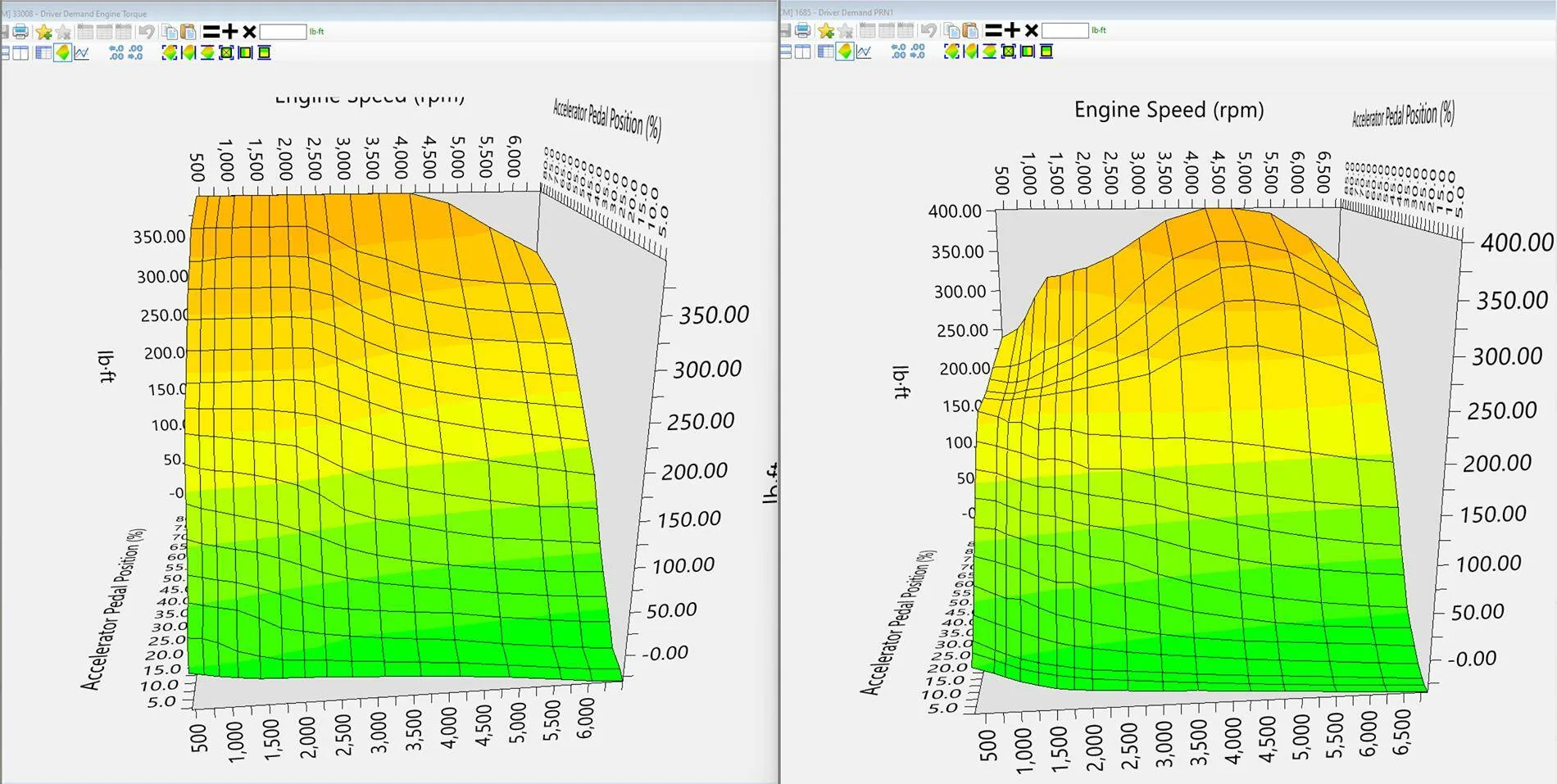
Left is auto, right is manual. Same below 30% throttle and above 4000RPM. In the region below 3500 and higher than 30% throttle the Automatic driver demand table torques are much higher than the torque the engine can put out.
Screenshot 2024-09-24 195242.webp


In this application, the torque converter slip can actually allow the engine to make more torque than what is applied to the wheels. So instead of the feedback loop being the engine brake torque and the driver demand torque being kept in sync, its the engine brake torque and the transmission output torque/ desired wheel torque being synced. Technically both are just engine brake torque and desired wheel torque being kept in sync. The torque converter clutch unlock/slip/lock parameters and target slip modify the demanded engine torque to give that desired wheel torque. Its just not as straight forward as only modifing the manual DD tables, as there is just more driver independant control going on there.
 

Pistol_91

Well-Known Member
Joined
Oct 25, 2023
Threads
12
Messages
1,381
Reaction score
1,407
Location
Clearwater
Vehicle(s)
2020 mustang GT
Your pedal produces an atmosphere condition compensated demand torque. Spark and fuel the ECU has control over, atmosphere conditions it does not and only has a base line of STP to go off of. This torque is turned into a desired mass airflow. This desired mass airflow value can be limited by any number of the models demand torque goes through to be turned into mass airflow as well as your MAF transfer function, as It may ultimately be turned into a desired MAF sensor frequency/ period. So if you are doubling your driver demand, you have to go through and scale everything else along the path to a desired MAF sensor frequency or its just going to be limited.

The ECU opens or closes the throttle until the actual mass airflow is achieved. This actual mass airflow is turned back into an indicated torque. This indicated torque is the base line at lambda 1, MBT spark, and STP conditions.

Prior to the pedal position exceeding WOT start, throttle opening is based on the requested torque from the driver demand table(s). The start position is when the ECU does straight line interpolation for WOT throttle. At the end position the throttle will be WOT. Now driver demand values can have your throttle opening to WOT when your pedal is less than the WOT start position. Automatic cars driver demand tables kind of do this in the factory tune.

Left is auto, right is manual. Same below 30% throttle and above 4000RPM. In the region below 3500 and higher than 30% throttle the Automatic driver demand table torques are much higher than the torque the engine can put out.
Screenshot 2024-09-24 195242.jpg


In this application, the torque converter slip can actually allow the engine to make more torque than what is applied to the wheels. So instead of the feedback loop being the engine brake torque and the driver demand torque being kept in sync, its the engine brake torque and the transmission output torque/ desired wheel torque being synced. Technically both are just engine brake torque and desired wheel torque being kept in sync. The torque converter clutch unlock/slip/lock parameters and target slip modify the demanded engine torque to give that desired wheel torque. Its just not as straight forward as only modifing the manual DD tables, as there is just more driver independant control going on there.
Awesome. Thanks murf. I have a manual so mine is a little less complicated.
 
OP
OP
WildHorse

WildHorse

N/A or GO HOME
Joined
Jun 28, 2017
Threads
270
Messages
10,297
Reaction score
8,350
Location
Home World: CLASSIFIED
First Name
Puddintane
Vehicle(s)
'17 S550
Vehicle Showcase
1
So I appreciate all the scientific analysis, and how Ford presents timing in any and all scenarios.

Myself, being a simpleton, just added 2° globally.

Wow.

Can't believe the difference 2° timing makes on these engines.

This was going from 91 to 93 octane.
 

K4fxd

Well-Known Member
Joined
Apr 2, 2020
Threads
121
Messages
13,455
Reaction score
12,262
Location
NKY
First Name
Dan
Vehicle(s)
2017 gt, 2002 FXDWG, 2008 C6,
Myself, being a simpleton, just added 2° globally.
Be careful with that because you could put your borderline tables into knock
Sponsored


Top