
Sponsored
OP
OP
mikes2017gt

mikes2017gt

Well-Known Member
Joined
Feb 21, 2017
Threads
64
Messages
999
Reaction score
343
Location
San Antonio, TX
Vehicle(s)
17 GT Prem M/T 3.55
I know that using 24db/oct slopes keeps things in phase (vs. 12db or 18db) but that's about the extent of my time-alignment knowledge. I know enough to research what the frequency response of a driver is and then keep it safely within its operating range and I'm pretty good with EQing, but this time alignment is new to me.

I figure since the TWK-88 has those capabilities, I should use them to get the system sounding as good as it possibly can. I'm planning on setting two different presets; one with good time alignment for the driver and the other for the passenger, so I can knock people's socks off. :D
Sponsored


Cathul

Well-Known Member
Joined
Sep 4, 2017
Threads
5
Messages
931
Reaction score
425
Location
Germany
First Name
Peter
Vehicle(s)
Ford Mach-E
I know that using 24db/oct slopes keeps things in phase (vs. 12db or 18db) but that's about the extent of my time-alignment knowledge. I know enough to research what the frequency response of a driver is and then keep it safely within its operating range and I'm pretty good with EQing, but this time alignment is new to me.
With LR 24 it’s in phase, but not phase aligned. The lowpass is backwards, the highpass forwards, so technically you need to delay the higher frequency speakers by a certain amount to bring them in phase again so that the phase matches in the crossover region for full and best summation in level and time. Best for this is a DSP that has both time and phase adjustments like the Helix processors. With them you can align the distance and after that the phase in ~11 degree steps (and use allpass filters and stuff).

Check out Facebook for „Gladen Audio“ and the video section on that site. The developer of the Mosconi DSPs shows the effect of the crossovers on time and phase alignment in detail in video „Tutorial 15.4 Timedelay 2“.
 
Last edited:
OP
OP
mikes2017gt

mikes2017gt

Well-Known Member
Joined
Feb 21, 2017
Threads
64
Messages
999
Reaction score
343
Location
San Antonio, TX
Vehicle(s)
17 GT Prem M/T 3.55
Thanks, @Cathul I wasn't aware of the high/lowpass issues. All I've got for DSP is the TWK-88, so it'll have to do. I do have REW and a calibrated microphone; I would think REW has tools that could help me with the alignment, but I'll have to learn how to use them. I am planning to use REW to EQ the system. That, I do know how to do.
 

Cathul

Well-Known Member
Joined
Sep 4, 2017
Threads
5
Messages
931
Reaction score
425
Location
Germany
First Name
Peter
Vehicle(s)
Ford Mach-E
My DSP doesn’t have allpass filters or phase adjustments either, so I have to come back to time alignment tweaking myself. Just watch the video I mentioned in my answer before to get an idea on how severe this can be. And yes, you can do that with REW also, but it’s more steps involved as with high end DSPs (and even then it can be a lot of work).

Distances get you very near though if measured correctly (and consistently near, as distances don’t change). And I guess most people won’t hear any differences anyway.
 
OP
OP
mikes2017gt

mikes2017gt

Well-Known Member
Joined
Feb 21, 2017
Threads
64
Messages
999
Reaction score
343
Location
San Antonio, TX
Vehicle(s)
17 GT Prem M/T 3.55
Thanks for mentioning the video; I didn't see that you edited your reply to list it. I'll check it out.
 
Last edited:

Sponsored

OP
OP
mikes2017gt

mikes2017gt

Well-Known Member
Joined
Feb 21, 2017
Threads
64
Messages
999
Reaction score
343
Location
San Antonio, TX
Vehicle(s)
17 GT Prem M/T 3.55
I was about to remove the seats when it dawned on me that it might be a little difficult to take time alignment measurements with no seats in the car. :facepalm: I'm trying to get as much prep work as possible done so that I'm not fiddling with building tuning files from scratch once I've finished the physical install. So it's measurement time.
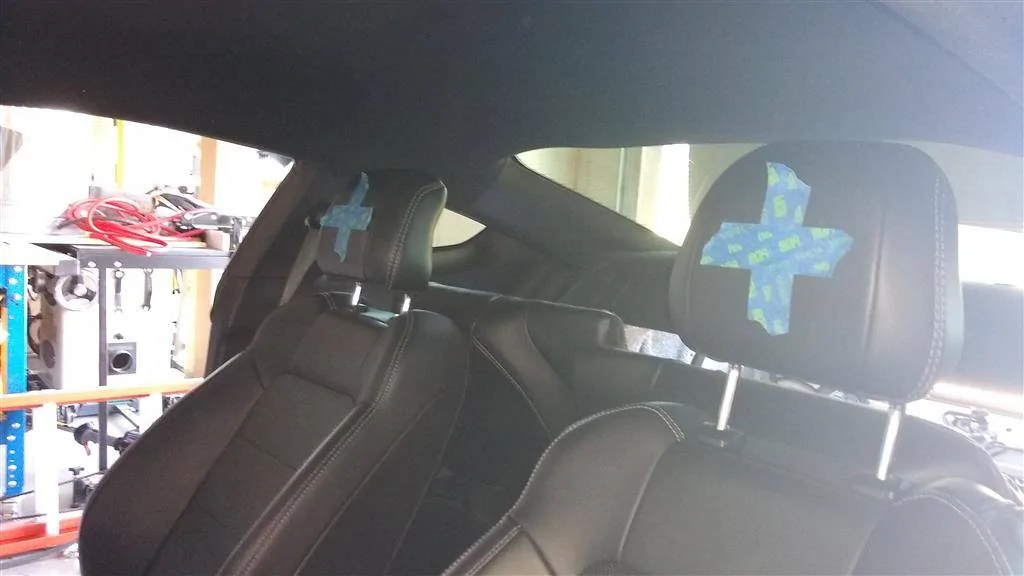
Also, when it's 92F in your garage, and you're sitting inside a closed car taking time alignment measurements, it's approximately eleventymillion degrees (Farenheit) inside the car.

I put both seats where they usually are and put an "X" with painter's tape in the middle of each headrest.
IMG_20201005_163617972 (Large).jpg


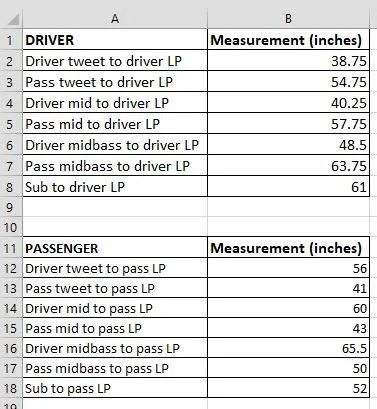
I then measured from the center of each speaker's grill to the middle of each X. I made the attached spreadsheet to help capture the info, but here's a screen grab of it. Coincidentally (not really, I did it on purpose) the order I've got the drivers listed in mirrors how the JL Audio TUN software lays them out in a 4-way system. It goes left tweet, right tweet, left mid, right mid and so on. I've gotten used to "looking" at the system like this so I stuck with the order.
Excel capture.JPG


Theoretically the passenger's measurements should be reverse mirrors of the drivers. But the passenger seat gets moved around, depending on who's riding with me, so I put it in what I think is its most-used position. I also move the driver's seat from time to time, but I put it in "the usual spot" for these measurements.

I realize these measurements are only starting points and they may be off by a 1/4" but by the time I finish tuning, all the delays affected by these starting points will likely change anyway. But at least I have a starting point.

Now to get them entered in the TWK-88 file.

As I've never tuned a car system with time alignment before, I'd imagine when setting the gains on the amps, the TA should be off? Conversely, I'd assume when running RTA sweeps and EQing, the TA should be on?
 

Attachments

Last edited:

Cathul

Well-Known Member
Joined
Sep 4, 2017
Threads
5
Messages
931
Reaction score
425
Location
Germany
First Name
Peter
Vehicle(s)
Ford Mach-E
Time alignment doesn't matter for single driver EQ work, but only if you're measuring driver pairs or sides with active crossovers together. Also, setting gains is unaffected by Time alignment as you're only electrically matching your amps to your output voltage of the DSP.
One tip for setting gains... if you need to lower the output gain in the DSP for one pair of drivers for a considerable amount to match another pair (tweeters to mids f.e.) lower the gain on the amps to get as close as possible to the target value. This minimises the amplifiers floor noise for the affected channels.

For time alignment you should put the tip of the microphone to a position where your head is, not to the headrest and measure from the grills to the tip of the microphone.
 
Last edited:
OP
OP
mikes2017gt

mikes2017gt

Well-Known Member
Joined
Feb 21, 2017
Threads
64
Messages
999
Reaction score
343
Location
San Antonio, TX
Vehicle(s)
17 GT Prem M/T 3.55
I'm running a 4-way, actively amplified system. 3 drivers per door (midbass, mid, tweet) with a sub in the trunk. As I understand it, I definitely need to time-align for the best possible performance.

Unless I'm misunderstanding your post? Are you saying I should measure each "door side" as a unit? E.G. all three drivers outputting sound at the same time vs. one driver at a time? I assume I should shut the sub off during those measurements?

I am aware that for ideal measurements, the microphone should be placed where the head/ear is. But technically, we have two ears, and they are at different points in space.. :)

I don't have a stereo microphone, so I figured simply measuring the distance from each driver to the same point on the headrest would suffice as a good starting point vs. simply guessing at the distances or having no time alignment at all.

Getting into the details like this reminds me of the IASCA SQ cars from the 1990's. They had under the dash horns, speaker pods on the dashboard obstructing the windshield and half the interior removed. My car is not one of those.

Basically, I'm trying to take "A quality installation of decent equipment" to the next level, if that makes sense. Much of what constitutes a "good system" is a mix of both equipment and the installation. You could have $20K worth of equipment installed by some idiot who has no idea what proper grounding or polarity is and it'll sound like crap, if it runs at all. Conversely, you could have $3K worth of equipment, properly installed and tuned and it'll sound like...not a million dollars but more than $3K. :D

Nobody will ever get 100% SQ and perfect alignment. I'm trying to get about 90% there, if possible with my equipment and keeping the vehicle every day driveable.
 

Cathul

Well-Known Member
Joined
Sep 4, 2017
Threads
5
Messages
931
Reaction score
425
Location
Germany
First Name
Peter
Vehicle(s)
Ford Mach-E
1. EQ each driver to your target curve seperately (for this you don't need any time alignment yet. You're only measuring and correcting one speaker driver at a time, so there is no interaction between drivers!)

2. set time alignment for all drivers

3. measure driver pairs (midbass left+right, mids left+right, tweeters left+right)

If your time alignment between pairs of drivers is severely off you'll see it here. You also can see if you have some phase problems in the passband of the drivers pairs (usually as dips where the individual measurements are flat)

4. measure left side all drivers (including subwoofer) to see if your time and phase alignment of your left drivers is spot on (check the crossover regions). If your alignment is off on either side (midbass to mid, mid to tweeter, midbass to sub) you'll see dips in the crossover region.
Adjust time alignment for maximum cohesion (maximum addition in the crossover region). Usually this means you need to delay the higher frequency drivers a bit further, i.e. delay tweeter in relation to mid, pair them up and delay both of them to the midbass, group them all up and delay relative to the subwoofer if cohesion is not already spot on).
Repeat that for the right side drivers afterwards.

5. measure everything to check for further phase problems (you cannot correct them without having allpass filters though, but small errors can be equalized).

And with all of the above we're still not at the point to check phase cohesion during the crossover regions of the different drivers yet. :p

But don't worry. Doing the above will get you 95% there. If left and right side measurements match in volume and both are within 1-2 db of each other and your time aligment is as good as you can possibly set it, you will have a system with a phenomenal staging and imaging as well as having a very good tonality throughout the complete frequency range.

The rest is just for the "itch" to get the maximum out of your equipment. ;)
 

StangTime

Well-Known Member
Joined
Apr 16, 2019
Threads
81
Messages
3,594
Reaction score
4,091
Location
Ontario 🇨🇦
First Name
Todd
Vehicle(s)
19' GT PP1 Manual
I was about to remove the seats when it dawned on me that it might be a little difficult to take time alignment measurements with no seats in the car. :facepalm: I'm trying to get as much prep work as possible done so that I'm not fiddling with building tuning files from scratch once I've finished the physical install. So it's measurement time.
Also, when it's 92F in your garage, and you're sitting inside a closed car taking time alignment measurements, it's approximately eleventymillion degrees (Farenheit) inside the car.

I put both seats where they usually are and put an "X" with painter's tape in the middle of each headrest.
IMG_20201005_163617972 (Large).jpg


I then measured from the center of each speaker's grill to the middle of each X. I made the attached spreadsheet to help capture the info, but here's a screen grab of it. Coincidentally (not really, I did it on purpose) the order I've got the drivers listed in mirrors how the JL Audio TUN software lays them out in a 4-way system. It goes left tweet, right tweet, left mid, right mid and so on. I've gotten used to "looking" at the system like this so I stuck with the order.
Excel capture.JPG


Theoretically the passenger's measurements should be reverse mirrors of the drivers. But the passenger seat gets moved around, depending on who's riding with me, so I put it in what I think is its most-used position. I also move the driver's seat from time to time, but I put it in "the usual spot" for these measurements.

I realize these measurements are only starting points and they may be off by a 1/4" but by the time I finish tuning, all the delays affected by these starting points will likely change anyway. But at least I have a starting point.

Now to get them entered in the TWK-88 file.

As I've never tuned a car system with time alignment before, I'd imagine when setting the gains on the amps, the TA should be off? Conversely, I'd assume when running RTA sweeps and EQing, the TA should be on?
My distances are about 5" to 8" less than yours. Maybe you sit farther back or more reclined. Or maybe you're taller and need to. I sat in the drivers seat and measured to the tip of my nose. Probably not the most accurate but it gets me close. I still have to do impulse measurements and probably should do that before I do any more serious EQ adjustments. My DSP has a place to add additional delay offsets to each channel so data from the impulse response should allow me to tweak the timing. I'm kicking myself for not buying the TwK 88. You really need parametric EQ. I have a nasty wide peak at 315hz in my drivers mid-bass and some other problems areas. On my 31 band fixed Q filters, I have 315hz pulled all the way down -12db and it's still not enough to tame the peak. Going to be a real challenge matching the left to the right side with 31 graphic eq. The right side is much better due to the longer distance to the speakers. I am really interested to see your first measurement of each driver with no EQ to see if we have similar frequency response problems.
 

Sponsored

StangTime

Well-Known Member
Joined
Apr 16, 2019
Threads
81
Messages
3,594
Reaction score
4,091
Location
Ontario 🇨🇦
First Name
Todd
Vehicle(s)
19' GT PP1 Manual
@mikes2017gt I use what's called "The moving mic" measurement method. It's much easier and gives very reliable, repeatable results.
How to do it:
1. Sit behind the drivers seat with the headrest removed, and mic/REW loaded up. (make sure you use your mic calibration file in settings)
2. Set REW to RTA mode and click on the gear in the upper right corner to open the RTA settings box.
Set up:
Mode: 1/12 octave
FFT: 32768
Averages: Forever
Window: Rectangular
Update Int: 1
Peak: 0
Leave the rest as is.
3. Start the RTA measurement with your mic pointed toward the passenger side where your right ear would be and move the mic around in circles about 6" in diameter taking about 3-4 seconds to complete each circle. Take about 7 to 10 circular measurements. You will see the response start to stabilize.
4. Save your measurement and move on to the next speaker. Saving each speaker independently.
5. Flip the mic direction and measure the same way for the left ear/left speakers.
6. Open a house curve as a measurement (this can be a text file) you will need this house curve reference to adjust your EQ filters.
7. Save all as a measurement so you have all these measurements grouped in one file. This will be your baseline from which you can play with your filters within REW.
I won't go into detail here because you can watch this as a guide on how to use EQ filters to get close to your target response.
 
OP
OP
mikes2017gt

mikes2017gt

Well-Known Member
Joined
Feb 21, 2017
Threads
64
Messages
999
Reaction score
343
Location
San Antonio, TX
Vehicle(s)
17 GT Prem M/T 3.55
@StangTime Thanks for the write up and that video link. Very helpful! REW is pretty intimidating for me, but I'll have to learn.

You can fit in the back seat? The driver's seat would have to be all the way forward for me to sit back there. LOL!

For when I'm tuning, I was planning on either using a tripod or sandwiching the mic b/t the headrest and seat and running the wires through the window. I'll be able to close the window almost fully and the 1/4" it'll have to be open to not pinch the wire won't matter measurement-wise. I'll have to do the same with the USB cable for the TWK. Thankfully it's like 20 feet long.

I did quite a bit of research before buying the TWK-88. It seemed to be a solid piece of equipment with great capabilities, and I've always gotten great support from JL whenever I had questions.

As a starting point for the EQ bands, I have them set to the standard 1/3 octave centers, broken up into four "band sets" per assignable EQ in JL's TUN software, which is how you tune the TWK-88. There is some band overlap b/t drivers, but that's OK. I'm sure the RTA will identify peaks and nulls and I'll have to adjust some bands accordingly.

One of the things that's great about the TWK is that you can not only precisely adjust the frequency center of each EQ band, but you can adjust the "Q" as well. So creating precise notch filters is easy. It's fully parametric.
 

Cathul

Well-Known Member
Joined
Sep 4, 2017
Threads
5
Messages
931
Reaction score
425
Location
Germany
First Name
Peter
Vehicle(s)
Ford Mach-E
4 bands for a single driver? I used 22 on my left midbass.
 
OP
OP
mikes2017gt

mikes2017gt

Well-Known Member
Joined
Feb 21, 2017
Threads
64
Messages
999
Reaction score
343
Location
San Antonio, TX
Vehicle(s)
17 GT Prem M/T 3.55
4 bands for a single driver? I used 22 on my left midbass.
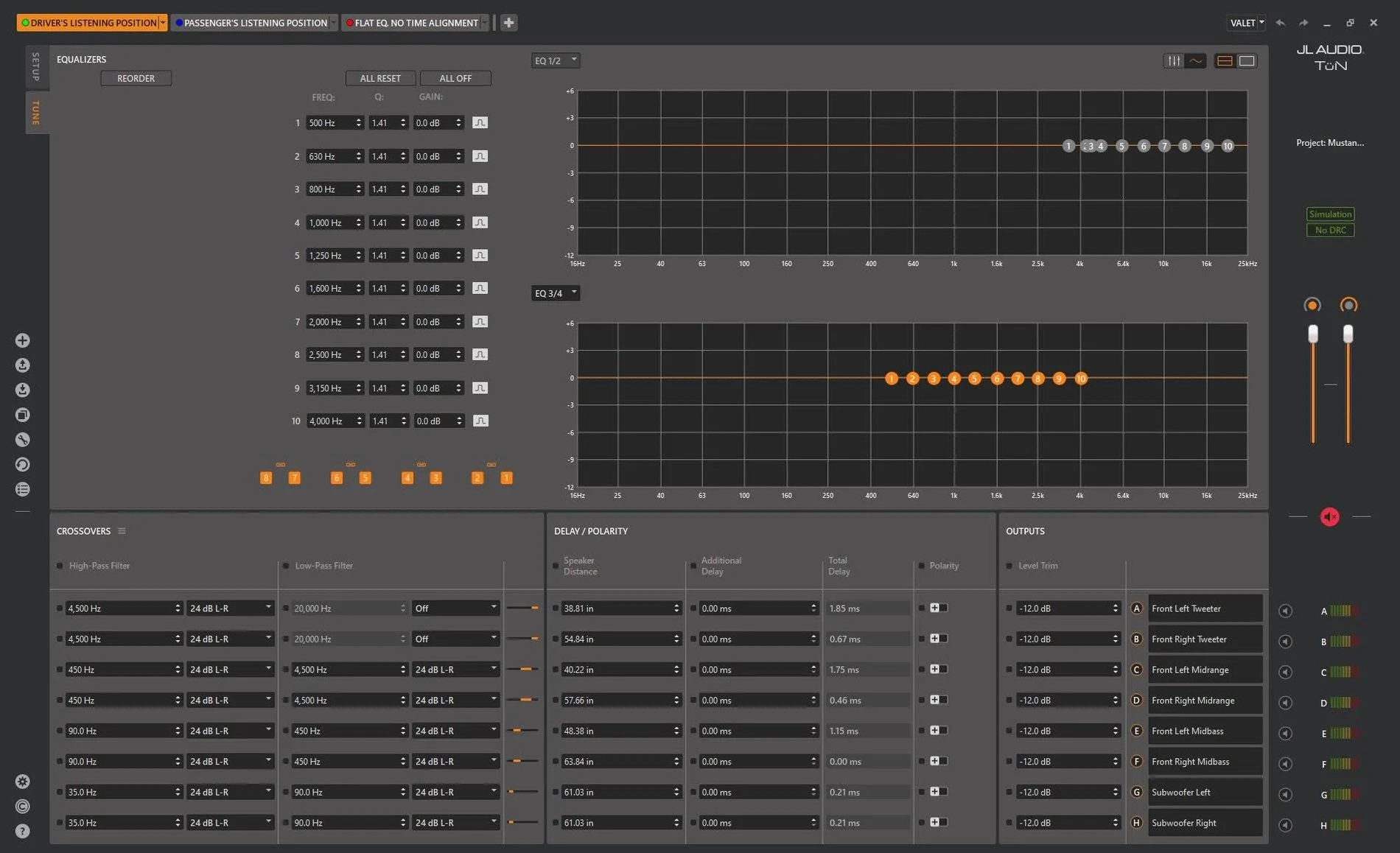
I probably didn't explain that correctly. The JL Tun software gives you two assignable, 10-band parametric EQs per input. You can link the two EQs in a stereo pair or independently assign them L/R. Here's a pic of my current tune. I have EQ 3/4 selected (midrange driver/input) and you can see the frequency centers I set.
TUN screen grab.webp
 

StangTime

Well-Known Member
Joined
Apr 16, 2019
Threads
81
Messages
3,594
Reaction score
4,091
Location
Ontario 🇨🇦
First Name
Todd
Vehicle(s)
19' GT PP1 Manual
@mikes2017gt I barely fit behind the seat! My head is crammed against the rear window and my knees are pressed into the seat the back. It is not fun! Haha!
If you can't get yourself in there, try sitting behind the passenger seat to do the moving mic measurements. Or hire a small human to move the mic for you. Nephews love doing stuff like this. I hate getting in the back of my car with my laptop and cables but I found this measurement method works far better than doing multiple single point measurements.

I thought the TWK88 has 10 band PEQ for EACH output? You will want to unlink those EQ's so you can do independent EQ adjustments for each driver.
Sponsored


Top