Sponsored

Fuel starvation on track

Flyhalf

Well-Known Member
Joined
Feb 25, 2018
Threads
34
Messages
1,617
Reaction score
2,132
Location
CA
Website
www.youtube.com
First Name
Alessandro
Vehicle(s)
Mustang GT 18 10speed auto PP1 , GT500 '21

josephstef

Well-Known Member
Joined
Oct 4, 2018
Threads
12
Messages
210
Reaction score
140
Location
New Zealand
First Name
Stefan
Vehicle(s)
2016 Mustang GT
Interesting. But still the same single pickup correct?
Single pick up with dual pumps, it still draws from the other side of the tank too. Its some sort of custom dual pump, i'm in New Zealand so get them from Australia where they're made.

This is the older smaller version: They're running 10litres of fuel around the track at the end of the video.

 
OP
OP
ChipG

ChipG

Well-Known Member
Joined
Jan 27, 2021
Threads
33
Messages
532
Reaction score
590
Location
Nashville TN
First Name
Chip
Vehicle(s)
'20 GT350/'95 F250/'65 Fastback/'96 Cobra Project
Thanks for all the input, folks. Some clarifications and thoughts:

  • This isn't a quarter tank issue. I'll start seeing fuel starvation when hitting between 5/8 and 1/2 tank during the session. If I start with over 3/4 tank I can generally finish out a 15 minute session. Anything else and I get fuel starvation before the session ends.
  • The sessions are 15 minutes and the full tank is a concern for me because I'm running Time Trials, not HPDE. Finishing a session with 5/8 tank vs 1/8 tank is nearly 50 pounds of weight.
  • That said, this is a dual purpose car that is also daily driven. I hope to only use it for time trials for one more season as I'm working to get a dedicated track car built (SN95 Cobra), at which point the Shelby moves back to being an occasional HPDE car when running outside of NASA events (Chin, etc.).
To this point, my solution has indeed been to just keep the tank topped up. Fortunately it's a bit less of a hassle than it could be because I have a transfer tank in my truck and I just fill up from there in the paddock. However, it's a hassle anyway after every session and, as I said, the extra weight sucks. Thanks for all the leads on surge tank options. I'll dig into those and consider them as options vs. sucking it up and running full and heavy when here at NSS. Also interesting to hear that the GT500 has solved this with dual pickups. Has anybody looked into what it would take to adapt the GT500 setup to a GT350? For a dual purpose car, the OEM solution has appeal as a 3rd option especially if it's cheaper and/or easier than a surge tank install.
 

Egparson202

Well-Known Member
Joined
Jul 28, 2021
Threads
1
Messages
756
Reaction score
807
Location
USA
Vehicle(s)
2019 Shelby GT350, 2018 Audi TTRS
Thanks for all the input, folks. Some clarifications and thoughts:

  • This isn't a quarter tank issue. I'll start seeing fuel starvation when hitting between 5/8 and 1/2 tank during the session. If I start with over 3/4 tank I can generally finish out a 15 minute session. Anything else and I get fuel starvation before the session ends.
  • The sessions are 15 minutes and the full tank is a concern for me because I'm running Time Trials, not HPDE. Finishing a session with 5/8 tank vs 1/8 tank is nearly 50 pounds of weight.
  • That said, this is a dual purpose car that is also daily driven. I hope to only use it for time trials for one more season as I'm working to get a dedicated track car built (SN95 Cobra), at which point the Shelby moves back to being an occasional HPDE car when running outside of NASA events (Chin, etc.).
To this point, my solution has indeed been to just keep the tank topped up. Fortunately it's a bit less of a hassle than it could be because I have a transfer tank in my truck and I just fill up from there in the paddock. However, it's a hassle anyway after every session and, as I said, the extra weight sucks. Thanks for all the leads on surge tank options. I'll dig into those and consider them as options vs. sucking it up and running full and heavy when here at NSS. Also interesting to hear that the GT500 has solved this with dual pickups. Has anybody looked into what it would take to adapt the GT500 setup to a GT350? For a dual purpose car, the OEM solution has appeal as a 3rd option especially if it's cheaper and/or easier than a surge tank install.
What tires are you running? And does this only happen at NSS? What about at Road Atlanta? Any fuel starvation there?
 

Sponsored

OP
OP
ChipG

ChipG

Well-Known Member
Joined
Jan 27, 2021
Threads
33
Messages
532
Reaction score
590
Location
Nashville TN
First Name
Chip
Vehicle(s)
'20 GT350/'95 F250/'65 Fastback/'96 Cobra Project
I'm still running Goodyear F1 SuperCar 3 tires, so good grip (similar to the stock Sport Cup 2s) but nothing crazy sticky. It has only happened at NSS thus far. I haven't run any other rovals, and Road Atlanta, Barber, and NCM are all clockwise tracks without significant sustained left-handers - nothing longer than a second or two that I can recall. I've run a quarter tank and lower at those tracks without issue.
 

Angrey

Well-Known Member
Joined
Jun 21, 2020
Threads
104
Messages
2,794
Reaction score
2,984
Location
Coral Gables
Vehicle(s)
2016 GT350
Sigh, plenty of threads (here and on trackmustangs).

It's not JUST a keep it filled issue. If you run hard and long enough left turn, even at just over half you can still end up with starvation. The problem is two part, the saddle style tank and the puny nature of the siphon system.

You can add an active lift pump system (replacing the siphon setup) for fairly cheap and easy. A small modification to the passenger side pickup and one or two lift pumps that push fuel to the active side pumps helps to not only provide inflow to the active bucket (and keep the pumps wet) but also quicky move the imbalance back to the driver's side.

After months of researching, the ONLY mention of any data I can find is from Radium who provides 3 different nozzle sizes/flows for their fuel bucket. Somewhere he mentions that the OE siphon systems flow about 40 liters per hour.

So if you have 10 gallons of fuel, evenly split, and 2 gallons of fuel flow up and over the saddle under a hard left turn, now you're sitting with 7 gallons on the passenger side and 3 gallons on the driver's side. The factory bucket doesn't have an inflow (or that much volume capacity for that matter) so it relies on over the top fill and the slow trickle that comes from the siphon. 40 liters/hour translates to roughly a gallon every 6 minutes. So it takes quite awhile to rebalance the fuel.

Over time, the siphon system will imbalance to the driver's side, but it only takes one left turn to send most of it rushing over. 40 liters per hour into the OE bucket isn't enough to supply the motor under full sauce/rpm.

The GT350 is no drag car, but at lower levels, even launch G's can send what little fue is in the bucket up and out and you're then relying on whatever is left and the trickle from the siphon.

Running the car out of fuel at idle is one thing, but running it out of fuel at load/rpm is a pretty big risk. You don't have to be a tuner or an engine builder to know that lean = bad.

Also noteworthy is that the dual senders are averaged so the fuel gauge reports the same level irrespective of how imbalanced it is.

The Radium bucket helps in two ways, it has a taller body so holds a little more fuel (capacity) and it also has a one way bladder valve in the bottom that allows fuel in but not out. If you want to go further then you can actively push from the other saddle.

Obviously a dedicated surge tank is the preferred solution, but that involves pressurized fuel components completely inside the firewall (although the tops of the fuel cell on each side are just below circular holes into the cabin so not exactly totally protected).

Maybe the simple answer is "don't run it hard below a half tank." That seems like a lazy answer/solution to me. It's like saying "don't drive in the rain." When someone mentions they can't see properly out the windscreen. Eventually someone installed windshield wipers.
 

Scootsmcgreggor

Well-Known Member
Joined
Oct 26, 2018
Threads
45
Messages
502
Reaction score
392
Location
CA
Vehicle(s)
2016 Ecoboost turned GT
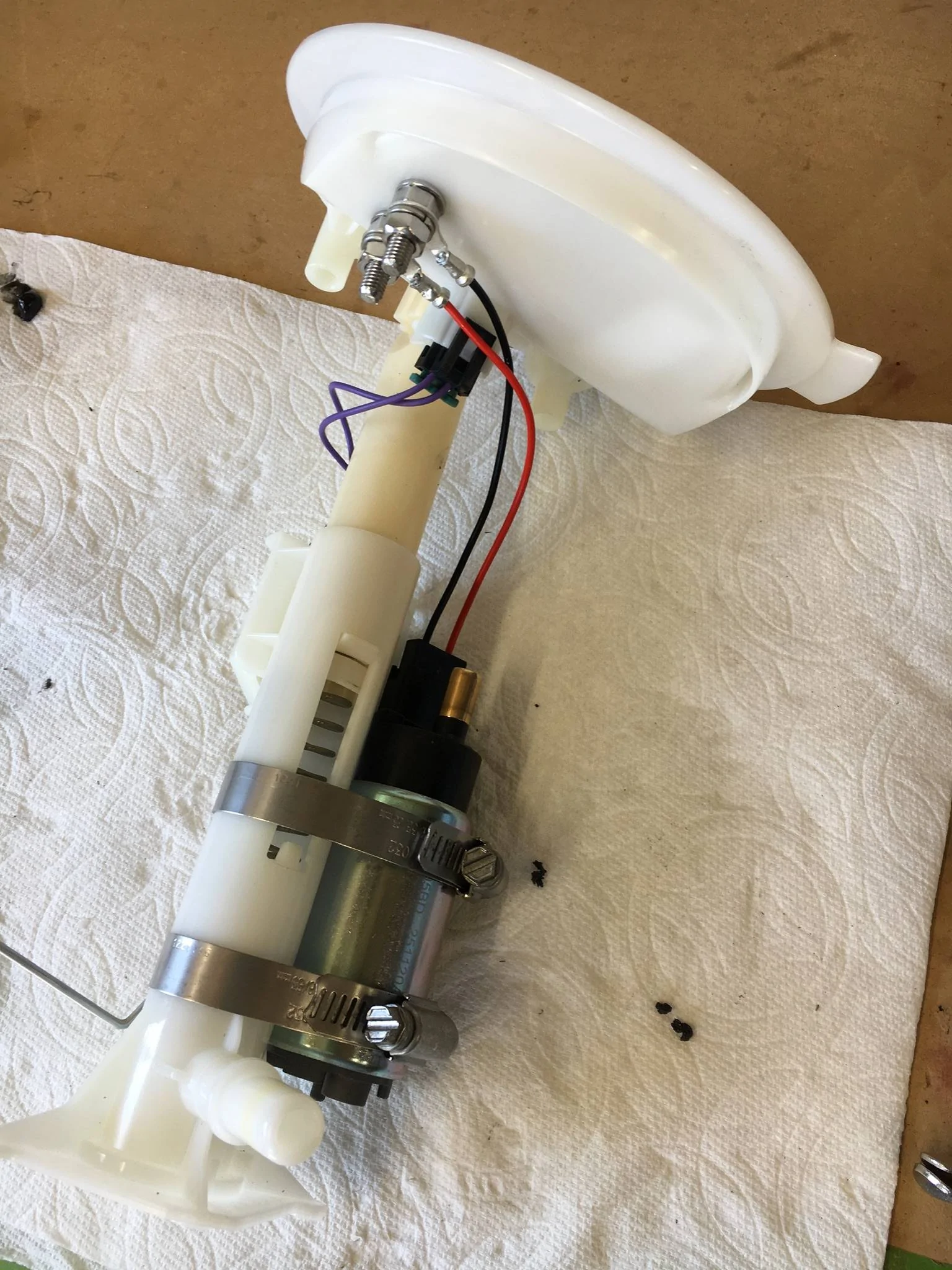
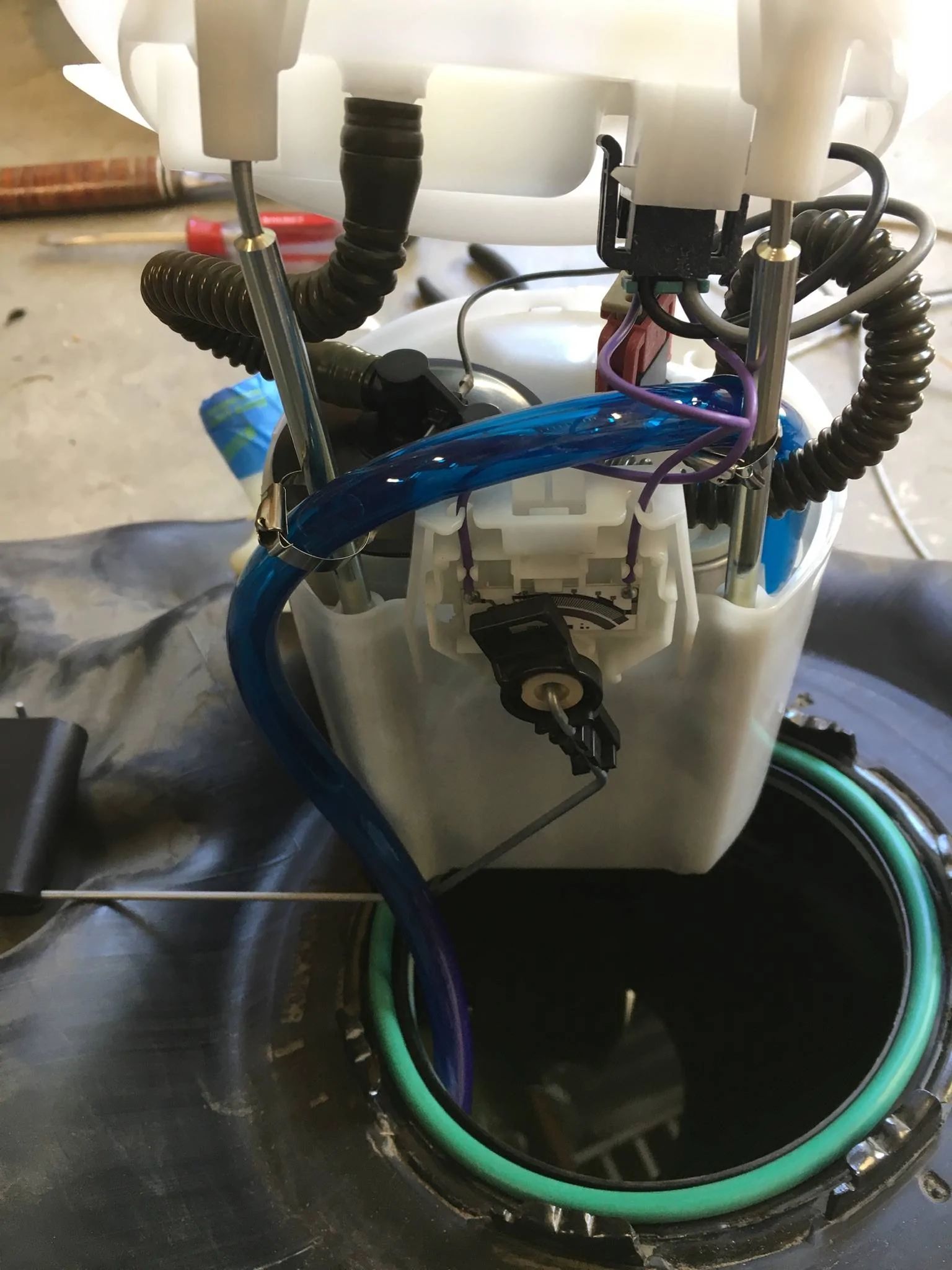
I installed a transfer pump in the passenger hanger, with a hose that crosses over the saddle and dumps into the bucket the main fuel pump sits in. I used to starve on long lefts below 3/4 tank. Have run this setup to 1/4 tank no problems but not going to go below that.

If you’re handy it’s a good solution that’s cheap, all inside the tank, and effective.

56E63100-C841-473F-8CBF-395816BCA3BE.webp


7E031134-01C3-4172-89E7-298F94DD9C77.webp
 
OP
OP
ChipG

ChipG

Well-Known Member
Joined
Jan 27, 2021
Threads
33
Messages
532
Reaction score
590
Location
Nashville TN
First Name
Chip
Vehicle(s)
'20 GT350/'95 F250/'65 Fastback/'96 Cobra Project
Angrey - thanks for the useful information despite the sigh :). Searching for "starvation" on this forum simply turned up oil starvation issues and I was unsuccessful finding related threads, though perhaps my search-fu was weak. I hadn't yet checked TMO though. Good detailed description, thanks.


Hey Scoots - that looks like my kinda solution. Would you mind sharing, whether here or DM, more info about parts and install? I am indeed pretty handy if I know what parts I'm hooking up where, and this might be just what I'm looking for.
 

Sponsored

honeybadger

Just don't care
Joined
Apr 20, 2016
Threads
63
Messages
4,097
Reaction score
7,440
Location
COTA
First Name
Kevin
Vehicle(s)
'17 GT350
FWIW, I hit fuel starve at T11 at COTA when running E85 and dipping below half a tank - and that's definitely not a long left hander. My assumption is the sequence of turns from 3-11 causes tons of sloshing and I just hit the right conditions to cause starvation problems.

How did the cars at the GT350 track attack racing school. not run into this problem? I realize they may not be going as fast as someone driving the course on their own, but they do 3-20 minute sessions, and then the instructor ride along at the end. And I never saw them refuel the cars when I was there.
Like others have said, they kept the cars pretty filled up. But, slower drivers and slow tires will also definitely contribute. While the Ford instructors are fast - there's only so much you can do with 300tw tires on a relatively risk-free track. If they hit fuel starve in those conditions, there would be some strong words for the engineers.

Id be curious to know how much fuel has to be in the tank to completely prevent starvation as-is vs with a surge tank. That info would determine how long the session can be and what the weight penalty really is. We need to take the weight of the surge tank into account as well.

I will say I’ve often seen my fast laps to come either on lap 2-3 and then again on laps 10-12 after a lot of fuel has burned off.
Surge tank should allow you to run almost all the way to the bottom on most tracks. Without one, I'd starting with above 3/4 will keep you safe. But it also depending on grip and speed.

Running the car out of fuel at idle is one thing, but running it out of fuel at load/rpm is a pretty big risk. You don't have to be a tuner or an engine builder to know that lean = bad.
Just for info - the GT350 has protections built-in to kill ignition if fuel pressure drops. While I wouldn't promote being reckless with fuel level - the PCM will protect the motor. So at least there's that
 

Flyhalf

Well-Known Member
Joined
Feb 25, 2018
Threads
34
Messages
1,617
Reaction score
2,132
Location
CA
Website
www.youtube.com
First Name
Alessandro
Vehicle(s)
Mustang GT 18 10speed auto PP1 , GT500 '21
FWIW, I hit fuel starve at T11 at COTA when running E85 and dipping below half a tank - and that's definitely not a long left hander. My assumption is the sequence of turns from 3-11 causes tons of sloshing and I just hit the right conditions to cause starvation problems.


Like others have said, they kept the cars pretty filled up. But, slower drivers and slow tires will also definitely contribute. While the Ford instructors are fast - there's only so much you can do with 300tw tires on a relatively risk-free track. If they hit fuel starve in those conditions, there would be some strong words for the engineers.


Surge tank should allow you to run almost all the way to the bottom on most tracks. Without one, I'd starting with above 3/4 will keep you safe. But it also depending on grip and speed.


Just for info - the GT350 has protections built-in to kill ignition if fuel pressure drops. While I wouldn't promote being reckless with fuel level - the PCM will protect the motor. So at least there's that
Thanks Kevin
 

Angrey

Well-Known Member
Joined
Jun 21, 2020
Threads
104
Messages
2,794
Reaction score
2,984
Location
Coral Gables
Vehicle(s)
2016 GT350
Hell, I'm open to ideas to improve my system.

I installed an autometer elite fuel gauge that monitors the passenger side. I'll spare you some of the brain damage, but of course, like the electrical charging system, like temperature monitoring, Ford couldn't just use tried and true engineering. The sending units don't use a "standard" resistance. It's an active 2 wire system. Luckily I was somehow able to get the autometer guage to calibrate (custom). It still wants to throw a code for the BCM, but I had the tuner permanently filter that out. (not having the OE fuel sending unit hooked up on the passenger side).

The reason I did that is because (in theory) the Elite gauge has a trigger/activation feature that will activate the pumps when the fuel level is above a certain level and turn them off when it gets too low (to keep them from burning out while running dry). Even though DW swears they ran the pumps for an hour dry and they didn't burn out, I didn't want that risk. So I was hoping to automate the whole thing. Well, despite their claims (and half a dozen phone calls with Autometer) I can't get the elite gauge to work as advertised.

So as a work around, I installed a manual switch wired up inside my console cubby and if I'm going to flog the car (or I just want to balance out the two sides) I turn it on. With 2 each 200 l/h pumps it doesn't take long to fill up the driver's side. I plumbed them directly into the siphon line that was already going through the tank to the active side.

If anyone knows of another device that could manage the fuel sending and have active states (active high, active low, inactive high, inactive low) to automate the pumps, I'm open to ideas. It works fine now, the only immediate improvement I could make is to add an additional relay tied to key on power so that If I ever forget the switch is on, it cuts power on cutting the car off.

Kinda functions like the old days of trucks with a second tank and a transfer pump/switch.
 

VictorH

Well-Known Member
Joined
Mar 4, 2021
Threads
30
Messages
642
Reaction score
923
Location
South Carolina
First Name
Victor
Vehicle(s)
2021 Mach 1
Well, I joined the fuel starvation club at Barber motorsports park this past weekend. Coming out of the museum turn, just prior to the left hand kink on the back straight would get a miss. Initially thought it was some sort of ignition miss but then next lap exact same thing and I was just above 1/4 tank, so figured it was a fuel issue and came in. Could only run one session per full tank. Not a problem at Barber as gas is nearby but could be a real nuisance at other tracks.
My preference is a real solution not "just keep it full, all the time."

I have call into Kohr Motorsports and Capaldi Development. Haven't heard anything back yet. The Ford Performance tech guy I spoke with yesterday said, "I've never heard of that problem." So, I'm exploring options like many of you for something of a more permanent fix.

Links to options I've seen described in this link.
Radium
http://www.radiumauto.com/Fuel-Pump-Hanger-2011-Ford-Mustang-P2165.aspx
AI
https://aftermarketindustries.com.au/ford/ford-mustang-2011-fuel-system-fs1000-mgt/
KPM (looks like they might be in Australia and cost is most expensive but looks like maybe in Australian dollars)
https://www.kpmfuelsystems.com.au/product/kpm-mustang-gt-1500hp-in-tank-fuel-module/
 

Angrey

Well-Known Member
Joined
Jun 21, 2020
Threads
104
Messages
2,794
Reaction score
2,984
Location
Coral Gables
Vehicle(s)
2016 GT350
Well, I joined the fuel starvation club at Barber motorsports park this past weekend. Coming out of the museum turn, just prior to the left hand kink on the back straight would get a miss. Initially thought it was some sort of ignition miss but then next lap exact same thing and I was just above 1/4 tank, so figured it was a fuel issue and came in. Could only run one session per full tank. Not a problem at Barber as gas is nearby but could be a real nuisance at other tracks.
My preference is a real solution not "just keep it full, all the time."

I have call into Kohr Motorsports and Capaldi Development. Haven't heard anything back yet. The Ford Performance tech guy I spoke with yesterday said, "I've never heard of that problem." So, I'm exploring options like many of you for something of a more permanent fix.

Links to options I've seen described in this link.
Radium
http://www.radiumauto.com/Fuel-Pump-Hanger-2011-Ford-Mustang-P2165.aspx
AI
https://aftermarketindustries.com.au/ford/ford-mustang-2011-fuel-system-fs1000-mgt/
KPM (looks like they might be in Australia and cost is most expensive but looks like maybe in Australian dollars)
https://www.kpmfuelsystems.com.au/product/kpm-mustang-gt-1500hp-in-tank-fuel-module/
Neither of those technically solves the "problem" just improves the symptoms. The radium hat and the KPM both provide a small amount of fuel storage around the pumps. Whether or not that's enough at applicable flow rates when navigating a left turn is probably dependent on how LONG of a turn and how tight of a turn it is.

The root of the problem is the IRS and the split tank setup. Not only does that mean you now have to balance the sides (or move fuel from the passenger side over the driver's side) it also means that there's limited ability to do things like sumps and rear exit fuel setups (which inline pumps and pickups).

At the end of the day, between hydramat, enclosed fuel buckets, better syphon jets, etc, it will HELP the issue, but the root is still there.

I was very close to solving this problem completely using low pressure lift pumps from the passenger side. And it does solve the issue by actively pumping passenger side fuel INTO my Radium bucket. I have yet to achieve a solution where it's automated. I wired in a switch to turn the pumps on and off, which is better, but not perfect. I bought the Autometer fuel guage (which allegedly has trigger capability based on custom fuel level targets) however, after multiple calls with Autometer, I can't get it to function as advertised. So now I simply have it as a second fuel guage so I can see how much fuel is in the passenger side. With the OE signal disconnected, I can also view how much is in the driver's side and when the driver's side is getting low(er) I can turn the pumps on and fill it back up.

Deatschwerks claims they've ran their micro lift pumps for an hour naked without burning them up, but I'm reluctant to try that (and simply wire the pumps to run constantly) in fear of them running dry when total fuel levels are 1/2 tank and lower (they'd push all the fuel to the driver's side). THat would automate everything, but then I'd stress about whether the pumps are unnecessarily creating heat or risking failure.

In the end, it's not THAT big of an inconvenience to simply fire them when I want more fuel over to the primary bucket and for a track application it's probably even more tolerable, but ultimately I haven't been able to get it to where I want it, which is no starvation issues (ever under any conditions) and no manual or unautomated features.
Sponsored


Top