Deleted member 35644
Guest
D.I. has a cooling effect on the combustion chamber that MPI doesn't. The cooling staves off pre-ignition.
Sponsored

Well if you put it in .001 sec or before detonation takes place it does make a difference.Not sure I get why the type of injection affects knock. Knock is pre-ignition. How the air/fuel mixture arrives in the combustion chamber would seem irrelevant.
As far as I know it’s always been 93. You can look it up under specifications on their website and then the sub category engine.Everything I've seen says 91 octane is what Ford used to achieve their stated HP. Short of asking a Ford engineer, there is no way to tell if they also tried 93 and got better results, but chose not to state them. You'd need some dyno time to prove otherwise.
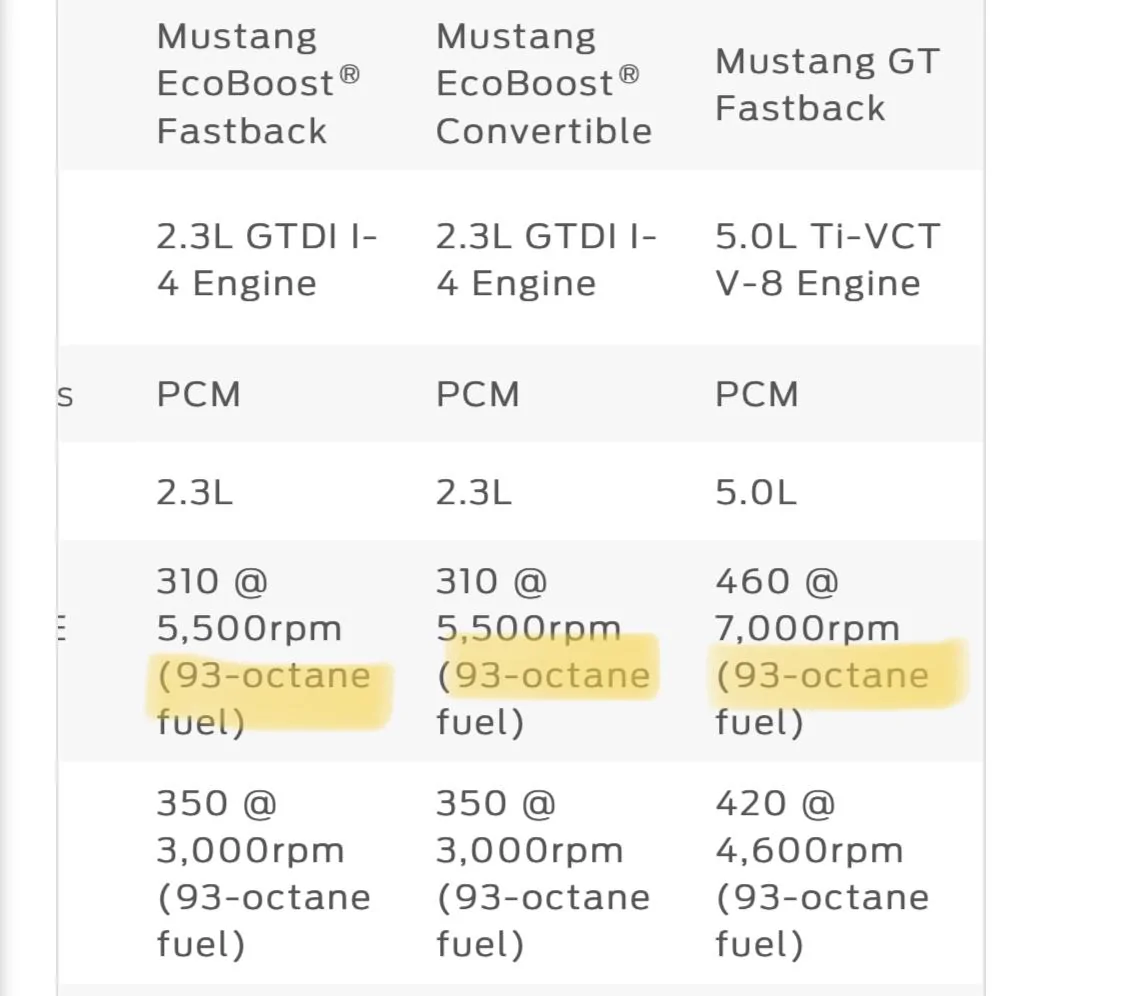
yesUgh I am I'm just asking if a higher grade premium does anything more than the lower grade premium (91).....
Interesting that they'd recommend an octane level that's not available everywhere. I guess the folks in CA don't get all 310 horses.As far as I know it’s always been 93. You can look it up under specifications on their website and then the sub category engine.
Where did you see it say 91?
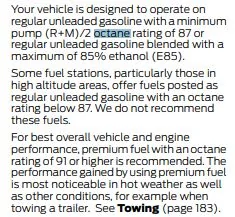

Imagine going back to the 60's and saying hey we run 12.1 compression with 87 octane! Technology is something!Just to answer an unasked question. 87 will knock in a port 12:1 engine. It is science.
Ford gets around this with direct injection and cooling but the engine will knock when the port fuel system is in use.
12:1 is just beyond the maximum of 87s stability.

Perfect thank you that helps as it seems the cars power was determined with higher octane than 91.As far as I know it’s always been 93. You can look it up under specifications on their website and then the sub category engine.
Where did you see it say 91?
No problem, happy to help. I have no idea what kind of a different 93 to 91 has but I would assume less than 93 to 87.Perfect thank you that helps as it seems the cars power was determined with higher octane than 91.
Yes I agree its likely fairly small. But at least this supports the idea that the ECM can ramp up some to utilize better fuel. In the Camaro SS I had GM said 91 minimum & 93 was recommended. It said the car could handle 87 but cautioned pretty strongly against it. More of a use it when you are stuck only kind of thing.No problem, happy to help. I have no idea what kind of a different 93 to 91 has but I would assume less than 93 to 87.
Okay then which pump is the "go pump" & which pump is the "blow pump"? LOL.......... In some cases one or two octane points can mean the diff between a blown engine and a great run.

Wouldn't be unheard of... Tetraethyl Lead was great.Imagine going back to the 60's and saying hey we run 12.1 compression with 87 octane! Technology is something!

I shared a link for you in my last response on this topic. Dave Pericak, the S550 chief engineer, has stated publicly the speed limiters (all of the S550 models at the time of the interview were electronically speed limited--I don't know if that applies to the GT-350/500, Bullit, etc.) are due to cooling concerns.Speed limiters are due to tire ratings, AFAIK.
If you have concrete Ford based information concerning top speed limiters and radiators please share it.
Engine knock is not preignition, it's detonation. You can search on YouTube for a video explanation of the difference, but suffice it to say engines can run under light detonation pretty much indefinitely, while preignition can destroy your engine in just a few seconds.Not sure I get why the type of injection affects knock. Knock is pre-ignition. How the air/fuel mixture arrives in the combustion chamber would seem irrelevant.


That is not the recommended octane, just the octane the used to achieve max horsepower. Minimum octane requirements remain at 87.Interesting that they'd recommend an octane level that's not available everywhere. I guess the folks in CA don't get all 310 horses.


