Sponsored

Blew up my gen3 motor and don’t know where to go from here

wingnutt

Well-Known Member
Joined
Oct 1, 2020
Threads
5
Messages
3,384
Reaction score
6,174
Location
@FL410
First Name
michael
Vehicle(s)
350R Procharged w/P1X
As is often the case, the OP starts a thread looking for advice only to never return.
…which means the old guard will start a 5 page diatribe about how it happened any why 😂

that being said, junkyard engine FTW 😬👍🏼
Sponsored


sk47

Well-Known Member
Joined
Nov 12, 2020
Threads
32
Messages
6,807
Reaction score
3,157
Location
North Eastern TN
First Name
Jeff
Vehicle(s)
Chevy Silverado & Nissan Sentra SE
…which means the old guard will start a 5 page diatribe about how it happened any why 😂

that being said, junkyard engine FTW 😬👍🏼
Hello; By now the OP has been given realistic options. No good options to be sure. Fix or replace.
Fix will depend on how bad the "scoring" is in the cylinder bore plus whatever else might be found upon tear down. That is assuming the OP has the tools, mechanical skills & a place to do the work.
Taking the car to a shop or to a ford dealer adds to the overall cost. Would not be surprised the labor + shop time will cost much more than the parts.

Replace ranges from a crate turnkey engine to a factory short block at the high end to a junkyard engine on the low end. All replacement scenarios have labor involved. A thing is the OP has not given us much of a clue as to his status. I have sort of a guess but do not know. My unsupported guess being he/she is strapped for cash and the Mustang was the only car. I likely am very wrong. OP may have millions in a bread box and the Mustang is merely one of many.

But if money is a key factor, I would try a junkyard (JY) engine at least once. If the JY engine is good and the shop is competent likely the least expensive outcome. If the JY engine is bad then an additional loss of time and money. A costly gamble.

Next and safer replacement would be a Jasper or some other remanufactured engine with a warranty. More cost over the JY upfront but less risk. Pick a good shop that stands by their work, and you get a good running car. Some knock on resale value I would guess.

A Ford dealer & a Ford crate engine likely has the least risk and least harm to resale value, but at greatest cost overall.

My nearest neighbor has the very same scenario on a chevy SUV. She was not checking the oil and ran it low. looks like the engine has jumped time since the code is for the crankshaft & cam shaft are out of sequence. She still owes on that car and did buy another used SUV. She is going to have to increase a loan to pay off the broken car or keep making payments on a broken car + another car.
I plan to dig into the broken car a bit to see what I can find on the slim hope the engine is fixable. I imagine the car will wind up in a salvage yard. But it is not a Mustang so there is that.
 

Hack

Well-Known Member
Joined
Nov 26, 2014
Threads
86
Messages
12,794
Reaction score
8,202
Location
Minneapolis
Vehicle(s)
Mustang, Challenger
Does VE change at different rpm’s? I know there are other factors but I assume it’s at its max at max torque. The stock gen2 manifold is a very compromised at higher rpm…in boosting the low end for the “world market” they sapped some of the higher rpm potential from the Boss 302 bits they put in. The gen3 has more torque I assume mostly from CR and maybe the 307 vs 302 ci so they could boost the high end more, incl the intake manifold.
Yes 100% correct VE changes with RPM. Old school engines have a relatively simple VE calculation because cam position is fixed, intake runner volume is fixed, and intake runner length is fixed. The Coyote is a lot more complex.

The way I understand VE, you can think of the air charge within the intake as being variable in density. You could also think of it as stopping and starting (having momentum) The valves opening and closing create pulses (higher density areas) inside each port. VE is best at certain RPMs where the denser part of the air charge arrives at the valve while it's open. Longer runners generally help torque production at low RPM, because the incoming air charge has more momentum pushing it into the chamber. This momentum somewhat counteracts the intake valve pulses that are moving in the wrong direction.

The charge motion control valves improve VE at lower RPM by reducing the mass of air in the runner and making the intake runners behave as though they are smaller but still long. My assumption is they might also reflect pressure pulses inside the runners. Less mass of air that the engine is trying to pull into the combustion chamber. Gen 3 Coyotes have larger intake runners which improve VE at higher RPM.

Normally VE has a single peak. Depending on the usage of the engine, the designers set up peak VE where it makes the most sense. On the Coyote, the designers use multiple adjustments of engine operating parameters to spread out VE peaks and improve VE over the entire RPM range.

Actual VE peak can be calculated if you have the engine tuning tables and wideband O2 information from the exhaust. If you know how much fuel is going in and air/fuel ratio, that enables you to figure out the actual volume of air going in vs. the theoretical perfect amount.
 

robvas

Well-Known Member
Joined
Nov 18, 2023
Threads
15
Messages
3,484
Reaction score
3,274
Location
MI
Vehicle(s)
2011 GT
Back in the 70's if you had a car that produced 450hp it did 12mpg, would rev to 5500rpm, had very little bottom end torque and was probably terrible to drive to work.
Engines stopped being good about 1970

but take the LS6 454, GM big block that was rated at 450hp gross (more like 375 in today's numbers)

it had a ton of low end torque and
spun to 6500rpm
 

engineermike

Well-Known Member
Joined
Jul 15, 2018
Threads
31
Messages
6,183
Reaction score
6,437
Location
La
Vehicle(s)
2018 GTPP A10
The charge motion control valves improve VE at lower RPM by reducing the mass of air in the runner and making the intake runners behave as though they are smaller but still long. My assumption is they might also reflect pressure pulses inside the runners. Less mass of air that the engine is trying to pull into the combustion chamber. Gen 3 Coyotes have larger intake runners which improve VE at higher RPM.
The CMCV aren't there to change VE and Ford's own SD data says as much, that there's almost no difference in VE at low rpm where they are generally closed. These valves simply block off most of the runner to increase air turbulence entering the cylinder, which of course speeds up combustion. It's interesting comparing MBT of IMRC-closed vs open mapped points, because in some regions MBT is over 10 deg less with IMRC closed which shows how much faster combustion takes place with the added turbulence.
 

Sponsored

Sheenapple

Well-Known Member
Joined
Aug 28, 2015
Threads
9
Messages
335
Reaction score
94
Location
Houston
Vehicle(s)
2019 Mustang GT PP2
You guys are funny and quick to spend money.

OP if your car still runs and drives, just keep going and do the bare minimum until you can figure out an option that works best for your budget. Slow down and don’t panic. Feed it oil and check it daily. There are thousands of cars on the same roads we all run on that are clapped out shit boxes but they still get you from point a to b.

sure you can’t stomp on it and be a cool kid anymore, but you’ll be back. Don’t worry about public perception of your situation.
 

Hack

Well-Known Member
Joined
Nov 26, 2014
Threads
86
Messages
12,794
Reaction score
8,202
Location
Minneapolis
Vehicle(s)
Mustang, Challenger
The CMCV aren't there to change VE and Ford's own SD data says as much, that there's almost no difference in VE at low rpm where they are generally closed. These valves simply block off most of the runner to increase air turbulence entering the cylinder, which of course speeds up combustion. It's interesting comparing MBT of IMRC-closed vs open mapped points, because in some regions MBT is over 10 deg less with IMRC closed which shows how much faster combustion takes place with the added turbulence.
You are right that Ford says the CMCVs increase turbulence. And I'm sure they do. But the question wasn't about turbulence or MBT. It was about VE.

A restriction in the intake will change VE. I agree it's a small change. But if you are measuring VE, you will see a difference if you compare an engine with vs. without CMCVs working.
 

engineermike

Well-Known Member
Joined
Jul 15, 2018
Threads
31
Messages
6,183
Reaction score
6,437
Location
La
Vehicle(s)
2018 GTPP A10
You are right that Ford says the CMCVs increase turbulence. And I'm sure they do. But the question wasn't about turbulence or MBT. It was about VE.

A restriction in the intake will change VE. I agree it's a small change. But if you are measuring VE, you will see a difference if you compare an engine with vs. without CMCVs working.
My point was that the IMRC are to increase turbulence, not VE. And being that they are basically just flaps that shut off most of the runner flow area, they really can't help VE...only hurt it.


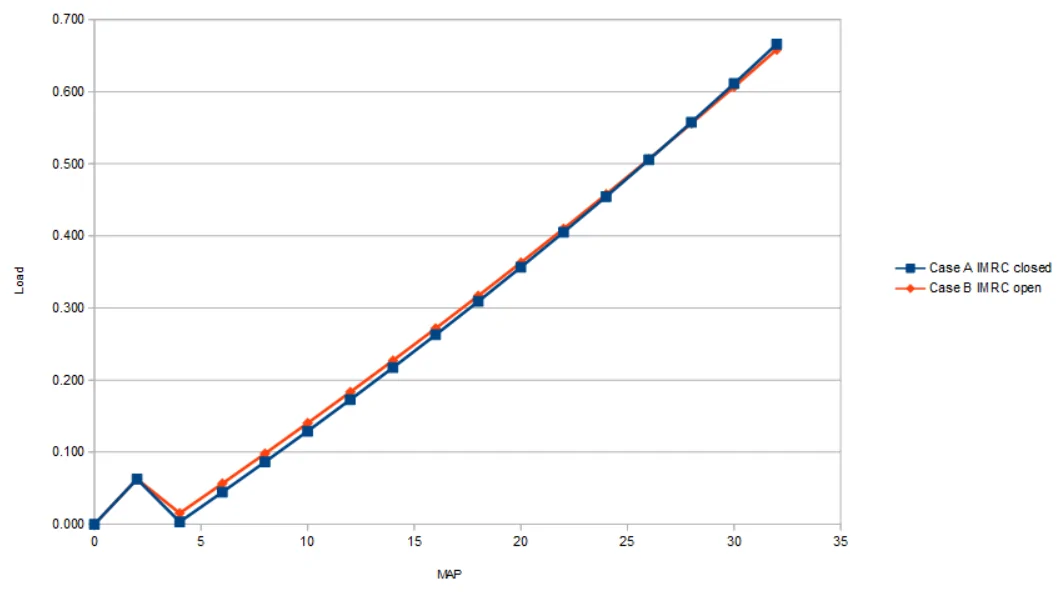
You might find this interesting, but Ford's logic doesn't work in VE, per se, but rather solves some complex equations to determine how full the cylinder is at a given MAP. A "full" cylinder has .0017 lb of air in it. Load is the actual air mass in the cylinder divided by .0017. So, if you have 29.92 inHg in the plenum (atmospheric pressure) and the load is 1.0, then you have .0017 lb of air in the cylinder and VE is 100% but they never actually work in terms of % VE. The following graph is a comparison of MAP vs load for IMRC open vs closed at low rpm. As you can see the difference is very slight, basically negligible:
1779639670728-jh.webp


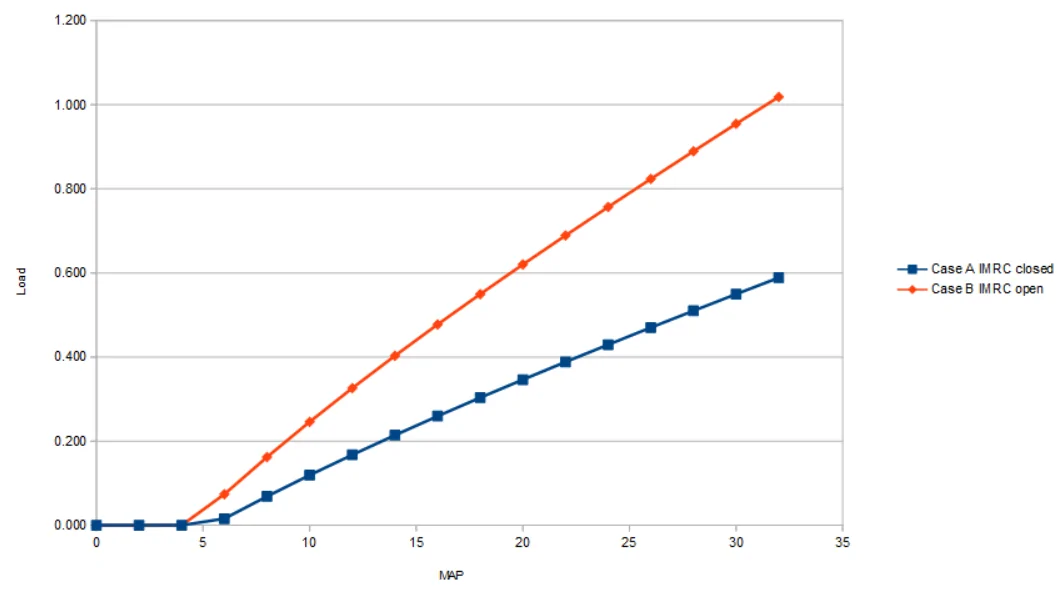
This is the same comparison, but at high rpm:
1779640020733-z2.webp


As you can see, blocking off most of the intake runner with IMRC makes a dramatic difference at high rpm where the VE is just a little over half what it is with IMRC open.
 

Hack

Well-Known Member
Joined
Nov 26, 2014
Threads
86
Messages
12,794
Reaction score
8,202
Location
Minneapolis
Vehicle(s)
Mustang, Challenger
My point was that the IMRC are to increase turbulence, not VE. And being that they are basically just flaps that shut off most of the runner flow area, they really can't help VE...only hurt it.
Yes I agree based on that information that there is a small change in VE with the CMCVs open at low RPM. For all intents and purposes it is zero.

For VE calculations, we would only look at the highest point on the graphs, which is WOT. The rest are not relevant to VE.
 

Sponsored

tdstuart

Well-Known Member
Joined
Apr 6, 2021
Threads
72
Messages
2,562
Reaction score
1,290
Location
Arizona
First Name
Triston
Vehicle(s)
2015 Mustang Gt Premium
You know the thread has gotten off track when we went from my engine blew what do I do, to engineermike posting graphs about the coyote's ve.

Heres the answer OP, buy a shortblock and have a trusted shop fix it and reuse your heads, and go back to a stock tune. Or buy a longblock and have a trusted shop put that in. Shortblock will be cheaper but the shop needs to take more care to swap the heads, cams, etc. Longblock is more expensive but the shop just needs to pull the old motor out and put the new one in.

If you have lots of money, build the motor so it won't blow again and have fun modding.

If you are really in a financial hole and can't afford to atleast pay most of the repair without getting screwed on financing the repair, then sell the car with a damaged motor, and buy a cheap car while you fix your financial situation. These cars are great, but from someone who has blown a few motors, and spent way too much money, and now has a turbo mustang, its not worth being in debt.
 

Gen 6 Mach1

Well-Known Member
Joined
Oct 1, 2025
Threads
3
Messages
464
Reaction score
917
Location
Arizona
First Name
Jer
Vehicle(s)
2021 Mach1
You know the thread has gotten off track when we went from my engine blew what do I do, to engineermike posting graphs about the coyote's ve.

Heres the answer OP, buy a shortblock and have a trusted shop fix it and reuse your heads, and go back to a stock tune. Or buy a longblock and have a trusted shop put that in. Shortblock will be cheaper but the shop needs to take more care to swap the heads, cams, etc. Longblock is more expensive but the shop just needs to pull the old motor out and put the new one in.

If you have lots of money, build the motor so it won't blow again and have fun modding.

If you are really in a financial hole and can't afford to atleast pay most of the repair without getting screwed on financing the repair, then sell the car with a damaged motor, and buy a cheap car while you fix your financial situation. These cars are great, but from someone who has blown a few motors, and spent way too much money, and now has a turbo mustang, its not worth being in debt.

62 posts of good suggestions, post 69 has a link to him posting a year ago , about tuning his car . Unfortunately tuning did damage .
Again He has plenty of suggestions . I think engineermike and a few others posting , and are way smarter than me on these Coyote engines is good information.

If a person has financed there car , it's a DD , you're renting an apartment or house have no Plan B in life 401k savings , tune you car , it hurts the engine have no resources to fix ... Sorry but very irresponsible . Or a person has the the resources, great .... Fix it , Sell it , buy another DD , but most of all get into a 401k , Money Market account, or IRA . Building Financial Security is way more important especially in a young persons life .
Post away em , love learning about the Coyote.
 

Joey_64

Member
Joined
Aug 12, 2025
Threads
2
Messages
8
Reaction score
4
Location
Australia
First Name
Joe
Vehicle(s)
2016 5.0ltr Mustang, AU XR8 363 Windsor, EF 5.0ltr Windsor
Honestly, if it was mine, I’d probably keep it simple at this point rather than chasing the current combo any further.

The quickest and usually cheapest path back on the road is to source a good second-hand Gen 3 engine from a salvage yard, swap it in, put all the factory intake hardware back on it, and return it to a stock calibration or very mild setup.

Once you start chasing custom tunes, lockouts, manifold swaps and trying to sort out drivability issues remotely, it can turn into a money pit pretty quickly, especially when the car’s already hurt.

At least with a stock-style setup, you know what you’ve got, the factory strategy works properly, and if you decide to sell it later, it’ll generally be an easier sell as well.

Either way it’s probably going to cost some money from here, but personally I’d be aiming for the least painful and most reliable option rather than doubling down on the current setup.
 

Crew4991

Well-Known Member
Joined
Sep 11, 2020
Threads
14
Messages
1,240
Reaction score
2,573
Location
Phoenix Arizona / Denver Colorado
First Name
Crew
Vehicle(s)
Ford Mustang GT/CS, Dodge Viper SRT10
if this is really a huge problem you shouldn't be modding it like that to begin with.
replacing the engine is the only logical move in this scenario.
leave it as stock as possible.

this is why I don't bother with tunes. most of the time they're fine but you might be that 1% guy and these cars are plenty fast enough for me.
Agree with everything you said!

Now imagine OP sells the car and the next sucker that buys the hot mess chooses not to get a pre purchase inspection...
Sponsored


Top