
Sponsored
engineermike
Well-Known Member
I didn't say it only takes a reading once every 250 rpm. I said that it uses a looking-back average over some interval. It might be based on drum revolutions or time. The 500 rpm span was just an example that would explain a 250 rpm offset, but it could average the data over 500 rpm span every 1 rpm, e.g. 6000-6500 average, then 6001 - 6501, then stamp them 6250 and 6260.5 rpm respectively.1 data point every 250RPM. IDK dyno graphs look like they have more resolution than that to me.
I believe both to be extremely accurate speed pickups. Of course the PCM isn't just a speed sensor, but a position sensor as well sampled numerous times per revolution, so it will be extremely accurate for sensing speed. The inductive pickup is just one pulse every 2 revolutions, so it's either reading correctly, or it's reading half speed, and so on. There's no such thing as a pulse phaser reading a little low or high - its either dead on or way off. But as I said, the dynojet software, by definition, is averaging power over some span prior to current engine speed, and reporting power for mid-span, so something like a rev limit at a given rpm will affect power mid-span, which will show up on the graph at a lower rpm than where the rev limiter is actually set. I have lots of examples of this where you can see a consistent rpm shift of events when comparing dynojet vs log data.I would think this difference comes from the inductive RPM pick up sensors coefficients vs the crank sensors coefficients. Like trying to get two different temp sensors to read the same temperature measuring the same thing. Different sensors, different characteristics. Which do you choose is the more accurate one? Id go with the one that polls faster.
engineermike
Well-Known Member
I've done exactly this on the dyno, which is where I'm getting my data from.. I log 'Engine RPM' with hptuners VCM Scanner and can evaluate how accurate the rpms seem given current gear and mph. Not sure what else I can do.
engineermike
Well-Known Member
To be clear, you asked what is the mass of 1 lb of lead in space, and you are saying 1 lb is wrong and the correct answer is a distance. Mmmmk.What is the mass?
...
0 lb in space.
... any three distances is right.
Correct, because friction is irrelevant when talking shift points because the friction inside the engine is taken into account by the dyno curve, and friction acting against the car is the same regardless of shift point. So why muddy the water further when it adds no value?And no I'm not trying to muddy the waters, you don't want to talk about friction.
I think you have me and you mixed up on this one.You want to talk about a single object floating in empty space.
I don't think I would describe a dyno as a device that measure's an engine's acceleration. A brake dyno can run a steady rpm and measure power just fine. An inertial dyno measure how fast it can acceleration a weighted drum of known moment of inertia. Neither really care how quickly the engine accelerates.A dyno measures your engines acceleration, and if you want to ignore that and incorrectly change that, go ahead keep doing it.
That said, I would love to use inerital dyno curves directly to choose shift points. The problem is that he didn't post dyno curves for every gear; just the one gear. If he did, you would see something like what I posted a week ago in post #5, where each gear puts more power to the ground than the one before it. This would definitely be a more accurate way to do it.
Is this you admitting you disagree with Gillespie's SAE book?thats your way or you read it written in a book by someone with a PHD, it doesn't effect me.
Sure, I don't need to use Gillespie's math. I originally derived my own, and it yielded the same result. We don't have dyno curves for the OP's car per gear, so the best I can do is approximate it using Gillespie's equations.I'm just trying to tell you, you don't need to do that and you are coming up with the wrong measurements.
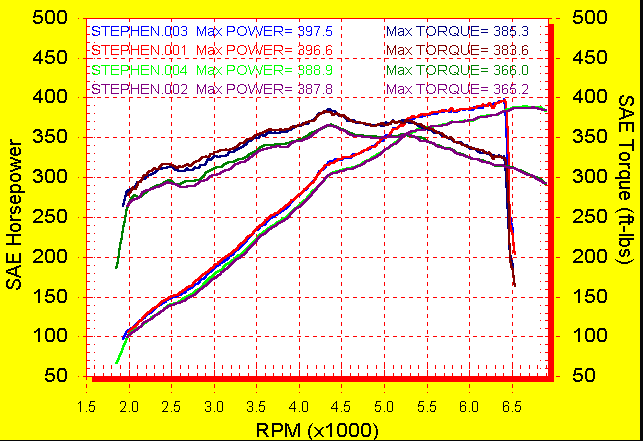
Here's one of dozens of examples of what I am referring to. This is a coyote dyno in 4th and 5th gear, of course with 5th making more. If we had this for gears 1-6 on the OP's car, then we wouldn't have to resort to the mass-equivalent math that SAE published. Alas, we don't, so we have to approximate if we want a more accurate answer. This is caused by the engine's mass-equivalent difference in 4th vs 5th gear and can be calculated using Gillespie's, Stephen Mason's, or my own methods.How do I calculate acceleration, I don't, I measure it on a dyno as horsepower.
Exactly! And if you were to calculate the power absorbed by accelerating an attached rotating mass, it would be dependent on acceleration rate, just like existing rotating mass in the engine. This is very easy to show and I did the math for you 2 days ago.Any mass attached to the engine after that, just increases what the total energy output gets distributed to.
Last edited:
Sponsored

markmurfie
Well-Known Member
I gave you how I calculate acceleration.To be clear, you asked what is the mass of 1 lb of lead in space, and you are saying 1 lb is wrong and the correct answer is a distance. Mmmmk.
Correct, because friction is irrelevant when talking shift points because the friction inside the engine is taken into account by the dyno curve, and friction acting against the car is the same regardless of shift point. So why muddy the water further when it adds no value?
I think you have me and you mixed up on this one.
I don't think I would describe a dyno as a device that measure's an engine's acceleration. A brake dyno can run a steady rpm and measure power just fine. An inertial dyno measure how fast it can acceleration a weighted drum of known moment of inertia. Neither really care how quickly the engine accelerates.
That said, I would love to use inerital dyno curves directly to choose shift points. The problem is that he didn't post dyno curves for every gear; just the one gear. If he did, you would see something like what I posted a week ago in post #5, where each gear puts more power to the ground than the one before it. This would definitely be a more accurate way to do it.
Is this you admitting you disagree with Gillespie's SAE book?
Sure, I don't need to use Gillespie's math. I originally derived my own, and it yielded the same result. We don't have dyno curves for the OP's car per gear, so the best I can do is approximate it using Gillespie's equations.
Here's one of dozens of examples of what I am referring to. This is a coyote dyno in 4th and 5th gear, of course with 5th making more. If we had this for gears 1-6 on the OP's car, then we wouldn't have to resort to the mass-equivalent math that SAE published. Alas, we don't, so we have to approximate if we want a more accurate answer. This is caused by the engine's mass-equivalent difference in 4th vs 5th gear and can be calculated using Gillespie's, Stephen Mason's, or my own methods.

Exactly! And if you were to calculate the power absorbed by accelerating an attached rotating mass, it would be dependent on acceleration rate, just like existing rotating mass in the engine. This is very easy to show and I did the math for you 2 days ago.
I didn't reply to you directly, but it's there.
I would not try to figure out the mass equivalent of my car from that. Because any thing of any size could do the same exact acceleration in any number of different conditions. With out the mass and all of the mass it is interacting with you can't get torque. You don't want to talk about friction not even where you want it and where you don't.
If I wanted the mass of my car I would start taking measurements, and listing what the material was made out of and break it down to moles of elements. Sorry that's too much for me to care to do.
Last edited:
deanm11
Well-Known Member
- Joined
- Oct 27, 2020
- Threads
- 55
- Messages
- 494
- Reaction score
- 324
- Location
- Northern NJ
- First Name
- Dean
- Vehicle(s)
- 2020 Mustang GT A10
- Thread starter
- #97
I have logs from the more distant dyno where I have a more logical measured ~ 2% slip between dyno reported RPM and dyno speed. I see log rpm in the range of 300rpm low to the dynojet inductive pickup rpm.I've done exactly this on the dyno, which is where I'm getting my data from.
engineermike
Well-Known Member
This could be changes to the timestamp method in the dynojet software (midspan vs end-span). The bottom line is that you would need to account for that when using inertial dyno power curves to make determinations.I have logs from the more distant dyno where I have a more logical measured ~ 2% slip between dyno reported RPM and dyno speed. I see log rpm in the range of 300rpm low to the dynojet inductive pickup rpm.
markmurfie
Well-Known Member
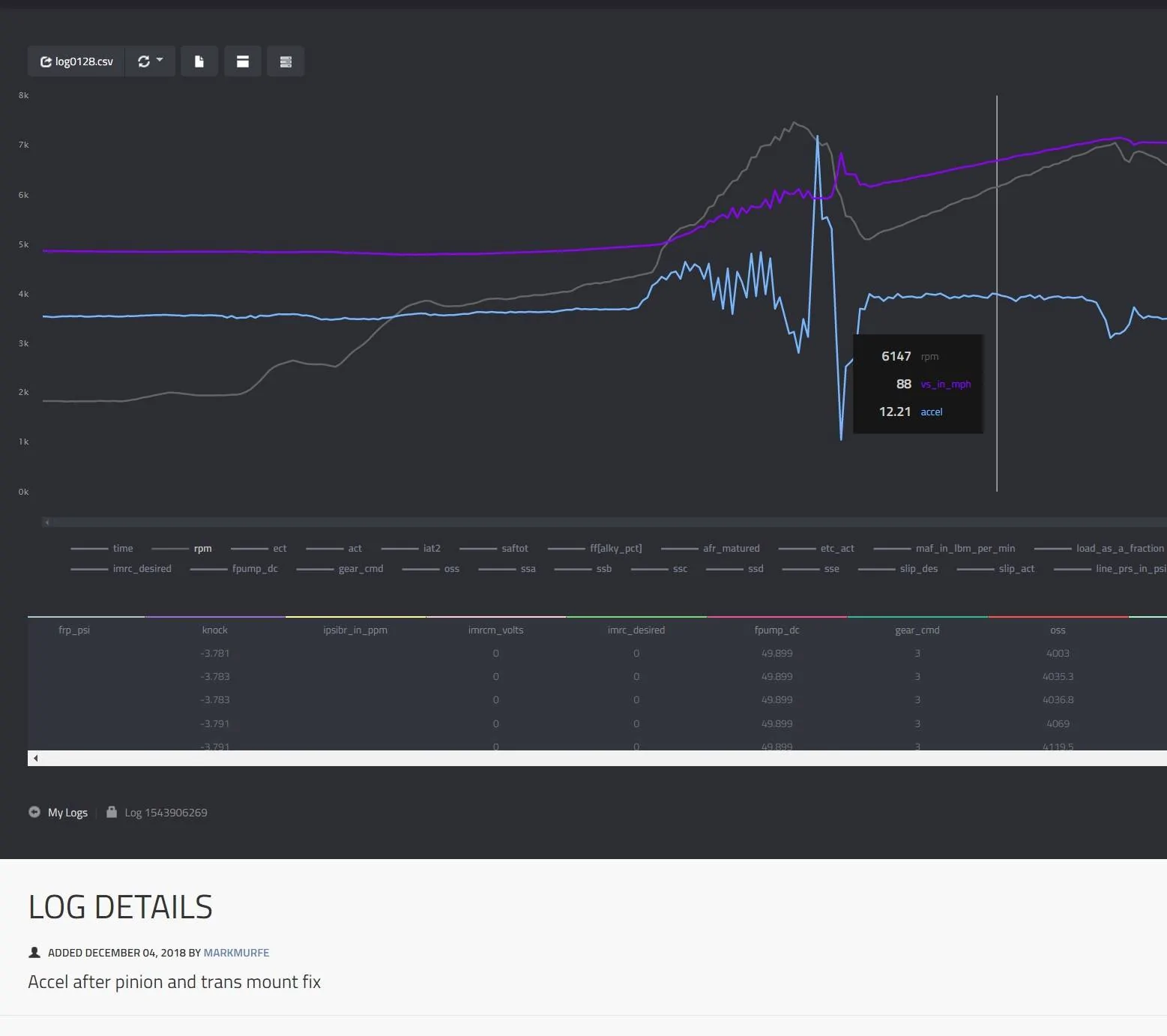
Here an example from trying to tune a 2-3 shift in 2018 where the car spun. I uploaded it to datazap then to show someone else. I have been doing this for shift points since 2006 in a manual Fbody. Automatics are definitely more precise. I learned it in algebra, but didn't understand it until calculus.
21.9 MPH/s is about 1g, so in the middle of third I was doing a near .56g. I'm telling you it looks just like your torque to MPH chart, I just added what the RPM looks like to that.
I know how to apply the theories and I know what is just text book nonsense.
.

21.9 MPH/s is about 1g, so in the middle of third I was doing a near .56g. I'm telling you it looks just like your torque to MPH chart, I just added what the RPM looks like to that.
I know how to apply the theories and I know what is just text book nonsense.
.

Sponsored
markmurfie
Well-Known Member
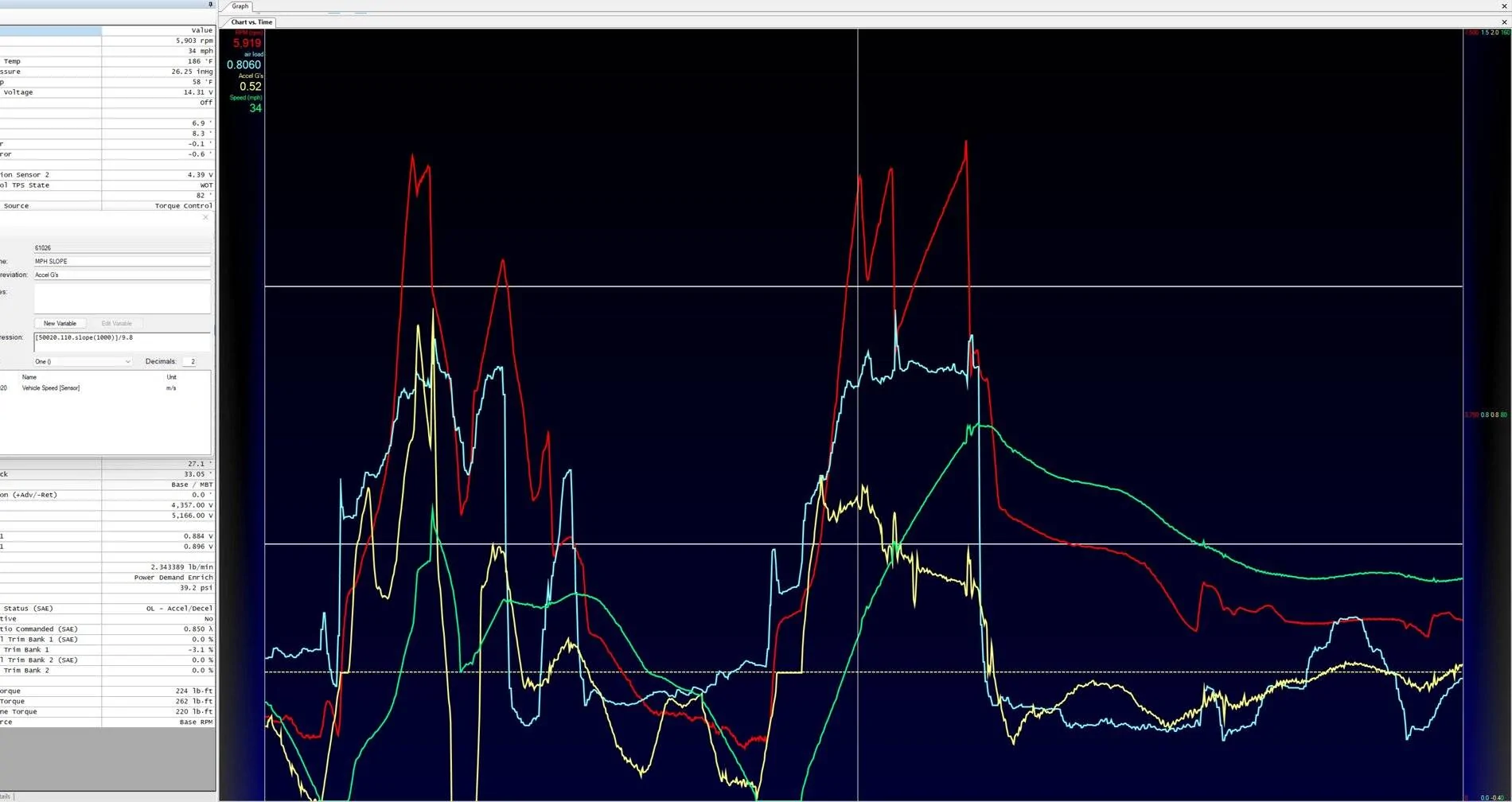
Here I am even willing to share how to do in in HPT. Its completely dependent on tire traction. You could improve upon it as is... and more with thinking about friction.


WildHorse
N/A or GO HOME
- Joined
- Jun 28, 2017
- Threads
- 270
- Messages
- 10,297
- Reaction score
- 8,350
- Location
- Home World: CLASSIFIED
- First Name
- Puddintane
- Vehicle(s)
- '17 S550
- Vehicle Showcase
- 1
What about convertor lockup @ WOT ?Here I am even willing to share how to do in in HPT.
markmurfie
Well-Known Member
This is wheel speed, same as oss with a little more math, if the tire has traction on the roads surface, it should be the speed the car is doing and the slope of acceleration, well as close as you can get to it over the time interval. Same thing a dyno sees if the tire sticks to the roller.What about convertor lockup @ WOT ?
You tell if you shifted to early or too late by comparing acceleration before and after each gear. There's nothing compensating for mass, just looking right at the acceleration.
It will even tell you the changes you should make to your shift points between a hot summer day in Denver and a cold autumn day in the east coast area.
Thread isn't about converter lock up, but yes this will tell you if tighter or looser improved the cars acceleration. It's just assuming tire to road friction is good.
If I made the software to manage an engine, this would be what my driver demand torque equivalent would be.
Your accelerator position would control your acceleration, crazy concept.
Last edited:
WildHorse
N/A or GO HOME
- Joined
- Jun 28, 2017
- Threads
- 270
- Messages
- 10,297
- Reaction score
- 8,350
- Location
- Home World: CLASSIFIED
- First Name
- Puddintane
- Vehicle(s)
- '17 S550
- Vehicle Showcase
- 1
But it's part of the equation at least in my opinion, of what you and @engineermike are debating about. I'm just asking questions to learn.Thread isn't about converter lock up
engineermike
Well-Known Member
The hardest part of finding the relevant mass equivalent is calculating the engine’s rotating mass moment of inertia. I estimated it before finding a technical article that calculated a more accurate number. That number was about double mine and also matched Gillespie’s example. After adopting this higher number, the math worked out to match dynojet results very closely, and the shift points became more reasonable for the 10r80 and other examples. I can’t say that it’s within 1% but I can guarantee it’s more accurate than neglecting it entirely.I would not try to figure out the mass equivalent of my car from that.
I assumed we were talking about straight-line acceleration of the car, which can not happen without rotational acceleration of the engine. The OP can confirm. Otherwise, this is just more water-muddying.Because any thing of any size could do the same exact acceleration in any number of different conditions.
By this, I’m assuming you’re referring to torque input into rotating mass, which turned out to not be that hard to estimate.With out the mass and all of the mass it is interacting with you can't get torque.
I’d be happy to talk about friction. It’s just irrelevant to determine shift points for reasons already explained, and muddies the water. If we were attempting to predict quarter mile time and speed, it would matter. That’s different thread entirely.You don't want to talk about friction not even where you want it and where you don't.
Based on the SAE math derived for this purpose, the only the mass that really matters when determining optimal shift points is the mass equivalent of the engine and torque converter, which can be estimated as discussed earlier. There is no value in over-complicating the matter.If I wanted the mass of my car I would start taking measurements, and listing what the material was made out of and break it down to moles of elements. Sorry that's too much for me to care to do.
Sponsored


