Sponsored

I like COVID 19

Status
Not open for further replies.

Caballus

Well-Known Member
Joined
Jan 24, 2016
Threads
43
Messages
3,613
Reaction score
2,087
Location
Over Yonder
Vehicle(s)
GT350
It is down to maths. (R0 - 1)/R0 is the calculation, so with an R0 of 2.5 it is 60% and R0 of 3 is 66%, R0 of 3.5 is 71% for herd immunity.

It is however a lot more complicated than that as firstly the R0 will be different in different subsets of populations nationally (such as in care homes) and also as more people become immune the available hosts fall so the R0 falls - which is why when 60% of the population have antibodies the R0 falls to 1. It isn't a switch at 60%, it is a gradual decrease from 2.5 to 1 between 0% and 60%

For diseases such as measles with an R0 of as much as 18 you need 94% of the population immune to stop logarithmic increases.

The R0 for COVID 19 is probably around 2.5 but maybe a little more

https://www.cebm.net/covid-19/when-...tion-to-viral-reproduction-numbers-r0-and-re/

So for example in NY, even left uncontrolled now the R0 will be lower than in a state with a naive population, it will still be more than 1 though.

Another important factor is that in most virus outbreaks the pathogenicity tends to fall with time. This is partly mutations, but primarily that the more severe strains get transmitted less easily as the victims are often in hospital and die meaning they can't pass it on. Milder asymptomatic strains are easily spread as people don't know they have it and spread it around. It also explains why a lot of health workers have the more serious strains as they are working in the places the more severe cases are present. They also get a higher viral load which is known to increase the severity of disease.
Fair enough; let's go with 60% for the sake of discussion. The question begged then is how long it would take to get to 60% and what the estimated loss would be en route to that number under various circumstances. To be useful for assessing risk in practical terms, such a calculation would have to assume that there is no vaccine, estimate when a reliable anti-body test will be available, and recognize that we do not yet know how long COVID immunity lasts or how robust any immunity really is...no?
Sponsored


Gregs24

Well-Known Member
Joined
Aug 31, 2018
Threads
23
Messages
4,760
Reaction score
3,038
Location
Wiltshire UK & Charente FR
First Name
Greg
Vehicle(s)
Mustang V8 GT, Ford Kuga PHEV
Fair enough; let's go with 60% for the sake of discussion. The question begged then is how long it would take to get to 60% and what the estimated loss would be en route to that number under various circumstances. To be useful for assessing risk in practical terms, such a calculation would have to assume that there is no vaccine, estimate when a reliable anti-body test will be available, and recognize that we do not yet know how long COVID immunity lasts or how robust any immunity really is...no?
You can get to 60% quickly (out of control) or slowly (under control) !

Reliable test is now available in the UK (co-developed by Roche in Switzerland) that meets the required specificity and sensitivity. Will be rolled out in the next 3 weeks or so. No other tests (although available) are reliable enough. Volume of testing will be the problem (as in making enough)

The only strategy for the future as lockdown is released is for testing and isolation of cases to minimise spread. There may be a need for strategic lockdowns in high incidence areas as well as long term social distancing.
 

Bikeman315

Well-Known Member
Joined
Apr 12, 2015
Threads
581
Messages
16,183
Reaction score
21,909
Location
Myrtle Beach, SC
First Name
Ira
Vehicle(s)
2019 Mustang GT/CS, 2021 Volvo XC60
Why all this talk of testing, vaccines, antibodies, masks, social distancing, etc. A waste of time and money. Mr. President says all this is just going to go away. :facepalm::headbang::frown:
 

Caballus

Well-Known Member
Joined
Jan 24, 2016
Threads
43
Messages
3,613
Reaction score
2,087
Location
Over Yonder
Vehicle(s)
GT350
You can get to 60% quickly (out of control) or slowly (under control) !

Reliable test is now available in the UK (co-developed by Roche in Switzerland) that meets the required specificity and sensitivity. Will be rolled out in the next 3 weeks or so. No other tests (although available) are reliable enough. Volume of testing will be the problem (as in making enough)

The only strategy for the future as lockdown is released is for testing and isolation of cases to minimise spread. There may be a need for strategic lockdowns in high incidence areas as well as long term social distancing.
That all makes sense, as most of it is quite obvious. Unfortunately, it does not put us any further down the road toward making well-informed strategic decisions based on reasonable risk assessments regarding herd immunity-related strategies. There are still too many variables to solve the equation. So, the questions for our representatives is what are the unknown variables, which are critical to developing an acceptable course of action, what specifically is being done to make each critical variable into either a known variable or a constant? That, in itself, is a phase of a strategy and allows the citizenry to understand, and all points in time, what risk is being accepted on their behalf--risk of a given action vs. risk of inaction.

Regarding the Swiss test...hopefully... Six weeks ago some here believed the French test was the solution.
 

Hack

Well-Known Member
Joined
Nov 26, 2014
Threads
86
Messages
12,810
Reaction score
8,226
Location
Minneapolis
Vehicle(s)
Mustang, Challenger
If most people have had this - which may be true - why is the US death continuing to rise without significant abatement? Are people getting reinfected and dying? Is long-term immunity not conferred with infection? And, therefore, is "herd immunity" not part and parcel to widespread infection? I'm not being a smart-ass - just posing the question. Here's my reference:

https://coronavirus.jhu.edu/us-map

"confirmed cases" is grossly less than "actual cases", but "deaths" are kind of hard to exaggerate.
I'm not sure what you mean by "US death continuing to rise". A certain number of people die every year. You can google search to find the US death rate. For instance, in 2015 it was 8.4 per thousand people. WIth about 328 million people being in the US, that means somewhere on the order of 2,760,000 Americans die every year.

So far, about 89,000 Americans have died from Covid, lets say about 30% of a year has passed with this virus in our population. I think it's longer, but I don't want to stretch any numbers based on my opinions. Based on the typical past death rate, we expect about 828,000 Americans to die in that amount of time. So Covid may account for about 11 percent of American deaths so far this year.

So, what my expectation is that Americans will continue to die from Covid, the flu, colds and other illnesses (typically compounded with other health problems) as time goes on just like always but with Covid being an additional cause of death that will probably supplant some others to a degree. If everything is completely open, Covid may account for a higher percentage of deaths for some time - maybe up to a year. But if I'm right and a high percentage of the population has already had Covid, 11% may be the peak and it will decline from here. Meaning Covid will be a smaller percentage of deaths in the future.

I don't believe we will ever get to zero Covid deaths, just like we have had the flu around for many years and still get tens of thousands of flu deaths. As people age and get sicker, they will pass away from something. I don't think Covid will be virtually eradicated like polio. I think it will be around forever like colds and the flu.
 

Sponsored

Gregs24

Well-Known Member
Joined
Aug 31, 2018
Threads
23
Messages
4,760
Reaction score
3,038
Location
Wiltshire UK & Charente FR
First Name
Greg
Vehicle(s)
Mustang V8 GT, Ford Kuga PHEV
I'm not sure what you mean by "US death continuing to rise". A certain number of people die every year. You can google search to find the US death rate. For instance, in 2015 it was 8.4 per thousand people. WIth about 328 million people being in the US, that means somewhere on the order of 2,760,000 Americans die every year.

So far, about 89,000 Americans have died from Covid, lets say about 30% of a year has passed with this virus in our population. I think it's longer, but I don't want to stretch any numbers based on my opinions. Based on the typical past death rate, we expect about 828,000 Americans to die in that amount of time. So Covid may account for about 11 percent of American deaths so far this year.

So, what my expectation is that Americans will continue to die from Covid, the flu, colds and other illnesses (typically compounded with other health problems) as time goes on just like always but with Covid being an additional cause of death that will probably supplant some others to a degree. If everything is completely open, Covid may account for a higher percentage of deaths for some time - maybe up to a year. But if I'm right and a high percentage of the population has already had Covid, 11% may be the peak and it will decline from here. Meaning Covid will be a smaller percentage of deaths in the future.

I don't believe we will ever get to zero Covid deaths, just like we have had the flu around for many years and still get tens of thousands of flu deaths. As people age and get sicker, they will pass away from something. I don't think Covid will be virtually eradicated like polio. I think it will be around forever like colds and the flu.
The deaths are only a part of it. The many who are critically ill, but don't die, are the ones bunging up the hospitals and exhausting medical provisions. Quite possibly the biggest crisis is about to happen in Brazil with a despot in charge that makes the Donald look like a lefty moderate !
 

Gregs24

Well-Known Member
Joined
Aug 31, 2018
Threads
23
Messages
4,760
Reaction score
3,038
Location
Wiltshire UK & Charente FR
First Name
Greg
Vehicle(s)
Mustang V8 GT, Ford Kuga PHEV
That all makes sense, as most of it is quite obvious. Unfortunately, it does not put us any further down the road toward making well-informed strategic decisions based on reasonable risk assessments regarding herd immunity-related strategies. There are still too many variables to solve the equation. So, the questions for our representatives is what are the unknown variables, which are critical to developing an acceptable course of action, what specifically is being done to make each critical variable into either a known variable or a constant? That, in itself, is a phase of a strategy and allows the citizenry to understand, and all points in time, what risk is being accepted on their behalf--risk of a given action vs. risk of inaction.

Regarding the Swiss test...hopefully... Six weeks ago some here believed the French test was the solution.
It does seem this test has finally made the grade with a 99.8% specificity which is well in excess of other tests available. The French situation was different in that that was lab capacity for testing that was contracted but the actual tests were not specific enough. There are people who spend their entire lives developing antibody tests ( I spoke to one last week and he did look just like the sort of person you would imagine develops antibody tests! ) and getting meaningful results and then applying them to population studies is immensely complex.

https://www.sciencemediacentre.org/...-at-porton-down-found-it-was-highly-specific/

As regards decision making - the best you can do is use the scientific information available at the time you make the decision - and that pretty much guarantees you will get it wrong some of the time but hopefully those occasions will become less and less. The other problem is that translating complex medical and mathematical information into simplistic terms that can be understood by the general public is not always easy or even possible. Never mind trying to explain it to politicians who often have their own agendas anyway.
 

Caballus

Well-Known Member
Joined
Jan 24, 2016
Threads
43
Messages
3,613
Reaction score
2,087
Location
Over Yonder
Vehicle(s)
GT350
It does seem this test has finally made the grade with a 99.8% specificity which is well in excess of other tests available. The French situation was different in that that was lab capacity for testing that was contracted but the actual tests were not specific enough. There are people who spend their entire lives developing antibody tests ( I spoke to one last week and he did look just like the sort of person you would imagine develops antibody tests! ) and getting meaningful results and then applying them to population studies is immensely complex.
You're right insofar as we are still in the hope phase at this point. As noted in the article you posted:

“What we still don’t know is whether a positive antibody test is associated with protection from future COVID-19 infection. And because we haven’t seen the study methods yet we can’t tell you whether these set of results are reliable or not.”

Regarding the French antibody test, the problem was two-fold. First, the test was not put through a rigorous enough regime to be reliable; in short, it was rushed. Then, as you noted, is the capacity issue. Per FT, France is not alone:

"Not all countries are on an equal footing in this race — and those with less testing capacity will be facing a greater likelihood of a second wave. With about 120,000 tests a week, the UK lags behind France as Europe’s worst performer. Meanwhile, Germany tests about 350,000 people per week, with a capacity of 700,000. Italy and Spain each test about 300,000 patients weekly."

https://www.ft.com/content/391e9ea6-fb1c-4d95-837f-9495508ed91b

While the Roche test seems to have overcome the first issue, is one to believe that Roche will be able to tackle the capacity challenge in the near term; i.e., produce enough tests not only for Switzerland, but for the world to manage the crisis? How will that be executed?

As regards decision making - the best you can do is use the scientific information available at the time you make the decision - and that pretty much guarantees you will get it wrong some of the time but hopefully those occasions will become less and less. The other problem is that translating complex medical and mathematical information into simplistic terms that can be understood by the general public is not always easy or even possible. Never mind trying to explain it to politicians who often have their own agendas anyway.
Disagree. I think you can identify critical information requirements and make a plan to fill information gaps. In the meantime, you make clear, deliberate assumptions and calculate risk based on those assumptions. Anything else is irresponsible--worse, dangerous.
Edit:
The other problem is that translating complex medical and mathematical information into simplistic terms that can be understood by the general public is not always easy or even possible.
'Impossible' is a foul word:
“The definition of genius is taking the complex and making it simple.” Einstein.
 

Gregs24

Well-Known Member
Joined
Aug 31, 2018
Threads
23
Messages
4,760
Reaction score
3,038
Location
Wiltshire UK & Charente FR
First Name
Greg
Vehicle(s)
Mustang V8 GT, Ford Kuga PHEV
'Impossible' is a foul word:
“The definition of genius is taking the complex and making it simple.” Einstein.
I hear what you are saying, but the reality is that sometimes the favourite saying 'can you explain that in simple terms' is just not possible because by simplifying you miss out the complicated bits that validate the information.

As somebody who regularly has to explain the difference between specificity and sensitivity of an antibody test I can assure you that some people just can't get it. And even that is a simplistic explanation of how antibody testing is validated.

I remember clearly learning Krebs cycle at 'O' levels, then being told at 'A' levels to forget everything we had been taught because it is more complicated, and then at degree level being told it was even more complicated so forget 'A' level teaching. And that is Krebs cycle which almost nobody other than a science level degree person will even have even have heard of.

Then my Masters degree level engineer son starts explaining supersonic airflow which makes no sense compared to subsonic airflow ...

The list goes on. Sometimes there is very specialised stuff that the man in the street will never be able to comprehend because they simply don't have the required knowledge or skill set to understand the explanation.

This will cause problems with the general public when something seems counter intuitive and 'obviously' wrong, when in fact it isn't. This is where the skill of the interpreter comes in to inspire the confidence in those that are never going to be able to understand to trust those that do. Not a nice concept for some people, but unless you want the human race to always be governed by the lowest common denominator then that is how it has to be.

This is why I find people like Trump, Bolsanaro, Putin and Kim Jong Un so frustrating because they think they know better, when that mere action proves they don't. They are too stupid and narcissistic to accept that they don't have the required knowledge or understanding about what they proclaim. Sadly their sycophantic followers reinforce their delusions.

Regarding the bit about assumptions - I agree you try and fill in gaps as best you can, but assumptions are the mother of all f**k ups and will come back to bite you one day !
 

Sponsored

Caballus

Well-Known Member
Joined
Jan 24, 2016
Threads
43
Messages
3,613
Reaction score
2,087
Location
Over Yonder
Vehicle(s)
GT350
I hear what you are saying, but the reality is that sometimes the favourite saying 'can you explain that in simple terms' is just not possible because by simplifying you miss out the complicated bits that validate the information.

As somebody who regularly has to explain the difference between specificity and sensitivity of an antibody test I can assure you that some people just can't get it. And even that is a simplistic explanation of how antibody testing is validated.

I remember clearly learning Krebs cycle at 'O' levels, then being told at 'A' levels to forget everything we had been taught because it is more complicated, and then at degree level being told it was even more complicated so forget 'A' level teaching. And that is Krebs cycle which almost nobody other than a science level degree person will even have even have heard of.

Then my Masters degree level engineer son starts explaining supersonic airflow which makes no sense compared to subsonic airflow ...

The list goes on. Sometimes there is very specialised stuff that the man in the street will never be able to comprehend because they simply don't have the required knowledge or skill set to understand the explanation.

This will cause problems with the general public when something seems counter intuitive and 'obviously' wrong, when in fact it isn't. This is where the skill of the interpreter comes in to inspire the confidence in those that are never going to be able to understand to trust those that do. Not a nice concept for some people, but unless you want the human race to always be governed by the lowest common denominator then that is how it has to be.

This is why I find people like Trump, Bolsanaro, Putin and Kim Jong Un so frustrating because they think they know better, when that mere action proves they don't. They are too stupid and narcissistic to accept that they don't have the required knowledge or understanding about what they proclaim. Sadly their sycophantic followers reinforce their delusions.

Regarding the bit about assumptions - I agree you try and fill in gaps as best you can, but assumptions are the mother of all f**k ups and will come back to bite you one day !
You're right... What did Einstein know anyway?

Or perhaps he was right...

Assumptions are a necessary element of strategic planning. What comes back to bite is failure to plan and relying on pseudo experts.

Biggest concern now is helping the UK catch up...
"With about 120,000 tests a week, the UK lags behind France as Europe’s worst performer."
 

Burkey

Well-Known Member
Joined
Feb 9, 2016
Threads
87
Messages
5,524
Reaction score
3,512
Location
Australia
Vehicle(s)
2016 Mustang GT
Vehicle Showcase
1
Why all this talk of testing, vaccines, antibodies, masks, social distancing, etc. A waste of time and money. Mr. President says all this is just going to go away. :facepalm::headbang::frown:
Not yet. It has to get warmer for that to happen :bow:
 

Gregs24

Well-Known Member
Joined
Aug 31, 2018
Threads
23
Messages
4,760
Reaction score
3,038
Location
Wiltshire UK & Charente FR
First Name
Greg
Vehicle(s)
Mustang V8 GT, Ford Kuga PHEV
You're right... What did Einstein know anyway?

Or perhaps he was right...

Assumptions are a necessary element of strategic planning. What comes back to bite is failure to plan and relying on pseudo experts.

Biggest concern now is helping the UK catch up...
"With about 120,000 tests a week, the UK lags behind France as Europe’s worst performer."
Clearly Einstein was a genius. But my point was that without the prerequisite building blocks of understanding you cannot understand complex problems. A five year old cannot understand quantum mechanics no matter how much of a genius the explainer is. I cannot understand quantum mechanics properly because I don't have the required mathematical and physics knowledge. I could learn those building blocks but I can't do that for every subject. This is why there are required minima for entrance to degrees where without them the course would be impossible.

You cannot teach the whole population the chemistry, maths, biology, then the epidemiology, virology etc etc for them to properly understand the science behind vaccination and immune reactions. And without that there is no 'simple' explanation that truly explains things. You have to go for a simplistic explanation that is incomplete and may appear 'obviously wrong' when it isn't.

I wouldn't say the worlds 'biggest concern' is the UK catching up with testing which it is slowly doing - rather more the countries ignoring the problem such as Brazil and Russia or even some countries that refuse to acknowledge the existence of COVID19

The assumptions are also the biggest weakness in strategic planning

You have the biggest psuedo expert in the world in Trump - he doesn't even know what he doesn't know (to half quote DR)
 

Burkey

Well-Known Member
Joined
Feb 9, 2016
Threads
87
Messages
5,524
Reaction score
3,512
Location
Australia
Vehicle(s)
2016 Mustang GT
Vehicle Showcase
1
I'm not sure what you mean by "US death continuing to rise". A certain number of people die every year. You can google search to find the US death rate. For instance, in 2015 it was 8.4 per thousand people. WIth about 328 million people being in the US, that means somewhere on the order of 2,760,000 Americans die every year.

So far, about 89,000 Americans have died from Covid, lets say about 30% of a year has passed with this virus in our population. I think it's longer, but I don't want to stretch any numbers based on my opinions. Based on the typical past death rate, we expect about 828,000 Americans to die in that amount of time. So Covid may account for about 11 percent of American deaths so far this year.

So, what my expectation is that Americans will continue to die from Covid, the flu, colds and other illnesses (typically compounded with other health problems) as time goes on just like always but with Covid being an additional cause of death that will probably supplant some others to a degree. If everything is completely open, Covid may account for a higher percentage of deaths for some time - maybe up to a year. But if I'm right and a high percentage of the population has already had Covid, 11% may be the peak and it will decline from here. Meaning Covid will be a smaller percentage of deaths in the future.

I don't believe we will ever get to zero Covid deaths, just like we have had the flu around for many years and still get tens of thousands of flu deaths. As people age and get sicker, they will pass away from something. I don't think Covid will be virtually eradicated like polio. I think it will be around forever like colds and the flu.
Just to inject some data into what you’ve just said:
According to one of my sources, the rate of infection in NY (state) is approximately 10 times the known infection count. Bear in mind, we are talking about one of the the most densely populated states in the US so it pays to use this cautiously as a predictor for other states/cities.
NY CITY sits at around 20% infection rate, which again makes sense when you look at population density.

Even if we assume that the pattern is consistent across the nation, you’re looking at roughly 15 million people infected so far. Now do the math and tell us how many will die in an environment where the healthcare system isn’t pushed beyond its limits and then do the same in a system where triage is in use.

The pertinent part of the source is below with the link for those who really want to take a look at what’s going on.


Actual Cases (1.7 million: 10 times the number of confirmed cases)
New York State conducted an antibody testing study [source], showing that 12.3% of the population in the state had COVID-19 antibodies as of May 1, 2020. The survey developed a baseline infection rate by testing 15,103 people at grocery stores and community centers across the state over the preceding two weeks. The study provides a breakdown by county, race (White 7%, Asian 11.1%, multi/none/other 14.4%, Black 17.4%, Latino/Hispanic 25.4%), and age, among other variables. 19.9% of the population of New York City had COVID-19 antibodies. With a population of 8,398,748 people in NYC [source], this percentage would indicate that 1,671,351 people had been infected with SARS-CoV-2 and had recovered as of May 1 in New York City. The number of confirmed cases reported as of May 1 by New York City was 166,883 [source], more than 10 times less.

https://www.worldometers.info/coronavirus/coronavirus-death-rate/


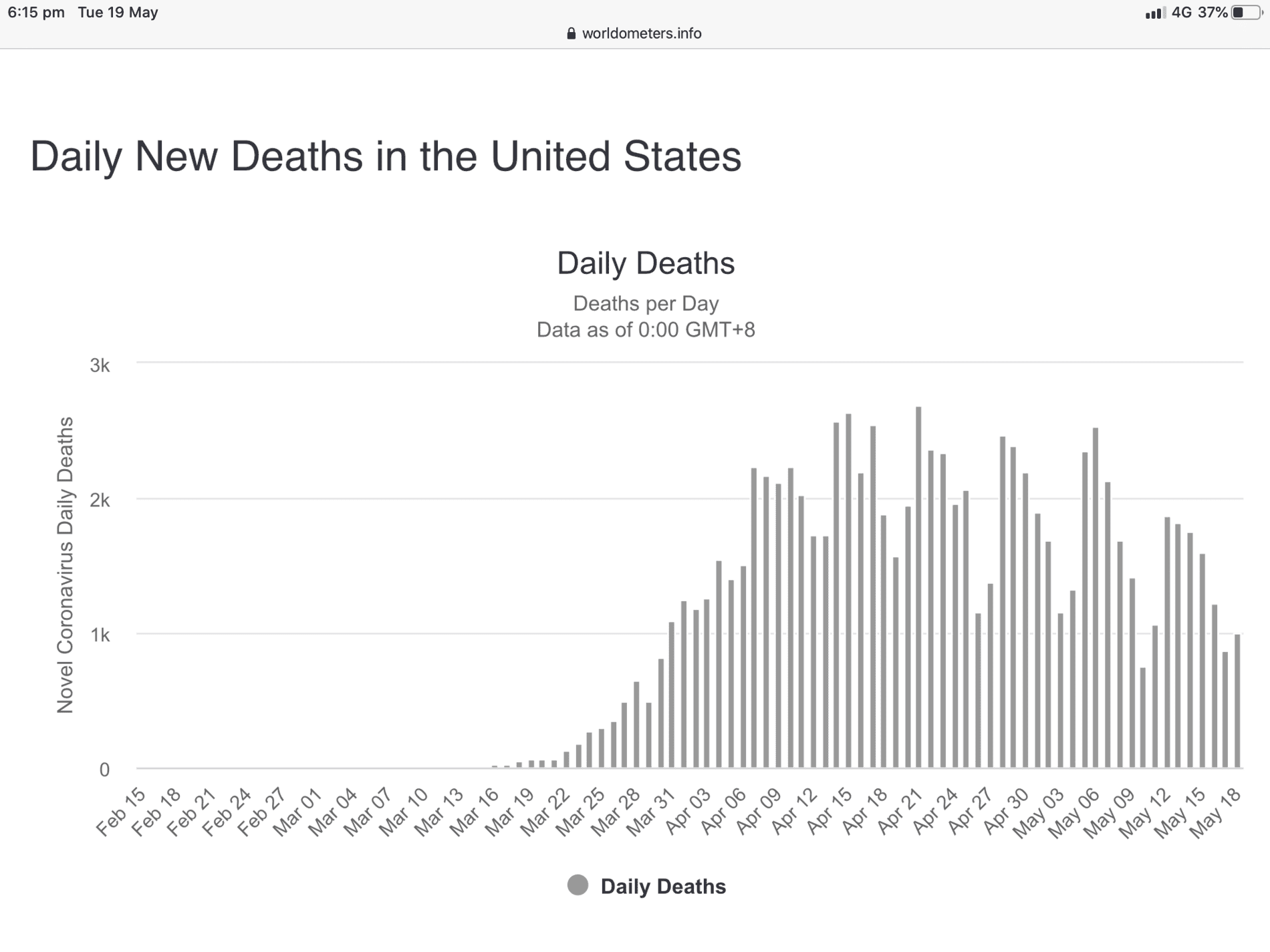
On the bright side, the US has been under 2,000 daily deaths for 10 days now.
It’s a strange world we live in when that’s considered “winning”.

For some perspective, the US has 12 times the population of Australia and at 2000 deaths per day, that’s 20 times more people PER DAY than we’ve lost IN TOTAL since this started.
I think that’s worth mentioning for some context.
646782FC-2242-4C29-8442-4F43447E08CD.png
 

Caballus

Well-Known Member
Joined
Jan 24, 2016
Threads
43
Messages
3,613
Reaction score
2,087
Location
Over Yonder
Vehicle(s)
GT350
Clearly Einstein was a genius. But my point was that without the prerequisite building blocks of understanding you cannot understand complex problems. A five year old cannot understand quantum mechanics no matter how much of a genius the explainer is. I cannot understand quantum mechanics properly because I don't have the required mathematical and physics knowledge. I could learn those building blocks but I can't do that for every subject. This is why there are required minima for entrance to degrees where without them the course would be impossible.

You cannot teach the whole population the chemistry, maths, biology, then the epidemiology, virology etc etc for them to properly understand the science behind vaccination and immune reactions. And without that there is no 'simple' explanation that truly explains things. You have to go for a simplistic explanation that is incomplete and may appear 'obviously wrong' when it isn't.

I wouldn't say the worlds 'biggest concern' is the UK catching up with testing which it is slowly doing - rather more the countries ignoring the problem such as Brazil and Russia or even some countries that refuse to acknowledge the existence of COVID19

The assumptions are also the biggest weakness in strategic planning

You have the biggest psuedo expert in the world in Trump - he doesn't even know what he doesn't know (to half quote DR)
The liberal use of words like "can't" and "not possible" are telling and very non-American. Explains why Einstein became American.

Einstein takes the burden of explanation upon himself, rather than minimizing the intellect of the message recipient. As good professors know: "If the student fails to learn, the teacher failed to teach." As good advisors and strategic planners live by, "They don't need to know everything you know; they need to know what they need to know." Each of those adages, like Einstein's, requires self confidence and humility. As for appearing obviously wrong, that's where leadership must intersect with humility.

Can't speak for the world, but one cannot help but be gravely concerned with the implications of undeniable facts, "With about 120,000 tests a week, the UK lags behind France as Europe’s worst performer."

Not sure what experience as a strategic planner would lead one to believe that assumptions are the biggest risk of strategic planning...not conjecture...professional experience. It simply isn't true.
Sponsored

 
Status
Not open for further replies.


Top