Sponsored

TDStuart Tuning Adventure

OP
OP
tdstuart

tdstuart

Well-Known Member
Joined
Apr 6, 2021
Threads
72
Messages
2,566
Reaction score
1,292
Location
Arizona
First Name
Triston
Vehicle(s)
2015 Mustang Gt Premium
I think I have it good enough I am going to make a tutorial/write-up.

https://www.mustang6g.com/forums/threads/how-to-tune-ghost-cam-question-pcmtec.202369/post-4058644

Let me know what you guys want added to it or expanded on. Ill be working on it in pieces so it might not be fully typed when you check.

Keep in mind it should give an entry-level tuner enough info to understand what is generally happening and how the things I am changing in the tune are affecting the car.
Sponsored
 

markmurfie

Well-Known Member
Joined
Jun 6, 2015
Threads
15
Messages
1,320
Reaction score
625
Location
Hawaii
First Name
Mark
Vehicle(s)
2015 Ford Mustang GT
I think I have it good enough I am going to make a tutorial/write-up.

https://www.mustang6g.com/forums/threads/how-to-tune-ghost-cam-question-pcmtec.202369/post-4058644

Let me know what you guys want added to it or expanded on. Ill be working on it in pieces so it might not be fully typed when you check.

Keep in mind it should give an entry-level tuner enough info to understand what is generally happening and how the things I am changing in the tune are affecting the car.
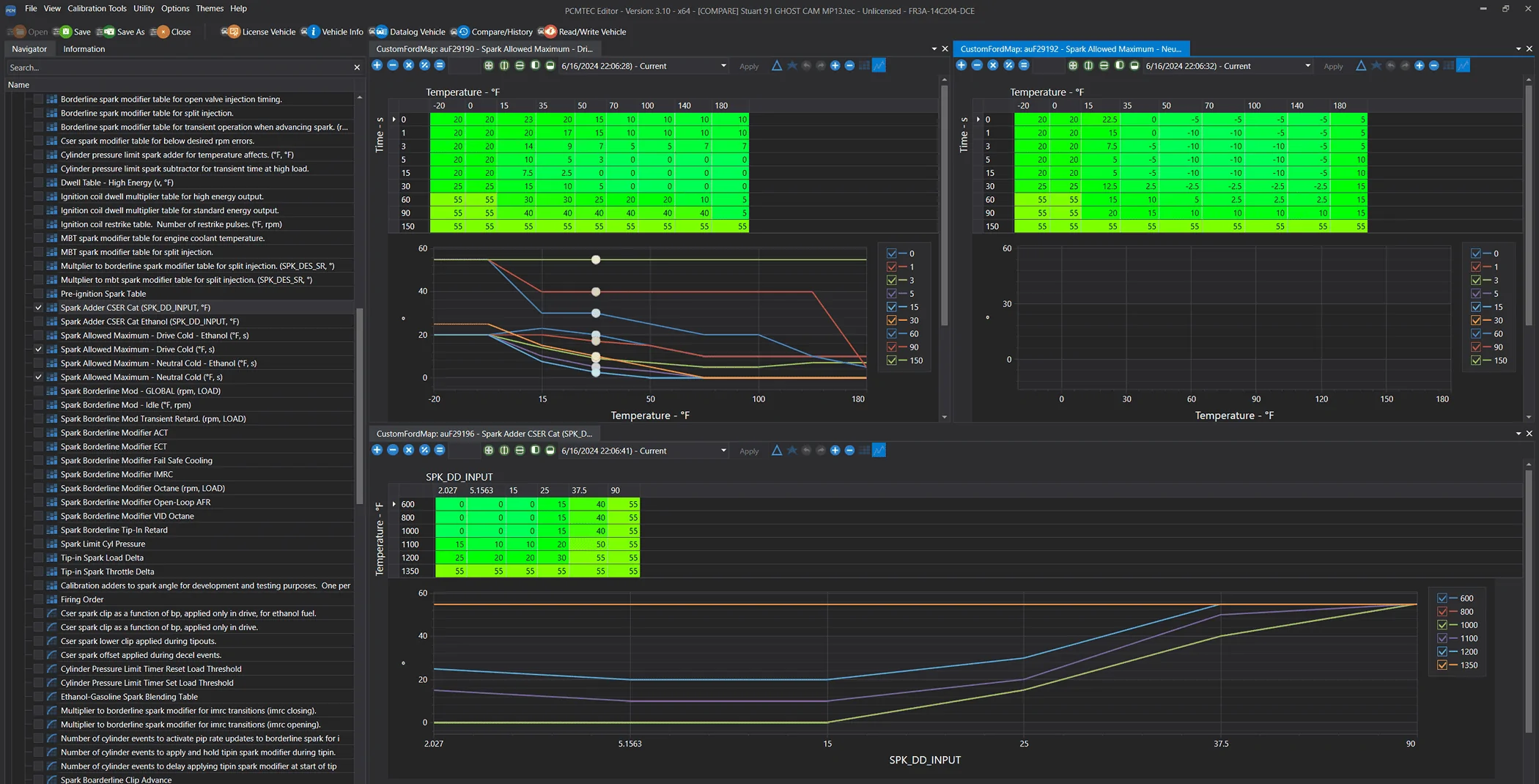
Raise these spark tables to 55 to eliminate emissions reduction mode on startup and go right to stability. low timing increases exhaust temps and heats up the catalytic converts quickly, raising this to 55 allows another spark source to be lower and therfore used.
813281-311316c32acfa279d4230abb0ca83233.png


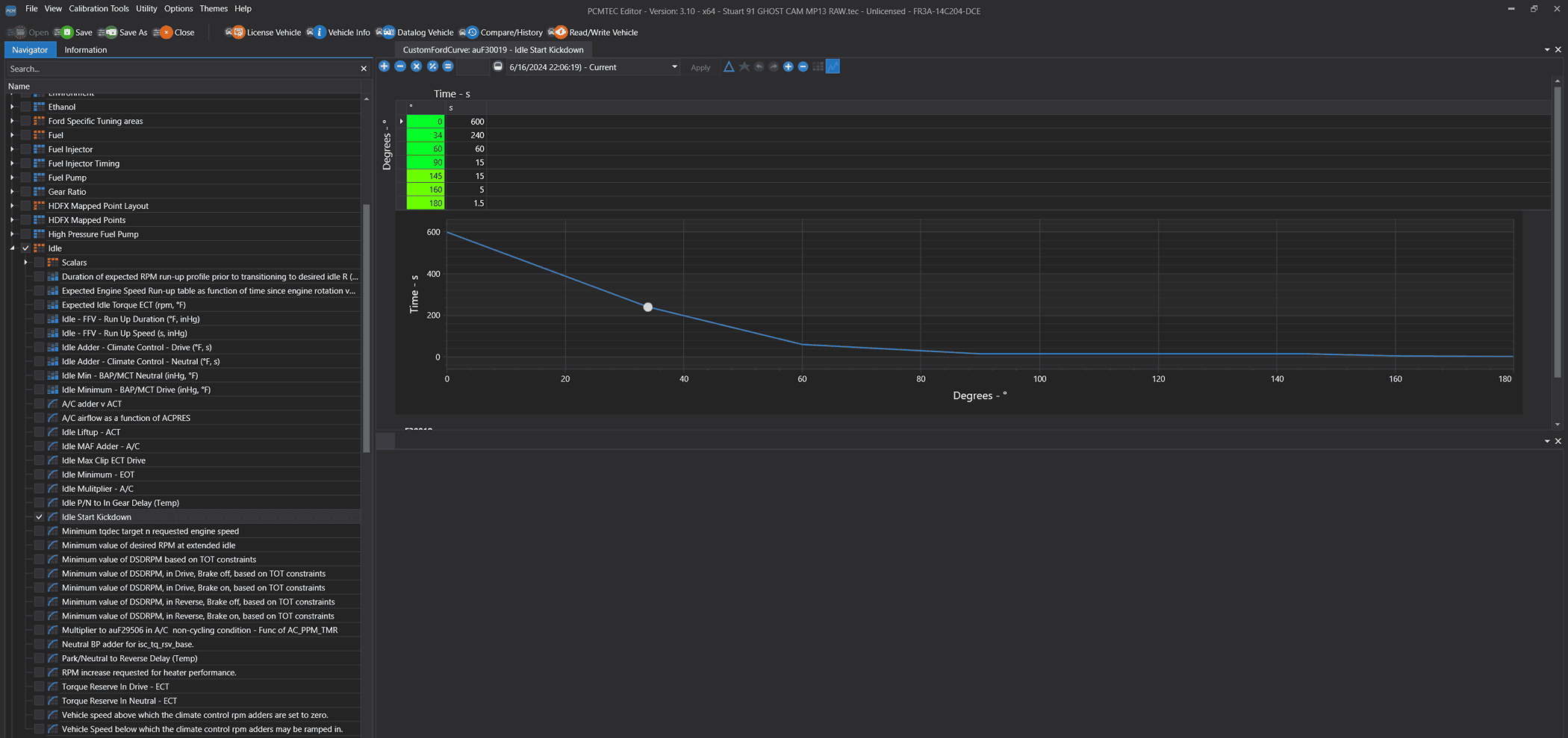
Reduce the times in the idle start kickdown to achieve a lower idle RPM quicker after startup.

813282-05674316efb4a53417f5159fca0d9415.png


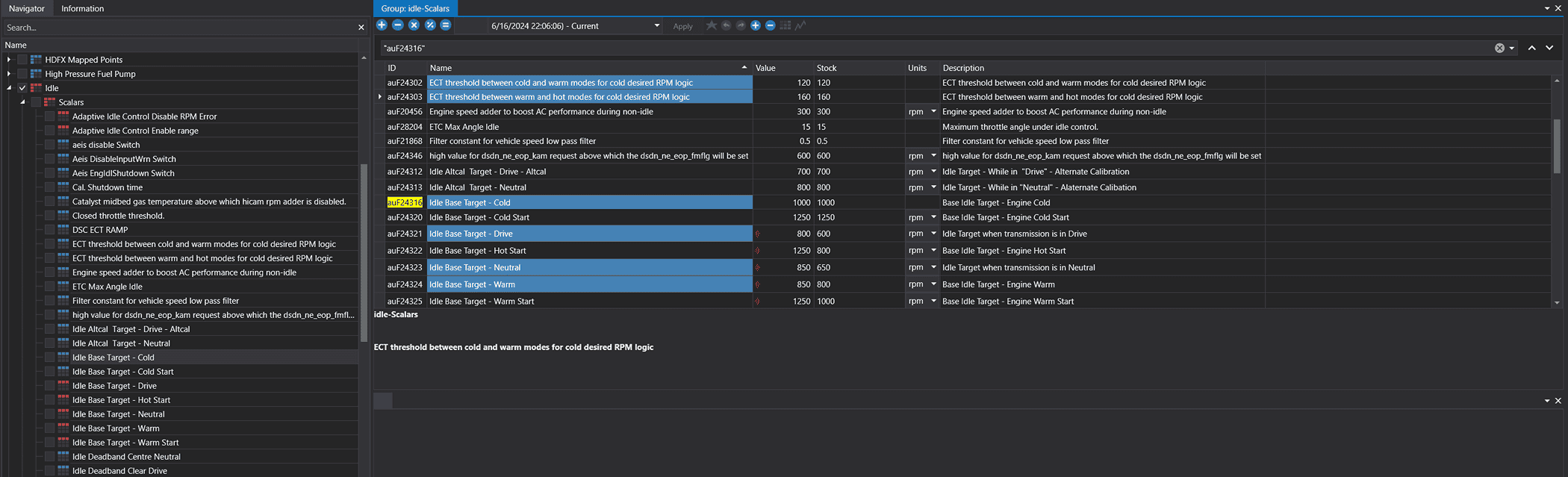
With out having to deal with the long startup times and startup RPMs Idle RPM is simplified you are left with the cold, warm, hot coolant temperatures which are less than 120, between 120 and 160, and above 160. These three areas get their own respective target RPM.
813288-4c09860a53689b1fe034ff20b6a91123.webp

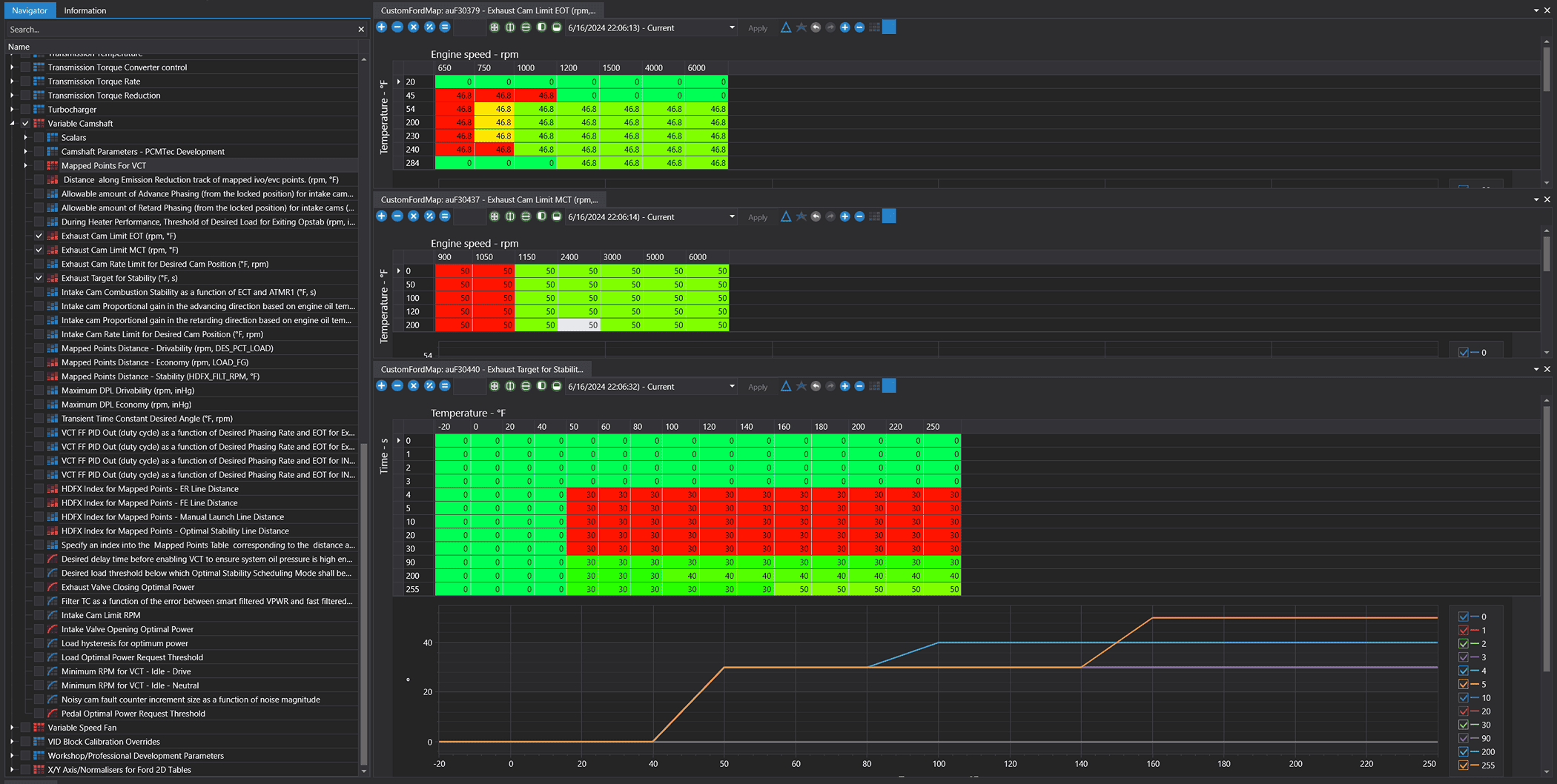
Then dont forget the exhaust phase limits that need to be adjusted to allow overlap at idle RPMS.
Currently your exhaust cam can't get to the 35* you are commanding it to go to for nearly 2 and a half minutes after the engine starts. close but limited to 30, not the 35 you want it to go to.
813283-3091add4a4463c83b287592363964d82.png


Screenshot 2024-06-16 220259.png


Screenshot 2024-06-16 221126.png


Screenshot 2024-06-16 222641.png


Screenshot 2024-06-16 221709.png
 
OP
OP
tdstuart

tdstuart

Well-Known Member
Joined
Apr 6, 2021
Threads
72
Messages
2,566
Reaction score
1,292
Location
Arizona
First Name
Triston
Vehicle(s)
2015 Mustang Gt Premium
Then dont forget the exhaust phase limits that need to be adjusted to allow overlap at idle RPMS.
Currently your exhaust cam can't get to the 35* you are commanding it to go to for nearly 2 and a half minutes after the engine starts. close but limited to 30, not the 35 you want it to go to.
Good info. And ya I just forgot to raise that part of the limit to allow for 35.

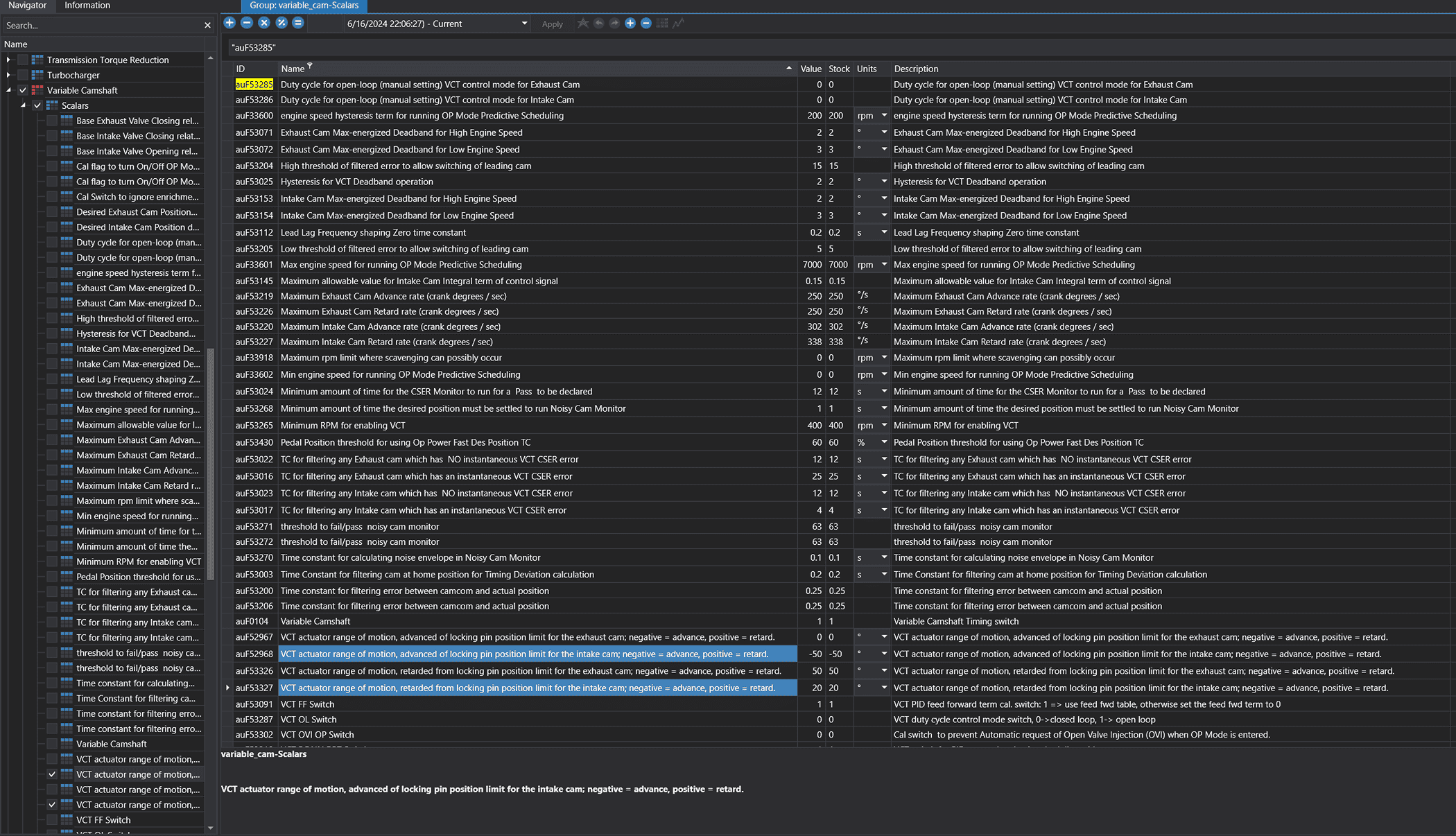
There is a weird intake cam limit of like -17 or -18 when I try to advance the intake cam to -20. I couldn’t find it anywhere. Will have to get a log tomorrow. Maybe it’s an interference thing?
 

markmurfie

Well-Known Member
Joined
Jun 6, 2015
Threads
15
Messages
1,320
Reaction score
625
Location
Hawaii
First Name
Mark
Vehicle(s)
2015 Ford Mustang GT
Good info. And ya I just forgot to raise that part of the limit to allow for 35.

There is a weird intake cam limit of like -17 or -18 when I try to advance the intake cam to -20. I couldn’t find it anywhere. Will have to get a log tomorrow. Maybe it’s an interference thing?
I recall once Ford went to the mid lock phasers all intake cam phase limits went away.

These values in PCMtec look a little funny. I would have thought they would be -20 and 40, not 20 and -50.

Screenshot 2024-06-16 225048.png
 
Last edited:
OP
OP
tdstuart

tdstuart

Well-Known Member
Joined
Apr 6, 2021
Threads
72
Messages
2,566
Reaction score
1,292
Location
Arizona
First Name
Triston
Vehicle(s)
2015 Mustang Gt Premium
I recall once Ford went to the mid lock phasers all intake cam phase limits went away.

These values in PCMtec look a little funny. I would have thought they would be -20 and 40, not 20 and -50.

Screenshot 2024-06-16 225048.png
Ya I'm not sure what limit its hitting. Ill have to play around with it and get a log. It should have been -20 intake but I think it was sitting around -17.8, so I thought it was hitting a limit of -18 but couldn't find it anywhere.
 

Sponsored

engineermike

Well-Known Member
Joined
Jul 15, 2018
Threads
31
Messages
6,189
Reaction score
6,454
Location
La
Vehicle(s)
2018 GTPP A10
As I understand it, the target-N idle logic adds up all the torque needed at idle, which would include friction, pumping losses, accessories, and probably a couple of other things. If this were to equal torque produced, the result would theoretically be a stable idle. Then, they add "torque reserve" so the engine would make torque in excess of what is needed. This torque is converted to load using the torque-to-load tables, and then load is easily converted to airflow. The required airflow is then converted to a throttle angle using the TB model and dP (baro minus calculated MAP from the SD model). Now it knows where to send the throttle to make the right amount of torque plus reserve. Since the reserve torque has been added, it's actually making more torque than it needs to idle a given speed, so the spark timing (on a feedforward and PID feedback loop) is lowered to reduce torque, theoretically by the reserve torque amount. It then floats as needed to achieve desired idle speed (target-N). My experience is the net final spark timing winds up around 10 deg. If it's too high, then it loses its ability to control torque adequately and if it's too low, you get high EGT, more NVH, etc.

That said, lots of things in the calibration have to be right for all this to work. You can see that the friction data, pumping loss model (function of SD model output), TB model, SD model, torque ratio S-curves (that determine the torque vs spark timing relationship), MBT, borderline, TTL, LTT, and others all need to be reasonably accurate for all this to work. The SD model actually affects it a couple of different ways. We already know with aftermarket cams the SD model, torque model, pumping loss model, and MBT will not be that accurate, but that's another discussion. The best that can be done is to 1) confirm the final idle timing is around 10 deg and modify the airflow possibly easiest using the TTL tables and 2) check to make sure timing isn't hitting any limits such as MBT as it's trying to control idle.
 

markmurfie

Well-Known Member
Joined
Jun 6, 2015
Threads
15
Messages
1,320
Reaction score
625
Location
Hawaii
First Name
Mark
Vehicle(s)
2015 Ford Mustang GT
As I understand it, the target-N idle logic adds up all the torque needed at idle, which would include friction, pumping losses, accessories, and probably a couple of other things. If this were to equal torque produced, the result would theoretically be a stable idle. Then, they add "torque reserve" so the engine would make torque in excess of what is needed. This torque is converted to load using the torque-to-load tables, and then load is easily converted to airflow. The required airflow is then converted to a throttle angle using the TB model and dP (baro minus calculated MAP from the SD model). Now it knows where to send the throttle to make the right amount of torque plus reserve. Since the reserve torque has been added, it's actually making more torque than it needs to idle a given speed, so the spark timing (on a feedforward and PID feedback loop) is lowered to reduce torque, theoretically by the reserve torque amount. It then floats as needed to achieve desired idle speed (target-N). My experience is the net final spark timing winds up around 10 deg. If it's too high, then it loses its ability to control torque adequately and if it's too low, you get high EGT, more NVH, etc.

That said, lots of things in the calibration have to be right for all this to work. You can see that the friction data, pumping loss model (function of SD model output), TB model, SD model, torque ratio S-curves (that determine the torque vs spark timing relationship), MBT, borderline, TTL, LTT, and others all need to be reasonably accurate for all this to work. The SD model actually affects it a couple of different ways. We already know with aftermarket cams the SD model, torque model, pumping loss model, and MBT will not be that accurate, but that's another discussion. The best that can be done is to 1) confirm the final idle timing is around 10 deg and modify the airflow possibly easiest using the TTL tables and 2) check to make sure timing isn't hitting any limits such as MBT as it's trying to control idle.
No its much simpler. All that torque model loss stuff goes away with desired torque and estimated engine torque should be attempting to come out to 0.

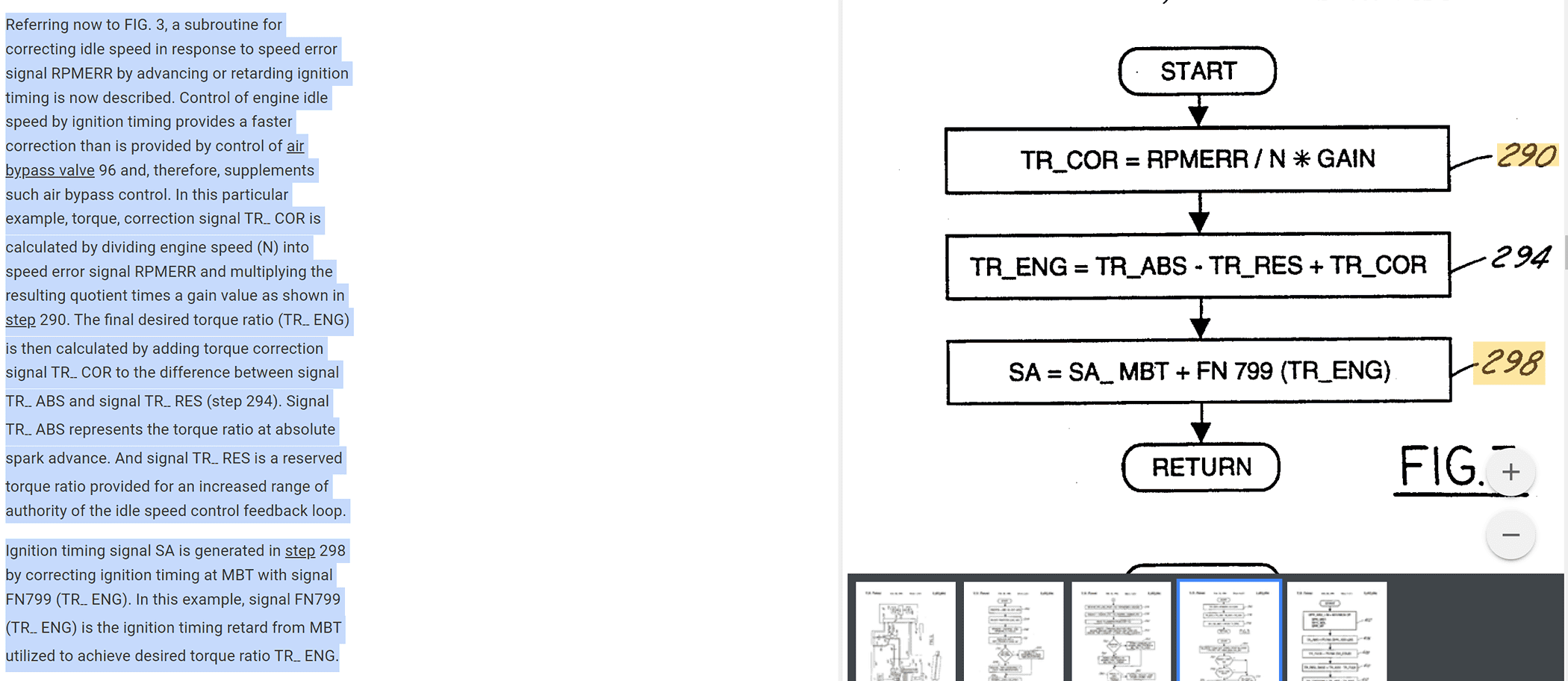
See this image for a better understanding of how the table under idle> torque tab are used to determine idle speed control spark advance. absolute spark advance is the lesser of MBTand BDL. TR_abs comes from one of those two spark advances.

As long as you have desired MAF from torque tables at idle high enough, and enough authority in the idle torque control through gain and reserve, it targets the idle speed and achieves it fine.

Theres virtually no way its knock limited at idle, so keeping BDL values higher than MBT in this area seems appropriate. The simple way to control spark advance would be directly through the MBT values. You only need to touch the torque tables if you need the throttle to open more at idle, which to lower the spark advance and keep it in torque control not using all of the MBT advance, it might need.

Screenshot 2024-06-17 033842.png
 

engineermike

Well-Known Member
Joined
Jul 15, 2018
Threads
31
Messages
6,189
Reaction score
6,454
Location
La
Vehicle(s)
2018 GTPP A10
No its much simpler. All that torque model loss stuff goes away with desired torque and estimated engine torque should be attempting to come out to 0.
Where, are you saying, is it obtaining the desired torque (and thus airflow) from if not from the engine torque model?
 

markmurfie

Well-Known Member
Joined
Jun 6, 2015
Threads
15
Messages
1,320
Reaction score
625
Location
Hawaii
First Name
Mark
Vehicle(s)
2015 Ford Mustang GT
Where, are you saying, is it obtaining the desired torque (and thus airflow) from if not from the engine torque model?
Im saying the torque model loss stuff goes away. " friction, pumping losses, accessories, and probably a couple of other things."

its all indicated torque and load to get desired maf. Even the TB is below choked flow vacuum so its model is inaccurate.
 

Sponsored
OP
OP
tdstuart

tdstuart

Well-Known Member
Joined
Apr 6, 2021
Threads
72
Messages
2,566
Reaction score
1,292
Location
Arizona
First Name
Triston
Vehicle(s)
2015 Mustang Gt Premium

Pistol_91

Well-Known Member
Joined
Oct 25, 2023
Threads
12
Messages
1,382
Reaction score
1,407
Location
Clearwater
Vehicle(s)
2020 mustang GT
Triston I still think you don't fully understand how the mapped points work. You understand what correlates with them like spark and torque, but I don't think you understand exactly what is telling the PCM to use which mapped point at which time. Do you?

" For example the car might say okay I want to be at MP 0, the cam position for MP 0 is (0, 0) so it will attempt to get the cams to (0,0) but if the cams deviate (lots of factors can affect this) it will start to blend in other Mapped Points along with the target MP 0. "

This is not true. They are not going to randomly move around the field just because... The distance tables TELL the pcm which cam angles to use and when and it will absolutely use those cam angles. The blending factor happens when cam angles of 2 or more mapped points are close in values to each other and/or when cam angles are "traveling" from one to another while accelerating or decelerating through the rpm and load ranges. Everything is based off the Distance tables. EVERYTHING.
 
OP
OP
tdstuart

tdstuart

Well-Known Member
Joined
Apr 6, 2021
Threads
72
Messages
2,566
Reaction score
1,292
Location
Arizona
First Name
Triston
Vehicle(s)
2015 Mustang Gt Premium
Triston I still think you don't fully understand how the mapped points work. You understand what correlates with them like spark and torque, but I don't think you understand exactly what is telling the PCM to use which mapped point at which time. Do you?

" For example the car might say okay I want to be at MP 0, the cam position for MP 0 is (0, 0) so it will attempt to get the cams to (0,0) but if the cams deviate (lots of factors can affect this) it will start to blend in other Mapped Points along with the target MP 0. "

This is not true. They are not going to randomly move around the field just because... The distance tables TELL the pcm which cam angles to use and when and it will absolutely use those cam angles. The blending factor happens when cam angles of 2 or more mapped points are close in values to each other and/or when cam angles are "traveling" from one to another while accelerating or decelerating through the rpm and load ranges. Everything is based off the Distance tables. EVERYTHING.
Maybe I should make it clearer. What I meant by deviating is not that the cams commanded position deviates but that the cams never hold exactly the commanded position and thus can blend in other mapped points even when commanded to an exact mapped point.
 

Pistol_91

Well-Known Member
Joined
Oct 25, 2023
Threads
12
Messages
1,382
Reaction score
1,407
Location
Clearwater
Vehicle(s)
2020 mustang GT
Maybe I should make it clearer. What I meant by deviating is not that the cams commanded position deviates but that the cams never hold exactly the commanded position and thus can blend in other mapped points even when commanded to an exact mapped point.
My cams hold exactly what I command perfectly and the MP is at 100%... Is that not what you're saying?
 
OP
OP
tdstuart

tdstuart

Well-Known Member
Joined
Apr 6, 2021
Threads
72
Messages
2,566
Reaction score
1,292
Location
Arizona
First Name
Triston
Vehicle(s)
2015 Mustang Gt Premium
My cams hold exactly what I command perfectly and the MP is at 100%... Is that not what you're saying?
It only varies like a degree or so. But especially at wot the cams can move several degrees. It’s why I think my cam phasers might have issues as I noticed some lag in the phasers on the Lund tune logs
Sponsored


Top