Sponsored

Supercharger....which one?

Torinate

Well-Known Member
Joined
Feb 18, 2018
Threads
87
Messages
2,037
Reaction score
943
Location
Ontario
Vehicle(s)
2016 GT Convertible
Until you post actual data like I did with a log, then you can call BS all day and it holds ZERO water. This is a very well known characteristic of the magnuson 2650 rotorpack. Yall in the mustang world act like nobody else has these and has any experience with them.

And furthermore we are specifically speaking about the TVS 2650R Magnuson rotorpack. Not some garbage eaton TVS of previous gen TVS setups. So make sure you are talking about the VMP Odin blower here because I believe its the only mustang blower that uses the 2650R rotorpack. Any other TVS blower is not this like the roush TVS or any rear inlet TVS setup. Those are different blowers completely.
Lol.

Golly gee, thanks Brian for the "lesson"... Perhaps you're unaware, but, I believe the Maggy uses the Eaton rotor pack... at least on their website and advertising information. Perhaps this a completely new variant 2650?

Just from Beef's website...
https://www.beefcakeracing.com/vmp-sk1820modin/
Sponsored


ZXMustang

Well-Known Member
Joined
Oct 24, 2020
Threads
9
Messages
774
Reaction score
947
Location
US
Vehicle(s)
2025 Mustang GT
Lol.

Golly gee, thanks Brian for the "lesson"... Perhaps you're unaware, but, I believe the Maggy uses the Eaton rotor pack... at least on their website and advertising information. Perhaps this a completely new variant 2650?

Just from Beef's website...
https://www.beefcakeracing.com/vmp-sk1820modin/
Front or rear inlet? Whats your setup? We are talking front inlet.
 

Torinate

Well-Known Member
Joined
Feb 18, 2018
Threads
87
Messages
2,037
Reaction score
943
Location
Ontario
Vehicle(s)
2016 GT Convertible
Absolutely front inlet.

Is there a 2650 rear inlet model?
 

WIST2019GT

Well-Known Member
Joined
Oct 9, 2019
Threads
10
Messages
155
Reaction score
179
Location
Madison
Vehicle(s)
2021 Mustang GT
Absolutely front inlet.

Is there a 2650 rear inlet model?
I think the old gen3R from VMP was rear inlet for the gen 2 coyotes.
 

HKusp

Well-Known Member
Joined
Jul 22, 2021
Threads
37
Messages
2,228
Reaction score
2,875
Location
Hampton, Md.
First Name
Jason
Vehicle(s)
2018 Mustang GT
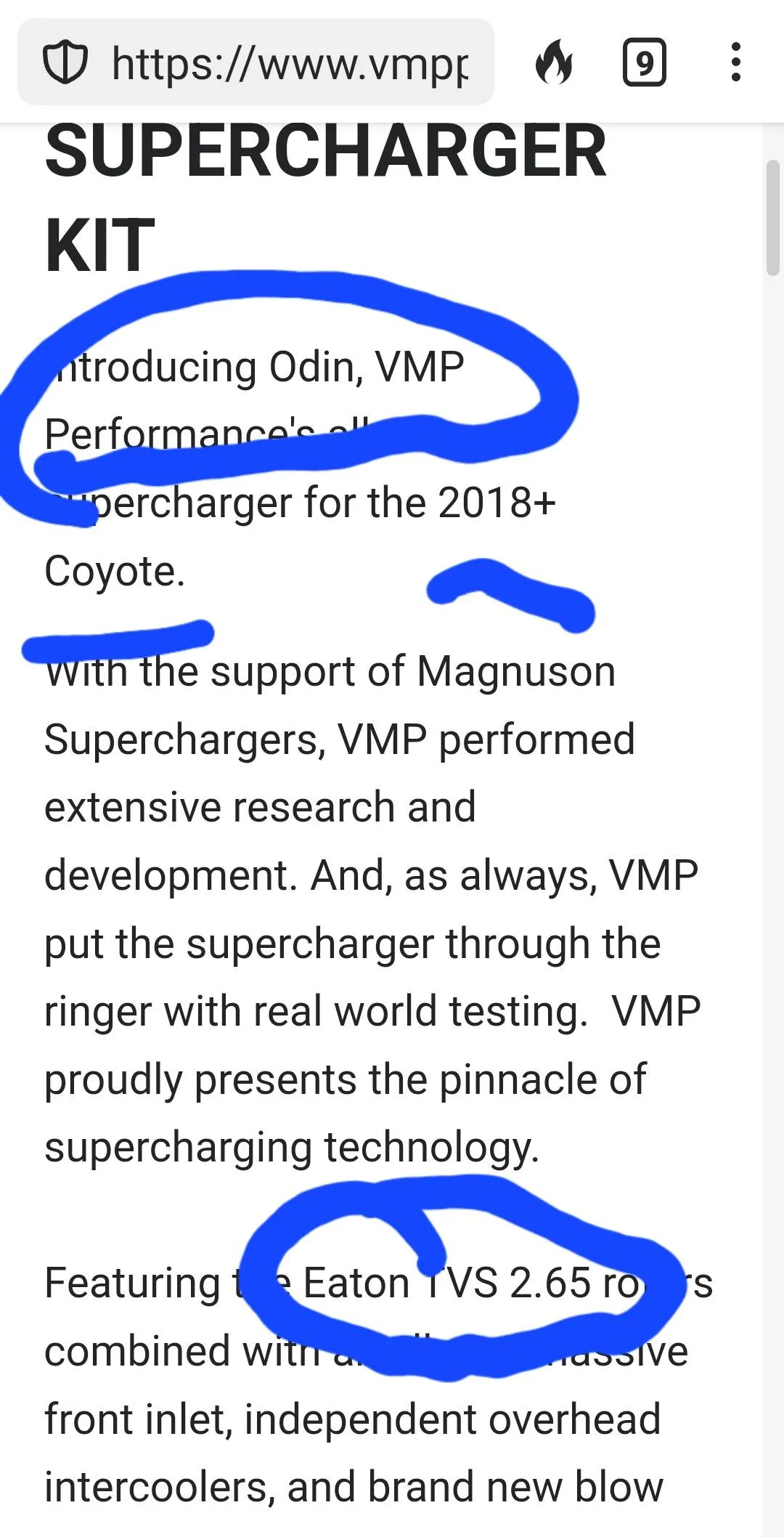
It was. This guy has data, from a LS set up, so all the Mustang guys that say the exact opposite is true on their Mustangs, this guys data log of his ZL1 is the truth, and people who report differently, without a data-log are mistaken. It's all about the Magnuson version that the Loki/Odin kit comes with. Not some shitty Eaton version...you might want to ACTULLY look at the VMP website before talking out of your ass about "shitty Eaton TVS", versus the Magnuson versions the VMP supposedly uses that are so much better. See my screenshot below from VMP's website.

Screenshot_20230412_133352_DuckDuckGo.jpg
 

Sponsored

Cory S

Well-Known Member
Joined
Dec 10, 2019
Threads
47
Messages
3,355
Reaction score
3,751
Location
Bradford, NH
First Name
Cory
Vehicle(s)
2016 Mustang GT Premium
I think the old gen3R from VMP was rear inlet for the gen 2 coyotes.
Yep. Mine is rear on the Gen3R. With my current pulley configuration, it Hits boost HARD to 13 at around 3800RPM, then builds it as high as 17-17.5psi by 8000 depending on DA.
 

Angrey

Well-Known Member
Joined
Jun 21, 2020
Threads
104
Messages
2,794
Reaction score
2,984
Location
Coral Gables
Vehicle(s)
2016 GT350
what options do I have if I want:
  1. 2022 50 state carb legal
  2. low end, more instant feeling torque (one thing I miss from my ecoboost lol)
  3. nothing crazy, maybe 600 whp
  4. plug and play, never have to tune again or upgrade other parts like the clutch etc
From what I've seen, only whipple (their 22 is in the process of being carb approved) or procharger offers something that meets all these criteria? Would consider Roush but when I contact them they say they can't disclose if the 22 is undergoing CARB or not

1. Only whipple, Procharger and Roush offer 50 state certs (that I'm aware of).
2. Low end torque is from highest to lowest, positive displacement, centrifugal, then turbo.
3. All of them will allow you to run 600 whp.
4. The centris are the easiest installation, then followed by the positive displacement, then turbos. Once you tune it, as long as you don't alter anything else, you shouldn't have to tune it again (unless you're getting issues that need a slight revision). As far as clutch goes, just remember the OE clutch isn't rated at the elevated torque levels so even if you're careful, it'll accelerate the wear/replacement (compared to the same operation at OE levels)
 

MCS

Well-Known Member
Joined
Aug 31, 2021
Threads
56
Messages
1,617
Reaction score
1,754
Location
SW Ontario
First Name
Michael
Vehicle(s)
'24 DH Premium
Speaking as a guy approaching 50 I can give you my perspective; YMMV.

You can see the build sheet using the link in my sig however I run the Phase 2 kit with upgraded coolers from Roush. I had it dyno'd to 661 WHP.

If you want something you can set and "forget" then Roush is the way to go. If you want something that can be tuned to run 700+ WHP then Odin or Whipple would be a good choice but really only because I know nothing about Procharger.

I would have gone Odin (cause Norse mythology? Why not) however they don't have anyone near me in Canada that could get the kit and do the installation for a decent price. We looked around a bit but not exhaustively. The local Ford dealership had done Roush kits before and there is a certified dealer near me anyways.

In retrospect, I made the right call for me as there will always be someone with a faster car, with deeper pockets or with a myriad of other things I don't have. I have ZERO plans to go bigger, swap to E85, retune, sacrifice a virgin or summon the blood god. 660 WHP is more than 95% of the cars on the street and I've still got money left over for all my other vices.
 

stannypack

Well-Known Member
Joined
Jan 9, 2023
Threads
116
Messages
1,185
Reaction score
1,392
Location
NOVA
Vehicle(s)
2022 Mustang GT
1. Only whipple, Procharger and Roush offer 50 state certs (that I'm aware of).
2. Low end torque is from highest to lowest, positive displacement, centrifugal, then turbo.
3. All of them will allow you to run 600 whp.
4. The centris are the easiest installation, then followed by the positive displacement, then turbos. Once you tune it, as long as you don't alter anything else, you shouldn't have to tune it again (unless you're getting issues that need a slight revision). As far as clutch goes, just remember the OE clutch isn't rated at the elevated torque levels so even if you're careful, it'll accelerate the wear/replacement (compared to the same operation at OE levels)
Still doing my research but any pros/cons between whipple vs procharger vs roush? I see a lot of people saying roush is the "worst" and has heat issues. Whipple seems better than procharger if you're not revving all the way out to redline?

My biggest focus is on low end torque since I don't really go too crazy.
 

Angrey

Well-Known Member
Joined
Jun 21, 2020
Threads
104
Messages
2,794
Reaction score
2,984
Location
Coral Gables
Vehicle(s)
2016 GT350
Man, some big misconceptions in this thread.

1) A twin screw is adiabatically more efficient than a roots blower. Thousands upon thousands of professional engineering studies and data to back that up. Not really a controversial statement.

2). The whipple 3.0 just by way of the additional volume is going to outflow a 2.65 TVS based blower. That's if all things were equal and all things are NOT equal. The twin screw will either result in more power and less heat (at equivalent flow rates from equivalently sized blower) OR will result in the same power output at slightly less flow just by nature of it's efficiency. The same comparison can be made between the twin screw and turbines or compressors. Facts are fact.

3). All the current offerings on the marketplace are simply Eaton TVS platforms with different window dressing. Whether it's Eaton themselves, Roush, VMP, they all start off as the same blower. VMP simply modifies some inlets and what not to slightly aid flow.

4) Anyone who thinks that the TVS blowers are "higher quality" than a whipple twin screw either doesn't have experience with both or is flat out wrong. The entire point of the roots blower in aftermarket enthusiast applications or OE applications is that roots blowers are easier (and cheaper) to manufacturer. The twin screw requires very exacting and precise dimensional tolerances where the roots is more of an air pump that can make up dimensional differences with a wearable/replaceable medium (which is why the roots is more common in racing associations and leagues because it's easier and cheaper to rebuild/refresh).

5). Regardless of particular pulley setups and conditions, the whipple 3.0 will absolutely outflow and outperform a 2.65 blower in virtually any rpm. At higher rpm and blower speeds, the differences become drastic. The whipple 3.0 is capable of over 1300 rwhp and with less heat. The differences between the two at moderate to low power levels are fairly negligible (slightly more heat from the TVS).

Eaton and it's after supply vendors/modifiers have made a good living off establishing themselves as an economical choice. 20 years ago, an eaton blower of comparable size and output to a whipple or a kenne bell was MUCH cheaper (as one would expect with an inferior design/product). Today, the cost differences have shrunk and they've either done a better job of marketing or people just aren't as informed. The entire point of buying a roots blower was to save money. If the price between the two is similar, it's puzzling why anyone would select a smaller displacement, less efficient blower with a much lower ceiling. Unless it's down to availability (which was an issue at the height of covid) for roughly the same price, the Whipple is the superior choice by just about any measure.
 

Sponsored

daSNAK3

Well-Known Member
Joined
May 9, 2022
Threads
28
Messages
1,313
Reaction score
1,864
Location
Cary, IL
First Name
Jake
Vehicle(s)
2021 GT
Vehicle Showcase
1
This rabbit hole is gonna give me a stroke lol stuck between whipple and ess with 120mm pulley. It is a tremec car any thoughts
Depends what you want it for I guess. For me, ESS fit the bill for sure.
 

Cux211

Well-Known Member
Joined
Mar 20, 2023
Threads
4
Messages
110
Reaction score
81
Location
PA
First Name
Steve
Vehicle(s)
22 f250 6.7 platinum tremor
Depends what you want it for I guess. For me, ESS fit the bill for sure.
That’s the way I was leaning but bits of this thread have me confused, people made it sound like the boost doesn’t come on with the ess until it’s screamin well I don’t want that it’s mainly going to be a fun/scary street car I doubt it’ll ever see a track I just don’t have time for that
 

ZXMustang

Well-Known Member
Joined
Oct 24, 2020
Threads
9
Messages
774
Reaction score
947
Location
US
Vehicle(s)
2025 Mustang GT
Man, some big misconceptions in this thread.

1) A twin screw is adiabatically more efficient than a roots blower. Thousands upon thousands of professional engineering studies and data to back that up. Not really a controversial statement.

2). The whipple 3.0 just by way of the additional volume is going to outflow a 2.65 TVS based blower. That's if all things were equal and all things are NOT equal. The twin screw will either result in more power and less heat (at equivalent flow rates from equivalently sized blower) OR will result in the same power output at slightly less flow just by nature of it's efficiency. The same comparison can be made between the twin screw and turbines or compressors. Facts are fact.

3). All the current offerings on the marketplace are simply Eaton TVS platforms with different window dressing. Whether it's Eaton themselves, Roush, VMP, they all start off as the same blower. VMP simply modifies some inlets and what not to slightly aid flow.

4) Anyone who thinks that the TVS blowers are "higher quality" than a whipple twin screw either doesn't have experience with both or is flat out wrong. The entire point of the roots blower in aftermarket enthusiast applications or OE applications is that roots blowers are easier (and cheaper) to manufacturer. The twin screw requires very exacting and precise dimensional tolerances where the roots is more of an air pump that can make up dimensional differences with a wearable/replaceable medium (which is why the roots is more common in racing associations and leagues because it's easier and cheaper to rebuild/refresh).

5). Regardless of particular pulley setups and conditions, the whipple 3.0 will absolutely outflow and outperform a 2.65 blower in virtually any rpm. At higher rpm and blower speeds, the differences become drastic. The whipple 3.0 is capable of over 1300 rwhp and with less heat. The differences between the two at moderate to low power levels are fairly negligible (slightly more heat from the TVS).

Eaton and it's after supply vendors/modifiers have made a good living off establishing themselves as an economical choice. 20 years ago, an eaton blower of comparable size and output to a whipple or a kenne bell was MUCH cheaper (as one would expect with an inferior design/product). Today, the cost differences have shrunk and they've either done a better job of marketing or people just aren't as informed. The entire point of buying a roots blower was to save money. If the price between the two is similar, it's puzzling why anyone would select a smaller displacement, less efficient blower with a much lower ceiling. Unless it's down to availability (which was an issue at the height of covid) for roughly the same price, the Whipple is the superior choice by just about any measure.
The gen 5 whipples have been failing at alarming rates. Ask the hellcat guys. And the magnuson 2650 build quality and kit quality is 2x that of any gen 5 whipple. Don't confuse efficiency with build quality. You could have a horribly engineered and built TS vs a precisely engineered and mfr'd TVS. The new gen whipples have notoriously bad build quality and guys having to send them in for warranty repair and replacements every few thousand and sometimes hundreds of miles.
 

Cory S

Well-Known Member
Joined
Dec 10, 2019
Threads
47
Messages
3,355
Reaction score
3,751
Location
Bradford, NH
First Name
Cory
Vehicle(s)
2016 Mustang GT Premium
Man, some big misconceptions in this thread.

1) A twin screw is adiabatically more efficient than a roots blower. Thousands upon thousands of professional engineering studies and data to back that up. Not really a controversial statement.

2). The whipple 3.0 just by way of the additional volume is going to outflow a 2.65 TVS based blower. That's if all things were equal and all things are NOT equal. The twin screw will either result in more power and less heat (at equivalent flow rates from equivalently sized blower) OR will result in the same power output at slightly less flow just by nature of it's efficiency. The same comparison can be made between the twin screw and turbines or compressors. Facts are fact.

3). All the current offerings on the marketplace are simply Eaton TVS platforms with different window dressing. Whether it's Eaton themselves, Roush, VMP, they all start off as the same blower. VMP simply modifies some inlets and what not to slightly aid flow.

4) Anyone who thinks that the TVS blowers are "higher quality" than a whipple twin screw either doesn't have experience with both or is flat out wrong. The entire point of the roots blower in aftermarket enthusiast applications or OE applications is that roots blowers are easier (and cheaper) to manufacturer. The twin screw requires very exacting and precise dimensional tolerances where the roots is more of an air pump that can make up dimensional differences with a wearable/replaceable medium (which is why the roots is more common in racing associations and leagues because it's easier and cheaper to rebuild/refresh).

5). Regardless of particular pulley setups and conditions, the whipple 3.0 will absolutely outflow and outperform a 2.65 blower in virtually any rpm. At higher rpm and blower speeds, the differences become drastic. The whipple 3.0 is capable of over 1300 rwhp and with less heat. The differences between the two at moderate to low power levels are fairly negligible (slightly more heat from the TVS).

Eaton and it's after supply vendors/modifiers have made a good living off establishing themselves as an economical choice. 20 years ago, an eaton blower of comparable size and output to a whipple or a kenne bell was MUCH cheaper (as one would expect with an inferior design/product). Today, the cost differences have shrunk and they've either done a better job of marketing or people just aren't as informed. The entire point of buying a roots blower was to save money. If the price between the two is similar, it's puzzling why anyone would select a smaller displacement, less efficient blower with a much lower ceiling. Unless it's down to availability (which was an issue at the height of covid) for roughly the same price, the Whipple is the superior choice by just about any measure.
Pretty much on point, except the TVS 2650 rotor pack will indeed punch harder (in the majority of combos) than the T/S Whipple on the hit from 3000-5000rpm, which is a common fun range with street driving. FWIW. My 2650 TVS makes 700-740wtq through the 6R80 from 3700–4800rpm at just 13-14psi in that RPM range.
 

Angrey

Well-Known Member
Joined
Jun 21, 2020
Threads
104
Messages
2,794
Reaction score
2,984
Location
Coral Gables
Vehicle(s)
2016 GT350
Pretty much on point, except the TVS 2650 rotor pack will indeed punch harder (in the majority of combos) than the T/S Whipple on the hit from 3000-5000rpm, which is a common fun range with street driving. FWIW. My 2650 TVS makes 700-740wtq through the 6R80 from 3700–4800rpm at just 13-14psi in that RPM range.
Yeah, I'm not convinced of that. It's all in the setup. My 3.0 makes over 620 rwtq (and 16 lbs) at 2850 rpm and makes almost 900 rwtq at peak (at 19 lbs). I'm skeptical a smaller PD blower would make more than that, and roots rotors vs twin screw at that.

At the lower power levels, the differences are not meaningful, but the idea that a smaller blower would make more power or torque is a bit of rose glasses/myth I think. The TVS may "SEEM" to punch more but that's probably because it falls off more up top.

Rotor design gets a vote, but it's a stretch to think that a smaller displacement would make more steam anywhere when given apples/apples comparison.
Sponsored


Top