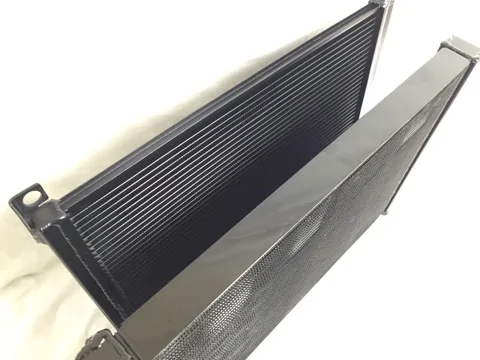
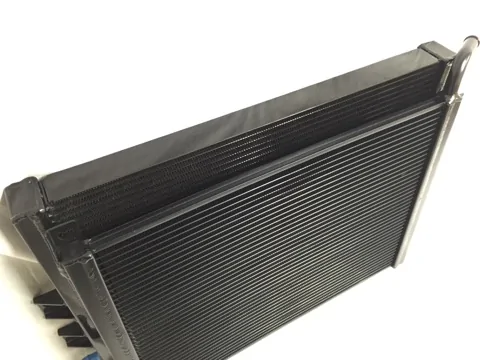
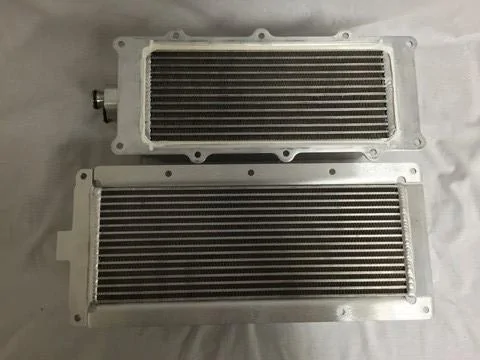
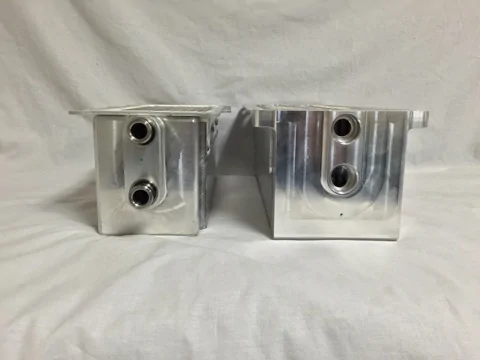
Since it was questioned, here's some direct comparison's. Note that the Whipple supplied LTR (heat exchanger) features 150% more volume as well as 16FPI vs 14FPI offering significant cooling capacity.I've got a list of stuff I'll be posting in the main/large supercharger thread tomorrow after a final meeting with engineering. But I want to hit a couple things tonight regarding post 32, I had seen a number of things I had an issue with but I wanted to wait until I had solid numbers straight from engineering before posting.
Billet fuel rails vs factory style rolled steel, the manufacturing process of billet items result in a porous metal. In short this leads to fuel leaks from those rails made of porous metal.
I'm concerned with the need of a 10 rib system to drive this new supercharger, we have seen approx 1000 hp with our blower on the 6 rib setup and haven't even considered needing a 10 rib setup.
The "Massive HD" tensioner will certainly cause an unnecessary stress on the pulleys, crankshaft specifically and certainly play a role in early bearing failures.
Mounting your intercooler reservoir behind the bumper cover in a hidden location. Does this mean you must use a mirror to add and check the fluid level or must your entire front end be removed every time ?
Yes, the front inlet does outflow our rear inlet at first glance but by no means "significantly" its by such a small amount that once you add the jack shaft and necessary drive gears etc. you've actually lost performance over the rear inlet, we have spent countless hours testing these supercharger designs and believe me when I say if front inlet was the way to go we would have been doing so long ago. However we did make some improvements over our last head unit as seen below.
Here is the old design which was still much more efficient over the twin screw design
Here is the new head unit, undoubtedly beats the front inlet jack shaft driven unit

Like I said after tomorrows meeting I will have some numbers I've been waiting on and would really like to touch base on the claims of the larger intercooler, the throttle body which we've taken up around 1000hp and still haven't maxed out as well as why this kit requires such a heavy cooling system to operate.


The IC core features over 33% more volume with 14 water passages vs 11 for increased cooling capacity. As shown in the image, you can see the shear size comparison.
What does all this mean? Not all boost is created equal. By increasing the capacity on the cooling system, the Whipple system will yield cooler IAT2 temps, net increased power on pump gas and race gas while doing it easier (easier on parts, further from detonation, further from catastrophic EGT's). While one maybe be able to push the boundaries on a quick chassis dyno run, in the real world, temps have to be maintained whether your doing a 195mph run (Hennessey), daily driving or running up and down the track.
As for a front feed unit (free of restrictions like shafts in the inlet) vs rear feeds are more efficient in everyway. While a claim that a jackshaft takes more power, this is only slightly true, as it takes 1.6HP to operate at 18,000RPM on the 2.9L compressor jackshaft version over a standard rear feed. But, because one cannot typically pull air directly from the back (think Ford GT), the air must make roughly a 160deg turn. Because of this, as well as firewall clearance and K-brace clearance, a rear feed loses some of its chance for laminar flow as the radius is restricted due to compressor placement. Furthermore, because the suction phase of the supercharger is dependent on the proper volume of air any turbulence will result in lower volumetric efficiency. Having nearly a straight path vs multiple angle changes and a 160deg (approx.) turn causes more inlet restrictions. Because a rear inlet needs a gradual turn to reduce turbulence, the driven rotor (when fed from driver side) will typically have a harder time maintaining proper volume fill as its on the shortest side of the inlet and the smallest radius. While it takes 1.6hp more (1.1 @14,000) at 18k, VE is 9.3% higher which allows for lower supercharger speeds to net the targeted airflow. The lower speeds lowers the parasitic loses significantly, thus in reality it takes less power to move the same amount of air.
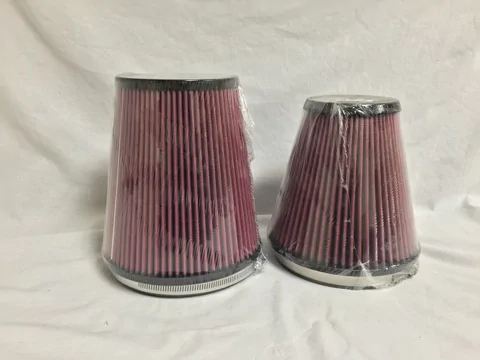
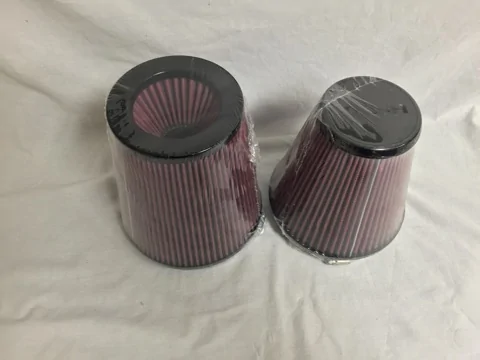
One must also factor in the round to oval shape, as oval has been proven to flow as much as 50% less than round at the equal square area. This is the reason we went away from the oval and came up with the elliptical throttle body and inlet (SVTP's Steve Turner called it the Roval) as it significantly outflows an oval shape. We used a 123mm round MAF housing (no need to go bigger, already included) with a bell mouth on the inlet. We also used a 8" long air filter vs. the 7". We also have countless hours on the airflow bench that shows the S&B "Power Stack" outflows the traditional type of filter allowing the compressor to breathe easier.
Sponsored
Last edited: