Sponsored

Lean code both banks after clutch replacement HELP

DevinN

Member
Joined
Apr 29, 2026
Threads
1
Messages
17
Reaction score
0
Location
Ohio
First Name
Devin
Vehicle(s)
2018 Mustang GT PP1, 2003 Mustang GT
Replaced the clutch in my manual 2018 Mustang GT PP1. 70k Miles. Dropped the trans while on floor jacks. Had to remove the exhaust and driveshaft to drop the trans. Did clutch, hydraulic clutch line, and slave cylinder. (Also took off the front bumper to install a cervinis upper grille and a tow hook.) No problems with the install at all. After driving the car about 60ish miles I got an engine light, codes P0171 and P0174. About 600 miles before the clutch went out, I installed a JLT 120mm cai and got a Lund 93/91 tune. The car ran great. No engine lights or other problems. Also has American Racing LTH and X-pipe as well as an J&L oil catch can. I have cleaned the MAF, taken off and reinstalled the cai as well as the catch can, and smoked the engine to look for any leaks. Does not seem to have any exhaust leaks. I never really messed with the headers anyways. I have cleaned and reinstalled the front O2's. I was unable to find any. I am not sure what to do. I have only had the car for about 6 months. I have not beat on the car yet since the clutch is still in its break in period, but the car does not seems to idle or run weird. After doing some data logs, I can see that the car is running lean as soon as I start the car, and seems to get a little worse once up to cruising speeds. Any help is greatly appreciated, I am dying to start driving my car again.
Sponsored
 

Clover

Well-Known Member
Joined
Aug 19, 2020
Threads
4
Messages
66
Reaction score
137
Location
Mountains
Vehicle(s)
Factory 5 1965 Shelby Daytona Replica in progress, , 2021 Ford Mustang Mach 1
Vehicle Showcase
1
You said it is running lean, meaning more air to fuel than ideal. From that standpoint, more air is getting by your MAF than it is detecting or your car is not supplying enough fuel.

Sounds like you have looked for exhaust leaks but have you tried seeing if it is sucking in extra air from your intake somewhere past the MAF? Old timers would spray a little either or starter fluid in the area with the engine running. If the engine picked up revs, it would tell them it was pulling that fuel into the engine.

It could be the tune telling it not to supply enough fuel. Maybe the tune was expecting less dense air and was too close to the line. The tune could tell your car not to give enough fuel for the amount of air coming in. With generic tunes, this can happen but it should not with a decent custom tune unless variables change. It could be fuel system related like lower pressure from the fuel regulator or an issue with your fuel pump. I don't know, maybe even if your fuel filter is clogged enough though I have not seen that before. Since you said it was both banks, it is unlikely to be an injector unless you have two acting up. Bad enough gas could cause issues too. In my area, a gas station had water getting in their fuel tanks. I imagine those people were getting lean conditions as some of what the injectors was injecting was water instead of fuel to burn. A little water would still run lean but a lot of water would not even run. Good luck.
 
OP
OP
DevinN

DevinN

Member
Joined
Apr 29, 2026
Threads
1
Messages
17
Reaction score
0
Location
Ohio
First Name
Devin
Vehicle(s)
2018 Mustang GT PP1, 2003 Mustang GT
Did you do a crank relearn after installing the clutch?
Yes. After doing the crank relearn I have a code (p160a), but it does not show up on the dash only on the scanner and I cannot clear it. Does not feel like it changes drivability.
 

Sponsored

OP
OP
DevinN

DevinN

Member
Joined
Apr 29, 2026
Threads
1
Messages
17
Reaction score
0
Location
Ohio
First Name
Devin
Vehicle(s)
2018 Mustang GT PP1, 2003 Mustang GT
Your O2 wires didn't get kinked or pinched during the clutch install right?
The o2 wires look good. After getting the CEL, I uninstalled them, cleaned them and reinstalled. No change with the code.
 

bKennedy

Well-Known Member
Joined
Aug 6, 2025
Threads
4
Messages
91
Reaction score
69
Location
Chapel Hill, NC
First Name
Bob
Vehicle(s)
2018 Mustang GT PP-1
Do you have a scan tool which will show you your long and short term fuel trim? I'm no exert on this but I would think if the codes were correct you should see the computer adding fuel.

Fuel trims are percentages showing how the Engine Control Module (ECM) adjusts fuel delivery (adding or subtracting) to maintain an ideal air/fuel ratio based on oxygen sensor data. Ideally, these should be near 0%; a combined (Short Term + Long Term) value outside $\pm$10% indicates a fuel system, sensor, or vacuum leak
 

robvas

Well-Known Member
Joined
Nov 18, 2023
Threads
15
Messages
3,484
Reaction score
3,274
Location
MI
Vehicle(s)
2011 GT
Do you have a scan tool which will show you your long and short term fuel trim? I'm no exert on this but I would think if the codes were correct you should see the computer adding fuel.

Fuel trims are percentages showing how the Engine Control Module (ECM) adjusts fuel delivery (adding or subtracting) to maintain an ideal air/fuel ratio based on oxygen sensor data. Ideally, these should be near 0%; a combined (Short Term + Long Term) value outside $\pm$10% indicates a fuel system, sensor, or vacuum leak
If it's lean, it's lean despite the car adding fuel
 

bKennedy

Well-Known Member
Joined
Aug 6, 2025
Threads
4
Messages
91
Reaction score
69
Location
Chapel Hill, NC
First Name
Bob
Vehicle(s)
2018 Mustang GT PP-1
If it's lean, it's lean despite the car adding fuel
Yes it may be lean despite the car adding fuel but how do you know that without looking at the fuel trim numbers? Depending on if the car is adding fuel, or not adding fuel, you may have different pats to follow. If it is adding fuel you may have a vacuum leak. If it is not adding fuel, and the coder is correct showing a lean mixture, why isn't it adding fuel?
 
OP
OP
DevinN

DevinN

Member
Joined
Apr 29, 2026
Threads
1
Messages
17
Reaction score
0
Location
Ohio
First Name
Devin
Vehicle(s)
2018 Mustang GT PP1, 2003 Mustang GT
Yes it may be lean despite the car adding fuel but how do you know that without looking at the fuel trim numbers? Depending on if the car is adding fuel, or not adding fuel, you may have different pats to follow. If it is adding fuel you may have a vacuum leak. If it is not adding fuel, and the coder is correct showing a lean mixture, why isn't it adding fuel?
Using my Lund tuning device, I can do datalogs. I am not very good at reading them, but ChatGPT seems to understand the logs. Based on what I can see, Bank 1 long term fuel trim is between 1.18 and 1.25. Bank 1 short term is between 1.05 and 1.15. Bank 2 Long term is between 1.1 and 1.2. Short term Bank 2 is between 1.02 and 1.12.
 

Sponsored
OP
OP
DevinN

DevinN

Member
Joined
Apr 29, 2026
Threads
1
Messages
17
Reaction score
0
Location
Ohio
First Name
Devin
Vehicle(s)
2018 Mustang GT PP1, 2003 Mustang GT

bKennedy

Well-Known Member
Joined
Aug 6, 2025
Threads
4
Messages
91
Reaction score
69
Location
Chapel Hill, NC
First Name
Bob
Vehicle(s)
2018 Mustang GT PP-1
Watch the video I have linked below. According to this guy anything between plus or minus 3 is ok. I have not looked up the codes you are seeing but if they are for a lean condition, and you fuel trim is only around 1, you have to ask yourself why you are getting lean codes and the fuel trim is not higher. Your computer should be supplying much more fuel to the mixture if it is really seeing a lean air/fuel mixture. Something doesn't sound correct and I don't have a clue what it is.


https://www.google.com/search?q=nor...AgiwAgHxBdWTF_UDAWt9&sourceid=chrome&ie=UTF-8


A lean condition (P0171/P0174) with "good" or normal fuel trims usually indicates a false lean reading caused by a faulty sensor or an air leak after the combustion chamber. The most common cause is an exhaust leak before the oxygen sensor, which allows air to enter and trick the sensor.
YouTube +1
Here is why you may see this contradiction:
  • Exhaust Leak Before Oxygen Sensor (O2): Cracked manifolds or leaky exhaust gaskets allow fresh air to enter the exhaust stream, making the O2 sensor believe there is too much oxygen (lean), even if the combustion process is perfectly normal.
  • Defective Oxygen Sensor (Bank 1 or 2): A contaminated or worn-out sensor may falsely report low voltage (lean) even when the actual air-fuel ratio is correct. It is stuck or sluggish, resulting in no dramatic change in fuel trim.
  • Incorrect Air Mass Reading (MAF/MAP): A faulty Mass Airflow Sensor might report slightly incorrect air volume, triggering a check engine light for lean conditions without hitting the 20-25% threshold required to significantly alter long-term fuel trim in all scenarios.
    YouTube +4
Common Troubleshooting Steps:
  • Listen for exhaust noises (hissing or ticking) while the engine is cold.
  • Inspect the exhaust manifold and pipe between the engine and the catalytic converter.
  • Review live data to check if the O2 sensor is switching properly.
    YouTube +4
1777567781499-b4.png
1777567781579-4u.png
1777567781649-vi.png
 
Last edited:
OP
OP
DevinN

DevinN

Member
Joined
Apr 29, 2026
Threads
1
Messages
17
Reaction score
0
Location
Ohio
First Name
Devin
Vehicle(s)
2018 Mustang GT PP1, 2003 Mustang GT
Have you talked with your tuner? Sent them data logs?
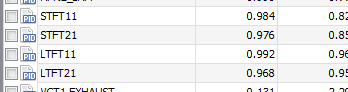
I did reach out to them and sent a datalog in which they said “It’s lean by a lot” and “did you change anything?” and they were confident that it has nothing to do with the tune since I did not change anything that should affect airflow or fuel. I only changed clutch, slave cylinder, hydraulic line and the front upper grille. Attached is the fuel trims from the first datalog I did (before changing clutch and after getting the tune revised, no CEL) and one from after changing the clutch (the higher fuel trim and CEL)

IMG_5239.png


IMG_5238.png


Top