engineermike
Well-Known Member
- Thread starter
- #1
Folks, lots and lots of discussion about fuel systems lately...but I think we've come up with "the" answer. We've been over the countless problems and shortcomings of bucketless systems, bucketed systems, return-style system, full-on-all-the-time systems, lack of diagnostics, lack of control, massive power wires run through the car, lack of venturis to keep the bucket full, high cost, the list goes on and on. Well, the following seems to address most of those shortcomings and delivers lots of fuel for a comparatively low cost.
For the record, my car is a 2018 GT PP1 with a Whipple setup, GT500 55# injectors, and the 3" pulley, which is good for 17-18 psi boost. I am currently running E85 as well. I have not had the car on the dyno in the current state, but research and talking to experienced folks have let me to the conclusion it is around 900 rwhp. It did run a sub-5 second 60-130 at full weight on the old 3.25 pulley. I do not test the e%, but the car maxed out the learning at 77.5%.
This fuel system consists of 4 basic components:
To test this setup, I did a 5th gear pull and logged rpm, load, fuel pump duty cycle, desired rail pressure, actual rail pressure, fuel flow, pulsewidth, max pulsewidth, (window) etc. This was done at about 76 deg ambient. You can see the pressure hovering in the 85-90 psi range even at max fuel flow. I'm running high pressure to get the most out of my 55# injectors, so you can imagine it will supply much more fuel in the 65-70 psi range that most people run.

One shortcoming of this system is that using only one FPDM keeps it really simple, but you lose some of the OEM diagnostics. For instance, the FPDM will send an error code to the PCM if it detects an open circuit to the pump. With this setup, if one pump loses power, the FPDM will not know it because the other one is wired in parallel. The short circuit detection should still work, though. Also, the current draw of 30 amps causes a loss of about 2 volts through the FPDM, so as good as it performed it's still leaving something on the table. We are working on an adapter harness that not only incorporates a second OEM FPDM, but also combines the FPM (fuel pump monitor) signal from both FPDMs and sends it to the PCM. This will allow full factory diagnostics plus an increase in fuel flow if needed.
Hope you guys find this interesting and helpful.
For the record, my car is a 2018 GT PP1 with a Whipple setup, GT500 55# injectors, and the 3" pulley, which is good for 17-18 psi boost. I am currently running E85 as well. I have not had the car on the dyno in the current state, but research and talking to experienced folks have let me to the conclusion it is around 900 rwhp. It did run a sub-5 second 60-130 at full weight on the old 3.25 pulley. I do not test the e%, but the car maxed out the learning at 77.5%.
This fuel system consists of 4 basic components:
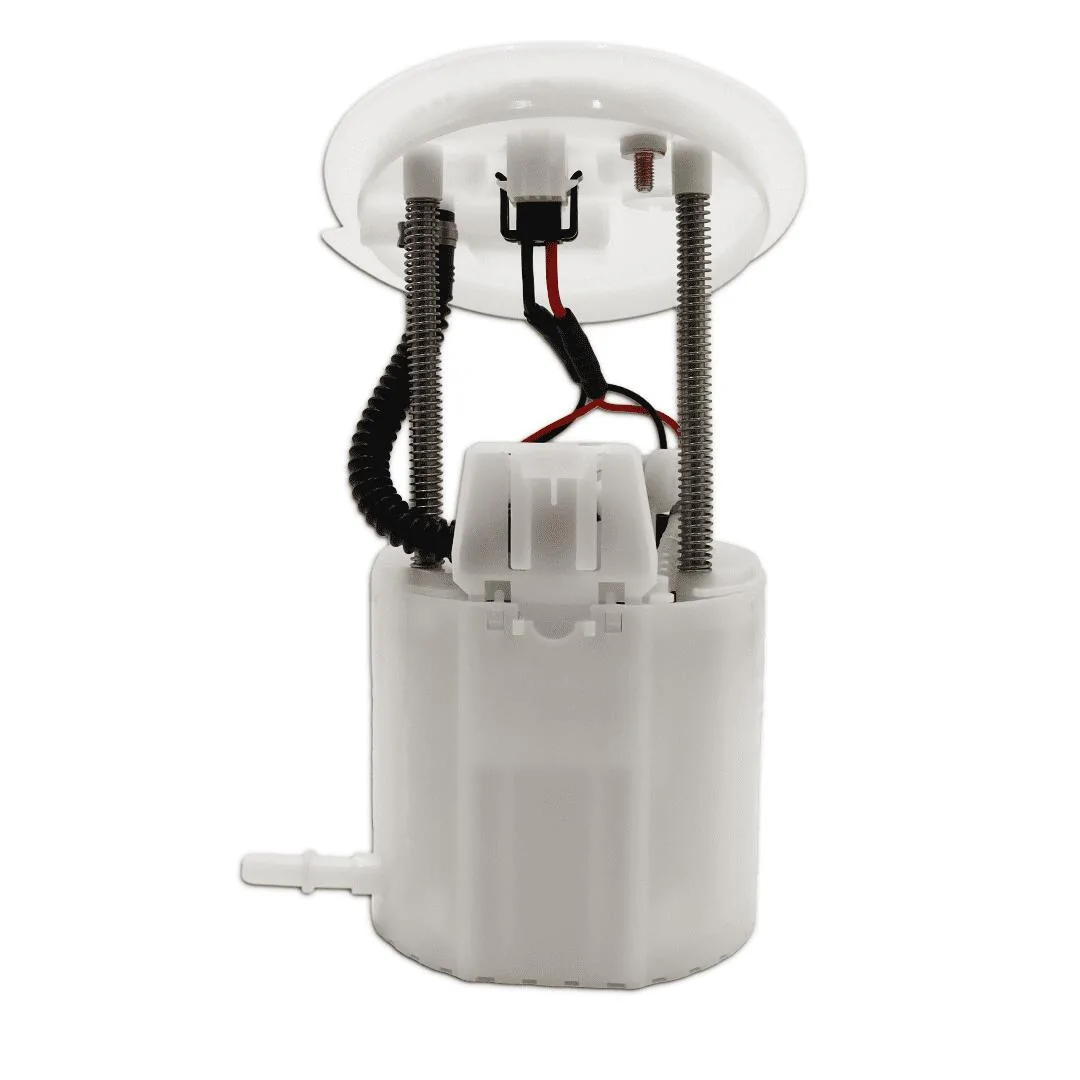
- The bucket - I'm using a stock GT500 bucket/hanger assembly which can be purchased new for $798 (2020-2022 Ford Mustang Fuel Pump And Sender Assembly kr3z9h307b | TascaParts.com) or less than half that used. Two changes MUST be made to the bucket for it to work.
- The line that supplies the PS venturi must be capped. The GT does not have a venturi on the passenger's side so there's nothing to connect to. I used this, but it should be confirmed it's Ethanol compatible: Fitting Fuel Line Quick Connector 10mm (9.89) Bundy Female Plug Cap $12
- The venturi in the bottom of the bucket must be converted to the GT style, which entail simply removing the black dual-venturi from the bottom of the stock GT bucket and swapping it into the GT500 bucket. The GT500 bucket only has a single venturi since one was relocated to the PS in that model. Edit: Actually the entire bottom part of the gen3 bucket needs to be swapped onto the gt500 module due to the venturi throat size. It also helps to drill the venturi nozzles and throats to increase bucket filling rates, more on this in post 13.
- The wiring adapter - The stock GT bucket uses a 4-pin plug, while the GT500 uses a 6-pin. A short adapter harness must be made connect it. This setup runs both pumps off the single stock FPDM. I believe this is how a popular dual pump system currently on the market also does it, plus I checked amps and temps and it's not run outside of what the community was previously doing with a BAP/DW400 setup. I did upgrade the fuse from 30 to 40 amps, but it should be ok on the 30 amp. The fuel level sender wires will just pass through, while the power and ground need to be split to feed the dual pumps. The connectors needed are:
- Amazon.com: Ballenger Motorsports - 4 way APEX 2.8 Receptacle Kit Compatible with Ford fuel pumps : Automotive$17
- Option: The same one might also be available here for $6, but I didn't confirm fitment: 54200414 (Aptiv p/n: 13754761) - FCI (Delphi/Aptiv) | APEX.28-4P-B - Corsa Technic | 4-Way Kit, Type B
- 54200609 (Aptiv p/n: 15412914) - FCI (Delphi/Aptiv) | APEX.28-6S-B - Corsa Technic | 6-Way Kit, Type B $7
- Amazon.com: Ballenger Motorsports - 4 way APEX 2.8 Receptacle Kit Compatible with Ford fuel pumps : Automotive$17
- The fuel filter - As has been previously discussed, the GT500 bucket and some other options lack the filter in the tank that the Gen3 specifically needs in order to protect the HPFP and injectors. I purchased a stock GT500 filter and a pair of pre-made Bundy-style fuel lines. This snapped together in a bout 2 minutes and puts a filter under the hood.
- FG-1152 FG1152 - Genuine Ford Fuel Filter Assembly $27
- Russell Performance 651121 Russell Stainless Steel Braided Fuel Hose Kits | Summit Racing$22 x 2 = $44
- Option: For an OEM alternative, this works the same: 84307609 - Genuine GM Pipe Assembly, Fuel Cooler $38 x 2 = $76
- Aeromotive 12701 Aeromotive Fuel Filter Mounting Brackets | Summit Racing $31 (haven't confirmed fitment but will in coming weeks)
- The tuning - Since this fuel module is an OEM module, the tuning was pretty simple and mostly done for us. The feed-forward voltage table can be copied from the GT500 into the Gen3, but the number of columns and rows is different and the flow rate doesn't go quite high enough. Some interpolation and extrapolation is needed to fit the GT500 data into the Gen3 table. For instance, the GT table max flow is 6 lb/min, GT500 is 9.4 lb/min, while my car is using 12 lb/min so the table needed to be extrapolated out to 12 or more lb/min while also making 9 flow columns fit into 4. Also, the max voltage needs to be increased to 15.2. It helps to use the high-fuel-demand smart alternator feature to lift system voltage to 15.2, and lower the low-rpm fuel pressure to 40 psi to take some electrical load off the single FPDM during normal driving. This helps keep it from getting warm. All in all, the tuning piece of this was the easiest part, and the rest was pretty easy.
To test this setup, I did a 5th gear pull and logged rpm, load, fuel pump duty cycle, desired rail pressure, actual rail pressure, fuel flow, pulsewidth, max pulsewidth, (window) etc. This was done at about 76 deg ambient. You can see the pressure hovering in the 85-90 psi range even at max fuel flow. I'm running high pressure to get the most out of my 55# injectors, so you can imagine it will supply much more fuel in the 65-70 psi range that most people run.
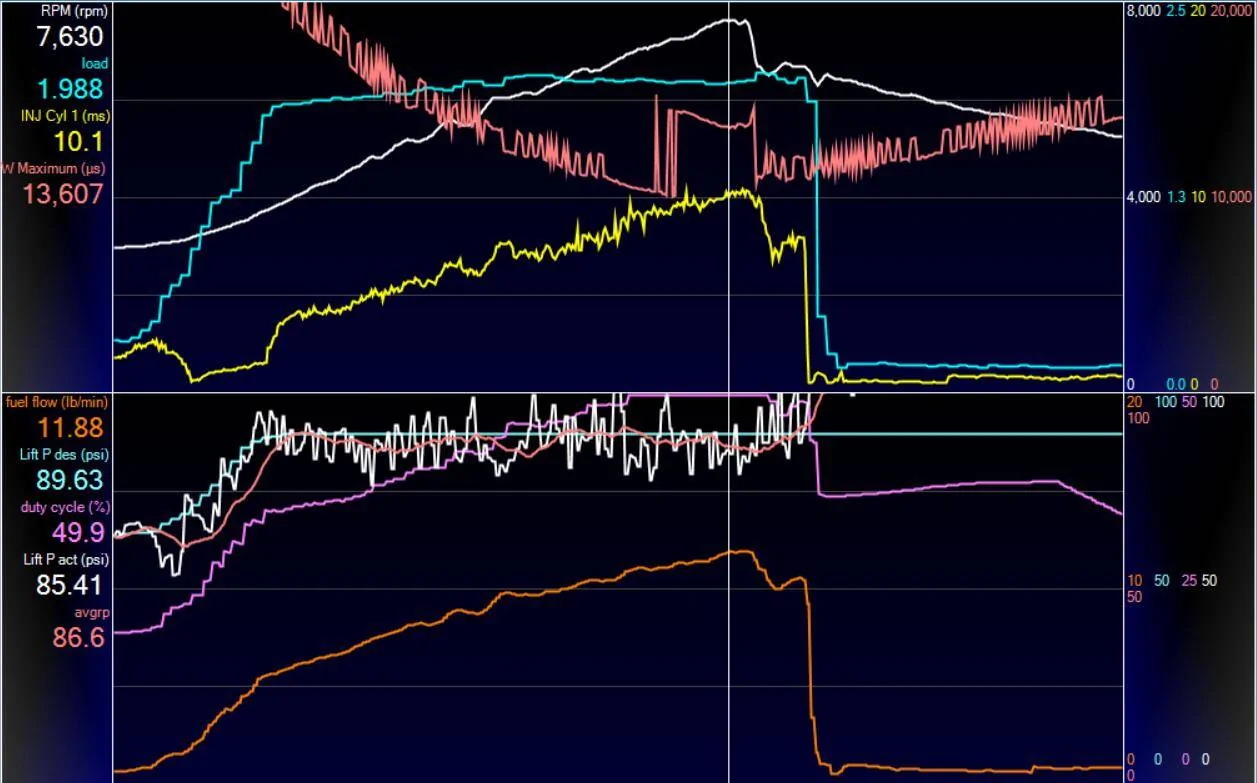
One shortcoming of this system is that using only one FPDM keeps it really simple, but you lose some of the OEM diagnostics. For instance, the FPDM will send an error code to the PCM if it detects an open circuit to the pump. With this setup, if one pump loses power, the FPDM will not know it because the other one is wired in parallel. The short circuit detection should still work, though. Also, the current draw of 30 amps causes a loss of about 2 volts through the FPDM, so as good as it performed it's still leaving something on the table. We are working on an adapter harness that not only incorporates a second OEM FPDM, but also combines the FPM (fuel pump monitor) signal from both FPDMs and sends it to the PCM. This will allow full factory diagnostics plus an increase in fuel flow if needed.
Hope you guys find this interesting and helpful.
Sponsored
Last edited: