
Sponsored

Warpath
Well-Known Member
- Joined
- Aug 24, 2020
- Threads
- 3
- Messages
- 578
- Reaction score
- 801
- Location
- Springfield, MO
- Vehicle(s)
- 2020 Ford GT500, 2021 Jeep Trackhawk
Yes sir, I just want to disable it.As in the battery monitor? I did a reset tonight when I installed my lithium battery.
OP
OP

Tomster
Beware of idiots
- Thread starter
- #18
Disable or reset?Yes sir, I just want to disable it.
The electrical system is kinda screwy..... the alternator is not always outputting. For the sake of fuel economy or performance, the alternator charges when the bms tells it to. Otherwise, you are running on battery. If you disable it, I think that will totally F your system and you may wind up on the side of the road.
Warpath
Well-Known Member
- Joined
- Aug 24, 2020
- Threads
- 3
- Messages
- 578
- Reaction score
- 801
- Location
- Springfield, MO
- Vehicle(s)
- 2020 Ford GT500, 2021 Jeep Trackhawk
Disable. I've unplugged the sensors for awhile now, and seems to charge the battery like normal without throttling charge to the battery. When I start the car I get a little message saying to have the charging system looked at but no fault code is generated. I wanted to turn the BMS off to get rid of the message.Disable or reset?
The electrical system is kinda screwy..... the alternator is not always outputting. For the sake of fuel economy or performance, the alternator charges when the bms tells it to. Otherwise, you are running on battery. If you disable it, I think that will totally F your system and you may wind up on the side of the road.
OP
OP
Tomster
Beware of idiots
- Thread starter
- #20
I didn't know it could be reverted to a standard alternating system.Disable. I've unplugged the sensors for awhile now, and seems to charge the battery like normal without throttling charge to the battery. When I start the car I get a little message saying to have the charging system looked at but no fault code is generated. I wanted to turn the BMS off to get rid of the message.
Sponsored
Warpath
Well-Known Member
- Joined
- Aug 24, 2020
- Threads
- 3
- Messages
- 578
- Reaction score
- 801
- Location
- Springfield, MO
- Vehicle(s)
- 2020 Ford GT500, 2021 Jeep Trackhawk
This was what I found on the super duty site.I didn't know it could be reverted to a standard alternating system.
Prior to BMS which came in around 2010, there was Smart Charging. Smart Charging came in around 1997. Before Smart Charging, there was alternator control voltage. Alternators have not controlled battery voltage for more than 20 years. It basically used an internal thermistor to estimate underhood temps and set battery voltage.
Smart Charging has the PCM control the battery voltage by commanding the alternator to operate at a certain voltage. The PCM uses an algorithm that better predicts battery temperature and therefore sets battery voltage. 13.3 - 14.7v was the operating range same as the Alternator control. This provided other benefits but did provide a healthier battery.
In comes BMS. The primary initial usage for BMS was for fuel economy. So instead of battery voltage set only based on battery temperature, it also now uses battery SOC, load conditions, engine efficiency and handful of other parameters. There is a range around based off battery temperature. When fuel economy is considered, it may drop it down to a lower value during high acceleration or idling and raise votlage during coasting. Voltage range can be between 12.3 to 15.2 volts.
BMS also controls load shed strategy which protects battery health. Load Shed can be turning off vehicle while in accessory mode or disabling features to protect system voltage. Load shedding is used to protect two conditions. One is to help maintain a healthy battery (primarily when engine is off) and secondly maintain battery voltage during high transient current load events or sometimes during idling. Battery voltage is more important with the EPAS to maintain 100% steering assist. It may temporarily lower heated/cooled functions or in more severe cases temporarily turn the feature off. So one operates with engine off the other engine on.
There is a difference between disconnecting the connector on the BMS sensor and disabling via Forescan. However BMS is disabled, system voltage defaults to Smart Charging range of 13.3 to 14.7v based on battery temperature. With the BMS sensor disconnected, the PCM uses a base algorithim for predicting battery temperature to set voltage. This isn't as accurate when algorithms were developed during Smart Charge only days years ago. With the BMS sensor plugged in, battery temperature is more accurate and the Smart Charge voltage setpoint based on battery temperature will provide a better charge voltage.
Powerpoints - this can get really confusing. Part of the confusion is the strategy changes constantly and is mainly driven by marketing, tgw's and battery warranty. Powerpoint operation also is different in accessory mode vs. simply turning the key off. And may operate differently when turning key off and opening door. So there are 3 operating strategies. I can provide generalities however. Powerpoint has had timers from 20 to 45 to now 75 minutes. They will run unless a load shed strategy is invoked to protect battery battery health.
However BMS is disabled, the system does not protect the battery if operating the power points to the end of timer. Nor does it protect the battery when running accessory mode. In both cases, lower SOC if powerpoints and accessory mode is often used.
Regarding long term battery health. Lot rot, production process, supplier quality, and how a vehicle is driven is has a higher effect on battery health vs. BMS. So this comes from the D&R who releases alternators, batteries and the h/w side of the BMS sensor for Ford. What do I do, leave it as is, embrace S/S technology (since it is my starter) but also to test the system. I don't do it for fuel economy, but mainly for emissions. When emission credits come to the US like Europe, it will be even more important and widespread compared to now.
BMS does effect battery health by cycling the battery more and therefore is more harmful to battery life. With AGM technology and added protections for aging batteries, battery cycling is less of an issue. Wait until you see what we are releasing for the new Explorer HEV's and the next gen F150.
OP
OP
Tomster
Beware of idiots
- Thread starter
- #22
Wow.This was what I found on the super duty site.
Prior to BMS which came in around 2010, there was Smart Charging. Smart Charging came in around 1997. Before Smart Charging, there was alternator control voltage. Alternators have not controlled battery voltage for more than 20 years. It basically used an internal thermistor to estimate underhood temps and set battery voltage.
Smart Charging has the PCM control the battery voltage by commanding the alternator to operate at a certain voltage. The PCM uses an algorithm that better predicts battery temperature and therefore sets battery voltage. 13.3 - 14.7v was the operating range same as the Alternator control. This provided other benefits but did provide a healthier battery.
In comes BMS. The primary initial usage for BMS was for fuel economy. So instead of battery voltage set only based on battery temperature, it also now uses battery SOC, load conditions, engine efficiency and handful of other parameters. There is a range around based off battery temperature. When fuel economy is considered, it may drop it down to a lower value during high acceleration or idling and raise votlage during coasting. Voltage range can be between 12.3 to 15.2 volts.
BMS also controls load shed strategy which protects battery health. Load Shed can be turning off vehicle while in accessory mode or disabling features to protect system voltage. Load shedding is used to protect two conditions. One is to help maintain a healthy battery (primarily when engine is off) and secondly maintain battery voltage during high transient current load events or sometimes during idling. Battery voltage is more important with the EPAS to maintain 100% steering assist. It may temporarily lower heated/cooled functions or in more severe cases temporarily turn the feature off. So one operates with engine off the other engine on.
There is a difference between disconnecting the connector on the BMS sensor and disabling via Forescan. However BMS is disabled, system voltage defaults to Smart Charging range of 13.3 to 14.7v based on battery temperature. With the BMS sensor disconnected, the PCM uses a base algorithim for predicting battery temperature to set voltage. This isn't as accurate when algorithms were developed during Smart Charge only days years ago. With the BMS sensor plugged in, battery temperature is more accurate and the Smart Charge voltage setpoint based on battery temperature will provide a better charge voltage.
Powerpoints - this can get really confusing. Part of the confusion is the strategy changes constantly and is mainly driven by marketing, tgw's and battery warranty. Powerpoint operation also is different in accessory mode vs. simply turning the key off. And may operate differently when turning key off and opening door. So there are 3 operating strategies. I can provide generalities however. Powerpoint has had timers from 20 to 45 to now 75 minutes. They will run unless a load shed strategy is invoked to protect battery battery health.
However BMS is disabled, the system does not protect the battery if operating the power points to the end of timer. Nor does it protect the battery when running accessory mode. In both cases, lower SOC if powerpoints and accessory mode is often used.
Regarding long term battery health. Lot rot, production process, supplier quality, and how a vehicle is driven is has a higher effect on battery health vs. BMS. So this comes from the D&R who releases alternators, batteries and the h/w side of the BMS sensor for Ford. What do I do, leave it as is, embrace S/S technology (since it is my starter) but also to test the system. I don't do it for fuel economy, but mainly for emissions. When emission credits come to the US like Europe, it will be even more important and widespread compared to now.
BMS does effect battery health by cycling the battery more and therefore is more harmful to battery life. With AGM technology and added protections for aging batteries, battery cycling is less of an issue. Wait until you see what we are releasing for the new Explorer HEV's and the next gen F150.
Did you stay at a holiday Inn express last night?
Impressive...
Warpath
Well-Known Member
- Joined
- Aug 24, 2020
- Threads
- 3
- Messages
- 578
- Reaction score
- 801
- Location
- Springfield, MO
- Vehicle(s)
- 2020 Ford GT500, 2021 Jeep Trackhawk
I copied that, I take no credit for the gentleman's hard work. I've never been accused of having brains.Wow.
Did you stay at a holiday Inn express last night?
Impressive...

gfcobra04
Well-Known Member
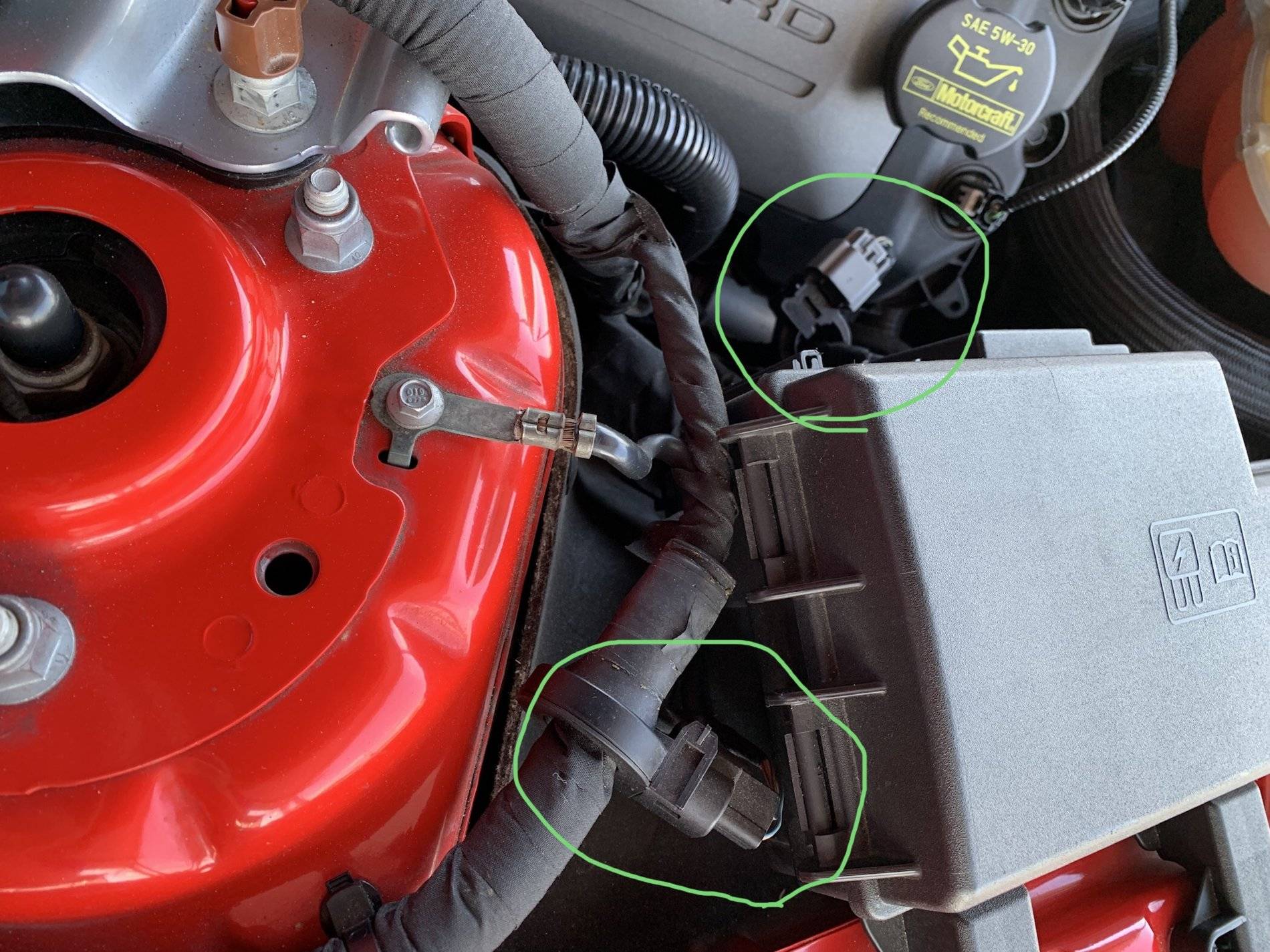
What sensors did you disconnect?Disable. I've unplugged the sensors for awhile now, and seems to charge the battery like normal without throttling charge to the battery. When I start the car I get a little message saying to have the charging system looked at but no fault code is generated. I wanted to turn the BMS off to get rid of the message.
And can you show us a picture?
Thanks been wanting to do something to the smart charging system.
Warpath
Well-Known Member
- Joined
- Aug 24, 2020
- Threads
- 3
- Messages
- 578
- Reaction score
- 801
- Location
- Springfield, MO
- Vehicle(s)
- 2020 Ford GT500, 2021 Jeep Trackhawk
Here's the pic i used as a reference.What sensors did you disconnect?
And can you show us a picture?
Thanks been wanting to do something to the smart charging system.
Sponsored


