Sponsored

F-150 Manifold Testing/Journey

BmacIL

Enginerd
Joined
Sep 21, 2014
Threads
69
Messages
14,989
Reaction score
8,910
Location
Naperville, IL
Vehicle(s)
2015 Guard GT Base, M/T
Vehicle Showcase
1
So does this still have the IMRC valves like the regular GT manifold? And do they work with the GT computer
Yes they both have CMCVs (but not IMRCs)
Sponsored


Rebellion

Well-Known Member
Joined
Aug 30, 2016
Threads
14
Messages
1,052
Reaction score
273
Location
Houston
Vehicle(s)
2016 Competition Orange GT
Yes they both have CMCVs (but not IMRCs)
I wonder if the design of the CMCV plates are different, to allow more turbulence at low flow.
 

BmacIL

Enginerd
Joined
Sep 21, 2014
Threads
69
Messages
14,989
Reaction score
8,910
Location
Naperville, IL
Vehicle(s)
2015 Guard GT Base, M/T
Vehicle Showcase
1
I wonder if the design of the CMCV plates are different, to allow more turbulence at low flow.
That's their function.

Engineering Explained explains well:
[ame]
 

armykyle1 [HACKED ACCOUNT

Banned
Banned
Banned
Joined
Mar 20, 2016
Threads
74
Messages
1,849
Reaction score
625
Location
Gulf Coast
Vehicle(s)
2018 GTPP premium
A good tune goes a long way for bottom end grunt. I prefer the power delivery our cars have, over The LS/LT platform. It's much more manageable and linear. If you're complaining about power below 3k, then you need to swap cams too or change platforms. Once I changed from a steeda tune to Lund, it was a huge difference down low. 3500 and up, it's a blast and the car keeps pulling to 7700-7800.
 

Rebellion

Well-Known Member
Joined
Aug 30, 2016
Threads
14
Messages
1,052
Reaction score
273
Location
Houston
Vehicle(s)
2016 Competition Orange GT
That's their function.

Engineering Explained explains well:
Yes, I know...but, is there any difference between the GT and F150 CMCV plates? Just thinking, could this be part of what's causing the low end gains.
 

Sponsored

BmacIL

Enginerd
Joined
Sep 21, 2014
Threads
69
Messages
14,989
Reaction score
8,910
Location
Naperville, IL
Vehicle(s)
2015 Guard GT Base, M/T
Vehicle Showcase
1
Yes, I know...but, is there any difference between the GT and F150 CMCV plates? Just thinking, could this be part of what's causing the low end gains.
No, that's all down to the length of the runners themselves. The CMCV hardware is common between the two.
 

gearhead2685

Well-Known Member
Joined
May 24, 2017
Threads
9
Messages
905
Reaction score
267
Location
Back in North Dakota
Vehicle(s)
2016 mustang
All the TQ

F150 intake
Cams
Long tubes
E85
3.73 gears with an auto.

Becuase the smell of burnt rubber is good for the soul!

LOL that combo might not win any dyno hp wars or be the fastest combo and certainly not good for MPGs with the 3.73 gears and e85 but it would be a damn riot for a daily driver!!

On E85 and living in North Dakota i could care less on MPGs anyways. :headbang:
 

WildHorse

N/A or GO HOME
Joined
Jun 28, 2017
Threads
270
Messages
10,297
Reaction score
8,350
Location
Home World: CLASSIFIED
First Name
Puddintane
Vehicle(s)
'17 S550
Vehicle Showcase
1
Yeah.. it's all about the tune (see sig). Pulls like a scalded dog to 7200 rpm with plenty of torque on tap down low with my stock GT intake with VCT tweeks.
 

347CobraII

Well-Known Member
Joined
Jul 16, 2015
Threads
5
Messages
806
Reaction score
106
Location
iowa
Vehicle(s)
2015 GT
The single plane vs dual plane debate doesn't really apply to late model EFI manifolds. Technically speaking all port EFI manifolds are single plane in design, even ones with long runners that make gobs of torque below 5k rpm.

Dual plane intake designs are really only beneficial for enhancing the vacuum signal to a carb, which typically gets weaker at lower rpm, hence the old school rule of dual plane for low rpm, single plane for high rpm. However even that rule failed to account for runner length and design, because there are dual planes that still perform very well above 6k as well as single planes that do well below 6k, but with injectors providing fuel instead of a carb, it's really an irrelevant subject.
All I was talking difference in runner length as in DIFFERANCE that's all and how it can effect RPM. NOT talking power, torq or how some do better than others. But since you want to go there are soo many other things that effect how manifold react too. Like cam, cam timing, even cam base circle size, heads, valve size, ignition, headers, carb size, compression ratio and bore and stroke. I've put together a lot of combinations that worked very well and helped my brother. Best one was my brothers Buick with 305 block, 350 small valve truck head, 66 327 vette cam, 600 cfm. Ran hard and every Camaro boy no way that's 305 LOL.

If runner length didn't matter then WHY Ford make a change for truck? Why not just use same manifold for both engines like 11-14
 

jcart953

Well-Known Member
Joined
Aug 26, 2016
Threads
6
Messages
312
Reaction score
55
Location
Cherry Hill, NJ
Vehicle(s)
2015 Ecoboost Mustang Premium
Is there a difference between a 2014 F150 manifold and a 2016 manifold?
I'm guessing so as the 2014 manifold costs $111, and the 2016 costs $321.

Any details on the differences?
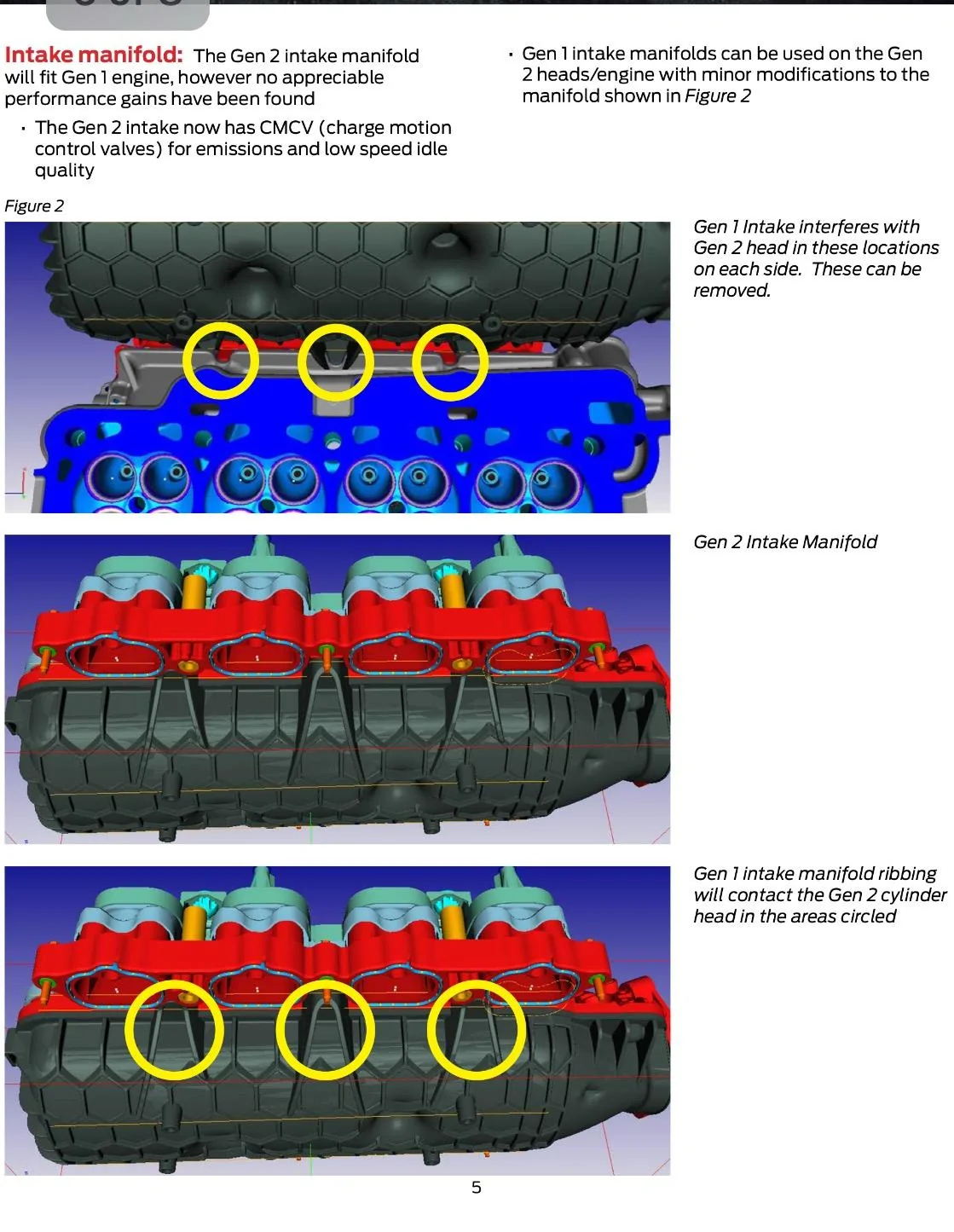
It might be possible since iit seems the generation 1 coyote (2011-14 mustang) intake manifold can fit the generation 2 mustang (2015+) with the below changes to the 2015 mustang. You might just have to find out if the manifold from the 2011-2014 mustang/F150 are interchangeable. If they are then I can't see why not. If there is no difference between the 2014 f150/mustang manifold might not be worth it.
image.webp
 

Sponsored

Kahboom

Kahboom
Joined
Nov 28, 2014
Threads
26
Messages
1,201
Reaction score
184
Location
Cathedral City, CA
Vehicle(s)
2015 Mustang GTPP, Recaros/2014 Explorer Sport 4X4
The 2014 through 2011 intake manifold on the GT and the F-150 do not have imrc also known as the charge motion valves for increasing torque at low RPMs. MMR sells imrc lockouts which people use for supercharged or boosted applications, some people have opted to purchase the older intake manifolds instead of buying the lockouts but you will have Two Notch the bottom of the intake manifold on the older one to make it fit the Gen 2 Motors.
 

[email protected]

Well-Known Member
Joined
Nov 20, 2015
Threads
21
Messages
515
Reaction score
65
Location
florida
First Name
Nick D
Vehicle(s)
red gt auto
A good tune goes a long way for bottom end grunt. I prefer the power delivery our cars have, over The LS/LT platform. It's much more manageable and linear. If you're complaining about power below 3k, then you need to swap cams too or change platforms. Once I changed from a steeda tune to Lund, it was a huge difference down low. 3500 and up, it's a blast and the car keeps pulling to 7700-7800.
What mods did you have when you switched? Did the shifting points improve much (if automatic)? I'm on a steeda tune with their intake and the combination of no low end power and shifting too soon makes driving in traffic awful.
 

Rick#7

Well-Known Member
Joined
Jun 28, 2017
Threads
27
Messages
383
Reaction score
192
Location
Hudson FL
Vehicle(s)
2015 GT 50 Years Appearance Package
If runner length didn't matter then WHY Ford make a change for truck? Why not just use same manifold for both engines like 11-14
Totally missed the point I was getting at. I never said runner length didn't matter, I merely referenced your statement about "single plane for high rpm" and pointed out that the single plane vs dual plane rule of thumb is only applicable to carburetor intake manifolds, not to the EFI manifolds in this thread since they (same as all EFI manifolds) have single plane plenums regardless of the RPM range they are designed for.

Single plane or dual plane, refers to plenum design only, and is only relevant to carb manifolds. It doesn't imply anything about runner length or anything else to do with EFI manifolds.
 

347CobraII

Well-Known Member
Joined
Jul 16, 2015
Threads
5
Messages
806
Reaction score
106
Location
iowa
Vehicle(s)
2015 GT
Totally missed the point I was getting at. I never said runner length didn't matter, I merely referenced your statement about "single plane for high rpm" and pointed out that the single plane vs dual plane rule of thumb is only applicable to carburetor intake manifolds, not to the EFI manifolds in this thread since they (same as all EFI manifolds) have single plane plenums regardless of the RPM range they are designed for.

Single plane or dual plane, refers to plenum design only, and is only relevant to carb manifolds. It doesn't imply anything about runner length or anything else to do with EFI manifolds.
Well you missed my point too....Like to see Dual plane work at 9000 rpm LOL. I know exactly what Dual and Single plane manifold are but wasn't talking plenums. I was talking about length of the RUNNERS that was it. Length of runner does matter on EFI too this has debated a lot. Only thing that runner length don't matter is boost. No pulse or pressure wave in manifold from opening and closing of intake valve as it does in NA.

If none of matter then why all design that goes into manifolds. It's not all about emissions as in current engines but it was important long before emissions. I like to see what all goes into manifold design first hand. I think more design goes into intake manifold than exhaust.
 

WildHorse

N/A or GO HOME
Joined
Jun 28, 2017
Threads
270
Messages
10,297
Reaction score
8,350
Location
Home World: CLASSIFIED
First Name
Puddintane
Vehicle(s)
'17 S550
Vehicle Showcase
1
Actually the biggest difference in runner length is where peak torque & horsepower are made. Both can make 500hp/500tq, but shorter runner at 7000 vs longer runner at 6400.
Sponsored


Top