Sponsored

Direct injection

Roostfactor

Active Member
Joined
Sep 27, 2021
Threads
1
Messages
38
Reaction score
26
Location
Texas
First Name
John
Vehicle(s)
2021 GT Premium auto
Thank you for this
I only look at what the cams actually do. Saying the extra range is for EGR or not IDK.

Ford has the exhaust cam:

at 0 (full advance) at idle
To maximize egr effect

at 40-50 in the low RPM low load areas, near full or full retard at cruising conditions
low load/low rpm mean less cylinder pressure and a longer time to need valves open due to slower airflow through the head

and at WOT, low RPMs 0-10, mid RPM 22 max, then advancing with high RPM back toward 15. well advanced considering its full range.
less overlap and time is needed at high rpm WOT because cylinder pressures are higher and gas velocity is high.

I think most people into tuning these would say the exhaust cam only moves because of emissions. Power Is mostly about intake cam VCT, and packages with intake cams only, etc. Some others will say you can "fix" turbo kit back pressure issues with the exhaust cam VCT.

I don't just look at the IVO and EVC events overlapping at top dead center, I also look at the IVC starting the compression stroke and the EVO ending the power stroke and their role in things.

Your MAF sensor doesnt care if both valves are open, it will tell you what amount of air is flowing in through the intake side, and you match that with fuel, and thats all that matters.
Sponsored

 

Rael

Grateful Member
Joined
Jan 12, 2017
Threads
11
Messages
567
Reaction score
880
Location
South California
Vehicle(s)
2022 Mach 1 HP Tremec
I've seen oil inside the intake, for sure. I just don't think it's hurting it as much as the catch can companies would have you believe. My car consumes less than a quart of oil in 10,000 miles, which means the gasoline/oil ratio is about 2000/1 or 0.04%. If I am somehow convinced that the anti-knock properties of a catch can will buy me something performance-wise, then I'll get one, but most of what I've seen so far is just qualitative "ugly pictures" and scare tactics.
I have fewer than 2,500 miles on my naturally aspirated GT. I haven't even tracked it yet, but today drained a couple of ounces of oil from a catch-can.
2,000 miles.webp
 

FruityJudy

Well-Known Member
Joined
Nov 13, 2018
Threads
15
Messages
877
Reaction score
766
Location
South Alabama
Vehicle(s)
2018 Mustang GT A10
I have fewer than 2,500 miles on my naturally aspirated GT. I haven't even tracked it yet, but today drained a couple of ounces of oil from a catch-can.
2,000 miles.jpg
Your amount seems exactly in line with his numbers
 

Rael

Grateful Member
Joined
Jan 12, 2017
Threads
11
Messages
567
Reaction score
880
Location
South California
Vehicle(s)
2022 Mach 1 HP Tremec
Well, I'm happy to keep that trapped oil from going back into the engine. It's not a "scare tactic," just information for anyone who wants it. I haven't even given the car a decent workout yet.

I had catch cans on my supercharged 2011 and my 2017 GT350. I expect to trap greater volumes in this car when I get back on track next year.
 

WD Pro

Well-Known Member
Joined
Jan 18, 2018
Threads
132
Messages
6,762
Reaction score
13,548
Location
United Kingdom
Vehicle(s)
Lime GT
Vehicle Showcase
1
I've seen oil inside the intake, for sure. I just don't think it's hurting it as much as the catch can companies would have you believe. My car consumes less than a quart of oil in 10,000 miles, which means the gasoline/oil ratio is about 2000/1 or 0.04%. If I am somehow convinced that the anti-knock properties of a catch can will buy me something performance-wise, then I'll get one, but most of what I've seen so far is just qualitative "ugly pictures" and scare tactics.
I'm not arguing that the ratio percentage of fuel / oil is low, but I'm not sure taking an across the board average is fair ?

Wouldn't the amount of oil vapour scavenged from the system be highest also when the reliance on octane is also highest ?

Also with regards to the comment higher up this thread about oil dripping from a removed manifold. I'm guessing any oil that's sat in there will stay put during easy driving / low RPM / low intake air speed, but will that oil get sucked into the engine at higher RPM / high intake air speed i.e. exactly when we wouldn't want it to with regards to octane dilution ?

Anyhow, I fell for the marketing and aesthetics ... lol :like:

WD :like:
 

Sponsored

engineermike

Well-Known Member
Joined
Jul 15, 2018
Threads
31
Messages
6,185
Reaction score
6,444
Location
La
Vehicle(s)
2018 GTPP A10
@WD Pro you make valid points but I still haven’t seen any compelling quantitative assessment on catch cans vs knock margin. The closest credible data I can find indicates small amounts of oil mist affects octane less than tenths of a number, but even that was only marginally applicable data.
 

Hack

Well-Known Member
Joined
Nov 26, 2014
Threads
86
Messages
12,801
Reaction score
8,209
Location
Minneapolis
Vehicle(s)
Mustang, Challenger
It's a really interesting discussion, and I think it's valuable when people actually run the numbers such as engineermike has done.

I dislike DI for a few reasons but high on my list is to me DI is extra complexity and cost for small benefits. I'm a fan of efficiency, but I think the car manufacturers are maximizing/minimizing the wrong things. I would much prefer that they maximize value to their customers rather than maximizing fuel efficiency.

I don't think catch cans are that important on a street driven, naturally aspirated engine with PI/DI combination or the PI by itself. If the car is tracked, I think catch cans are good insurance. And for those that have turbo DI only engines like the 2.3 in Mustangs or the 1.6 in my Fiesta - then I think the catch can is a good idea even if the car is only street driven.

A lot of what has been talked about in this thread is theory. For example, there has been a theory postulated that if an engine has PI + DI there's no concern about carbon build up on the valves. Really the only way to determine the answer is to test and find out. It's possible if the PI doesn't run enough that you will get carbon buildup anyway. You have to trust that Ford did their homework. I can tell you that ECOboost Ford engines get carbon buildup and it affects driveability over the long term. My wife's Escape pings all the time just driving around with ~100,000 miles on it.
 

EFI

Well-Known Member
Joined
May 19, 2015
Threads
65
Messages
5,287
Reaction score
4,732
Location
Masshole central
Vehicle(s)
5.Br0
but I think the car manufacturers are maximizing/minimizing the wrong things. I would much prefer that they maximize value to their customers rather than maximizing fuel efficiency.
Maximizing fuel economy IS how manufacturers maximize value for their customers, not only at purchase time but over the life of the car. If manufactures have to pay a fee for not meeting EPA standards for fuel economy, that will increase the price of the car.

A lot of what has been talked about in this thread is theory. For example, there has been a theory postulated that if an engine has PI + DI there's no concern about carbon build up on the valves.
It's not a theory, it's proven. It's proven that PI cleans the intake valves and prevents carbon deposits. Since the Coyote has PI that is in use most of the time (you can easily see in the calibration when PI is used or not and how much) then there's nothing to theorize about its benefit.
 

Vlad Soare

Well-Known Member
Joined
Jan 21, 2020
Threads
67
Messages
3,643
Reaction score
4,464
Location
Bucharest, Romania
First Name
Vlad
Vehicle(s)
2020 Mustang GT 6MT
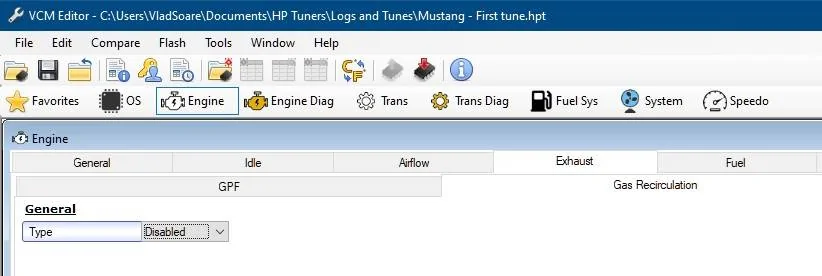
Speaking of the EGR and the way it's implemented in the Coyote, here's what I see in my car:

EGR_1.jpg


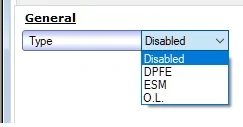
The options you can choose from are these:

EGR_2.jpg


Does this mean that it doesn't actually do any kind of exhaust gas recirculation? Or maybe this option is just for external EGR types, and it's disabled because the Coyote does it internally?
 

engineermike

Well-Known Member
Joined
Jul 15, 2018
Threads
31
Messages
6,185
Reaction score
6,444
Location
La
Vehicle(s)
2018 GTPP A10
Those acronyms all refer to an external egr system. I haven’t seen anything in the program that seems to control cam timing for egr, except maybe emissions reductions vct but that appears to just work during cold start. That said, at cruise the cam LSA in old-school terms is about 115 deg which is pretty tight for oem so maybe that’s how it gets it.
Sponsored


Top