frequency already takes into account corner weights. so even if the car were extremely unbalanced, say 70/30 the absolute value of the springs fore/aft doesn't matter as long as the relationship is maintained.
PS. I doubt a 70/30 car would handle good no matter what you did to it.
It's really about all the spices in the soup. With the correct tires, you could make it work, but would be unusual. The Delta Wing had something like a 30/70 weight distribution.
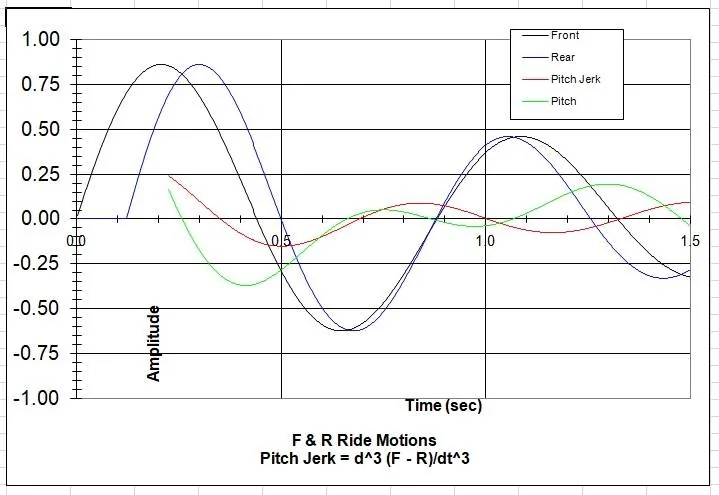
On edit, there was an ad and a page break right above Brian's post, so I didn't see it before putting this together. But maybe the picture will still help.
Flat ride is basically the relationship among front and rear ride frequencies and car speed. The idea is for the rear suspension to complete exactly one full static-to-bump-to-rebound-and-back-to-static at exactly the same time that the front suspension does the same thing.
Since the front suspension gets a head start, the rear suspension needs to be of a higher frequency in order to "catch up". The amount of catching up needed is defined by the car's wheelbase and how fast the car is traveling. Look at the front (black) and rear (blue) displacement traces in the picture below where they both cross the horizontal axis at the same time (around 0.88 seconds). This is just for purposes of illustration and probably isn't exactly what would happen in an S550, but it is representative of having a theoretical flat ride occur at about 50 mph in a 107" wheelbase car.
Side note to Brian . . . 10% damping was assumed but does not materially affect the calculated flat ride speed. The actual flat ride speed numbers are 49.2 mph (undamped) vs 48.9 mph @ 10%. Not enough difference to matter here.
What is a flatride speed number? The 10% rf split was for anti porposing while in motion in old texts. "Flat ride" isn't in any vehicle dynamics texts I have read but what read is old. Flat ride seems to be a newer name for an old concept?
I have always seen the rf split in hertz or cycles per min but never attached to a velocity unless the velocity is a default 50mph and I missed that. I only know how to plug numbers in the formula.
I guess in essence at high speed say 100mph thats 0.06sec the rear hits after the front so basically zero. It that why racers violate the typical rf split or flatride?
Yeah and I wonder how much ‘flat ride’ matters when the spring rates / ride freq is above a certain value.
For slower ride frequencies it may matter more since everything is moving for so much longer, and for OEM cars that will get reviewed on how they feel in a straight line over highway expansion joints and bumps, not how they carve at 10/10ths. Even the sports cars.
Yeah and I wonder how much ‘flat ride’ matters when the spring rates / ride freq is above a certain value.
For slower ride frequencies it may matter more since everything is moving for so much longer, and for OEM cars that will get reviewed on how they feel in a straight line over highway expansion joints and bumps, not how they carve at 10/10ths. Even the sports cars.
I always thought flatride or the anti porposing rf to be a good place to start selecting a highet rf for racing. Stanforths text iirc said somewhere around 2.5 hz for non-aero racer but street car around 1.5...I cannot remember the numbers
GREAT thread! Love seeing this stuff being discussed in the open.
This type of stuff is what we use early on with developing parts so its typically "kept within" - very cool to see the end user consumers dabbling in this stuff. Love it.
Yeah and I wonder how much ‘flat ride’ matters when the spring rates / ride freq is above a certain value.
For slower ride frequencies it may matter more since everything is moving for so much longer, and for OEM cars that will get reviewed on how they feel in a straight line over highway expansion joints and bumps, not how they carve at 10/10ths. Even the sports cars.
It's definitely something that loses priority as overall stiffness goes up to account for large aero loads or R compound tires. Ultimately the percentage of total roll stiffness for the front becomes the target you're trying to hit within a nominal range of ride frequencies. Too stiff and you can overload the tire in turn-in/exit and cannot maximize it except if driven perfectly or on really good surfaces. Too soft and the tire will force bigger than necessary roll/pitch, compromising geometry and transient response.
If you're running 200tw tires, even the best ones, over 2.5 Hz on either end is not something I'd recommend.
What is a flatride speed number? The 10% rf split was for anti porposing while in motion in old texts. "Flat ride" isn't in any vehicle dynamics texts I have read but what read is old. Flat ride seems to be a newer name for an old concept?
It's in Milliken, but not indexed so you have to know exactly where to find flat ride mentioned with respect to pitch (probably aka "porpoising"). Fred Puhn actually provided the formulas in his 1976 book, strictly in terms of 'pitch'. I don't remember where I first heard of "flat ride" specifically.
I have always seen the rf split in hertz or cycles per min but never attached to a velocity unless the velocity is a default 50mph and I missed that. I only know how to plug numbers in the formula.
What can I say about general guidelines except that in order to be easy enough for the average non-engineer to get any feel for, they have to be simplified. And in a manner that generally works for most normally encountered situations. I only chose 50 mph for my plot because it's representative of street driving and I didn't have to play around with spring rates in the spreadsheet that created that plot too much.
I guess in essence at high speed say 100mph thats 0.06sec the rear hits after the front so basically zero. It that why racers violate the typical rf split or flatride?
Racers have different needs that are apt to be more important than ride comfort for the driver (and passenger ride comfort isn't a consideration at all). Think RWD traction, for one. But mainly they're running with somewhat more damping than is present in the average street driven production car, and more damping quiets both pitch and bounce responses down much more rapidly.