Sponsored

Calculating ride frequency for the Mustang

Brian@BMVK

Well-Known Member
Joined
Apr 27, 2020
Threads
7
Messages
951
Reaction score
973
Location
Illinois
Vehicle(s)
2015 GT - Sold
What's this "Flat Ride Concept"? Is it about the ratio of the ride frequencies front to rear or something else?
Yes. Setting up the car with a rear RF somewhat higher than the front (typically 10-15%) allows the sprung mass to settle much quicker in response to bumps at typical road or even track speeds. This is because when you hit a bump, the sprung mass is still moving from the front bump before it hits the rear. The rear needs to be stiffer ride frequency to "catch up". It's done by most OEMs as it allows for better overall ride quality with less damping. In fact, it's possible to get it just right so that the car will actually settle with zero damping.

How does it apply to a handling focused car? Well, it's a hot topic of debate. In my experience both with open wheel formula car and something like the S550, setting up with some flat ride makes for a car that is much more of a willing dance partner for transitional handling. It is "eager". The tricky part is doing that while also getting the front roll stiffness percentage in the right range that provides a car that is balanced and easy and confidence inspiring to drive on the throttle. This is where bar tuning comes in.

This works for low/no aero autocross and HPDE cars as well as significant aero track cars like @Flyhalf 's. Some of them end up with rear RF lower than the front due to prioritization of roll stiffness with respect to the changing aero balance.
Sponsored

 

Norm Peterson

corner barstool sitter
Joined
Jul 22, 2013
Threads
11
Messages
8,852
Reaction score
4,652
Location
On a corner barstool not too far from I-95
First Name
Norm
Vehicle(s)
'08 GT #85, '19 WRX
What's this "Flat Ride Concept"? Is it about the ratio of the ride frequencies front to rear or something else?
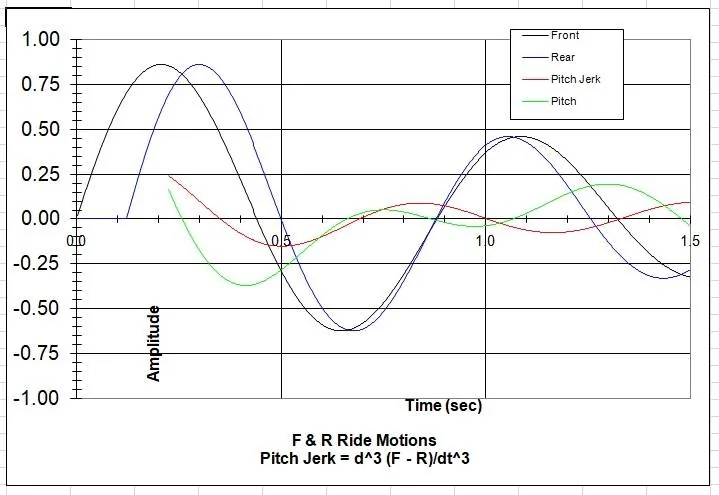
On edit, there was an ad and a page break right above Brian's post, so I didn't see it before putting this together. But maybe the picture will still help.


Flat ride is basically the relationship among front and rear ride frequencies and car speed. The idea is for the rear suspension to complete exactly one full static-to-bump-to-rebound-and-back-to-static at exactly the same time that the front suspension does the same thing.

Since the front suspension gets a head start, the rear suspension needs to be of a higher frequency in order to "catch up". The amount of catching up needed is defined by the car's wheelbase and how fast the car is traveling. Look at the front (black) and rear (blue) displacement traces in the picture below where they both cross the horizontal axis at the same time (around 0.88 seconds). This is just for purposes of illustration and probably isn't exactly what would happen in an S550, but it is representative of having a theoretical flat ride occur at about 50 mph in a 107" wheelbase car.

At Theoretical Flat Ride Speed.webp


Side note to Brian . . . 10% damping was assumed but does not materially affect the calculated flat ride speed. The actual flat ride speed numbers are 49.2 mph (undamped) vs 48.9 mph @ 10%. Not enough difference to matter here.


Norm
 

Brian@BMVK

Well-Known Member
Joined
Apr 27, 2020
Threads
7
Messages
951
Reaction score
973
Location
Illinois
Vehicle(s)
2015 GT - Sold
Flat ride is basically the relationship among front and rear ride frequencies and car speed. The idea is for the rear suspension to complete exactly one full static-to-bump-to-rebound-and-back-to-static at exactly the same time that the front suspension does the same thing.

Since the front suspension gets a head start, the rear suspension needs to be of a higher frequency in order to "catch up". The amount of catching up needed is defined by the car's wheelbase and how fast it is traveling. Look at the front (black) and rear (blue) displacement traces in the picture below where they both cross the horizontal axis at the same time (around 0.88 seconds). This is just for purposes of illustration and probably isn't exactly what would happen in an S550, but it is representative of having a theoretical flat ride occur at about 50 mph in a 107" wheelbase car.

At Theoretical Flat Ride Speed.webp


Side note to Brian . . . 10% damping was assumed but does not materially affect the calculated flat ride speed. The actual flat ride speed numbers are 49.2 mph (undamped) vs 48.9 mph @ 10%. Not enough difference to matter here.


Norm
Yes I've seen that when doing calculations as well. The damping in a typical road range doesn't have a significant effect if your in the right window for frequencies. If you're off some way it definitely has a more significant effect
 

Brian@BMVK

Well-Known Member
Joined
Apr 27, 2020
Threads
7
Messages
951
Reaction score
973
Location
Illinois
Vehicle(s)
2015 GT - Sold
No, it doesn't. If your front roll stiffness percentage is below a certain amount, any Mustang, no matter what the ride frequency ratio, will be tail happy.

It can be tail happy with a higher rear RF if you run a stiff rear bar setting (which isn't conducive to putting power down anyway).
 

NightmareMoon

Well-Known Member
Joined
Nov 22, 2015
Threads
62
Messages
7,111
Reaction score
6,390
Location
Austin
Vehicle(s)
2016 Mustang GT PP w/ Voodoo
Vehicle Showcase
1
Thanks guys, thats kind of what I thought it was. Clearly seems important for a street car and it jives with what I’ve experienced bombing bumpy corners on track with PP1 springs. The car would take large mid corner joinces with composure, (assuming the driver could do the same)
 

Sponsored

Bluemustang

Well-Known Member
Joined
Nov 6, 2015
Threads
151
Messages
3,969
Reaction score
2,348
Location
Maryland
First Name
Ryan
Vehicle(s)
2015 Mustang Base GT
No, it doesn't. If your front roll stiffness percentage is below a certain amount, any Mustang, no matter what the ride frequency ratio, will be tail happy.

It can be tail happy with a higher rear RF if you run a stiff rear bar setting (which isn't conducive to putting power down anyway).
Also, you could probably use a bigger front bar with flat ride to help get the extra front stiffness you need.
 

Norm Peterson

corner barstool sitter
Joined
Jul 22, 2013
Threads
11
Messages
8,852
Reaction score
4,652
Location
On a corner barstool not too far from I-95
First Name
Norm
Vehicle(s)
'08 GT #85, '19 WRX
Also, you could probably use a bigger front bar with flat ride to help get the extra front stiffness you need.
That's why, for a street-only car, you'd be well off to set your flat ride tuning first and fix the understeer-oversteer handling balance with bars afterward.


Norm
 

shogun32

Well-Known Member
Joined
Feb 8, 2019
Threads
92
Messages
16,223
Reaction score
14,019
Location
Northern VA
First Name
Matt
Vehicle(s)
'19 GT/PP, '23 GB Mach1, '12 Audi S5 (v8+6mt)
Vehicle Showcase
2
frequency already takes into account corner weights. so even if the car were extremely unbalanced, say 70/30 the absolute value of the springs fore/aft doesn't matter as long as the relationship is maintained.

PS. I doubt a 70/30 car would handle good no matter what you did to it.
Sponsored


Top