Sponsored

BBQ Tick After Oil Change...

Kong76

Well-Known Member
Joined
Apr 23, 2016
Threads
47
Messages
1,925
Reaction score
440
Location
Turlock, Ca
Vehicle(s)
2016 Ingot Silver GT
Lion you mentioned ceratec looses its effectivness after an oil change. I was understanding it was good for 30,000 miles. Second how do all three of these additives do under winter conditions with cold starts? Especially the Tribo tex. Oil pressure is my concern.

Im ready to try something but now I have no clue which one. I'm no Christopher Columbus but Tribo tex sounds tempting.
Sponsored

 

TheLion

Well-Known Member
Joined
Jul 1, 2016
Threads
68
Messages
1,621
Reaction score
601
Location
US
Vehicle(s)
Ruby Red 2016 Mustang GT PP 6-MT
Lion you mentioned ceratec looses its effectivness after an oil change. I was understanding it was good for 30,000 miles. Second how do all three of these additives do under winter conditions with cold starts? Especially the Tribo tex. Oil pressure is my concern.

Im ready to try something but now I have no clue which one. I'm no Christopher Columbus but Tribo tex sounds tempting.
It looses PART of it's effectiveness. There are two things working in Cera Tech, a Chemical Friction modifier and a Solid Lubricant friction modifier. Once you change your oil, you loose the chemical friction modifier as it goes out with the oil. It may create a film, but I have my doubts the chemical film will stay on for very long after the oil it's dispersed in is changed. Liqui Moly specifically says for their chemical friction modifiers you need to use them with every oil change. Motor Protect is a solid lubricant friction modifier based on Molybdenum Silicon Dioxide while Oil Saver is chemical friction modifier based on Molybdenum. Not sure what chemical friction modifier is in Cera Tec, but it will need to be replenished with every oil change.

However, the nBN additive (aka Hexagonal Boron Nitride) will be worked into the load bearing surfaces of the engine and that's what lasts for UP TO 30k. It's a solid lubricant. Cera Tec is their 2 in 1 formula containing both. So there are some down sides to Cera Tec and Archoil as both use base oil carriers and chemical friction modifiers that are lost when the oil is changed, but also contain solid lubricant friction modifiers that remain for extended periods and multiple oil changes. So there's still a benefit after the oil is changed out, but it's less.

It MIGHT make more sense to spread out the Cera Tech in smaller increments over each oil change. Instead of using 600 mL in one oil change, use 150 mL each oil change at 5k intervals. The buildup of hBN will be slower as your concentration is much smaller per oil change, but you get and equal benefit with each oil change making it more consistent.

TriboTEX is entirely a solid lubricant friction modifier and is based on MSH instead of hBN and is supposed to last for 40k miles, so it seems a bit more durable than hBN and it's effects also remain entirely after each oil change until it's consumed entirely. However I believe the concentration of TriboTEX is probably much higher than Cera Tec or Archoil given it's price point and volume of material and that it's the primary friction modifier as opposed to being used with other chemical friction modifiers. 99% of Cera Tech and Archoil is NOT solid lubricants, its base oil and chemical fiction modifiers and I think that's where some of the noise dampening is actually coming from. The "ceramic" solid lubricants are only a very small percentage of the concentration of those two. The more concentration, the higher the price point as it's still fairly pricey to produce hBN and MSH solid lubricants, but they have excellent boundary layer lubrication which results in substantial decreases in wear and energy loss from friction which results in heat as waste product. So more of your gasoline's energy is converted into motion energy instead of thermal.

I'm looking into use TriboTEX's "Diesel" concentration in my GT as it's geared towards higher compression and higher oil capacity applications and their literature on Amazon indicates that it's also their recommendation for high performance sports cars. I think it would be especially beneficial in a coyote 5.0L due to it's very high friction losses in the valve train and higher RPM operation compared to say the lower RPM cam in block LT1 6.2L in the SS or the 6.4L in the Charger / Challengers.

I've seen reviews where one guy with a Charger RT Scat used it and said it made the car a little quieter but he couldn't tell a difference otherwise. Yet I've seen 3 reviews of the mustang (two 5.0's and one twin turboed V6) all say the engine revved more freely, slight improvement in gas mileage, two of which had 3%+ increases on a dyno after 500 miles of use (before and after results). Makes sense, Ford uses DOHC designs and friction losses in the valve train are higher with DOHC designs compared to cam in block or SOHC.

At the same RPM, the 5.0L has 2x the valve train loses total because it has...double the valve train. Combine that with higher average revs as it's rev range is higher, especially the 3rd gen out to 7,500 RPM or a Power Pack 3 2nd Gen out to 7450 rpm...the benefits grow and grow for wear, heat and power. Fuel efficiency gains are likely similar, as your rev range isn't dramatically higher while cruising and there's fairly low friction at light loads and low rpm even with DOHC designs. It's high RPM / high load operation, exactly where the 5.0 makes its power, that there's the greatest benefits to reducing friction.
 

GT Pony

Well-Known Member
Joined
Mar 13, 2015
Threads
77
Messages
9,402
Reaction score
4,839
Location
Pacific NW
Vehicle(s)
2015 GT Premium, Black w/Saddle, 19s, NAV
... how do all three of these additives do under winter conditions with cold starts? Especially the Tribo tex. Oil pressure is my concern.
Adding 300 ml (less than 1/3 quart) of any of these additives to 8 or 10 quarts of oil isn't going to change the viscosity enough to see any noticeable difference in oil pressure.
 
Last edited:

TheLion

Well-Known Member
Joined
Jul 1, 2016
Threads
68
Messages
1,621
Reaction score
601
Location
US
Vehicle(s)
Ruby Red 2016 Mustang GT PP 6-MT
I would think TrobTEX would provide the best cold weather protection long term. I have 0 proof, but based on the fact that it's a solid lubricant and is always present on the part surfaces after it's worn into the surface aberrations, then it will remain weather an oil film is present or not.

Here's some more testing for Cera Tec: https://www.rspmotorsports.com/rsp-dynotest-results.html

Here's another research paper on hBN: https://www.researchgate.net/profil...l-Diesel-Engine.pdf?origin=publication_detail

Here's a great one on MSH for Water Turbine Applications, I also found some for applications in gas engines an diesel engines etc.: https://www.hydrofoundation.org/uploads/3/7/6/1/37618667/rudenko_final_findings.pdf

More or less hBN or MSH (or a variation MMSH) nano ceramic solid lubricants provide excellent boundary layer lubrication. There's pros and cons to each in terms of their available forms, how effective they are long term, cost etc. I'm not sure if one is better than the other in all situations. They seem to have similar coefficients of friction and work by a similar methodology. Both provide surface "self healing" of bearing surfaces by filling in the voids with nano sized particles. Both shear easily making them excellent boundary layer lubricants. I think you just need to decide which product suits your price and goals and you can always switch to a different one later on down the road.

And I confirmed with TriboTEX that either 2 standard syringes would be needed for the 5.0L or one Diesel (it's the same material, just higher concentration). So it's going to cost you nearly $200.

If noise is your only concern, I'd suggest CeraTec or Archoil. But based on what I've seen, TriboTEX would provide more consistent performance over it's interval due to it's concentration and focus on boundary layer lubrication and I believe at this point it has great potential for the 5.0 in reducing valve train friction losses.

I wouldn't be surprised to see peak power gains in the 10 to 20 hp range. It may sound like hype, but not based on the testing I've seen with both Cera Tec and TriboTEX in high powered sports car or suv dynos. Both provide "self healing" of metal surfaces.

There's one thing in common, ALL of the research I've seen for hBN and MSH/MMSH indicates substantial reduction of friction in boundary layer lubrication of lubricating oils in engines, turbines, bearings etc. They are legit. The gains of course are going to vary and not be constant. Results are also going to vary depend on how good your oil additive package already is, engine condition, usage etc. Some may not notice any changes, only long term wear testing would reveal its working. Others may see benefit. But I have a feeling the 5.0 will see some very measurable benefits due to it being a high compression, high revving engine with a lot of valve train losses. As the sacrificial layer wears, friction will increase, just as it does with the motor oils as their additive packages get used up. So they do need to be replenished at regular intervals.
 
Last edited:

TheLion

Well-Known Member
Joined
Jul 1, 2016
Threads
68
Messages
1,621
Reaction score
601
Location
US
Vehicle(s)
Ruby Red 2016 Mustang GT PP 6-MT
Adding 300 ml (less than 1/3 quart) to 8 or 10 quarts of oil isn't going to change the viscosity enough to see any noticeable difference in oil pressure.
Nope, I think it's primarily due to the surface "polishing" effects which increase the sealing of tight clearance parts. But as for the noise dampening, the jurey's still out. I may be a result of higher oil pressure or it may be due to the film created by the hBN or MSH or a combination of both, but that does seem to be a generally unanimous result which is most relevant to this thread. That might be why the Ford Field engineer suggest carbon powders for an OP with the BBQ tick on his second new engine (the Boss 302 example).
 

Sponsored

GT Pony

Well-Known Member
Joined
Mar 13, 2015
Threads
77
Messages
9,402
Reaction score
4,839
Location
Pacific NW
Vehicle(s)
2015 GT Premium, Black w/Saddle, 19s, NAV
Adding 300 ml (less than 1/3 quart) of any of these additives to 8 or 10 quarts of oil isn't going to change the viscosity enough to see any noticeable difference in oil pressure.
Nope, I think it's primarily due to the surface "polishing" effects which increase the sealing of tight clearance parts. But as for the noise dampening, the jurey's still out. I may be a result of higher oil pressure or it may be due to the film created by the hBN or MSH or a combination of both, but that does seem to be a generally unanimous result which is most relevant to this thread. That might be why the Ford Field engineer suggest carbon powders for an OP with the BBQ tick on his second new engine (the Boss 302 example).
The only mechanical component that might "seal better" to cause increased oil pressure is the oil pump rotors-to-housing inside the pump. The journal bearings aren't going to "seal" better and cause any pressure increase.

Who has reported increased oil pressure due to using Cera Tec or a similar additive? Keep in mind that in order to have a good oil pressure change comparison the oil temperature and engine RPM has to be exactly at the same point to compare accurately.
 

Kong76

Well-Known Member
Joined
Apr 23, 2016
Threads
47
Messages
1,925
Reaction score
440
Location
Turlock, Ca
Vehicle(s)
2016 Ingot Silver GT
Right on fellas, thank you very much for the detailed information. Price is not really a concern as much as safety in use. That little syring must be potent though for $100+ . I don't have the guts to try the Tribtex so I will leave that up to Lion. Ill go with the pack and use Ceratec.
 

GT Pony

Well-Known Member
Joined
Mar 13, 2015
Threads
77
Messages
9,402
Reaction score
4,839
Location
Pacific NW
Vehicle(s)
2015 GT Premium, Black w/Saddle, 19s, NAV
Edit to my Post above: Even if the oil pressure went up 5 PSI (which I doubt it would), it's not going to hurt anything. The oil pump has a pressure relief valve on it, so nothing is going to get hurt if you happened to redline the engine with cold oil ... but everyone should know not to hammer the throttle until the oil is warmed up in any case.
 

GT Pony

Well-Known Member
Joined
Mar 13, 2015
Threads
77
Messages
9,402
Reaction score
4,839
Location
Pacific NW
Vehicle(s)
2015 GT Premium, Black w/Saddle, 19s, NAV
Right on fellas, thank you very much for the detailed information. Price is not really a concern as much as safety in use. That little syring must be potent though for $100+ . I don't have the guts to try the Tribtex so I will leave that up to Lion. Ill go with the pack and use Ceratec.
Let us know how it works out. Others seem to have good results with the Cera Tec.
 

TheLion

Well-Known Member
Joined
Jul 1, 2016
Threads
68
Messages
1,621
Reaction score
601
Location
US
Vehicle(s)
Ruby Red 2016 Mustang GT PP 6-MT
The only mechanical component that might "seal better" to cause increased oil pressure is the oil pump rotors-to-housing inside the pump. The journal bearings aren't going to "seal" better and cause any pressure increase.

Who has reported increased oil pressure due to using Cera Tec or a similar additive? Keep in mind that in order to have a good oil pressure change comparison the oil temperature and engine RPM has to be exactly at the same point to compare accurately.
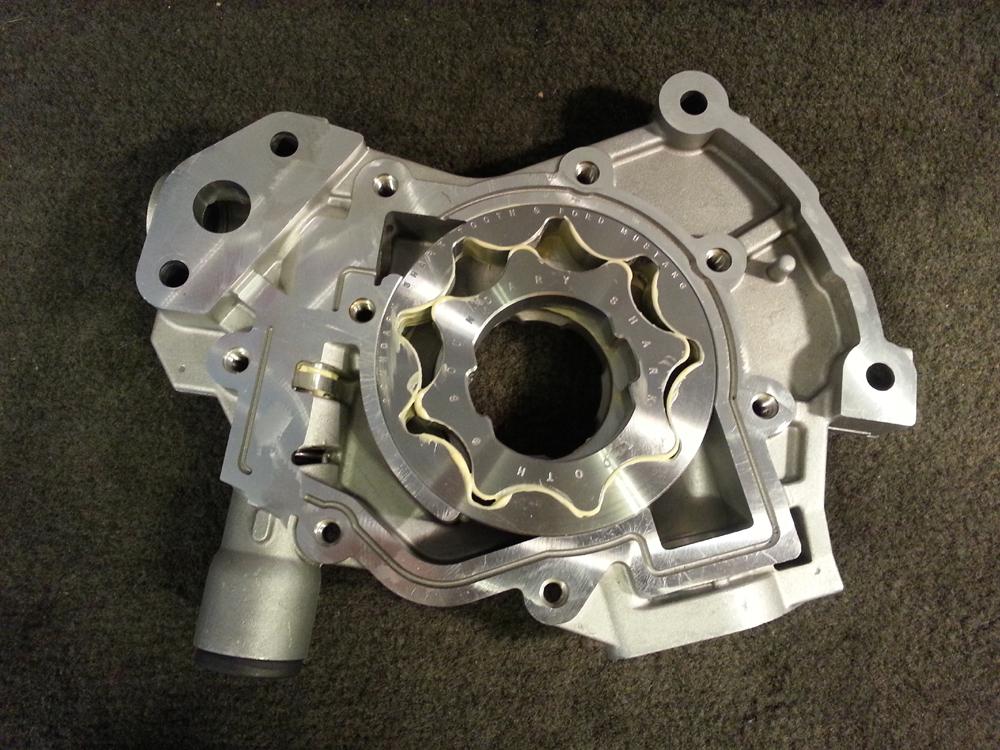
No of course not. Any hydrodynamic bearings won't see a benefit unless they collapse in a failure mode due to loss of oil pressure or loss of oil (pan goes out). But any boundary layer lubrication applications will. The gerotor oil pump is a contact pump, not a turbine pump like a water pump, so it's surface uniformity and the friction of the lubricants affect it's ability to generate pressure at a given rpm (here's one from a Terminator Cobra):

Oil%20pump%20new%20gears.jpg


As far as I know this is a common oil pump design and that's likely why many report a slight increase in oil pressure. hBN and MSH / MMSH have 0 impact on oil viscosity. They don't thicken oils at all. Their concentration's are extremely small as well. 0.1% wt for hBN and 0.15% wt for MSH / MMSH for optimal lubrication. So I believe that is why many report (user views, quite a few of them report that) slight increase in oil pressure.
 

Sponsored

GT Pony

Well-Known Member
Joined
Mar 13, 2015
Threads
77
Messages
9,402
Reaction score
4,839
Location
Pacific NW
Vehicle(s)
2015 GT Premium, Black w/Saddle, 19s, NAV
No of course not. Any hydrodynamic bearings won't see a benefit unless they collapse in a failure mode due to loss of oil pressure or loss of oil (pan goes out). But any boundary layer lubrication applications will. The gerotor oil pump is a contact pump, not a turbine pump like a water pump, so it's surface uniformity and the friction of the lubricants affect it's ability to generate pressure at a given rpm.
Yes, I know all about gerotor positive displacement oil pumps. My point was the journal bearings are not going to "polish and seal" to increase oil pressure because they are hydrodynamic and ideally never have any real contact. So adding something like Cera Tec or other additives isn't going to cause any oil pressure increase by changing the clearance of the journal bearings. Only the oil pump gears if anything at all.
 

TheLion

Well-Known Member
Joined
Jul 1, 2016
Threads
68
Messages
1,621
Reaction score
601
Location
US
Vehicle(s)
Ruby Red 2016 Mustang GT PP 6-MT
Edit to my Post above: Even if the oil pressure went up 5 PSI (which I doubt it would), it's not going to hurt anything. The oil pump has a pressure relief valve on it, so nothing is going to get hurt if you happened to redline the engine with cold oil ... but everyone should know not to hammer the throttle until the oil is warmed up in any case.
Absolutely. It's not a pressure problem per say. Oil, even the best synthetics are about 5x to 6x thicker when cold vs. at operating temp. There's just not enough flow to provide even adequate boundary layer lubrication even if the hydrodynamic bearings function without issue. So your putting a lot of excessive wear on the cams, chains, lash adjusters etc. due to low flow rates and consequently less exposure to the anti-wear additives in the oil. Bob is the oil guy has some excellent examples of accelerated wear from people who floor it on a cold engine and them having some bad ticking by 75k~100k miles due to wear. So as you said, it's still not smart to go WOT on a cold engine even if it won't blow up.

However these nano ceramics would certainly protect against wear much better in those situations and in daily use. They are being quite a bit now by Hybrid owners to extend the life of their gas engines due to high start / stop cycles, frequent short trips with little time to warm up (worst boundary layer lubrication condition) etc. There's a lot of great applications for nano ceramic solid lubricants to enhance existing oil's (and their additive packages) big weaknesses.

I honestly wouldn't be surprised if some of these new 20k and 25k high end oils contain some of these types of additives to achieve proper protection over these service intervals. MSH / MMSH also has been shown to increase the base number of the oil, so that's one component that is really important for extended drain intervals.
 

TheLion

Well-Known Member
Joined
Jul 1, 2016
Threads
68
Messages
1,621
Reaction score
601
Location
US
Vehicle(s)
Ruby Red 2016 Mustang GT PP 6-MT
Yes, I know all about gerotor positive displacement oil pumps. My point was the journal bearings are not going to "polish and seal" to increase oil pressure because they are hydrodynamic and ideally never have any real contact. So adding something like Cera Tec or other additives isn't going to cause any oil pressure increase by changing the clearance of the journal bearings. Only the oil pump gears if anything at all.
Agreed, but it seems to be enough to matter. Results are results. It would however provide some added protection in a failure event for the rod bearings. That was one application for hydro generators, in case of a loss of oil pressure due to seal failure in the pump, it can provide added protection for a short period of time to prevent bearing damage. It's also been researched in that application as a possible short term fix for "fried bearings" to keep the generator running until it can be torn down and another unit switched on to take its place. Really interesting stuff! But I'll be trying some out, just deciding on what's best for my application and goals.
 

GT Pony

Well-Known Member
Joined
Mar 13, 2015
Threads
77
Messages
9,402
Reaction score
4,839
Location
Pacific NW
Vehicle(s)
2015 GT Premium, Black w/Saddle, 19s, NAV
Agreed, but it seems to be enough to matter. Results are results. It would however provide some added protection in a failure event for the rod bearings. That was one application for hydro generators, in case of a loss of oil pressure due to seal failure in the pump, it can provide added protection for a short period of time to prevent bearing damage. It's also been researched in that application as a possible short term fix for "fried bearings" to keep the generator running until it can be torn down and another unit switched on to take its place. Really interesting stuff! But I'll be trying some out, just deciding on what's best for my application and goals.
Yeah, I agree ... but I'm talking specifically about the effect on oil pressure due to the additive, and you keep switching the topic to added wear protection in parts that make contact. Not the same thing, but all good info at any rate.
 

TheLion

Well-Known Member
Joined
Jul 1, 2016
Threads
68
Messages
1,621
Reaction score
601
Location
US
Vehicle(s)
Ruby Red 2016 Mustang GT PP 6-MT
My bad, I look at things as a whole. While most of those on here are interested in noise reduction with some possible anti-wear benefits, there are other benefits that I get excited about. It's inefficiencies in the engine due to design and lubrication limitations.

Anyway, here's the MSDS which gives you what's in it in a general sense, confirms that TriboTEX is MSH while we know Cera Tec is hBN based. However with TriboTEX you have much more control over the concentration you wish to achieve and you can experiment with different concentrations more easily as there's very little carrier fluid (also in Ester oil as the carrier fluid, just a lot less): https://www.dropbox.com/s/ezxcqpuxcwrbz55/TriboTEXengineCoatings_MSDS_(6-14-2017).pdf?dl=0

However it's very pricey comparatively. Everyone will have to decide for themselves if they are ready to try TriboTEX at it's price point or if they are fine with Cera Tec or Archoil. But based on my research the best overall anti-wear / efficiency gains (power and fuel economy) is most likely able to be achieved with TriboTEX due to it's concentration and the ability to adjust it to maximum benefit as well as it's service life before needing to be replaced.

At any rate we now have THREE good solutions that also have other benefits and will worth with any off-the-shelf synthetic / semi-synthetic motor oil. Nano Carbon Powders are great when properly applied. I'll stop posting now. I promise :crackup:
Sponsored


Top