
Sponsored
Skye
Well-Known Member
Something I failed to mention and did not notice in other posts is the Battery Management System (BMS) State of Charge (SoC) test.
After shutdown, using the Hall Effect sensor attached to the negative battery cable, the Body Control Module (BCM) performs a SoC test on the vehicle battery. This test often takes several hours.
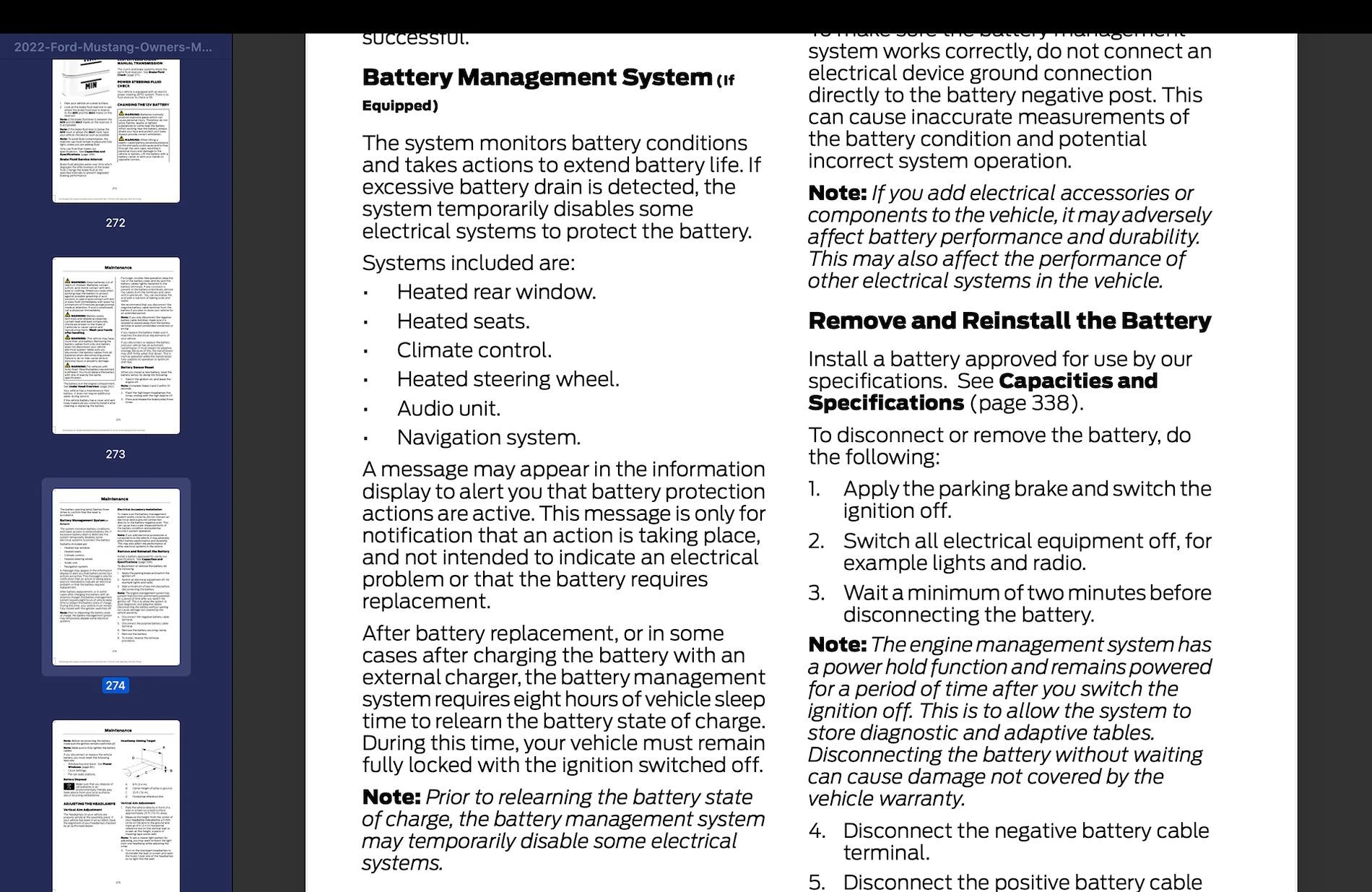
Attached is an excerpt from the 2022 Owners Manual. Along with resetting BMS to let the car know a new battery has been installed, the car should sit (I recommend locked, with no tender attached) for eight hours.
The SoC test is a function of BMS to evaluate the battery. It's like an overnight load test.
BMS tracks battery replacement and adjusts the charging profile over time. The SoC evaluation provides data to support that.
Edit,
I continue to study BMS, the BCM, FORScan and its use for making the change to an AGM.
Some Mustang and F150 owners have installed an AGM and not changed the battery type in the BCM. Most have. Some have claimed the vehicle will automatically recognize an AGM type, from the SoC evaluation data. But I haven't found any definitive documentation on this.
FWIW, if I were making the change, I'd want confirmation the correct type is listed in the car's systems. From the information I have thus far, I'd be willing to wait a few days to see if it auto-changes. If not, take to dealer to have them adjust or make the change via FORScan, Ford Diagnostic and Repair System (FDRS) or something else.
When using FORScan or similar program, a list of batteries will be presented. Your battery might not exactly match something available in the tables. If in that situation, select an AGM with the closest, but lower, Amp-hour (Ah) and Cold Cranking Amperage (CCA) rating. Selecting one higher would lead to overcharging.

After shutdown, using the Hall Effect sensor attached to the negative battery cable, the Body Control Module (BCM) performs a SoC test on the vehicle battery. This test often takes several hours.
Attached is an excerpt from the 2022 Owners Manual. Along with resetting BMS to let the car know a new battery has been installed, the car should sit (I recommend locked, with no tender attached) for eight hours.
The SoC test is a function of BMS to evaluate the battery. It's like an overnight load test.
BMS tracks battery replacement and adjusts the charging profile over time. The SoC evaluation provides data to support that.
Edit,
I continue to study BMS, the BCM, FORScan and its use for making the change to an AGM.
Some Mustang and F150 owners have installed an AGM and not changed the battery type in the BCM. Most have. Some have claimed the vehicle will automatically recognize an AGM type, from the SoC evaluation data. But I haven't found any definitive documentation on this.
FWIW, if I were making the change, I'd want confirmation the correct type is listed in the car's systems. From the information I have thus far, I'd be willing to wait a few days to see if it auto-changes. If not, take to dealer to have them adjust or make the change via FORScan, Ford Diagnostic and Repair System (FDRS) or something else.
When using FORScan or similar program, a list of batteries will be presented. Your battery might not exactly match something available in the tables. If in that situation, select an AGM with the closest, but lower, Amp-hour (Ah) and Cold Cranking Amperage (CCA) rating. Selecting one higher would lead to overcharging.
Last edited:
DM_BK
Well-Known Member
- Thread starter
- #18
I connected same way as @StangTime in post #2 here https://www.mustang6g.com/forums/threads/batter-tender-battery-connection.172738/#post-3500740Is the car doing updates over Wifi or cellular?
Second the BMS does not know the car is on a battery charger. It records power consumption from the battery and does not know it has infinite power available. The correct location to mount a charger is past the current sensor in the negative terminal lead so the current sensor outputs zero current while the charger is attached.

Mike Pfeifer
Well-Known Member
- Joined
- Feb 4, 2021
- Threads
- 11
- Messages
- 1,530
- Reaction score
- 1,873
- Location
- Wesley Chapel, FL
- First Name
- Mike
- Vehicle(s)
- 2019 Ruby Red Mustang GT A10
Can you give a source for this? I don’t think it’s true, at least not as it implies an active test occurring. The first thing that made me take note is the “Hall effect sensor on the negative terminal” which is definitely not true in and of itself. If you have details about this, I’d love to check it out.Something I failed to mention and did not notice in other posts is the Battery Management System (BMS) State of Charge (SoC) test.
After shutdown, using the Hall Effect sensor attached to the negative battery cable, the Body Control Module (BCM) performs a SoC test on the vehicle battery. This test often takes several hours.
The SoC test is a function of BMS to evaluate the battery. It's like an overnight load test.
Skye
Well-Known Member
I'm enclosing some references that led to my understanding of the sensors and the SoC evaluation process.Can you give a source for this?
In the first thread, some pictures of the sensors on a 6G, around the negative (-) battery cable.
https://www.mustang6g.com/forums/threads/what-is-this-connector-on-negative-battery-cable.150176/
In the general search that follows, in the 7G cars, the sensor has moved from the cable to the (-) terminal.
https://www.google.com/search?sca_e...QIHen9IO8QtKgLegQIFhAB&biw=1470&bih=747&dpr=2
The following paragraph is a quote from a Ford Support document, downloaded as part of a 3-day subscription.
"414-00 Charging System - General Information Description and Operation
Battery State of Charge
The BCM uses the battery current sensor to keep track of the battery state of charge. The battery current sensor is a Hall-effect sensor attached to the battery ground cable. During a drive cycle the Electrical Energy Management software adjuststhe battery state of charge by monitoring the charge and discharge current and adjusting the state of charge up during charging, and down during discharge. During rest periods (key off with no electrical loads) when the vehicle enters sleepmode, the battery voltage is sampled to calibrate the State of Charge. The BCM automatically executes this calibration anytime the vehicle enters sleep mode and when the total vehicle current draw is below 300mA. It takes 8 hours in the sleep mode to calibrate the battery state of charge to high accuracy. If the system draw does not allow the battery state of charge calibration over the previous 7 to 10 days the State of Charge quality factor changes to flag this and some Electrical Energy Management Functions which rely on the accuracy of the battery state of charge may be temporarily turned off until a calibration takes place."
A page on the sensor and how they work.
https://www.electronics-tutorials.ws/electromagnetism/hall-effect.html
Last edited:
Sponsored
Fordphanatic
Well-Known Member
When using forscan you will be presented with 3 options. Std , AGM , EFBSomething I failed to mention and did not notice in other posts is the Battery Management System (BMS) State of Charge (SoC) test.
After shutdown, using the Hall Effect sensor attached to the negative battery cable, the Body Control Module (BCM) performs a SoC test on the vehicle battery. This test often takes several hours.
Attached is an excerpt from the 2022 Owners Manual. Along with resetting BMS to let the car know a new battery has been installed, the car should sit (I recommend locked, with no tender attached) for eight hours.
The SoC test is a function of BMS to evaluate the battery. It's like an overnight load test.
BMS tracks battery replacement and adjusts the charging profile over time. The SoC evaluation provides data to support that.
Edit,
I continue to study BMS, the BCM, FORScan and its use for making the change to an AGM.
Some Mustang and F150 owners have installed an AGM and not changed the battery type in the BCM. Most have. Some have claimed the vehicle will automatically recognize an AGM type, from the SoC evaluation data. But I haven't found any definitive documentation on this.
FWIW, if I were making the change, I'd want confirmation the correct type is listed in the car's systems. From the information I have thus far, I'd be willing to wait a few days to see if it auto-changes. If not, take to dealer to have them adjust or make the change via FORScan, Ford Diagnostic and Repair System (FDRS) or something else.
When using FORScan or similar program, a list of batteries will be presented. Your battery might not exactly match something available in the tables. If in that situation, select an AGM with the closest, but lower, Amp-hour (Ah) and Cold Cranking Amperage (CCA) rating. Selecting one higher would lead to overcharging.
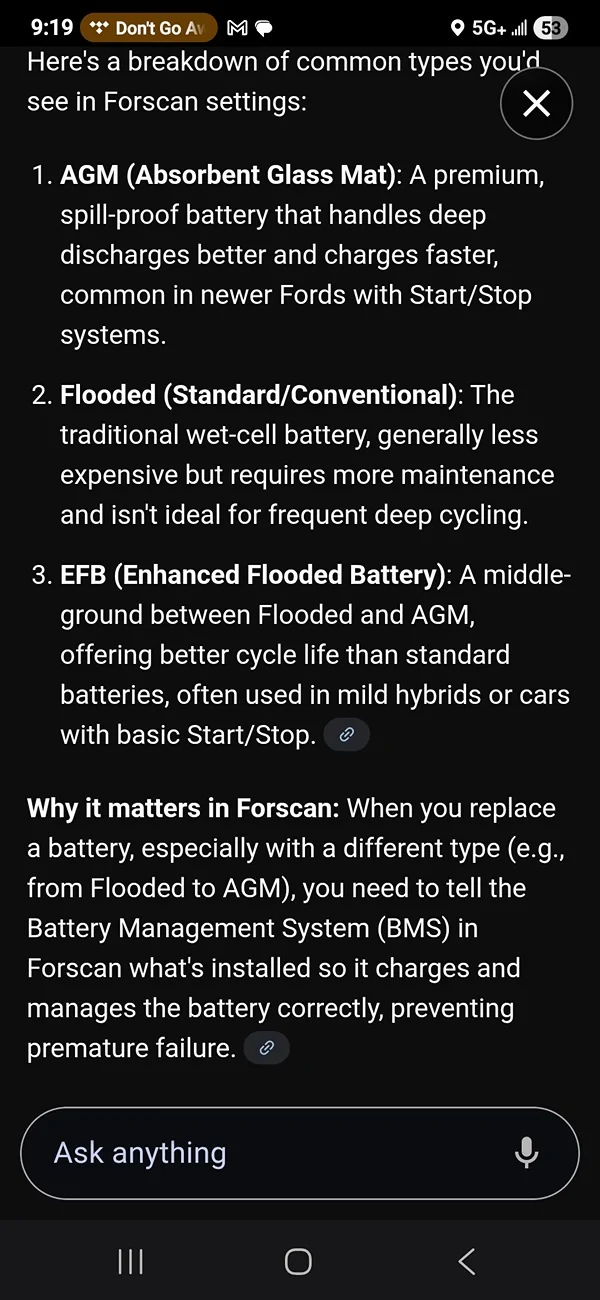
Forscan is the only option available to make this change. Your dealor will not do anything with forscan as it is a 3rd party platform. There are tons of videos on you tube to teach you all about forscan and how to use it.
Mike Pfeifer
Well-Known Member
- Joined
- Feb 4, 2021
- Threads
- 11
- Messages
- 1,530
- Reaction score
- 1,873
- Location
- Wesley Chapel, FL
- First Name
- Mike
- Vehicle(s)
- 2019 Ruby Red Mustang GT A10
Thanks for all that. Gotta admit, I’ve never heard of an inductive current measurement device being referred to as Hall effect. I am aware of the current sampling over time and calculating a SoH / SoC based on that data but I wouldn’t call that an active test. Maybe it’s semantics.I'm enclosing some references that led to my understanding of the sensors and the SoC evaluation process.
In the first thread, some pictures of the sensors on a 6G, around the negative (-) battery cable.
https://www.mustang6g.com/forums/threads/what-is-this-connector-on-negative-battery-cable.150176/
In the general search that follows, in the 7G cars, the sensor has moved from the cable to the (-) terminal.
https://www.google.com/search?sca_e...QIHen9IO8QtKgLegQIFhAB&biw=1470&bih=747&dpr=2
The following paragraph is a quote from a Ford Support document, downloaded as part of a 3-day subscription.
"414-00 Charging System - General Information Description and Operation
Battery State of Charge
The BCM uses the battery current sensor to keep track of the battery state of charge. The battery current sensor is a Hall-effect sensor attached to the battery ground cable. During a drive cycle the Electrical Energy Management software adjuststhe battery state of charge by monitoring the charge and discharge current and adjusting the state of charge up during charging, and down during discharge. During rest periods (key off with no electrical loads) when the vehicle enters sleepmode, the battery voltage is sampled to calibrate the State of Charge. The BCM automatically executes this calibration anytime the vehicle enters sleep mode and when the total vehicle current draw is below 300mA. It takes 8 hours in the sleep mode to calibrate the battery state of charge to high accuracy. If the system draw does not allow the battery state of charge calibration over the previous 7 to 10 days the State of Charge quality factor changes to flag this and some Electrical Energy Management Functions which rely on the accuracy of the battery state of charge may be temporarily turned off until a calibration takes place."
A page on the sensor and how they work.
https://www.electronics-tutorials.ws/electromagnetism/hall-effect.html
jheissjr
Well-Known Member
Current sense chips and Hall effect devices are the same thing. The sensors are used in everything including automotive and on the S550 battery cable. Monitoring battery parameters during operation is more accurate to say than test. The battery parameters are measured and the BMS initializes for the specs of the battery installed.
LCK22GT
Well-Known Member
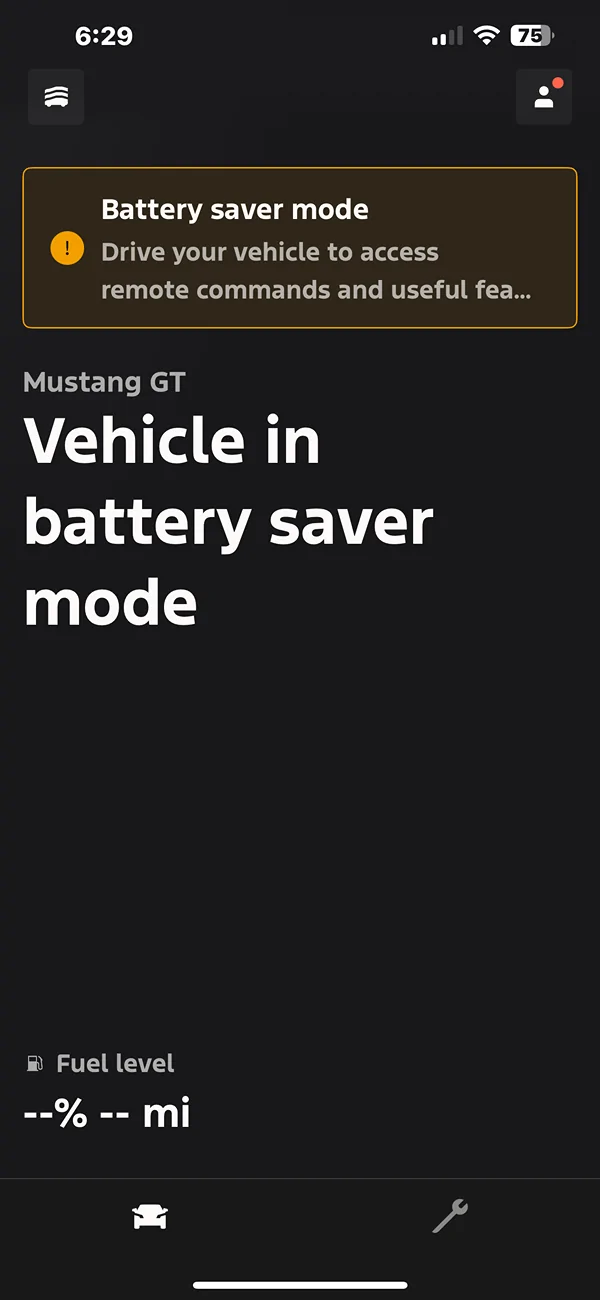
Yeah same here. BSM message came up a couple weeks after storage with battery tender in place.Battery saver mode comes on after 2 weeks of not using the car, whether you have a battery tender hooked up or not. Every Winter when I put my car away, with the battery tender attached, the battery saver mode will appear on my Ford app exactly 2 weeks later. It will stay that way unless I turn on the car again. And after 2 weeks of non-use, battery saver will come on again.
Skye
Well-Known Member
I continued reading up on these topics this morning. The following are some links and insight I found useful.
There are a lot of sites, threads, and comments on BMS. I was interested if, in even the latest Ford software, BMS was capable of auto-sensing battery type. I was also interested on how that could be possible.
With respect to 6G threads, I parsed the sensing comments into three buckets:
- Those that claimed BMS senses the battery type, or the battery type does not matter, and no BCM changes are required
- Those that felt, if a battery was selected with the same Ah rating as the original, the battery type setting could stay the same
- Those who changed the battery type, size and capacity via FORScan
The following thread is from a Maverick forum. In post #26, someone who had changed battery type monitored his system over several days. He confirmed BMS does not sense the type (Flooded, Absorbent Glass Matt, Lithium, etc.).
https://www.mavericktruckclub.com/f...onitoring-system-bms-explanation.43482/page-2
The next thread, from an F150 forum, highlights many of the BMS-related parameters that could be changed. Note the post is from a 2017 era F150 forum. It's simply an example of the Ford software.
https://www.ford-trucks.com/forums/1677378-forscan-agm-battery-setting-2.html
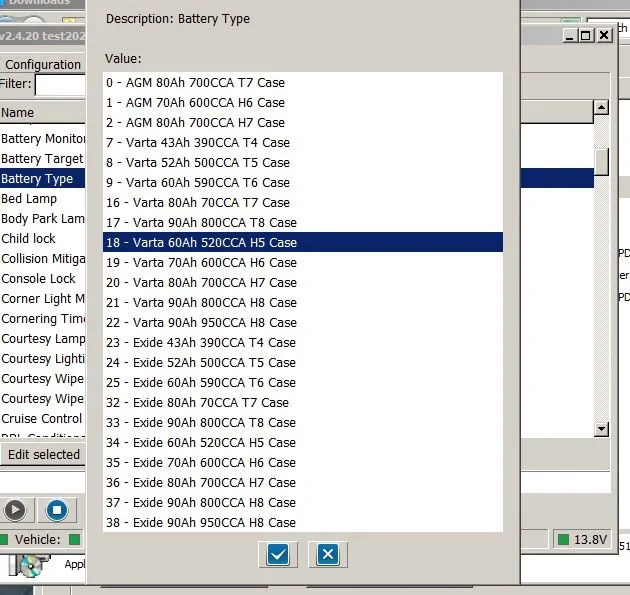
In the last thread, several screenshots in post #6 highlight battery case types. This is from another F150 forum. The parameters displayed in the thread might not exist in a Mustang. This example and the one above show how granular the software can be, depending on model and year.
https://www.f150forum.com/f118/battery-size-change-forscan-553330/
One 6G discussion on selecting battery type.
https://www.mustang6g.com/forums/threads/forscan-setting-for-agm-battery.146806/
Another 6G discussion, showing (Post #15) some of the 6G battery parameters in FORScan.
https://www.mustang6g.com/forums/threads/bms-not-working….186393/
YMMV.
There are a lot of sites, threads, and comments on BMS. I was interested if, in even the latest Ford software, BMS was capable of auto-sensing battery type. I was also interested on how that could be possible.
With respect to 6G threads, I parsed the sensing comments into three buckets:
- Those that claimed BMS senses the battery type, or the battery type does not matter, and no BCM changes are required
- Those that felt, if a battery was selected with the same Ah rating as the original, the battery type setting could stay the same
- Those who changed the battery type, size and capacity via FORScan
The following thread is from a Maverick forum. In post #26, someone who had changed battery type monitored his system over several days. He confirmed BMS does not sense the type (Flooded, Absorbent Glass Matt, Lithium, etc.).
https://www.mavericktruckclub.com/f...onitoring-system-bms-explanation.43482/page-2
The next thread, from an F150 forum, highlights many of the BMS-related parameters that could be changed. Note the post is from a 2017 era F150 forum. It's simply an example of the Ford software.
https://www.ford-trucks.com/forums/1677378-forscan-agm-battery-setting-2.html
In the last thread, several screenshots in post #6 highlight battery case types. This is from another F150 forum. The parameters displayed in the thread might not exist in a Mustang. This example and the one above show how granular the software can be, depending on model and year.
https://www.f150forum.com/f118/battery-size-change-forscan-553330/
One 6G discussion on selecting battery type.
https://www.mustang6g.com/forums/threads/forscan-setting-for-agm-battery.146806/
Another 6G discussion, showing (Post #15) some of the 6G battery parameters in FORScan.
https://www.mustang6g.com/forums/threads/bms-not-working….186393/
YMMV.
Last edited:
Sponsored
Skye
Well-Known Member
I do not have an answer. Just a thought.
As a reference my battery is a BXT-96R-590. The stock, OEM unit.
From what I've seen thus far, there is no AGM 96R in the selection menus, just the more modern "T" and "H" case sizes. Post #20 in the following thread confirms that.
https://www.mustang6g.com/forums/threads/performance-battery.138087/page-2
Here is a thread discussing case sizes and AGM batteries. Several have used a Group 48 size battery.
https://www.mustang6g.com/forums/threads/48-agm-battery.208970/page-3
Group 48 translates to a "H6" battery size.
https://antigravitybatteries.com/he...cmtRvNOHIpMphkWDWw1eRlhj3fs3MCuuzaRsuapmgoBHe
Given all that, the closest AGM selection to my batt I see in the menu is "1- AGM 70ah 600CCA H6 case".
Edit,
@james cole , when you made the change from flooded to AGM battery, which battery did you select from the FORScan menus?
TIA.
As a reference my battery is a BXT-96R-590. The stock, OEM unit.
From what I've seen thus far, there is no AGM 96R in the selection menus, just the more modern "T" and "H" case sizes. Post #20 in the following thread confirms that.
https://www.mustang6g.com/forums/threads/performance-battery.138087/page-2
Here is a thread discussing case sizes and AGM batteries. Several have used a Group 48 size battery.
https://www.mustang6g.com/forums/threads/48-agm-battery.208970/page-3
Group 48 translates to a "H6" battery size.
https://antigravitybatteries.com/he...cmtRvNOHIpMphkWDWw1eRlhj3fs3MCuuzaRsuapmgoBHe
Given all that, the closest AGM selection to my batt I see in the menu is "1- AGM 70ah 600CCA H6 case".
Edit,
@james cole , when you made the change from flooded to AGM battery, which battery did you select from the FORScan menus?
TIA.
Last edited:

Postal Bob
Well-Known Member
- Joined
- Dec 28, 2020
- Threads
- 10
- Messages
- 859
- Reaction score
- 1,076
- Location
- Long Island, NY
- First Name
- Bob
- Vehicle(s)
- 2019 Shelby GT350
After reading this thread, particularly the part about needing to let the computer know you installed an AGM battery, I called several dealer service depts. I asked what is the procedure when replacing the stock battery with an AGM type battery. They all said they simply swap the battery, and do the BMS reset. They said there is nothing else they do as for reprogramming the cars computer to let it know there is know an AGM battery installed.
This was the answer from 3 different service depts. So who knows what the truth is.
This was the answer from 3 different service depts. So who knows what the truth is.
Fordphanatic
Well-Known Member
You need to change it in your BCM as-built. An AGM battery operates at higher voltage then a flooded battery . The option is available in your BCM for a reason. Dealership service dept does not use forscan. It is a third party application.After reading this thread, particularly the part about needing to let the computer know you installed an AGM battery, I called several dealer service depts. I asked what is the procedure when replacing the stock battery with an AGM type battery. They all said they simply swap the battery, and do the BMS reset. They said there is nothing else they do as for reprogramming the cars computer to let it know there is know an AGM battery installed.
This was the answer from 3 different service depts. So who knows what the truth is.
Sponsored
Similar threads


- Replies
- 0
- Views
- 680


