Sponsored

Anyone seen a gen3 piston failure like this?

Robottrainer

Well-Known Member
Joined
Apr 25, 2021
Threads
79
Messages
995
Reaction score
422
Location
Canada
First Name
John
Vehicle(s)
2018 Ford Escape. 2020 Jeep Cherokee. 2021 Ford Mustang GT Stage 2 Roush
At least so far, it sounds to me like no one who has responded has seen a Gen3 piston fail in this manner. So maybe it was a fluke, manufacturing defect, or perhaps just on the edge of the statistical manufacturing distribution of overall strength.

As far as root cause goes, there is some very interesting data in the log. The following log is only a 2 second window containing the failure, and the channel list was limited so polling rate was very fast.

1767467550706-tb.webp


The following was the sequence of events:

46.296 (relative): Traction control intervened (this was triggered by stability control) at 7200 rpm, cut throttle to 55 deg and spark to 9 deg by 7300.

46.611: Peak rpm of 7345 reached as driver was releasing throttle and throttle was closing.

46.770: Engine speed 7226 rpm and decreasing, first indication of failure becomes evident. Driver indicated no signs of distress until after he let off throttle and log agrees. Next is debatable, but I believe the piston failed between 46.745 and 46.770 because that is when the WBO2 signals diverged. By 46.869 the STFT was reacting to attempt to correct just before going into DFCO. WBO2 response rate is only 20 ms with less than 5 ms of transport delay at that load and speed. When the piston failed it turned into a large air leak, causing the air/fuel ratio to become very imbalanced between banks. This becomes more evident after DFCO. The initial indication of this divergence is at 46.770 and subtracting the 25 ms of response time gets you to 46.745 as the actual failure time.

This seems to indicate that the failure actually occurred after throttle and timing dropped and even just after the rpm started falling.
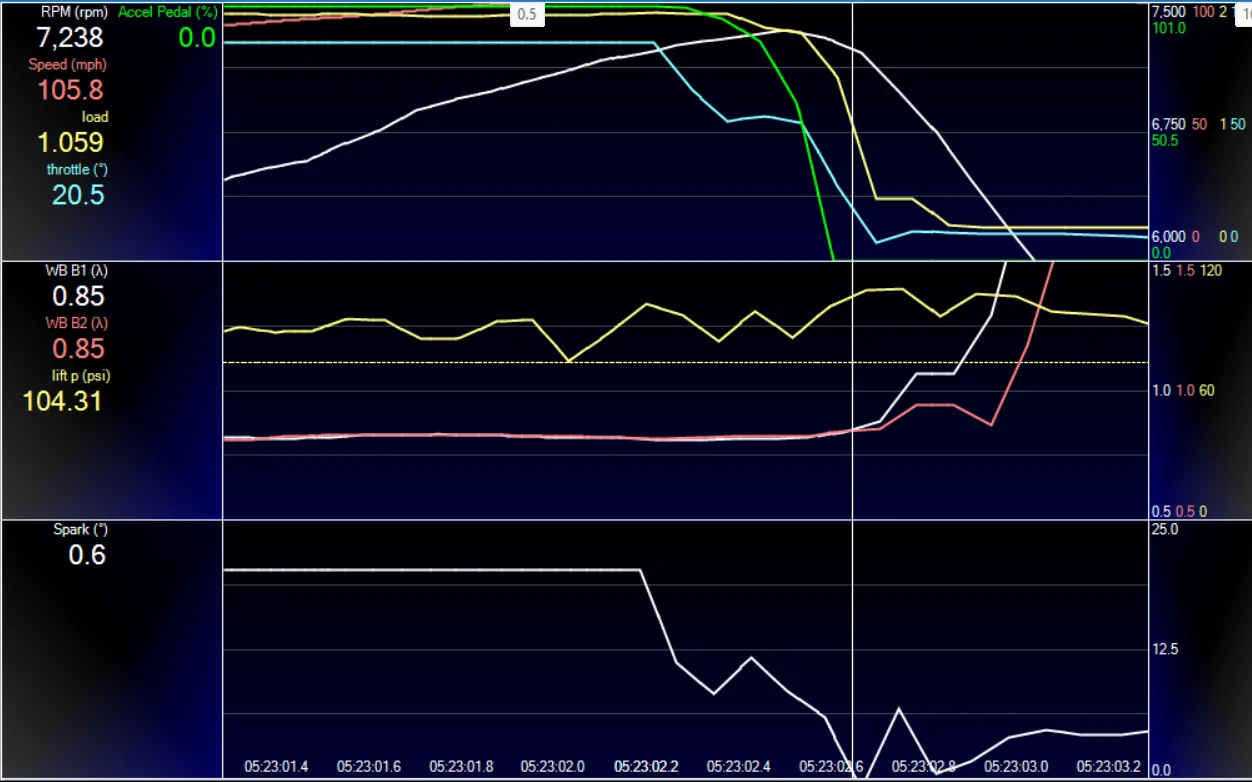
This almost supports what I said earlier about rods failing on the intake stroke which gets exacerbated when the throttle is closed
Sponsored


Gen 6 Mach1

Well-Known Member
Joined
Oct 1, 2025
Threads
3
Messages
495
Reaction score
976
Location
Arizona
First Name
Jer
Vehicle(s)
2021 Mach1
I hope this is relevant, and ok to add in ,we are talking Coyotes, Boosted tho , but they all stated life as Stock NA . The thread where OP is asking about staying with Motor craft oil or high mileage.
125k on his Odometer and plenty members with 60k and up milage . For a guy like me who has had his fun with modification's in the past many years ago , and is content with 480 crank HP NA . Im very pleased and satisfied to hear that . I'll never come close to that amount of miles , but is very reassuring this platform is most likely the best or 1 of the best to come out of Detroit.
Been following along since EngineerMike Posted.
 
OP
OP

engineermike

Well-Known Member
Joined
Jul 15, 2018
Threads
31
Messages
6,198
Reaction score
6,480
Location
La
Vehicle(s)
2018 GTPP A10
Rods/rod bolts tend to fail on the crank down stroke during the intake stroke. This puts the most stress on the piston pin, lower rod cap and rod bolts. What does the rod look like?
Big end of rod was still attached to crank. Bolts and bearing were fine. The little end was in pieces and scattered around. I'll try to look at the fracture surface but it was beat up pretty bad.
 
OP
OP

engineermike

Well-Known Member
Joined
Jul 15, 2018
Threads
31
Messages
6,198
Reaction score
6,480
Location
La
Vehicle(s)
2018 GTPP A10
So, just maybe 900rwhp is too much to run safely for years on end. How long was this setup in the car at 900rwhp.
Car had roughly 60k miles, boosted for at least. The current 3" pulley was installed about 5000 miles before the failure.
 

Robottrainer

Well-Known Member
Joined
Apr 25, 2021
Threads
79
Messages
995
Reaction score
422
Location
Canada
First Name
John
Vehicle(s)
2018 Ford Escape. 2020 Jeep Cherokee. 2021 Ford Mustang GT Stage 2 Roush
Big end of rod was still attached to crank. Bolts and bearing were fine. The little end was in pieces and scattered around. I'll try to look at the fracture surface but it was beat up pretty bad.
Just a theory, but stresses will find the weakest link. In this case it may have been in the pin boss area. The crank is trying to pull the piston down. Vacuum and ring drag is resisting putting the rod and piston boss area under tension.
 

Sponsored

Mach1Racer

Well-Known Member
Joined
Oct 10, 2022
Threads
12
Messages
334
Reaction score
512
Location
Everywhere
Vehicle(s)
Mach 1
Car had roughly 60k miles, boosted for at least. The current 3" pulley was installed about 5000 miles before the failure.
So, would you recommend this 900 rwhp setup still or should people use a little caution and back it down to 800 rwhp.

I literally turned the car down for the winter but still in the 850+ range. We are not racing at these temps anyway. I think if I make it thru this year with no problems, I will invest in a Aluminator for the forged pistons and rods.
 

Robottrainer

Well-Known Member
Joined
Apr 25, 2021
Threads
79
Messages
995
Reaction score
422
Location
Canada
First Name
John
Vehicle(s)
2018 Ford Escape. 2020 Jeep Cherokee. 2021 Ford Mustang GT Stage 2 Roush
Just a theory, but stresses will find the weakest link. In this case it may have been in the pin boss area. The crank is trying to pull the piston down. Vacuum and ring drag is resisting putting the rod and piston boss area under tension.
Actually, I take that back. Its been awhile since ai looked at this when trying g to figure out a rod bearing failure due to a stretched rod bolt. The worst scenario is actually the exhaust stroke. The piston is flung upwards at a high velocity at high rpm with little resistance as the exhaust valves are open. It comes to a crashing halt at the top of the stroke and wants to continue by inertia through the head.
 
OP
OP

engineermike

Well-Known Member
Joined
Jul 15, 2018
Threads
31
Messages
6,198
Reaction score
6,480
Location
La
Vehicle(s)
2018 GTPP A10
So, would you recommend this 900 rwhp setup still or should people use a little caution and back it down to 800 rwhp.
If the prevailing failure theory is correct, then it's more of a statistical thing. Even stock NA pistons fail, so any additional stress will increase the failure rate. We've seen 1050 rwhp from a PD blower on stock pistons hold for at least a few dyno pulls....could last forever...could fail on the next hit, but for sure the chances are higher than with 400 rwhp. That said, I've heard it stated that 850 rwhp is the sweet spot for a stock coyote and 10r80. You can generally make on live a long time at that power level.

...I will invest in a Aluminator for the forged pistons and rods.
The owner is going wtih Mahle 10.4/1 pistons and GT500 rods. It's an interesting combination, but should be very strong and more forgiving.

I'm friends with a guy who retired as an engine calibrator from a large-scale performance engine manufacturer. He thinks we're all crazy for running the compression, timing, and boost that we do. They got engines to hold up long-term at high power levels by running very low compression and timing even if knock was not encountered.
 

OldbutNew

Well-Known Member
Joined
Jul 22, 2024
Threads
6
Messages
234
Reaction score
266
Location
S.E.Michigan
First Name
Greg
Vehicle(s)
2019 Kona Blue GT 10R (Wife's car) 2018 Mustang GT Royal Crimson PP1 Manual
So, would you recommend this 900 rwhp setup still or should people use a little caution and back it down to 800 rwhp.

I literally turned the car down for the winter but still in the 850+ range. We are not racing at these temps anyway. I think if I make it thru this year with no problems, I will invest in a Aluminator for the forged pistons and rods.
Putting 18# or more of boost into a production built, essentially stock long block has inherent risks.
The Aluminator reduces those risks to more realistic levels. It boggles the mind that doubling the designed output of SO MANY of these engines doesn't result in MORE failures!

https://www.ford.com/product/50l-gen-4-aluminator-sc-crate-engine-p2868577589
 

schmeky

Well-Known Member
Joined
Apr 7, 2019
Threads
57
Messages
784
Reaction score
845
Location
West Monroe Louisiana
First Name
David
Vehicle(s)
2018 Mustang GT, 2024 Mustang GT
The Gen3 and up coyotes are nothing short of amazing. To take a straight off the dealers lot and make 700 - 900 whp, reliably is incredible.

I know my Gen3 at 780 whp has been rock solid. Kudos to Ford.
 

Sponsored

Mach1Racer

Well-Known Member
Joined
Oct 10, 2022
Threads
12
Messages
334
Reaction score
512
Location
Everywhere
Vehicle(s)
Mach 1
We've seen 1050 rwhp from a PD blower on stock pistons hold for at least a few dyno pulls....could last forever...could fail on the next hit, but for sure the chances are higher than with 400 rwhp. That said, I've heard it stated that 850 rwhp is the sweet spot for a stock coyote and 10r80. You can generally make on live a long time at that power level.


The owner is going wtih Mahle 10.4/1 pistons and GT500 rods. It's an interesting combination, but should be very strong and more forgiving.

I'm friends with a guy who retired as an engine calibrator from a large-scale performance engine manufacturer. He thinks we're all crazy for running the compression, timing, and boost that we do. They got engines to hold up long-term at high power levels by running very low compression and timing even if knock was not encountered.
To your point about the sweet spot being 850+; that’s where I turned down to.

As far as the new engine build. It would seem the GT500 rods are proven a good upgrade. Mahle makes the pistons for the Aluminator as well. Therefore, dude got a good plan right there.

As far as compression goes, the GT500 is lower (9.5:1) and I wonder should a built motor Coyote benefit with at least a one point decrease in compression for safety sake. 11:1 compression and not lose to much power.
 

Robottrainer

Well-Known Member
Joined
Apr 25, 2021
Threads
79
Messages
995
Reaction score
422
Location
Canada
First Name
John
Vehicle(s)
2018 Ford Escape. 2020 Jeep Cherokee. 2021 Ford Mustang GT Stage 2 Roush
If the prevailing failure theory is correct, then it's more of a statistical thing. Even stock NA pistons fail, so any additional stress will increase the failure rate. We've seen 1050 rwhp from a PD blower on stock pistons hold for at least a few dyno pulls....could last forever...could fail on the next hit, but for sure the chances are higher than with 400 rwhp. That said, I've heard it stated that 850 rwhp is the sweet spot for a stock coyote and 10r80. You can generally make on live a long time at that power level.


The owner is going wtih Mahle 10.4/1 pistons and GT500 rods. It's an interesting combination, but should be very strong and more forgiving.

I'm friends with a guy who retired as an engine calibrator from a large-scale performance engine manufacturer. He thinks we're all crazy for running the compression, timing, and boost that we do. They got engines to hold up long-term at high power levels by running very low compression and timing even if knock was not encountered.
Since the Coyotes were never meant to have an OEM FI system, its understandable why they went so high with it. Roush and the like did fantastic job juggling the engine manage to make this work. The DI and combustion chamber layout helps alot. Ideally 9 to 1 would be a safer set up.
 
OP
OP

engineermike

Well-Known Member
Joined
Jul 15, 2018
Threads
31
Messages
6,198
Reaction score
6,480
Location
La
Vehicle(s)
2018 GTPP A10
Compression ratio is an interesting subject, for sure. The owner wants to be able to make more power on pump gas, which is the main reason he is dropping to 10.4/1. The rule of thumb is that DI can tolerate ~1 number higher compression than PFI, so using Predator as a comparison, it aligns and they make very good power on 93 octane. Beyond that, there is a credible argument that boosted engines should have lower compression even when knock is not encountered, to reduce peak cylinder pressure and engine stresses.
 

HKusp

Well-Known Member
Joined
Jul 22, 2021
Threads
37
Messages
2,229
Reaction score
2,876
Location
Hampton, Md.
First Name
Jason
Vehicle(s)
2018 Mustang GT
When I built my gen 3 after ring land failure. I dropped my compression from 12:1 down to 11;1 so that it was less stressful. I used Manley pistons and Manley H-tuff rods with a stock block and crank. If I had it to do all over again, I probably would have dropped it to at least 10.5:1 maybe 9.5:1. You can make up for compression with more boost and it is supposedly less stressful on the engine than static compression.
 
OP
OP

engineermike

Well-Known Member
Joined
Jul 15, 2018
Threads
31
Messages
6,198
Reaction score
6,480
Location
La
Vehicle(s)
2018 GTPP A10
Owner got the car running today with the following:
  • Stock block
  • Stock crank
  • Gt500 rods
  • Mahle 10.4/1 forged pistons
  • Stock heads and cams
  • Boss tensioners
  • Gt500 oil pan and pump
The idea was to make it tough and also have more tolerance to and power on pump gas. We made some simple tune changes to accommodate the compression ratio. It started and drove with no issue. Once he gets through the break-in period we’ll start finding knock limits at the new compression ratio. I’m super interested to see where the knock limits are now.
Sponsored


Top