Sponsored

Alignment

s550 luke

Active Member
Joined
Feb 7, 2025
Threads
8
Messages
25
Reaction score
5
Location
Pennsylvania
First Name
Luke
Vehicle(s)
2016 mustang v6
I have a 2016 mustang that I am building for street/track use. I have been using stock alignment but am wondering if there is a better set of alignment specs I could use
Sponsored

 

icecreamtruckz

Well-Known Member
Joined
Jan 21, 2025
Threads
21
Messages
154
Reaction score
238
Location
FL
Vehicle(s)
2018 GT350
Better is subjective. It all depends on so many variables it’s hard to say. In general, most cars benefit from additional negative camber for track use. But it is likely different front to back, and dependent on other suspension parts. Like anything else, it’s a trade off. I knew guys running crazy negative camber for auto cross, because straight line acceleration is not vital.

If you do too much camber, and have a stiff anti roll bar, you may unbalance the car. The rear may need less negative camber. It’s always a balancing act.

I wouldn’t worry too much until you get enough track time that you can really experiment with your setup. You may like the balance with one setting, but pull faster times with another.

You need repeatable testing to really dial in the car the way you want it to perform.
 
OP
OP

s550 luke

Active Member
Joined
Feb 7, 2025
Threads
8
Messages
25
Reaction score
5
Location
Pennsylvania
First Name
Luke
Vehicle(s)
2016 mustang v6
Better is subjective. It all depends on so many variables it’s hard to say. In general, most cars benefit from additional negative camber for track use. But it is likely different front to back, and dependent on other suspension parts. Like anything else, it’s a trade off. I knew guys running crazy negative camber for auto cross, because straight line acceleration is not vital.

If you do too much camber, and have a stiff anti roll bar, you may unbalance the car. The rear may need less negative camber. It’s always a balancing act.

I wouldn’t worry too much until you get enough track time that you can really experiment with your setup. You may like the balance with one setting, but pull faster times with another.

You need repeatable testing to really dial in the car the way you want it to perform.
I was looking for something better on track than the stock alignment but still good for street use as it is my daily.
 

NightmareMoon

Well-Known Member
Joined
Nov 22, 2015
Threads
62
Messages
7,053
Reaction score
6,314
Location
Austin
Vehicle(s)
2016 Mustang GT PP w/ Voodoo
Vehicle Showcase
1
I was looking for something better on track than the stock alignment but still good for street use as it is my daily.

Do you have camber plates? you need camber plates to adjust the front camber.

DISCLAIMER: The specs I'll give are for a lively handling car which will turn well and which ISN"T set up to to understeer in a corner on the street. You need to be prepared for the rear of the car to step out more than you may be used to with OEM alignments if you're cornering near the limit. OEM alignments are set to hit the limits of the meager front camber first, which results in some mid corner understeer.. however they do this by limiting the grip you're going to get out of the front tires. More grip is available if you set up the alignment to maximize corner grip at higher Gs, but that means the front is going to have more 'authority' than with an OEM alignment. The rear grip will be about the same. A little more in a corner, but we're not sacrificing rear grip to get more front grip here, we're just adding front grip. If you're not used to that the car is going to feel different.

You also need to find an alignment shop which will align it closely to your specs. The average Firestone or Ford dealer will only get it in the ballpark of OEM and may not do it to your spec.

Anyway, OEM Specs for front and rear toe are pretty good. For camber, rear camber a bit less than 2.0 is fine (1.8ish) and you can go anywhere from 2.5° to 3.5° (or more) in the front.

To get the full amount of camber in the front, you need camber plates and you may need to open up the strut tower holes a bit. Vorshlag and Steeda sell jigs you can use for that. If you don't want to cut the tower holes then just get as much as you can get. High 2s or low 3s are fine. I like the Steeda plates if you are using an OEM style spring and perch.

On the street you don't really need 3 degrees or more of front camber, but it won't hurt tire wear much, so long as you make sure your front toe is exactly 0° or like 0.05 toe in. You won't really be using the full tire unless you're corning hard at the track with good sticky tires. You will feel the camber working in corners on the street however.

On the track with sticky tires, anything less than 3 degrees won't fully even out the tire wear, but with a bit more than 3° you can get even tire wear across the tread, which will let your track tires work the best and you'll get the most life out of them. Less than that and the shoulders will be overused, overheated, and wear out before the rest of the tire.

So to summarize.

Mild street/track
Front
Toe: 0.0 or +0.05 toe in
Camber: -2.8
Caster: (not adjustable)

Rear:
Toe: +0.1 to +0.15 toe in per side
Camber: -1.8

Aggressive/Track camber
Front:
Toe: 0.0 or +0.05 toe in
Camber: -3.4

Rear:
Toe: +0.1 to +0.15 toe in per side
Camber: -1.9..-2.1

Don't sweat the camber being exactly equal on each side, but try to get it w/in 0.1°. Getting the rear camber AND toe exact is pretty difficult. With camber plates you can get the front pretty close to spot on. I would not recommend any toe out really.
 

NightmareMoon

Well-Known Member
Joined
Nov 22, 2015
Threads
62
Messages
7,053
Reaction score
6,314
Location
Austin
Vehicle(s)
2016 Mustang GT PP w/ Voodoo
Vehicle Showcase
1
Lots of us daily with track alignments, and its fine. I get about 20k miles out of a set of MP4S with track alignments on the street. Sometimes a bit more, sometimes 1-2k less.
 

Sponsored

OP
OP

s550 luke

Active Member
Joined
Feb 7, 2025
Threads
8
Messages
25
Reaction score
5
Location
Pennsylvania
First Name
Luke
Vehicle(s)
2016 mustang v6
Do you have camber plates? you need camber plates to adjust the front camber.

DISCLAIMER: The specs I'll give are for a lively handling car which will turn well and which ISN"T set up to to understeer in a corner on the street. You need to be prepared for the rear of the car to step out more than you may be used to with OEM alignments if you're cornering near the limit. OEM alignments are set to hit the limits of the meager front camber first, which results in some mid corner understeer.. however they do this by limiting the grip you're going to get out of the front tires. More grip is available if you set up the alignment to maximize corner grip at higher Gs, but that means the front is going to have more 'authority' than with an OEM alignment. The rear grip will be about the same. A little more in a corner, but we're not sacrificing rear grip to get more front grip here, we're just adding front grip. If you're not used to that the car is going to feel different.

You also need to find an alignment shop which will align it closely to your specs. The average Firestone or Ford dealer will only get it in the ballpark of OEM and may not do it to your spec.

Anyway, OEM Specs for front and rear toe are pretty good. For camber, rear camber a bit less than 2.0 is fine (1.8ish) and you can go anywhere from 2.5° to 3.5° (or more) in the front.

To get the full amount of camber in the front, you need camber plates and you may need to open up the strut tower holes a bit. Vorshlag and Steeda sell jigs you can use for that. If you don't want to cut the tower holes then just get as much as you can get. High 2s or low 3s are fine. I like the Steeda plates if you are using an OEM style spring and perch.

On the street you don't really need 3 degrees or more of front camber, but it won't hurt tire wear much, so long as you make sure your front toe is exactly 0° or like 0.05 toe in. You won't really be using the full tire unless you're corning hard at the track with good sticky tires. You will feel the camber working in corners on the street however.

On the track with sticky tires, anything less than 3 degrees won't fully even out the tire wear, but with a bit more than 3° you can get even tire wear across the tread, which will let your track tires work the best and you'll get the most life out of them. Less than that and the shoulders will be overused, overheated, and wear out before the rest of the tire.

So to summarize.

Mild street/track
Front
Toe: 0.0 or +0.05 toe in
Camber: -2.8
Caster: (not adjustable)

Rear:
Toe: +0.1 to +0.15 toe in per side
Camber: -1.8

Aggressive/Track camber
Front:
Toe: 0.0 or +0.05 toe in
Camber: -3.4

Rear:
Toe: +0.1 to +0.15 toe in per side
Camber: -1.9..-2.1

Don't sweat the camber being exactly equal on each side, but try to get it w/in 0.1°. Getting the rear camber AND toe exact is pretty difficult. With camber plates you can get the front pretty close to spot on. I would not recommend any toe out really.
I do my own alignments, I have access to an alignment rack and everything. I have done camber before and you can get a bit past -3 camber without plates. Thank you for the info, I got some new camber arms for the rear and some poly bushings and was thinking about better alignment before the next autocross season
 

Dana Pants

Well-Known Member
Joined
Oct 11, 2018
Threads
11
Messages
1,167
Reaction score
1,202
Location
Burlington MA
First Name
Dana
Vehicle(s)
2018 GT PP1
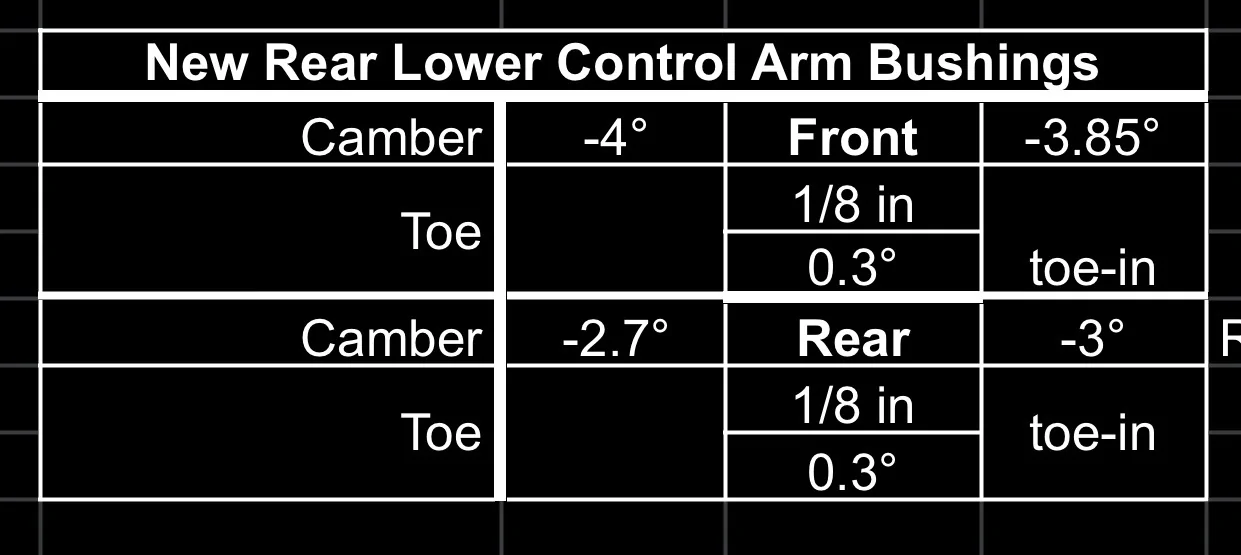
There is also this alignment… which prioritizes lateral grip above all else:

clear compromises in acceleration and braking traction. Street tires have to be flipped inside to outside to extend life.

IMG_4592.webp
 

Steeda-Sergio

Well-Known Member
Joined
Apr 21, 2025
Threads
0
Messages
142
Reaction score
140
Location
Valdosta, Ga
First Name
Sergio
Vehicle(s)
2018 Ford Mustang Ecoboost, 2016 Jeep Grand Cherokee, 2022 Suzuki GSXS 1000 GT
Hey OP,

Not sure how you are making camber adjustment at the front w/o camber platers, but here are the specs we use. The street is what we set cars up to here in our shop. The Track is a starting point adjustment- change as you feel is needed.


Street
Front camber -1.03 degrees on both sides (Performance and Handling Pack)
Front camber -.72 degrees on both sides (non-Performance and Handling Pack)
Caster +7.0 degrees on both sides
Front toe +0.01 degrees per side total toe of +0.02 degrees, this is toe in
Rear camber -1.5 degrees on both sides
Rear toe +0.115 degrees per side, total toe of +0.23 degrees, this is toe in


Track
Typical track/autocross alignment settings(not street use);
Front camber -3.0 degrees on both sides
Caster +7.0 degrees on both sides
Front toe +0.01 degrees per side total toe of +0.02 degrees, this is toe in
Rear camber -1.6 to -1.7 degrees on both sides
Rear toe +0.12 degrees per side, total toe of +0.24 degrees, this is toe in
 
OP
OP

s550 luke

Active Member
Joined
Feb 7, 2025
Threads
8
Messages
25
Reaction score
5
Location
Pennsylvania
First Name
Luke
Vehicle(s)
2016 mustang v6
Hey OP,

Not sure how you are making camber adjustment at the front w/o camber platers, but here are the specs we use. The street is what we set cars up to here in our shop. The Track is a starting point adjustment- change as you feel is needed.


Street
Front camber -1.03 degrees on both sides (Performance and Handling Pack)
Front camber -.72 degrees on both sides (non-Performance and Handling Pack)
Caster +7.0 degrees on both sides
Front toe +0.01 degrees per side total toe of +0.02 degrees, this is toe in
Rear camber -1.5 degrees on both sides
Rear toe +0.115 degrees per side, total toe of +0.23 degrees, this is toe in


Track
Typical track/autocross alignment settings(not street use);
Front camber -3.0 degrees on both sides
Caster +7.0 degrees on both sides
Front toe +0.01 degrees per side total toe of +0.02 degrees, this is toe in
Rear camber -1.6 to -1.7 degrees on both sides
Rear toe +0.12 degrees per side, total toe of +0.24 degrees, this is toe in
What you do is lift the vehicle, loosen the bolts for the strut to the steering knuckle and have someone move the wheel a bit before tightening, tighten the bolts and set the car down. You have to repeat this process a lot to do it right and you need multiple people to do it so most shops say it can’t be done but the hunter alignment racks tell you to do it that way
 

Steeda-Sergio

Well-Known Member
Joined
Apr 21, 2025
Threads
0
Messages
142
Reaction score
140
Location
Valdosta, Ga
First Name
Sergio
Vehicle(s)
2018 Ford Mustang Ecoboost, 2016 Jeep Grand Cherokee, 2022 Suzuki GSXS 1000 GT
What you do is lift the vehicle, loosen the bolts for the strut to the steering knuckle and have someone move the wheel a bit before tightening, tighten the bolts and set the car down. You have to repeat this process a lot to do it right and you need multiple people to do it so most shops say it can’t be done but the hunter alignment racks tell you to do it that way
Sounds like you have camber bolts or the hole in the struts are slotted.
 

Sponsored

NightmareMoon

Well-Known Member
Joined
Nov 22, 2015
Threads
62
Messages
7,053
Reaction score
6,314
Location
Austin
Vehicle(s)
2016 Mustang GT PP w/ Voodoo
Vehicle Showcase
1
What you do is lift the vehicle, loosen the bolts for the strut to the steering knuckle and have someone move the wheel a bit before tightening, tighten the bolts and set the car down. You have to repeat this process a lot to do it right and you need multiple people to do it so most shops say it can’t be done but the hunter alignment racks tell you to do it that way
do it all you like, the stock camber dont care, its not designed with any adjustment

Theres less than a mm of slop in the strut to spindle bolts, so I cant imagine what doing it a lot with multiple people is going to do. Those bolts are not even intended to be restretched so really, just leave em alone.
Sponsored


Top