
Mishimoto
Well-Known Member
- Thread starter
- #1
Hey guys,
We've discussed our catch can system, and posted several teaser images in a variety of threads here on the forum. We are now getting a bit closer to the completion of this project. We thought it would be a great idea to show you guys the development process that we take to design our direct fit catch can setups. Follow the progress on our blog, or posted in this thread below. Additionally, our testing will confirm/deny any claims regarding the need or effectiveness of installing a catch can on your Mustang.
http://engineering.mishimoto.com/?cat=207
Additionally, if we have enough interest, we would like to launch a pre-sale for this kit with discounted pricing for the members of 6G. If you are interested, feel free to chime in!
Mishimoto 2015+ Ford Mustang 2.3L EcoBoost Direct-Fit Baffled Oil Catch Can System, Part 1: Introduction and Project Plans

Mishimoto 2015 Ford Mustang EcoBoost
Does it need a catch can?
This question is on the minds of many vehicle enthusiasts. If it doesn’t add power, why would I want it? Why should I waste my money on it? All valid questions here. True, a catch can install will not add power to your vehicle, but that does not negate its function as a beneficial component for your vehicle.
Let’s jump into the basic benefits of a catch can. Its primary function is to separate and collect oil and fuel by-products from your vehicle’s crankcase ventilation (CCV) system before they reenter the intake tract. If these by-products are not captured, they move into the intake system, which can cause several problems. But first, let’s learn a bit about CCV systems and how they function to improve emissions and protect our environment.
Without going into too much detail, your engine features a CCV (crankcase ventilation) system that works to improve engine efficiency and emissions. During engine operation the crankcase generates pressure as combustion gases pass the piston rings. This pressure is evacuated from the crankcase and is routed into the intake system. The byproducts within the ventilated air will then be burned in the combustion process.When oil enters the intake, it coats the tract, throttle body, and valves. It is then burned in the combustion chamber, which lowers the octane rating of the mixture. Although not optimal for performance, this process does create a clean engine that requires no emptying of by-products and contaminants. Most manufacturers utilize this process. Ideally, however, these contaminants should be separated, collected, and disposed of properly.

Mishimoto 2015 Ford Mustang EcoBoost engine bay
Every engine is susceptible to blow-by from the piston rings. It is impossible to have a completely leak-free seal between the rings and cylinder wall. If pressure builds up in the crankcase, it will eventually find a weak point, normally a gasket or seal, and will result in fluid leaks.
Ford Mustang 2.3L EcoBoost CCV System
Two primary lines make up the CCV system equipped on most modern engines. The first, the makeup air line, routes from the valve cover to the intake piping. This line provides a light vacuum on the crankcase and is mostly used during wide-open throttle situations. This line can be found on the passenger side of the 2.3L Ecoboost and routes to the intake just before the turbocharger compressor housing. Check out a shot of the port on the valve cover and the stock line.
Makeup air line valve cover port 2.3L EcoBoost
Makeup air line stock hose 2.3L EcoBoost
Makeup air line stock hose 2.3L EcoBoost
You will notice a few unique features on this hose. One, this hose features some slick quick-disconnect fittings that seal to the connection points with an O-ring. Second, this line features an in-line sensor. Take a closer look at this sensor, which reads pressure/flow.
Makeup air line sensor
This sensor would help identify any leaks or blockages in the system, which could cause internal engine concerns or just emissions problems. We would need to retain this particular component when we develop our kit.
The second, the ventilation line, routes from the PCV valve to the throttle body. A small plate attaches to the side of the engine block on the driver side of the vehicle, which encompasses the PCV valve. This line features a higher vacuum source than the makeup air line. The ventilation line is used during idle and part-throttle driving situations. The valve works to eliminate the pressure from the intake manifold so it cannot enter the crankcase. Here is a shot of the connection point, just after the throttle body.
PCV Throttle body port
The other end of this hose is connected to a plate that encompasses the PCV valve. This is very similar to the 2.0L EcoBoost engine found in the Focus, as well as a few other Ford models from the 2000s. Take a look at this unique PCV valve system.
2.0L EcoBoost PCV port
The hose shown below connects the PCV valve to the throttle body.
Mustang PCV to throttle body stock hose
These two hoses/lines will function together to provide optimal crankcase pressures for efficient operation. Engines typically function more efficiently with a slight pull on the crankcase.
Now that we know how the system functions, we can determine what will happen if this system is left as stock, without the use of a catch can.
Pitfalls of Not Utilizing a Catch Can
If a valve begins to incur deposits, airflow into the combustion chamber can be reduced or even blocked, which would negatively affect performance. This is another reason you want to keep the intake tract of your vehicle clean.
I hope none of this scared you away from driving your car! These issues are generally accepted by vehicle manufacturers; however, they are not ideal. Your car is not going to fall to pieces if you continue to drive it as-is for 100,000 miles. However, if you want to effectively reduce the negative impacts of the CCV system on your new Mustang, a catch can is a great upgrade for you. We could call this an upgrade in preventive maintenance.
With our new knowledge of the Mustang system, it was time to set our team to work selecting a catch can and making brackets and lines.
Check back with us next time for a look at our projected catch can setup, including some fabrication work to design the brackets.
Thanks for reading!
We've discussed our catch can system, and posted several teaser images in a variety of threads here on the forum. We are now getting a bit closer to the completion of this project. We thought it would be a great idea to show you guys the development process that we take to design our direct fit catch can setups. Follow the progress on our blog, or posted in this thread below. Additionally, our testing will confirm/deny any claims regarding the need or effectiveness of installing a catch can on your Mustang.
http://engineering.mishimoto.com/?cat=207
Additionally, if we have enough interest, we would like to launch a pre-sale for this kit with discounted pricing for the members of 6G. If you are interested, feel free to chime in!
Mishimoto 2015+ Ford Mustang 2.3L EcoBoost Direct-Fit Baffled Oil Catch Can System, Part 1: Introduction and Project Plans

Mishimoto 2015 Ford Mustang EcoBoost
Does it need a catch can?
This question is on the minds of many vehicle enthusiasts. If it doesn’t add power, why would I want it? Why should I waste my money on it? All valid questions here. True, a catch can install will not add power to your vehicle, but that does not negate its function as a beneficial component for your vehicle.
Let’s jump into the basic benefits of a catch can. Its primary function is to separate and collect oil and fuel by-products from your vehicle’s crankcase ventilation (CCV) system before they reenter the intake tract. If these by-products are not captured, they move into the intake system, which can cause several problems. But first, let’s learn a bit about CCV systems and how they function to improve emissions and protect our environment.
Without going into too much detail, your engine features a CCV (crankcase ventilation) system that works to improve engine efficiency and emissions. During engine operation the crankcase generates pressure as combustion gases pass the piston rings. This pressure is evacuated from the crankcase and is routed into the intake system. The byproducts within the ventilated air will then be burned in the combustion process.When oil enters the intake, it coats the tract, throttle body, and valves. It is then burned in the combustion chamber, which lowers the octane rating of the mixture. Although not optimal for performance, this process does create a clean engine that requires no emptying of by-products and contaminants. Most manufacturers utilize this process. Ideally, however, these contaminants should be separated, collected, and disposed of properly.
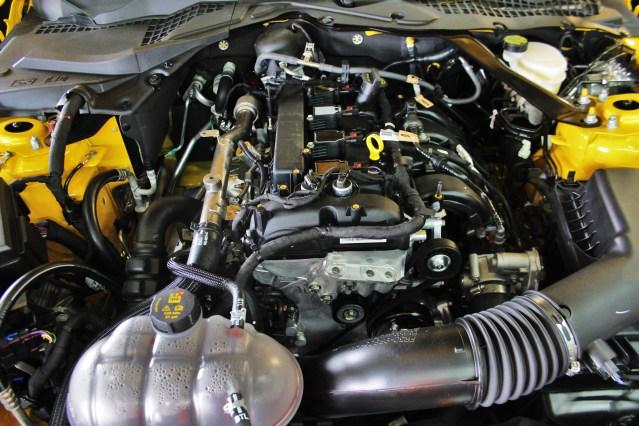
Mishimoto 2015 Ford Mustang EcoBoost engine bay
Every engine is susceptible to blow-by from the piston rings. It is impossible to have a completely leak-free seal between the rings and cylinder wall. If pressure builds up in the crankcase, it will eventually find a weak point, normally a gasket or seal, and will result in fluid leaks.
Ford Mustang 2.3L EcoBoost CCV System
Two primary lines make up the CCV system equipped on most modern engines. The first, the makeup air line, routes from the valve cover to the intake piping. This line provides a light vacuum on the crankcase and is mostly used during wide-open throttle situations. This line can be found on the passenger side of the 2.3L Ecoboost and routes to the intake just before the turbocharger compressor housing. Check out a shot of the port on the valve cover and the stock line.

Makeup air line valve cover port 2.3L EcoBoost

Makeup air line stock hose 2.3L EcoBoost

Makeup air line stock hose 2.3L EcoBoost
You will notice a few unique features on this hose. One, this hose features some slick quick-disconnect fittings that seal to the connection points with an O-ring. Second, this line features an in-line sensor. Take a closer look at this sensor, which reads pressure/flow.

Makeup air line sensor
This sensor would help identify any leaks or blockages in the system, which could cause internal engine concerns or just emissions problems. We would need to retain this particular component when we develop our kit.
The second, the ventilation line, routes from the PCV valve to the throttle body. A small plate attaches to the side of the engine block on the driver side of the vehicle, which encompasses the PCV valve. This line features a higher vacuum source than the makeup air line. The ventilation line is used during idle and part-throttle driving situations. The valve works to eliminate the pressure from the intake manifold so it cannot enter the crankcase. Here is a shot of the connection point, just after the throttle body.

PCV Throttle body port
The other end of this hose is connected to a plate that encompasses the PCV valve. This is very similar to the 2.0L EcoBoost engine found in the Focus, as well as a few other Ford models from the 2000s. Take a look at this unique PCV valve system.

2.0L EcoBoost PCV port
The hose shown below connects the PCV valve to the throttle body.

Mustang PCV to throttle body stock hose
These two hoses/lines will function together to provide optimal crankcase pressures for efficient operation. Engines typically function more efficiently with a slight pull on the crankcase.
Now that we know how the system functions, we can determine what will happen if this system is left as stock, without the use of a catch can.
Pitfalls of Not Utilizing a Catch Can
- Oil will coat the internal portion of your intake and intercooler system.
- Oil/carbon will build up on your intake valves, eventually resulting in reduced flow or blockages.
If a valve begins to incur deposits, airflow into the combustion chamber can be reduced or even blocked, which would negatively affect performance. This is another reason you want to keep the intake tract of your vehicle clean.
- Oil is burned in the combustion chamber, reducing the octane rating of the mixture and increasing the chance of predetonation.
I hope none of this scared you away from driving your car! These issues are generally accepted by vehicle manufacturers; however, they are not ideal. Your car is not going to fall to pieces if you continue to drive it as-is for 100,000 miles. However, if you want to effectively reduce the negative impacts of the CCV system on your new Mustang, a catch can is a great upgrade for you. We could call this an upgrade in preventive maintenance.
With our new knowledge of the Mustang system, it was time to set our team to work selecting a catch can and making brackets and lines.
Check back with us next time for a look at our projected catch can setup, including some fabrication work to design the brackets.
Thanks for reading!
Sponsored
Last edited: