Sponsored

FBO, Non-Cobrajet Intake Optimal Shift Points, A10

engineermike

Well-Known Member
Joined
Jul 15, 2018
Threads
31
Messages
6,197
Reaction score
6,473
Location
La
Vehicle(s)
2018 GTPP A10
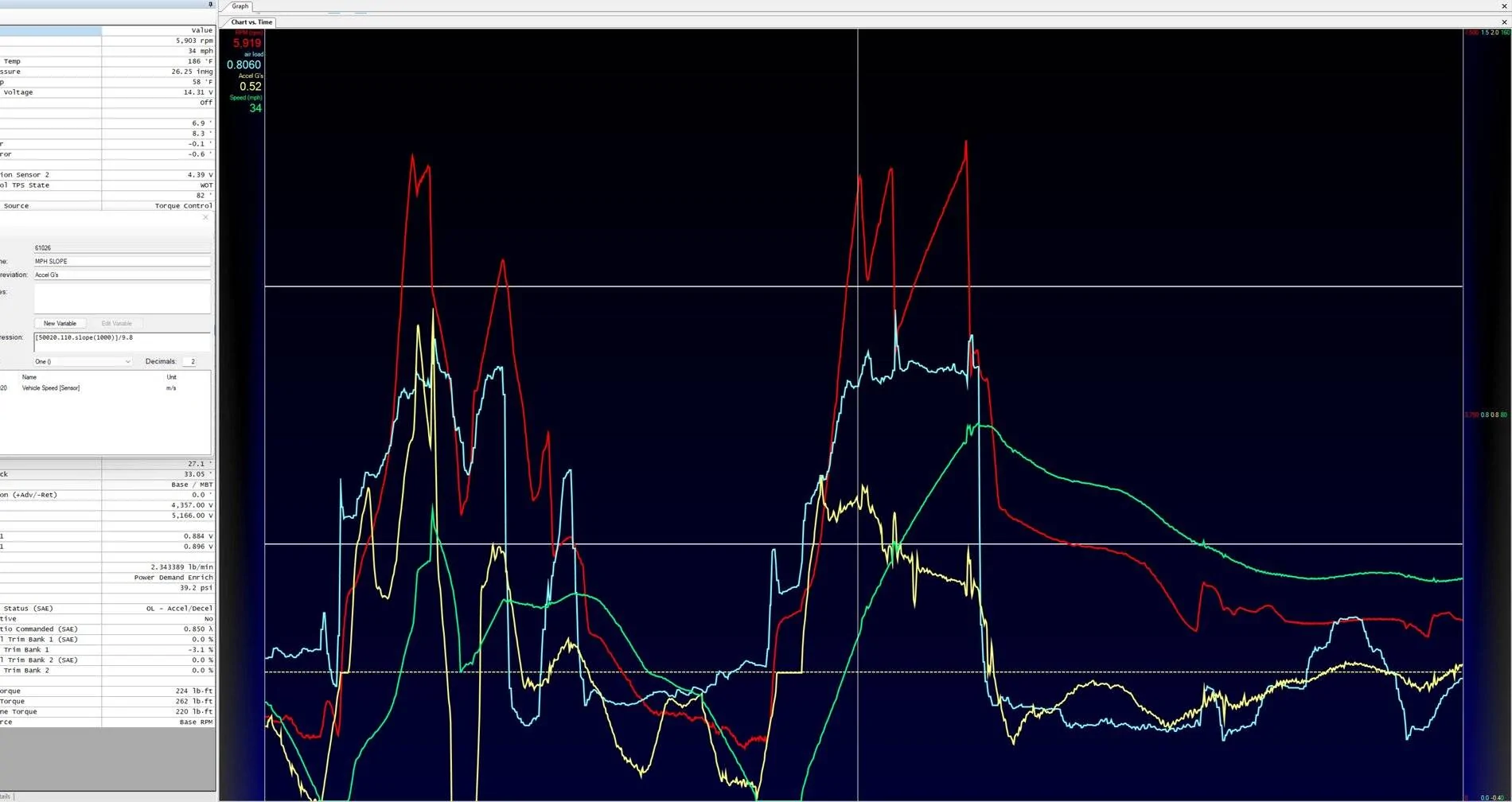
Here I am even willing to share how to do in in HPT. Its completely dependent on tire traction. You could improve upon it as is... and more with thinking about friction.

Acceleration in HPT.webp
I like what you did there. There's a problem, though, because you are taking the average slope of speed (dv/dt=a) over a 1 second interval, looking back. If you assume the acceleration rate is linear, then the value at that time is actually applicable to 1/2 second before that time. You could reduce the timespan of the slope and that would reduce the 1/2 second offset, but from experience I know if you reduce the timespan you get way too much noise in the output. It might be better if you average the slope looking 1/2 second back and 1/2 second forward, which would make the offset 0 and also allow for one change in slope over the 1 second span. However, this has it's limitations as well because it's still averaging data from 2 gears at a time. Yours already does this because after the gear change it's still including the acceleration of the prior gear as long as it was within the prior 1 second.

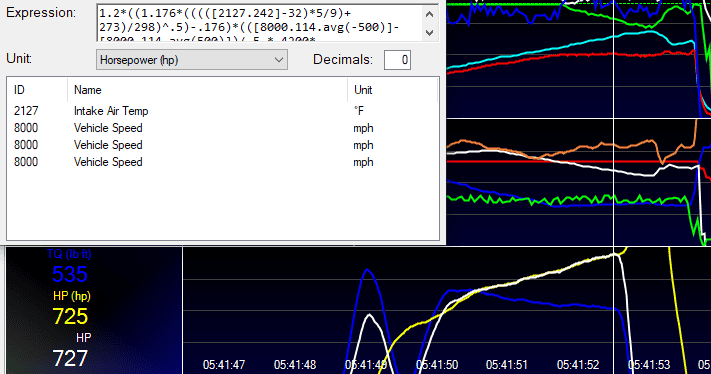
I did something similar to calculate power and torque. I included factors for wind and rolling resistance, and included an SAE correction for air temperature:
1636902405616.png


I used the average speed over the next 1/2 second minus the average speed over the prior 1/2 second, which smoothed out the output. This turned out to be a good tool for tuning but has its limitations. For one, the correction doesn't account for humidity and baro changes, and it doesn't seem to account for temperature very well either. You really have to try to match conditions as best you can. Plus, it has the exact same inescapable problem that your acceleration math has, in that it has to take data over some timespan and the output is only applicable in the middle of the span, meaning the output is not useful near max rpm. I have tried shortening the span but the data gets too noisy and becomes useless. Basically what you see above is a tradeoff between data noise and narrowing span to get power close to max rpm. What's also interesting is that it’s only calibrated for one gear. If I make pulls in different gears, the power is always higher in higher gears. I'm 100% certain I know what is causing this....

It's really a shame that you have such disdain for me, as we could probably accomplish a lot if we collaborated.
Sponsored

 
Last edited:

engineermike

Well-Known Member
Joined
Jul 15, 2018
Threads
31
Messages
6,197
Reaction score
6,473
Location
La
Vehicle(s)
2018 GTPP A10
Here I am even willing to share how to do in in HPT. Its completely dependent on tire traction. You could improve upon it as is... and more with thinking about friction.

Acceleration in HPT.jpg
Try this for the acceleration:

([50020.110.avg(-500)]-[50020.110.avg(500)])/.5/9.81

This will at least fix the time offset. I think it will also smooth the data some since it's using an average of several points before and after the current time, rather than the difference between just two single data points to get slope.
 

markmurfie

Well-Known Member
Joined
Jun 6, 2015
Threads
15
Messages
1,320
Reaction score
625
Location
Hawaii
First Name
Mark
Vehicle(s)
2015 Ford Mustang GT
I don't have any disdain for you. I just think you are wrong and don't get it. You read a book and have a wrong idea of a concept that acceleration or speed can be used to describe any earth based objects that are not pure elements. This is the misconception of physics in the 1600's.

There is a difference between slope of a point, known as a limit in calculus, and two points being averaged over some chosen time interval. The real limit to slope is the time of the polling rate.

(9.8m per 1s) for 1s = 9.8m this is the "slope" in HPT, but thats not all I used. You could use MPH if you understood the math.

9.8m / 9.8m/s^2 for that same 1 second = 1 gravity

Time is removed as a factor for the vehicle speed data point, because slope turns it into a length. Time is only a factor for the rate at which you collect data points. You don't have to use 1000ms in the slope, but changing it requires changing the 9.8m/s^2 to keep it in G's. If I did that, I know you wouldn't have gotten it. I see you still didn't get it.

tire traction, and a straight line are assumed, at least you got that. This is keeping it simple and just trying to help you get on the right path and away from things describing motion that use weight for the units of mass. Its ELEMENTAL, and what makes something an element, but science keeps breaking things down smaller and smaller. Unless you are in nuclear power or the military, stick to the elements.
 
Last edited:

engineermike

Well-Known Member
Joined
Jul 15, 2018
Threads
31
Messages
6,197
Reaction score
6,473
Location
La
Vehicle(s)
2018 GTPP A10
I just think you are wrong and don't get it.
If I am wrong then SAE is wrong and many others as well. I've posted links to several reputable sources that directly address the issue as it applies to vehicle acceleration. Is it more likely we are all wrong, or just you?

You read a book and have a wrong idea of a concept that acceleration or speed can be used to describe any earth based objects that are not pure elements.
Funny story if you've been following....I derived this concept myself intuitively based on known physics fundamentals and posted it in post 15. It wasn't until post 38 that I decided to find it published. So you think my own derivation and the SAE book, which agree perfectly, are both wrong. You think we are wrong because we are applying F=ma to alloys and compounds rather than pure elements? You are lost as a goose, my friend.

There is a difference between slope of a point, known as a limit in calculus, and two points being averaged over some chosen time interval. The real limit to slope is the time of the polling rate.

(9.8m per 1s) for 1s = 9.8m this is the "slope" in HPT, but thats not all I used. You could use MPH if you understood the math.

9.8m / 9.8m/s^2 for that same 1 second = 1 gravity

Time is removed as a factor for the vehicle speed data point, because slope turns it into a length. Time is only a factor for the rate at which you collect data points.
Why are you explaining this? Show me where I said your math was wrong. What I said was that the way you are applying the math function in VCM is introducing a 1/2 second offset in time.

Your math subtracts the speed 1 second earlier from the current speed, then divides by 1 second in order to get the slope. This means it's the average slope over 1 second prior to current time, so it would be most accurate in the middle of the span, or 1/2 second prior to current time. I showed you how to fix the time offset, but you still have the problem of it being an average over 1 second which means you can't compare acceleration before and after a gear change to determine shift point.

You don't have to use 1000ms in the slope, but changing it requires changing the 9.8m/s^2 to keep it in G's.
Actually, it doesn't. 9.8 would still be right even if you used a 500 ms slope span. For my method (post 108), it would be different because I did change in speed/change in time, so a different span would change the time, but since you did slope you would still use 9.81.

If I did that, I know you wouldn't have gotten it. I see you still didn't get it.
Oh I got it and I can prove it. See my post 108 where I showed you a better way to do it. Note that I divided by .5. That would be the "length", as you described it. I had to divide by 0.5 second since I'm looking at average speed 1/4 second in the future minus speed 1/4 second in the past, so the span or "run" is 1/2 second. It's still a slope, but it's over a shorter timespan and it uses an average of speed data before and after, rather than just 2 datapoints. I've done this experiment a number of ways and if you use the math parameter I posted in 108, you'll get a more accurate, but not perfect, result.

...help you get on the right path and away from things describing motion that use weight for the units of mass.
Maybe the problem is you don't understand where I used lbm vs lbf? Yes, I prefer SI units, and you can see in my post 15 that I correctly applied the gravitational constant where lbm needed converting to lbf. I've taken this into account in all my calculations when appropriate.

So far, I derived my own way to account for rotational inertia and you said it was wrong.

You insisted on using energy, so I did that and it yielded the same answer. You said it was wrong.

You insisted on using dyno curves, so I did that and it yielded the same answer. You said it was wrong still.

Let's try to break this down to something simple....have you every pushed your grandpa's old-timey reel lawn mower? I don't mean through grass, but just on flat ground. Did you notice that it's much harder to get it going than you would think, based on it's weight? Why is that? If you geared it to spin the blade even faster, what effect would that have on the effort needed to get it moving? Straight answers will suffice.
 

markmurfie

Well-Known Member
Joined
Jun 6, 2015
Threads
15
Messages
1,320
Reaction score
625
Location
Hawaii
First Name
Mark
Vehicle(s)
2015 Ford Mustang GT
Anyone can go to HPT, input my custom math, only change the 1000ms to 500ms, and see you are wrong.

Change the 1000ms to 100ms and the 9.8 to .98 tho....

I was going to go the same route you went with the lawn mower idea, but with a manual car rolling down a hill in different gears, then start doing thinks like removing the heads and putting them in the trunk, disconnect the accessory drive belt, ect. I see that I'm just not going to get through to you, the concept of friction from your misunderstanding that it is some how extra weight.

It's friction not because of a change in moment of inertia in the blades or it's angular momentum, and if you gave that friction more leverage over your push, it would make it harder to push. The complete opposite of what gears do for your engine to move your car.

Don't change the gear ratio, just put some fresh oil or grease on it, so much easier to push, did you eliminate all friction, absolutely not even close. I'm guessing your dad didn't make you spend hours greasing his heavy machinery. Your grandpa was kinda mean to you not showing you where the grease and oil for the thing was.

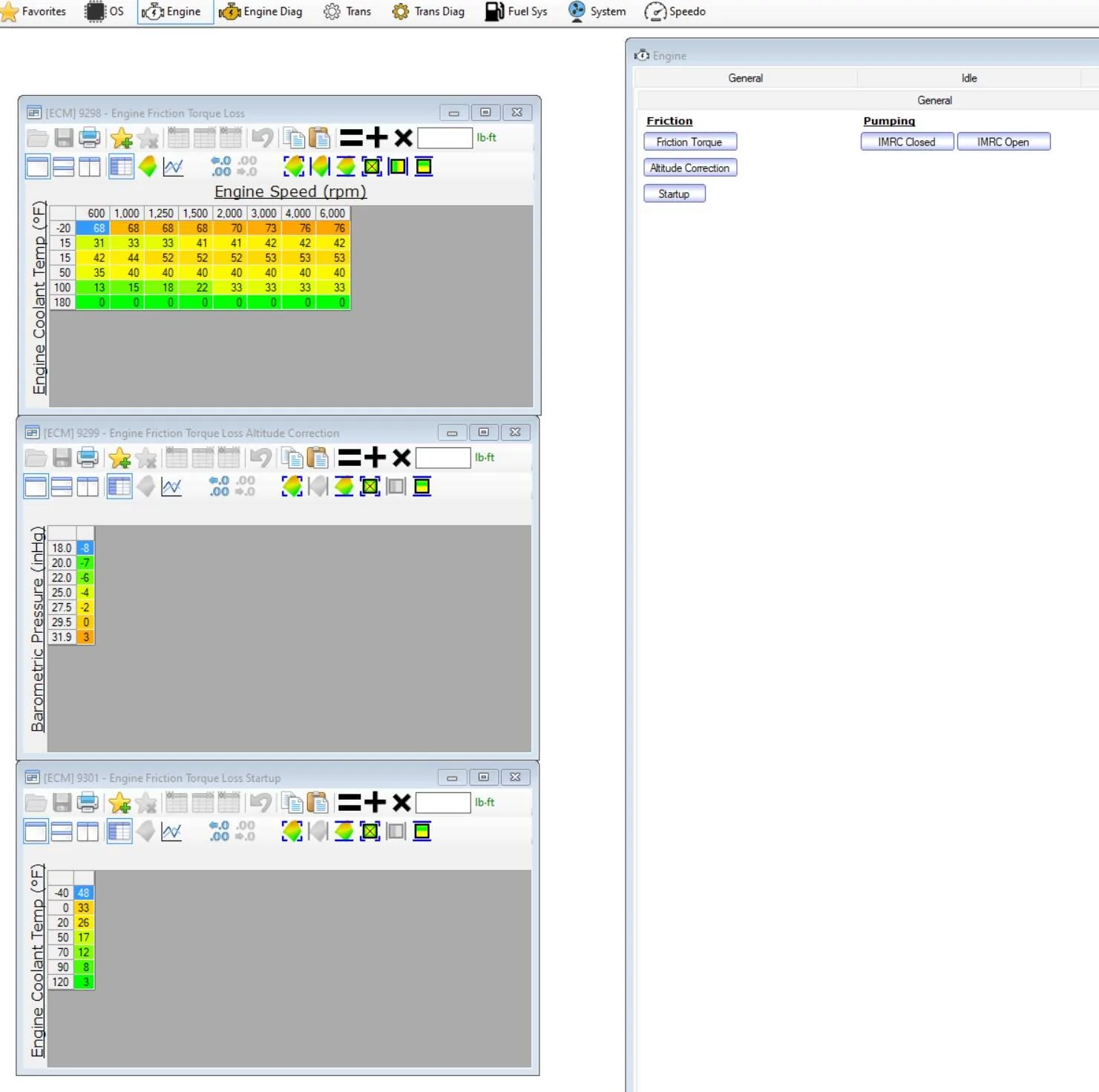
I think every one, especially mechanics, have a strong intuition for friction. This is all that is in the ECU from Ford, at least according to HPT. So when I disagree with people using 1600's physics, its because I understand it and its limits. All I am saying is, if you don't want to talk about friction, stick to describing motion with just time and distance. It will be simple, and far more intuitive.

Friction loss.jpg
 
Last edited:

Sponsored

engineermike

Well-Known Member
Joined
Jul 15, 2018
Threads
31
Messages
6,197
Reaction score
6,473
Location
La
Vehicle(s)
2018 GTPP A10
Anyone can go to HPT, input my custom math, only change the 1000ms to 500ms, and see you are wrong.

Change the 1000ms to 100ms and the 9.8 to .98 tho....
Oh wow, I can't believe you didn't realize somewhere along the way that the slope function actually just returns the difference between the current value and the value x milliseconds prior. Anyone with even the most basic algebra understanding knows that y=mx+b and m = rise/run. Using a shorter run (timespan) at constant slope will yield the same exact slope. Go ahead and try a few different slope timespans and you'll see it's just giving you difference instead of slope.

Go ahead and plug this in for any span you want, and you'll see it returns the same exact result as "slope", even though it's clearly just "difference":

[50020.110]-[50020.110.shift(500)]

I was going to go the same route you went with the lawn mower idea, but with a manual car rolling down a hill in different gears, then start doing thinks like removing the heads and putting them in the trunk, disconnect the accessory drive belt, ect. I see that I'm just not going to get through to you, the concept of friction from your misunderstanding that it is some how extra weight.

It's friction not because of a change in moment of inertia in the blades or it's angular momentum, and if you gave that friction more leverage over your push, it would make it harder to push. The complete opposite of what gears do for your engine to move your car.

Don't change the gear ratio, just put some fresh oil or grease on it, so much easier to push, did you eliminate all friction, absolutely not even close. I'm guessing your dad didn't make you spend hours greasing his heavy machinery. Your grandpa was kinda mean to you not showing you where the grease and oil for the thing was.

I think every one, especially mechanics, have a strong intuition for friction. This is all that is in the ECU from Ford, at least according to HPT. So when I disagree with people using 1600's physics, its because I understand it and its limits. All I am saying is, if you don't want to talk about friction, stick to describing motion with just time and distance. It will be simple, and far more intuitive.
You can't seem to accept that I'm NOT talking about friction. You're trying to muddy the water to distract from the actual point of contention.

Let's assume the old reel mower has zero friction. The blade is geared to spin faster than the wheels. You push it and the blade has to speed up to some speed that is multiples of the wheel speed. Are you saying it doesn't take any additional effort to accelerate the mower due to the high final speed of the blades and their rotating inertia?

What about a flywheel? Do you believe that it takes energy to spin up a zero-friction flywheel from, say, 0 rpm to 100 rpm? Do you believe that if you want to spin it up in 1 second vs 2 seconds, that the energy needs to be applied twice as fast?
 
Last edited:

markmurfie

Well-Known Member
Joined
Jun 6, 2015
Threads
15
Messages
1,320
Reaction score
625
Location
Hawaii
First Name
Mark
Vehicle(s)
2015 Ford Mustang GT
If you are not talking about friction, your math will never be right. Continuing this discussion is worthless.
 

engineermike

Well-Known Member
Joined
Jul 15, 2018
Threads
31
Messages
6,197
Reaction score
6,473
Location
La
Vehicle(s)
2018 GTPP A10
If you are not talking about friction, your math will never be right. Continuing this discussion is worthless.
If you don't understand that it takes energy to spin up a flywheel, and that energy/time = power, then you will never understand the concept to begin with. That's such a basic principal that I'm shocked that you don't get it. Do you seriously not agree with that?

And by the way, my math comes directly out of the SAE book on Vehicle Dynamics, so you are saying it will never be right puts you at odds with people that have way more credibility than either of us.
 

markmurfie

Well-Known Member
Joined
Jun 6, 2015
Threads
15
Messages
1,320
Reaction score
625
Location
Hawaii
First Name
Mark
Vehicle(s)
2015 Ford Mustang GT
You might as well put the pencil and paper down, put you calculator away, close the excel program, what ever it is you are using.

Go get a timer and an old lawn mower and a distance measuring device. Put two minutes on the timer. Start the timer, start pushing, stop when the timer expires, and write down the distance it got to. You would never be able to predict that with the 1600's physics you are using.

Your Dyno, it's a distance measuring device.

Your 1/4 mile, it's a time measuring device.

sponge bob meme.jpg
 

engineermike

Well-Known Member
Joined
Jul 15, 2018
Threads
31
Messages
6,197
Reaction score
6,473
Location
La
Vehicle(s)
2018 GTPP A10
What about a flywheel? Do you believe that it takes energy to spin up a zero-friction flywheel from, say, 0 rpm to 100 rpm? Do you believe that if you want to spin it up in 1 second vs 2 seconds, that the energy needs to be applied twice as fast?

it takes energy to spin up a flywheel, and that energy/time = power... Do you seriously not agree with that?
@markmurfie why can’t you answer these simple questions?
 

Sponsored

markmurfie

Well-Known Member
Joined
Jun 6, 2015
Threads
15
Messages
1,320
Reaction score
625
Location
Hawaii
First Name
Mark
Vehicle(s)
2015 Ford Mustang GT

engineermike

Well-Known Member
Joined
Jul 15, 2018
Threads
31
Messages
6,197
Reaction score
6,473
Location
La
Vehicle(s)
2018 GTPP A10
You might as well put the pencil and paper down, put you calculator away, close the excel program, what ever it is you are using.

Go get a timer and an old lawn mower and a distance measuring device. Put two minutes on the timer. Start the timer, start pushing, stop when the timer expires, and write down the distance it got to. You would never be able to predict that with the 1600's physics you are using.
Did it ever occur to you that maybe, just maybe since what you are saying is that SAE’s Fundamentals of Vehicle Dynamics book is flat out wrong, that maybe you’re the one not understanding what’s going on?

Your Dyno, it's a distance measuring device.
A tape measure is a distance measuring device.

Your 1/4 mile, it's a time measuring device.
A stopwatch is a time measuring device.
 

engineermike

Well-Known Member
Joined
Jul 15, 2018
Threads
31
Messages
6,197
Reaction score
6,473
Location
La
Vehicle(s)
2018 GTPP A10
A 0 friction flywheel, would not be able to be moved.
Wrong. Friction acts in the opposite direction of intended motion. Zero friction means zero resistance to motion due to friction. So the only resistance to motion is the inertia. In light of this, feel free to answer the simple questions.

How could you apply any force to it?
Whether it’s infinite or zero friction, you could still apply force to it. Statements like these are telling.
 

markmurfie

Well-Known Member
Joined
Jun 6, 2015
Threads
15
Messages
1,320
Reaction score
625
Location
Hawaii
First Name
Mark
Vehicle(s)
2015 Ford Mustang GT
Wrong. Friction acts in the opposite direction of intended motion. Zero friction means zero resistance to motion due to friction. So the only resistance to motion is the inertia. In light of this, feel free to answer the simple questions.


Whether it’s infinite or zero friction, you could still apply force to it. Statements like these are telling.
So static friction just isn't a thing huh? Only kinetic friction. You have no clue what you are talking about.
 

WildHorse

N/A or GO HOME
Joined
Jun 28, 2017
Threads
270
Messages
10,297
Reaction score
8,350
Location
Home World: CLASSIFIED
First Name
Puddintane
Vehicle(s)
'17 S550
Vehicle Showcase
1
Continuation of rotational inertia
Sponsored


Top