Sponsored

FBO, Non-Cobrajet Intake Optimal Shift Points, A10

engineermike

Well-Known Member
Joined
Jul 15, 2018
Threads
32
Messages
6,216
Reaction score
6,516
Location
La
Vehicle(s)
2018 GTPP A10
This plot makes me wonder what the usefulness of the concept of power is at all when describing car engines. All you need to know is the torque curve and gearing. What’s the relevance of the hp peak?
You can use hp or torque to solve for optimal shit points and the answer is exactly the same.

If you increase torque, the curves you quoted all shift upward.

If you increase hp but not torque, the curves all shift to the right.

Either way, you wind up with more area under the acceleration curve, which results in a faster drag car.
Sponsored
 

markmurfie

Well-Known Member
Joined
Jun 6, 2015
Threads
15
Messages
1,320
Reaction score
626
Location
Hawaii
First Name
Mark
Vehicle(s)
2015 Ford Mustang GT
Hey @markmurfie you sure went way down an unnecessary rabbit-hole there. Since you don't believe my formulas and I don't see the relevance of yours, can we go back to Dr. Gillespie's published equations that were derived specifically to solve the problem we are discussing?

All of these are straight from Gillespie:

Surplus Effort = Tractive Effort - Total Resistance

Surplus Effort = 0, so Tractive Effort = Total Resistance

Total Resistance = IR, assuming air and rolling resistances are negligible
So, Tractive Effort = IR

Tractive Effort = engine torque x trans gear ratio x rear gear ratio x efficiency/wheel radius. I assumed 100% efficiency for simplicity.

IR = (mcar + meq) x acceleration

Therefore, (mcar + meq) x acceleration = engine torque x trans gear ratio x rear gear ratio x efficiency/wheel radius

Solve for acceleration:

acceleration = engine torque x trans gear ratio x rear gear ratio/wheel radius/(mcar + meq)

Everything in the above equation is easy to find, except meq. meq happens to be the sticking point here and Gillespie defines it as the "equivalent mass of rotating parts". Mass doesn't change, but their affect on acceleration does change, as the equation shows:

meq = polar moment of inertia of the engine x gear efficiency x (trans gear ratio x rear gear ratio / wheel radius)^2. There are terms for wheel and driveshaft inertia but I am assuming 0 for simplicity. I also assume 100% efficiency to keep it simple.

Putting it all together....
acceleration = engine torque x trans gear ratio x rear gear ratio/wheel radius/(mcar + polar moment of inertia of the engine x (trans gear ratio x rear gear ratio/wheel radius)^2 )

If we solve for acceleration assuming 410 ftlb torque, 4.69 ratio, 3.55 gear, 1.125 ft wheel radius, 4000 lb car, and 4.7 lb ft ft engine moment of inertia, we get:

acceleration = 1.206 G's, which passes the gut check.

If we solve the same equation except substitute 2.98 for the transmission ratio, then we get:

acceleration = 0.873 G's

Here's the interesting part....

4.69/2.98 = 1.57
1.206/0.873 = 1.38

So even though 1st gear has 57% more mechanical advantage than 2nd, it only offers 38% better acceleration.

Since we can now very easily solve for acceleration as a function of torque curve and gear ratio, we can overlay each gear's curve onto a graph and choose shift points that give the maximum acceleration at that speed, then translate to rpm.

Engine torque needs the function of RPM(the time) to produce acceleration, you are assuming 0 RPM. This is because he is using the math to equivalent mass between rotating objects and non rotating objects.

Even with a constant torque you should see acceleration isn't constant. You literally posted the acceleration curve a vehicle would see based on your drive shaft torque vs Speed graph.
 

engineermike

Well-Known Member
Joined
Jul 15, 2018
Threads
32
Messages
6,216
Reaction score
6,516
Location
La
Vehicle(s)
2018 GTPP A10
Engine torque needs the function of RPM(the time) to produce acceleration, you are assuming 0 RPM.
The Gillespie equations do not include rpm. I won't even attempt to explain why...

This is because he is using the math to equivalent mass between rotating objects and non rotating objects.
Yes! Exactly! And that relationship is different in each gear.

Even with a constant torque you should see acceleration isn't constant.
Depends on your assumptions. If torque, mass, tire size, and gear ratio are constant and air and rolling resistance are zero, then acceleration is constant.

You literally posted the acceleration curve a vehicle would see based on your drive shaft torque vs Speed graph.
Right, I originally went about it from the other direction by calculating the torque input to the rotating components and assumed the remainder would accelerate the car. I won't even bother defending my original method because I like Gillespie's method better, though it yields an identical result. I think his method is easier to understand and more widely accepted in the automotive engineering community.
 

markmurfie

Well-Known Member
Joined
Jun 6, 2015
Threads
15
Messages
1,320
Reaction score
626
Location
Hawaii
First Name
Mark
Vehicle(s)
2015 Ford Mustang GT
You do realize you are saying Einsteins E=mc^2 is wrong or at least do you see the resemblance in the equations?
 

engineermike

Well-Known Member
Joined
Jul 15, 2018
Threads
32
Messages
6,216
Reaction score
6,516
Location
La
Vehicle(s)
2018 GTPP A10
You do realize you are saying Einsteins E=mc^2 is wrong or at least do you see the resemblance in the equations?
I specifically set up my all of the calculations in post #45 to only come from an SAE book and deliberately DID NOT use any of my own derivations or logic, yet somehow I am still wrong and at odds with Einstein? I honestly can't tell if you're serious at this point.

Can you go to post #45 and show me which one of Dr. Gillespie's equations you think is wrong?
 

Sponsored

markmurfie

Well-Known Member
Joined
Jun 6, 2015
Threads
15
Messages
1,320
Reaction score
626
Location
Hawaii
First Name
Mark
Vehicle(s)
2015 Ford Mustang GT
I specifically set up my all of the calculations in post #45 to only come from an SAE book and deliberately DID NOT use any of my own derivations or logic, yet somehow I am still wrong and at odds with Einstein? I honestly can't tell if you're serious at this point.

Can you go to post #45 and show me which one of Dr. Gillespie's equations you think is wrong?
If you want to know the mass equivalence it is energy and mass based on speed or velocities.


You/ they are using equations for
Torque and acceleration equivalence which requires energy, mass, distance, and time, what is described as space time.

I'm sorry they mislead you.
 

WildHorse

N/A or GO HOME
Joined
Jun 28, 2017
Threads
270
Messages
10,297
Reaction score
8,350
Location
Home World: CLASSIFIED
First Name
Puddintane
Vehicle(s)
'17 S550
Vehicle Showcase
1
Hi, long time lurker, first time commenter.. which would accelerate faster;

100 hp / 1000 ft-lbs of torque
..............................or..................................
1000 hp / 100 ft-lbs of torque

All things being equal. Thanks.
 

markmurfie

Well-Known Member
Joined
Jun 6, 2015
Threads
15
Messages
1,320
Reaction score
626
Location
Hawaii
First Name
Mark
Vehicle(s)
2015 Ford Mustang GT
Hi, long time lurker, first time commenter.. which would accelerate faster;

100 hp / 1000 ft-lbs of torque
..............................or..................................
1000 hp / 100 ft-lbs of torque

All things being equal. Thanks.
One would happen near 500 RPM the other near 50000rpm, so you tell me.
 

engineermike

Well-Known Member
Joined
Jul 15, 2018
Threads
32
Messages
6,216
Reaction score
6,516
Location
La
Vehicle(s)
2018 GTPP A10
You do realize you are saying Einsteins E=mc^2 is wrong or at least do you see the resemblance in the equations?
You have been arguing "kinetic energy = m * v^2" this whole time and saying that I must be wrong because I am instead using F=ma. Gillespie's equations also use F=ma. I never said that energy was wrong (you put those words in my mouth); I just wouldn't use that approach myself because it's a less efficient way to get to the answer we're after - maximizing acceleration. Physics is rarely at odds with itself. Let me demonstrate:

I think we can all agree that the engine must accelerate from 6500 to 7500 rpm in both 1st and 2nd gears.

The kinetic energy of the engine's rotating parts is 1/2 * I * w^2.

At 6500 rpm, the KE of the engine's rotating parts is 33,100 ftlb.
At 7500 rpm, the KE of the engine's rotating parts is 44,000 ftlb.

Therefore the change in KE of the engine's rotating parts is 10,900 ftlb, regardless of the transmission gear, acceleration rate, etc. I think we all agree on this.

However, energy is not torque, power, or acceleration, so we must calculate what power it took to add that energy to the engine's rotating parts.

We know from documented acceleration tests that it takes the coyote about 0.31 seconds to pull from 6500 to 7500 in first gear, and just under 0.49 seconds in second gear. Now that we know the delta energy and delta time, we can divide to find the power.

10,900 ftlb/0.31 seconds = 35,200 ftlb/s. Divide by 550 to convert to power and you get 64 hp.
10,900 ftlb/0.49 seconds = 22,200 ftlb/s. Divide by 550 to convert to power and you get 40 hp.

This is power that is being used to add *energy* to the rotating components, that does not contribute to linear acceleration of the car. It affects 1st gear more than 2nd, 2nd more than 3rd, and so on, and therefore will affect optimal shift points.

In post #15 4 days ago, I estimated moment of inertia and calculated power loss in 1st to be 33 hp. Later the same day, I posted that I realized my estimation for moment of inertia was about half of what it should have been. If you double the 33 you get 66 hp, or essentially the same result regardless of which method you use. It's just much easier to calculate and plot the acceleration curves using the a = F/m method and, as I mentioned, Gillespie's method is much cleaner.
 

Meatball

Well-Known Member
Joined
Apr 21, 2018
Threads
20
Messages
590
Reaction score
349
Location
CA
Vehicle(s)
17 GT
One would happen near 500 RPM the other near 50000rpm, so you tell me.
Wouldn’t the max accel be at the torque peak? So the 100hp car would feel more instantaneous acceleration at some point but the 1000 hp one would kill it in a drag race? Assuming gearing the same and logically chosen as a compromise between the two engines.

Am I right mark/mike?
 

Sponsored

engineermike

Well-Known Member
Joined
Jul 15, 2018
Threads
32
Messages
6,216
Reaction score
6,516
Location
La
Vehicle(s)
2018 GTPP A10
Hi, long time lurker, first time commenter.. which would accelerate faster;

100 hp / 1000 ft-lbs of torque
..............................or..................................
1000 hp / 100 ft-lbs of torque

All things being equal. Thanks.
When you say "all things being equal", do you mean same exact gear ratio *or* geared for the same exact top speed?
 

markmurfie

Well-Known Member
Joined
Jun 6, 2015
Threads
15
Messages
1,320
Reaction score
626
Location
Hawaii
First Name
Mark
Vehicle(s)
2015 Ford Mustang GT
All he has given is two different speeds... No time/distance, so no acceleration can be given....

You could say the same mass will have more kinetic energy at 50000+ RPMs, but you can't say it will accelerate faster until you know what that mass is.


Depending on the mass you choose you can come up with any acceleration rate you want.

The other way to know would be and actual torque curve of how it got from 100 to 1000 torque. So you have a point at every RPM between 500 and 50000.
 
Last edited:

engineermike

Well-Known Member
Joined
Jul 15, 2018
Threads
32
Messages
6,216
Reaction score
6,516
Location
La
Vehicle(s)
2018 GTPP A10
Wouldn’t the max accel be at the torque peak? So the 100hp car would feel more instantaneous acceleration at some point but the 1000 hp one would kill it in a drag race? Assuming gearing the same and logically chosen as a compromise between the two engines.

Am I right mark/mike?
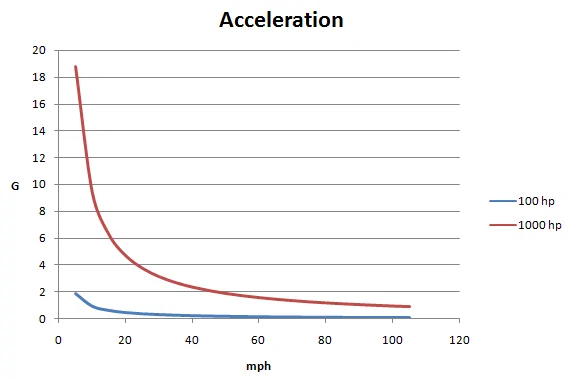
If you applied pure basic physics, the acceleration curves would look as follows, assuming a 4000 lb car:

1636679023821.webp


In real life that would require a CVT with an infinitely low min ratio. Really, the problem needs more definition, especially around gearing.
 

WildHorse

N/A or GO HOME
Joined
Jun 28, 2017
Threads
270
Messages
10,297
Reaction score
8,350
Location
Home World: CLASSIFIED
First Name
Puddintane
Vehicle(s)
'17 S550
Vehicle Showcase
1
When you say "all things being equal", do you mean same exact gear ratio *or* geared for the same exact top speed?
Yes all things being equal. Equal gearing. Equal rpm. Etc., etc.
 

Meatball

Well-Known Member
Joined
Apr 21, 2018
Threads
20
Messages
590
Reaction score
349
Location
CA
Vehicle(s)
17 GT
If you applied pure basic physics, the acceleration curves would look as follows, assuming a 4000 lb car:

1636679023821.png


In real life that would require a CVT with an infinitely low min ratio. Really, the problem needs more definition, especially around gearing.
The thing that gets me is that, if the cars are otherwise exactly the same including mass and gearing and let’s say their engines are magical and wouldn’t grenade at ANY rpm, in the same gear the 100hp/1000ft-lbs car will generate the greatest, if momentary, feel of acceleration but the 1000/100 car would have a much, much higher avg accel and fly by it eventually. Fair enough but it seems like the real benefit of hp is you can stay in a lower gear longer so take more advantage of it higher tq multiplication. I just don’t get the concept of “hp”.
Sponsored


Top